Measuring fuel efficiency
By Mark Devlin, Contributing Editor | TLT Lubrication Fundamentals November 2026
Lubricants help enable engine technology designed to improve fuel efficiency.

In a previous Lubrication Fundamentals article, I mentioned that I drive a hybrid sedan that averages ~45 mpg. I know this because the dashboard has a fuel economy read-out, and fuel economy is easily calculated from the number of miles I have driven divided by the amount of fuel delivered to the engine. While I am driving there are times when the battery supplies the energy to move my vehicle. My vehicle is not a plug-in hybrid, so the battery is charged by the engine while the engine is idling and from regenerative braking, so the energy to charge the battery is initially generated by burning fuel. It takes many miles of driving and lots of fuel burned to accurately determine the fuel economy in my hybrid sedan. In fact, if I reset my fuel economy gauge after I refuel and drive slowly, the engine is not burning gas, and I get infinite fuel economy!! (I am sure you don't believe that.)
The fuel economy listed on the Monroney label for a new vehicle is not measured in such a simple way.
1 To determine fuel economy for all of the various vehicle makes and models, fuel economy needs to be estimated in a more efficient way.
2,3 To do this, the emissions generated during specific standard driving cycles are determined. The concentration of CO
2, NO and NO
2 (the N species are combined and designated as NO
x) and hydrocarbon (HC, unburned fuel) emitted from an engine can be used to determine the amount of a fuel that has been burned.
2,3 Think about the engine as a chemical reactor where air and fuel are mixed and reactions occur that can oftentimes be incomplete. Determining the concentration of the products from the reaction can be used to determine how efficiently fuel was burned. Changing reaction conditions such as the rate at which fuel is added to the combustion chamber will affect the chemical reactions. On the Monroney label there are separate fuel economy numbers for "City" and "Highway" driving cycles. The first obvious observation is that there are significantly different results for fuel economy measured under these two conditions. The "City" and "Highway" driving cycles change the reaction conditions in the combustion chamber and emission results change. As a side note, there are also many other driving cycles that exist in other parts of the world.
In the "City" and "Highway" driving cycles there are accelerations and decelerations as well as steady state speed conditions. Human or robot drivers are used to follow the specific driving cycles, and the drivers must match the speed versus time profiles within specific tolerances. There is an inherent imprecision in following these profiles when control is through the gas and brake pedals. This imprecision changes the efficiency of the chemical reactions and the ability to determine factors affecting efficiency. For example, during the development of the Sequence VID fuel economy engine test, a consortium of companies reviewed automaker-submitted fuel economy data from more than 600 vehicle tests.
6 The conclusions were that changes in lubricant properties were too subtle to statistically determine in the vehicle tests. Multiple drivers were used in this study, and the effect of the driver may well have overwhelmed the results. Therefore, a consumer should not use the Monroney label to determine the exact fuel economy they will get since it depends upon their driving style. Instead, the label gives a consumer the ability to compare the fuel economy performance of different makes and models under the same set of conditions.
To develop lubricants with improved fuel economy results, fired engine tests have been developed where the amount of fuel consumed can be directly measured. Fuel efficiency is typically measured under a variety of steady state conditions that are computer controlled to very tight tolerances (see for example ASTM D8114: Sequence VIE engine test, which is used to measure the fuel economy performance of passenger car motor oils). Fuel consumed is measured for up to 30 minutes under each steady state condition, so there is plenty of time for the system to stabilize. This improves the precision of the fired engine tests versus the vehicle tests. However, in these fired engine tests, fuel economy is not measured during transient operating conditions where a significant amount of fuel is consumed.
System level tests in motored engines, transmissions and axles have also been designed to measure lubricant efficiency properties by tracking the torque into and out of the mechanical device of interest. This is a more precise way to track the ability of lubricants to reduce friction and improve efficiency. However, these tests are a further step away from the "real world" measurement of vehicle fuel efficiency required by government regulations. In all efficiency tests, the efficiency of a candidate lubricant is compared to that of a baseline lubricant. The intent is to calculate the percent efficiency improvement (%FEI) of the candidate lubricant versus the baseline lubricant. The efficiency performance of the baseline oil often improves as the engine, transmission or axle is aged due to running-in conditions that cause wear and tribofilm formation. Wear and tribofilm formation change the structure of surfaces in the mechanical device, and this changes the frictional properties of the system. Therefore, it is critical to know the changes in efficiency of the baseline lubricant when %FEI is calculated.
This brief discussion of the measurement of fuel efficiency is meant to alert tribologists to pay attention to the methodology used to measure fuel efficiency when interpreting the efficiency performance of lubricants. The balance is between improvement in the precision of the efficiency tests and determination of efficiency under conditions that are relevant to the actual operation of a machine.
Relative effect of viscosity, boundary and thin film friction on fuel economy
For many years, researchers have tried to determine the relative effect of viscosity, boundary friction and thin film friction on efficiency in engines, transmissions and axles.
7 In these research efforts, a series of lubricants with different tribological properties are developed. The fuel economy improvements as a result of using these lubricants are measured. Finally, correlations between changes in viscosity, boundary friction, thin film friction and fuel economy are determined. These correlations are often in the form of multi-linear regression equations. From these equations, the general effect of changes in tribological properties on fuel economy can be calculated.
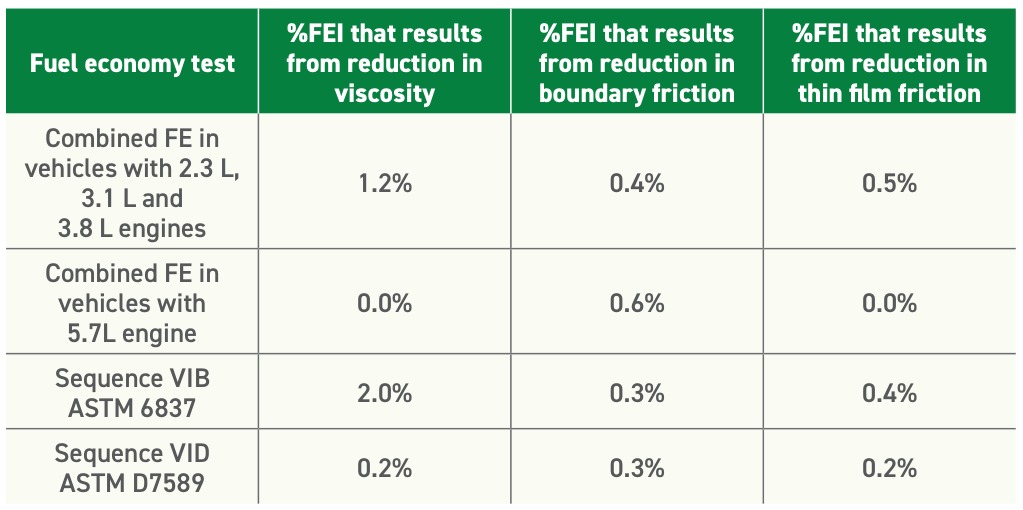 Table 1. Relative effect of lubricant properties on fuel economy
Table 1 shows several examples of the output from these analyses for engine oil effects on fuel economy.
7 (These studies were performed many years ago and do not reflect results for current engine or lubricant technology and are just used to illustrate a critical point.) The effects of reductions in viscosity, boundary friction or thin film friction on %FEI are listed. The reduction in viscosity is similar to a change from a xxW30 to an xxW20 grade oil. The reduction in boundary friction is similar to a change due to the addition of an organic friction modifier (OFM). The reduction in thin film friction is similar to a change due to the use of a Group III versus a Group II base oil. These values are calculated from correlations between these lubricant properties and %FEI measured in various fuel economy tests. The higher the %FEI, as a result of a reduction in each physical property, indicates a greater benefit of that physical property. The effect of each physical property is not the same in each test. Viscosity has the greatest effect in the Sequence VIB engine test. Boundary friction has the greatest effect on combined city and highway fuel economy (FE) in vehicles with 5.7 L engines, and thin film friction has the greatest effect on combined FE in vehicles with 2.3 L, 3.1 L and 3.8 L engines. This data shows that while each of the three lubricant properties affect fuel efficiency, the benefit of improving each physical property does not show up in all applications. For example, the 5.7 L engine does not respond to changes in viscosity or thin film friction.
In the last six TLT Lubrication Fundamentals articles I have concentrated on how lubricant viscosity and friction can be optimized to improve fuel efficiency. However, it is critical to give some perspective on the amount of energy saved by controlling viscosity and friction. Energy balance analyses have shown that only 30%-40% of the chemical energy created by burning fuel is used to move a vehicle and operate essential systems in a vehicle.
4,5,8 Energy loss due to friction in the engine, transmission and axle accounts for approximately 10%-20% of the energy created from combusting fuel. Therefore, 40%-60% of the energy created by combusting fuel is lost due to non-frictional inefficiencies in a vehicle, including inefficient conversion of chemical to mechanical energy. (The exact percentages are different when studies are performed on trucks versus passenger cars.) New engine technologies to improve the conversion of chemical to mechanical energy have been and are being developed with lubricants helping enable and improve the performance of these technologies.
8 Your homework is to read about some of these technologies.
8 Controlling frictional energy loss with lubricants may not seem to be the best way to improve efficiency, but it is much easier to change the lubricant in an engine, transmission and axle than it is to get a new engine, transmission or axle. The next series of TLT Lubrication Fundamentals articles will explore how lubricants enable and improve the performance of new technology to improve fuel efficiency. Perhaps we can get to infinite fuel efficiency or maybe I need to let my battery recharge.
REFERENCES
1.
Becker, E. (2022), "The Monroney label," TLT,
78 (2), p. 76. Available at
www.stle.org/files/TLTArchives/2022/02_February/Automotive_Tribology.aspx.
2.
www.epa.gov/emission-standards-reference-guide
3.
www.epa.gov/fueleconomy
4.
Wong, V. W. and Tung, S. C. (2016), "Overview of automotive engine friction and reduction trends - Effects of surface, material, and lubricant-additive technologies,"
Friction, 4 (1), pp. 1-28.
5.
Tung, S. C. and McMillian, M. L. (2004), "Automotive tribology overview of current advances and challenges for the future,"
Tribology International, 37, pp. 517-536.
6.
Consortium to Develop a New Sequence VID Fuel Efficiency Test for Engine Oils, Final Report. October 15, 2008.
7.
Devlin, M. T. (2018), "Common properties of lubricants that affect vehicle fuel efficiency: A North American historical perspective,"
Lubricants, 6 (3), p. 68.
8.
Van Rensselar, J. (2014), "The drive for more fuel-efficient engines," TLT,
70 (9), p. 34-43. Available at
www.stle.org/files/TLTArchives/2014/09_September/Feature.aspx.
Mark Devlin is a retired chemist and STLE Fellow living in Richmond, Va. You can reach him at markdstle@gmail.com.