HIGHLIGHTS
•
Alkaline thermal treatment of three commonly used plastics leads to the production of hydrogen.
•
Introduction of oxygen functionalities into common hydrocarbon-based plastics was needed to facilitate readily degrade the polymer chains and generate hydrogen.
•
The carbon present in the polymer chains decomposes to carbon dioxide during this process and is effectively captured by reaction with sodium hydroxide to produce sodium carbonate.
Finding approaches for converting readily available waste plastic into useful products through the process of upcycling is ongoing. Work has been reported for potentially converting plastic waste into hydrogen and into lubricant base stocks.
In a previous TLT article,
1 researchers found that a heterogeneous catalyst based on mesoporous silica can convert high density polyethylene (HDPE) to hydrocarbons with molecular weights similar to mineral base oils. The processive polymer deconstruction reaction enables the catalyst to act in a similar manner to enzymes by cleaving specially sized chains from HDPE. Treatment of the plastic with the catalyst was conducted at temperatures between 250°C and 300°C under a hydrogen gas atmosphere for 24 hours. A bell-like distribution of hydrocarbons ranging from C9 to C35 with a peak at C14 was identified.
Thermal treatment of plastic waste has become the most widely used method for transforming plastic waste into useful products such as hydrogen and organic compounds. Through a process known as gasification, plastics can be oxidized at high temperatures to form syn gas, a mixture of carbon monoxide, hydrogen and hydrocarbons. Dr. Woo-Jae Kim, professor of chemical engineering and materials science at Ewha Womans University in Seoul, South Korea, says, "Significant research has been conducted on gasification but this process has limitations such as being too energy intensive, typically requiring high pressures and extreme temperatures (800-1,000°C), and generating complex product mixtures. Among the products isolated are hydrocarbons such as ethane and methane, carbon monoxide, carbon dioxide and char in addition to hydrogen."
In previous work, Kim and his colleagues were attempting to convert biomass to hydrogen. The biomass they worked with was seaweed. Kim says, "Seaweed is readily available and in contrast to some common plastics, contains carbon, hydrogen and oxygen. Initial work using gasification produced syn gas and two times more carbon dioxide than was found with biomass obtained from other sources. The challenge is that seaweed has a more complex structure that is difficult to degrade."
The researchers then decided to treat seaweed biomass with sodium hydroxide in a process known as alkaline thermal treatment (ATT). Kim says, "We found that utilizing sodium hydroxide led to a reduction in the reaction temperature, and conversion of biomass only to hydrogen. The carbon produced was captured as sodium carbonate with sodium hydroxide regenerated when this salt is converted to calcium hydroxide in a recovery process."
Kim and his colleagues now applied ATT to evaluate three commonly used plastics: polyethylene terephthalate (PET), polyethylene (PE) and polypropylene (PP).
Oxidation pretreatment
Initially, PET was subjected to conventional thermal treatment at a temperature of 700°C, which yielded 26.9 millimoles of hydrogen per gram of plastic. When ATT was used, a 1:1 ratio of sodium hydroxide to PET led to the initiation of hydrogen production at a much lower temperature, 400°C, and yielded a higher concentration of hydrogen at 43.7 millimoles per gram of the plastic. Kim says, "Use of sodium hydroxide readily leads to hydrolysis of the PET causing rapid depolymerization. We believe that the fragmented PET chains then progress through a distribution of oxygenated intermediates including partially depolymerized oligomeric fragments, and transient alcohol and/or carbonyl-containing species. Eventually, additional decomposition and reforming reactions in the presence of aqueous sodium hydroxide led to the formation of hydrogen and carbon dioxide. Sodium hydroxide then facilitates the capture of carbon by reacting with carbon dioxide to produce sodium carbonate."
PE and PP were initially reacted with sodium hydroxide in the ATT process, but the researchers obtained significantly lower yields of hydrogen gas. Kim says, "The reason for this result is that PE and PP contain no oxygen functional groups and are relatively inert when exposed to sodium hydroxide. To improve the reactivity of PE and PP, we developed an oxidation pretreatment process that enables oxygen to be added to the two polymers prior to ATT."
The researchers conducted the oxidation pretreatment at temperatures ranging from 150°C to 350°C on molten PE and PP. Fourier-transform infrared (FTIR) and elemental analysis indicated that oxygen-functionality was introduced as carbonyl and hydroxyl groups dramatically altering the chemical structure of the two plastics.
Subjecting both PE and PP to elevated temperatures led to hydrogen formation though a balance between oxygen incorporation and polymer stability needed to be taken into account to maximize hydrogen yield. PE generates a maximum of 44.8 millimoles of hydrogen per gram at 250°C while PP's maximum yield is 20.7 millimoles per gram at 200°C. Kim says, "These two polymer chains are more readily degraded after oxidation pretreatment because hydroxyl groups can readily carry out nucleophilic reactions with the newly formed carbonyl carbons."
In both cases, the carbon formed is isolated as sodium carbonate
(see Figure 4).

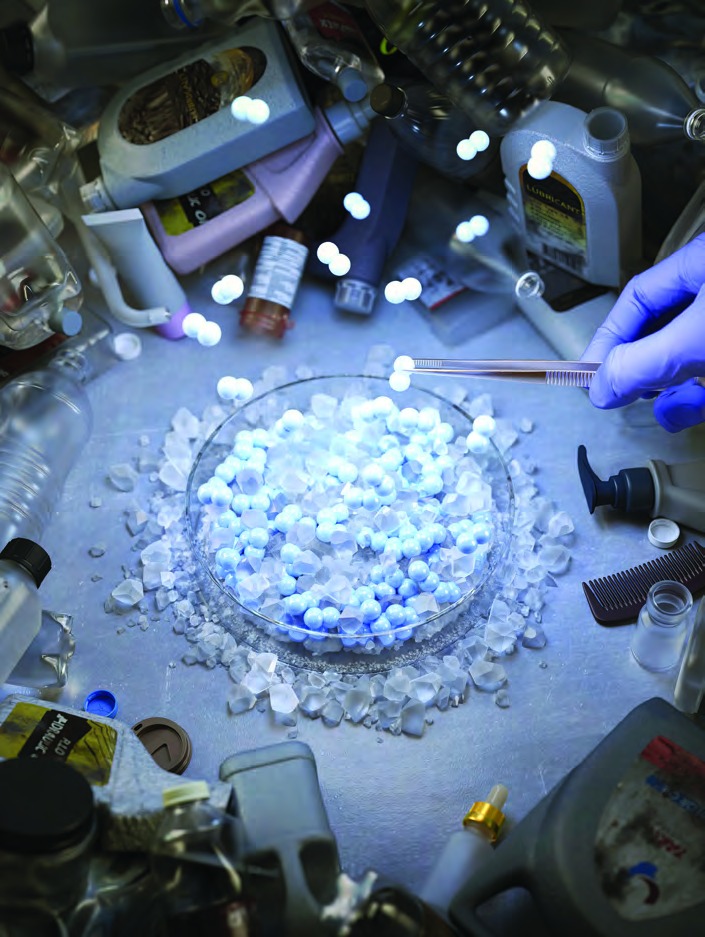 Figure 4. Alkaline thermal treatment of three common plastics, PET, PP and PE, produces hydrogen and the carbon released is isolated as shown in the figure as sodium carbonate. Figure courtesy of Ewha Womans University.
The researchers then prepared a mixture of PET, PP and PE (1:1:1 ratio) and conducted the ATT process. Hydrogen was the main product generated from this mixture which was set up to emulate waste streams.
Density functional theory calculations demonstrated that oxidation pretreatment is essential to degrade PE and PP by ATT. Carbonyl groups are particularly vulnerable to alkaline hydrolysis causing the polymer backbones to degrade.
Kim says, "Future work will focus on commercializing this process and evaluating other plastics such as polystyrene. We started at the milligram scale and are now at the 100-gram scale. Our hope is to design a commercial prototype reactor."
Additional information can be found in a recent paper
2 or by contacting Kim at
wjkim1974@ewha.ac.kr.
REFERENCES
1.
Canter, N. (2021), "Preparation of base oils from plastic resins," TLT,
77 (3), pp. 16-17. Available at
www.stle.org/files/TLTArchives/2021/03_March/Tech_Beat_II.aspx.
2.
Park, J., Kim, H., Seo, H., Lee, J., Lim, H., Jung, W., Park, A. and Kim, W. (2026), "Selective and direct hydrogen generation from mixed plastic waste via alkaline thermal treatment with inherent carbon storage,"
Proceedings of the National Academy of Sciences,
123 (28), e2537552123.
Neil Canter heads his own consulting company, Chemical Solutions, in Willow Grove, Pa. Ideas for Tech Beat can be submitted to him at neilcanter@comcast.net.