HIGHLIGHTS
•
Intermetallics exhibit comparable strength to steel but are extremely brittle to the point that dropping an ingot will lead to fracture.
•
Researchers introduced plasticity into a body centered cubic cobalt aluminum intermetallic by using the following two types of engineered defects: amorphous interfaces, and a high density of dislocations.
•
Micropillar compression testing of the modified intermetallic demonstrated evidence of significant plasticity without sacrificing high yield strength.
As demands are placed on machinery to perform at exceptionally high levels under extreme operating conditions, researchers are working to synthesize new materials equipped to handle these challenging environments. One material that has been under study because of its exceptional strength is intermetallics.
Dr. Ke Xu, postdoctoral researcher in the school of materials engineering at Purdue University in West Lafayette, Ind., says, "Intermetallics are compounds formed between two or more metallic elements that are held together by a combination of mostly metallic and partially covalent or ionic bonds. They exhibit fixed stoichiometries and contain ordered crystal structures which often have high melting points and high strength."
Xinghang Zhang, professor of materials engineering at Purdue University, adds, "Examples of intermetallics include titanium combined with aluminum, and nickel combined with aluminum. These materials are light compared to steel but have comparable strength. For this reason, they are used in applications such as gas turbines, jet engine blades and automotive systems."
In a previous TLT article,
1 Zhang and his colleagues prepared an intermetallic from aluminum and four transition metals (titanium, iron, cobalt and nickel) using the additive manufacturing technique of selective laser melting. In contrast to previous aluminum alloys that are vulnerable to hot cracking when subjected to selective laser melting, this intermetallic displayed strength values in excess of 800 megapascals enabling this material to exhibit comparable strength values to steel. Previous attempts at producing aluminum alloys in this manner yielded materials with half the strength. The researchers speculated that the strength of this alloy is due to the interactions among three phases identified by microstructural characterization.
The one property limiting the usefulness of intermetallics is their brittleness. This deficiency means that intermetallics exhibit low fracture toughness and limited plasticity. As a result, intermetallics cannot activate plastic deformation via dislocations, and it also prevents the initiation of work hardening which is a property that enables a metal to become stronger when subjected to bending, hammering or stretching at room temperature.
Zhang says, "The brittleness of intermetallics prevents their use in other applications and also restricts the ability of designers to use them in more complex structures in existing applications because they cannot easily be processed using existing techniques."
Multiple strategies have been attempted to inject plasticity into intermetallics. These include such approaches as the preparation of metal/intermetallic composites, tailoring planar defect energy and synthesis of high entropy intermetallic alloys. All of these pathways have produced some plasticity improvement but still not enough uniform deformation and work hardening has been obtained.
To address this issue, Zhang, Xu and their colleagues have devised a new strategy for improving the plasticity of a specific intermetallic.
Cobalt aluminum intermetallics
The researchers selected B2 (body centered cubic) cobalt aluminum as the intermetallic to be studied. Zhang says, "Cobalt aluminum intermetallics are one of the most brittle materials that has been evaluated. We have found that dropping an ingot of cobalt aluminum intermetallic onto the floor will lead to fracture."
Xu fabricated an approximately two-micrometer-thick nanolayered material using magnetron sputtering. It was built from alternating 100-nanometer layers of the intermetallic cobalt aluminum (prepared by co-sputtering) and 10-nanometer aluminum layers. During deposition, energetic cobalt atoms mixed into the thin aluminum layers, transforming them into an aluminum-rich amorphous alloy. These amorphous regions extended along the boundaries of the cobalt aluminum intermetallic grains, ultimately forming a nanoscale framework of amorphous interfaces throughout the material.
Xu says, "We decided to study nanocrystalline intermetallics because they exhibit a high level of strength but are still plagued by limited plasticity."
The researchers introduced plasticity by the use of engineered defects. Xu says, "We used high-energy ion bombardment during magnetron sputtering deposition to introduce two types of important defects into the intermetallics: amorphous interfaces sandwiching among the nanocrystalline cobalt aluminum intermetallic grains and a high density of dislocations within the intermetallic grains. These types of defects work together to make the brittle intermetallic plastically deformable."
In situ scanning electron microscopy micropillar compression testing was conducted to better understand the impact of adding plasticity to the cobalt aluminum intermetallic. The performance of this modified intermetallic was compared to single crystal cobalt aluminum. While a high yield strength of 5.5 gigapascals was attained for the single crystal cobalt aluminum, multiple shear bands were detected during deformation that eventually led to the formation of a major crack.
The modified intermetallic with the added amorphous interphases also exhibited a high yield strength of approximately 6 gigapascals, but no fracturing was observed. Instead, the material displayed uniform deformation up to 15% which is evidence of significant plasticity. During the experiment, work hardening occurred boosting the strength of the intermetallic to approximately 8.5 gigapascals.
Working in collaboration with doctoral student Anand Mathew and Professor Yashashree Kulkarni at the University of Houston, the researchers used molecular dynamics simulations to uncover the atomic-scale origin of the unusual plasticity. The simulations revealed that the amorphous interfaces played an important role during deformation. Localized regions within amorphous interfaces crystallize into body centered cubic-like atomic clusters that act as new sources for dislocation nucleation. These dislocations then propagate from the interfaces into the crystalline cobalt aluminum intermetallic grains, where they interact with the high density of preexisting dislocations, leading to dislocation reaction, multiplication, entanglement and storage. This sustained dislocation activity allows the brittle intermetallic to accommodate substantial plastic deformation while also producing pronounced work hardening.
Figure 3 displays an inverse pole figure of the nanocrystalline cobalt aluminum intermetallics with an amorphous interface that shows the crystal orientation evolution of the material after deformation. Xu says, "Inverse pole figure is a method for identification of the crystal orientations of a material. The blue, red, green and yellow colors are assigned based on the orientation of each grain of the material. By comparing the maps before and after deformation, we can directly visualize how grains rotate and evolve as the material deforms."

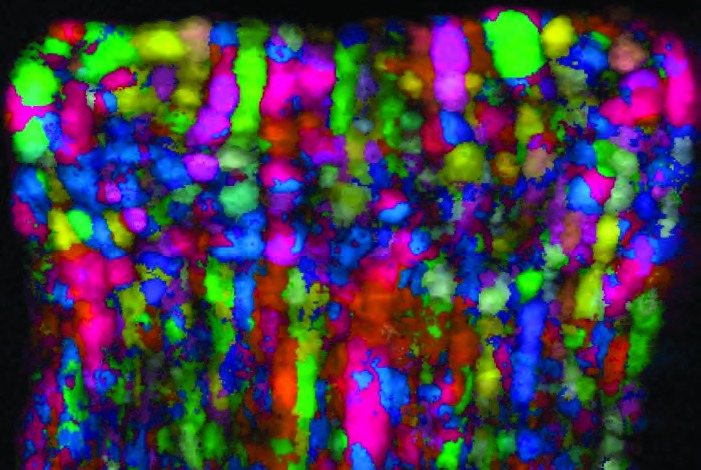 Figure 3. An inverse pole figure of a cobalt aluminum intermetallic modified to introduce plasticity displays the crystal orientation after deformation. Figure courtesy of Purdue University.
Xu says, "Going forward, we intend to extend this strategy into other brittle intermetallics such as iron aluminum and nickel aluminum, and other materials such as ceramics to determine if we can battle their inherent brittleness. Our goal is to determine whether interface and defect engineering can be broadly used to overcome inherent brittleness and enable plastic deformation."
Zhang says, "We also are working to develop a process for scaling up the manufacturing so that we can take intermetallic powders and convert them into high strength bulk intermetallic materials that display plasticity."
Additional information can be found in a recent article
2 or by contacting Zhang at
xzhang98@purdue.edu.
REFERENCES
1.
Canter, N. (2024), "New high-strength aluminum alloy suitable for additive manufacturing," TLT,
80 (10), pp. 14-15. Available at
www.stle.org/files/TLTArchives/2024/10_October/Tech_Beat_II.aspx.
2.
Xu, K., Mathew, A., Shang, Z., Paul, D., Shang, X., Wang, H., Kulkarni, Y. and Zhang, X. (2026), "Plasticity in brittle intermetallics enabled by framework of amorphous interfaces and preexisting dislocations,"
Science Advances,
12 (25), eaeb0766.
Neil Canter heads his own consulting company, Chemical Solutions, in Willow Grove, Pa. Ideas for Tech Beat can be submitted to him at neilcanter@comcast.net.