HIGHLIGHTS
•
A study was conducted to better understand how a carbon dioxide atmosphere influences the friction and wear produced when AISI 52100 steel test pairs are evaluated on a pin-on-disk tester under electrified conditions.
•
Lower coefficient of friction and wear scar diameters were found when testing was done in carbon dioxide compared to ambient air, and nitrogen atmospheres.
•
Spectral analysis indicates that test samples kept under carbon dioxide were found to be relatively clean due to the formation of a stable carbon-rich tribofilm that is probably responsible for lower coefficient of friction and wear scar diameters under both electrified and non-electrified conditions.
Electrification is presenting a new challenge to tribologists as this added parameter influences the degree of friction and wear generated under the various lubrication regimes. The growth of electrified machinery, such as battery electric vehicles, is leading tribologists to gain a better understanding of how metal surfaces interact with each other.
In a previous TLT article,
1 a dispersion of graphene nanoplatelets in polyalphaolefin (PAO) was evaluated under rolling-sliding electrified conditions using a modified mini-traction machine test rig. While the graphene dispersion displayed shallow wear scars indicative of a protective tribofilm under mixed and boundary lubrication conditions, the results were different when a 1.5 ampere electric current was applied. At low rolling speeds, reduced traction coefficients were achieved but more severe wear was observed at higher speeds than with the PAO control. The apparent reason for this result is the formation of abrasive carbonaceous debris that may also include the presence of nanoparticle agglomeration.
Carbon dioxide is a relatively inert gas under standard temperature and pressure conditions. This property has enabled carbon dioxide to be used in a number of applications including to carbonating beverages and acting as a refrigerant. But carbon dioxide has been found to become reactive under high contact pressures.
STLE Past President and Fellow, and corresponding author, Dr. Ali Erdemir, professor in the mechanical engineering department at Texas A&M University in College Station, Texas, says, "Past research determined that carbon dioxide under severe sliding conditions, decomposes into carbon and oxygen that can both react with an iron metal surface to form highly protective carbon-rich tribofilms."
Under specific carbon dioxide gas pressures, the coefficient of friction of steel interfaces is lowered due to the formation of tribofilms produced from the reaction of carbon dioxide with iron. These films were found to be primarily based on iron carbonate and bicarbonate.
With the growth of battery electric vehicles, research has accelerated to better understand the effect of shaft currents originating from electric motors on driveline components. Erdemir says, "Evidence has been accumulated that electrical discharges at contact interfaces can intensify tribo-oxidation, causing accelerated wear under ambient conditions. To counter this negative phenomenon, we devised an interesting strategy to evaluate the wear produced at electrified interfaces under controlled atmospheric conditions."
Erdemir and his colleagues are now reporting results from a study where dry sliding interfaces are evaluated under carbon dioxide, ambient air and dry nitrogen atmospheres.
Carbon-rich tribofilm
The study commenced with an evaluation of AISI 52100 test pairs on a pin-on-disk tester in air under non-electrified conditions. The coefficient of friction (CoF) found was approximately 0.60. When the procedure was repeated using carbon dioxide, and nitrogen, the CoF for carbon dioxide declined to approximately 0.20 while the figure in a nitrogen atmosphere was higher (approximately 0.84). Application of a constant DC current of one ampere to the test pairs exposed to each of the three gases led to an increase in the CoF in all cases. Under the carbon dioxide atmosphere, the CoF increased to 0.50 while for air the figure rose to 0.75. In nitrogen, the CoF increased to 0.90.
Wear as measured by the scar diameter was nearly six times higher for the steel ball tested in air and nitrogen under electrified conditions as compared to in carbon dioxide under non-electrified conditions. There is only a slight increase in the wear scar diameter in the carbon dioxide atmosphere when the DC current is applied.
Wear scars on the ball specimens are shown for the six test runs in non-electrified and electrified conditions in Figure 1. To understand the results, the researchers evaluated the sliding surfaces and wear debris particles by employing Raman spectroscopy.

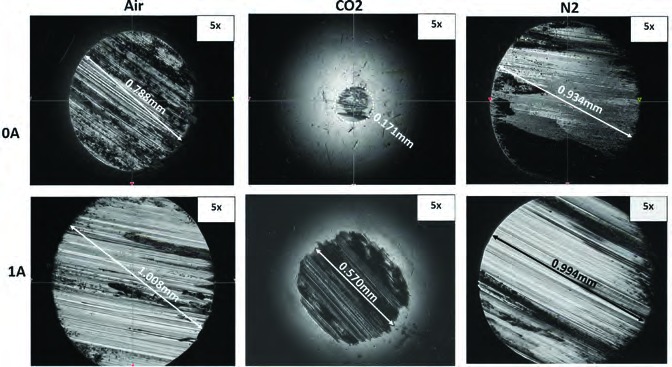 Figure 1. Microscopic images of wear scars generated under air, carbon dioxide (CO2) and nitrogen (N2) atmospheres are shown under non-electrified (0A) and electrified (1A) conditions. Figure courtesy of Texas A&M University.
Erdemir says, "The samples evaluated in air were found to show evidence of tribo-oxidation particularly when run under electrified conditions. Some oxidation was observed in the nitrogen samples, which may be attributed to trace amounts of oxygen and water molecules present in the test chamber or could be due to native oxide layers present in the test specimens."
But the test samples kept under carbon dioxide were found to be relatively clean and still metallic-looking. Erdemir says, "The Raman spectra reveal the formation of carbon-based tribolayers both on the surface and along the edges of the wear scar. We believe that carbon dioxide decomposes to carbon and oxygen that react with the iron surface. These interactions cause the formation of a stable carbon-rich tribofilm that consists of graphitic or graphene-like nanostructures, amorphous carbon, iron carbonate and some iron oxides. This carbon-rich tribofilm is probably responsible for the lower CoF and wear scar diameter values even under electrified conditions."
Further analysis conducted by high resolution transmission electron microscopy also found evidence for the presence of iron carbide that may have originally been part of the 52100-steel ball or from a tribochemical reaction with carbon dioxide.
Analysis of the steel surface used in air indicates evidence of enhanced oxidation during electrification. Erdemir says, "The oxygen present in air is reactive under the sliding conditions and displays an affinity to the iron surface. Moisture present in the air increases the likelihood of surface tribo-oxidation."
In the carbon dioxide testing computational sliding simulations generate data that confirmed the transition of this gas to a solid tribofilm. This appears to be a relatively complex process.
Figure 2 summarizes the possible phases formed in air (left image) and carbon dioxide under non-electrified (middle image) and electrified (right image) conditions. Erdemir says, "The ramifications of this research may lead to further evaluation of gearboxes used in battery electric vehicles hermetically sealed with carbon dioxide. Such an approach may provide superior lubricity and reduce vulnerability of mechanical components in battery electric vehicles to an electrified environment."

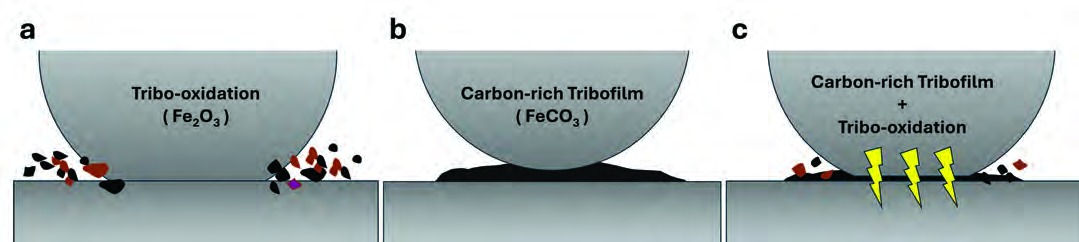 Figure 2. This schematic illustrates potential phases formed under ambient air (left image), non-electrified carbon dioxide (middle image) and electrified carbon dioxide atmospheres (right image). Figure courtesy of Texas A&M University.
This work was the result of a multinational collaboration of scientists from Mexico, Japan and the U.S. Additional information can be found in a recent paper
2 or by contacting Erdemir at
aerdemir@tamu.edu.
REFERENCES
1.
Canter, N. (2026), "Evaluation of graphene based-low viscosity oil dispersion under rolling-sliding electrified conditions," TLT,
82 (7), pp. 14-15. Available at
www.stle.org/files/TLTArchives/2026/07_July/Tech_Beat_I.aspx.
2.
Gallegos, J., Lee, S., Yelkarasi, C., Cabrera, L., Okamoto, R., Washizu, H. and Erdemir, A. (2026), "On the friction and wear mechanisms of electrified steel contacts in CO
2: unveiling the role of carbon-rich tribofilms under dry sliding conditions,"
Advanced Materials Interfaces,
13 (14), e70579.
Neil Canter heads his own consulting company, Chemical Solutions, in Willow Grove, Pa. Ideas for Tech Beat can be submitted to him at neilcanter@comcast.net.