Friction in trees
By R. David Whitby, Contributing Editor | TLT Worldwide November 2026
It may seem that tall trees might have greater difficulty getting water to their leaves, but research shows this isn't true.

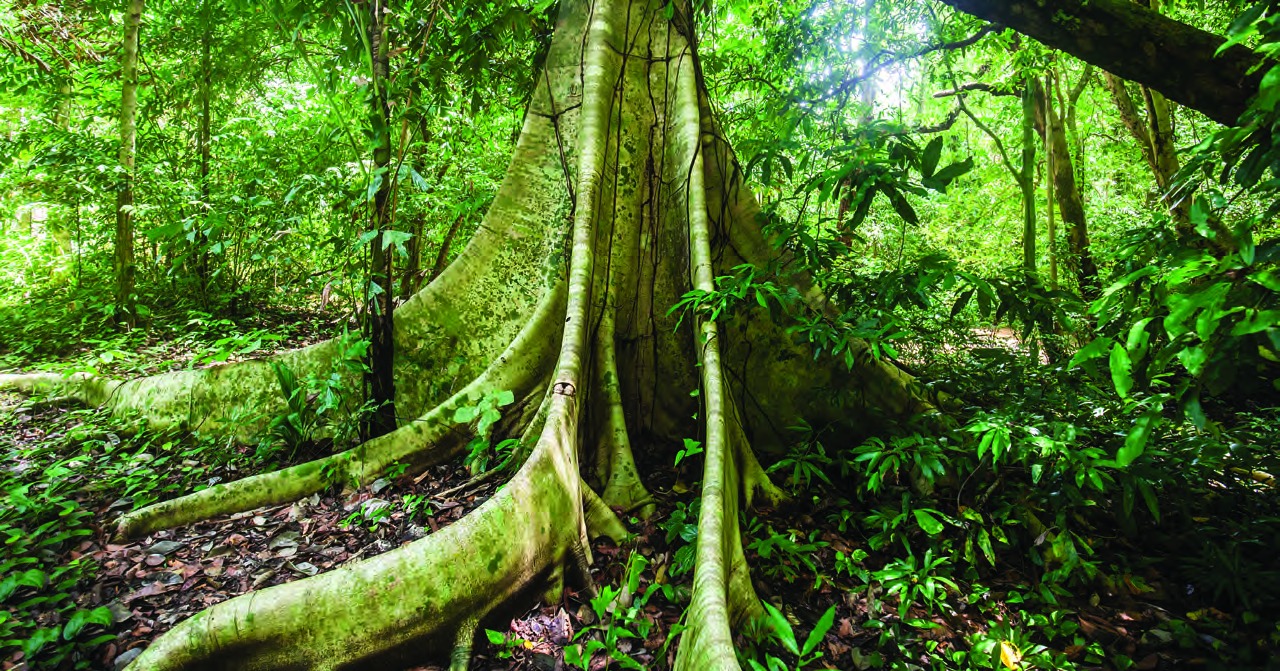
Trees, like all plants, need water and light in order to grow. The laws of physics suggest that moving water from the ground to the leaves should be harder for tall trees compared with smaller trees and bushes.
Trees grow taller so as to get more light and that they are not overshadowed by neighboring trees. To get water to the tops of trees, they have a network of tubes known as xylem that transport water up the tree. While animals rely on a heart to pump blood around their bodies, trees rely on evaporation from their leaves to keep water flowing.
When water evaporates from the leaves, it creates suction in the xylem, and this draws in more water to fill the space. This process is aided by the properties of water. Water molecules tend to adhere to each other, so as one molecule is drawn up, others move to fill the space. Water molecules also adhere to the walls of the xylem, which helps to counteract the downward pull of gravity.
However, this system poses two problems for tall trees. The first is caused by gravity. As the tree gets taller, the tension toward the top of the xylem increases. If that tension gets too large, links between water molecules can break, allowing pockets of air to form in the xylem. These will block the flow of the water. The second problem is the length of the xylem tubes. Longer xylem tubes in taller trees require more force to overcome the friction involved in moving water molecules along the tube. So, the greater the distance between the tree's roots and leaves, the harder it is for water to flow upward.
These problems have led botanists to speculate that tall trees might have greater difficulty getting water to their leaves and be at higher risk during times of drought. Now, an international team, led by Dr. Paulo Bittencourt at Cardiff University in Cardiff, Wales, in the UK,
1 and formerly of University of Exeter in Exeter, Devon, in the UK, have found that this is not true.
Collecting evidence is hard work because the tallest trees can be scaled only by experienced climbers. Fortunately, some members of the team were specialist climbers. They chose as test subjects a collection of Dipterocarp trees, which grow up to 100 meters, in a rainforest in north-eastern Borneo.
The team measured the growth rates of 27 trees, ranging in height from 7 to 71 meters, for 770 days during 2022 and 2024.
1 Each tree's xylem tubes widened as they grew from tip to base, thereby reducing the friction in the tubes closest to the ground. In the tallest trees, the widening was more pronounced than might be expected if they were simply larger versions of the shorter trees. Also, the highest leaves of the tall trees had higher concentrations of osmolytes, chemicals that help cells hold their shapes when water is scarce.
1
As a result of the clever engineering, the team found no relation between a tree's height and a reduction in growth rate during a six-month drought that began in December 2023. The assumption that tall trees will be the most affected by droughts is factored into a number of climate change models. This may now need to be revised. More research is needed to investigate the hydraulic systems and drought resilience of other tall trees, so the team is now expanding its work to test its generality across the tropics, for example, in the giant trees in the Amazon forests.
1
The research team included scientists in the Sabah Forestry Department (Malaysia), the UK Centre for Ecology and Hydrology and the University of Aberdeen, as well as institutions from the Czech Republic, Spain, Brazil and the U.S.
REFERENCES
1.
Bittencourt, P. et al. (2026), "Height does not impair the hydraulic system of the tallest tropical Dipterocarp trees,"
Science, 393, pp. 60-64.
https://doi.org/10.1126/science.aea9013
David Whitby is chief executive of Pathmaster Marketing Ltd. in Surrey, England. You can reach him at pathmaster.marketing@yahoo.co.uk.