-
The structure and performance of a commercially produced sodium-ion battery have been reported.
-
A tabless, double-aluminum collector configuration is used to arrange the cathode and anode. The cathode contains a layered-oxide of four transition metals in alternating layers with sodium. The anode is hard carbon and two electrolyte solvents: propylene carbonate and ethylene propionate are found in the battery.
-
Charge and discharge testing indicate that the sodium-ion battery has the potential for use in high-power applications.
Sodium-ion batteries are emerging as a viable option for use in energy storage applications where there is need to ensure reliability of power at times when renewable sources are not available. The appeal of working with sodium is this element's abundance and lower cost compared to lithium-ion batteries. But challenges remain in increasing the ability of sodium-ion batteries to be commercially used due, in part, to their inferior energy density compared to lithium.
One of the trends in the development of sodium batteries is to identify and develop solid-state electrolytes. In a previous TLT article,
1 three key requirements for a solid-state electrolyte were discussed and include displaying high ionic conductivity at room temperature, electrical conductivity five to six times lower than ionic conductivity and stability under dry-room condition to facilitate manufacturing. Researchers worked with a solid-state electrolyte candidate, NBH, that is derived from sodium salts of a specific closo-polyhedral borane and borohydride. By adjusting the synthesis conditions, a stabilized NBH was obtained that exhibits a higher ionic conductivity than previously reported.
A strategy for assessing the progress made in the development of sodium-ion batteries is to study the structure and performance of those types currently used commercially. Moritz Schütte, chair for Electrochemical Energy Conversion and Storage Systems at the Institute for Power Electronics and Electrical Drives (ISEA), at RWTH Aachen University in Aachen, Germany, says, "Sodium-ion batteries have their limitations, but we believe they have a comparable energy density to lithium iron phosphate (LFP) batteries, which are now more widely used due to their lower cost than NMC (nickel, manganese and cobalt) batteries. The latter exhibit better energy density which current sodium-ion battery technology cannot meet."
This finding necessitates the need for evaluating sodium-ion batteries to gain an understanding of their performance benefits and limitations to better understand how they can be positioned as energy sources versus lithium-ion batteries. Past research has found wide differences in the performance and quality of sodium-ion batteries. Significant differences in production uniformity and aging behavior were found. In studies comparing sodium-ion and LFP batteries, similar specific energies and cell impedances were obtained. One study concluded that sodium-ion batteries exhibited lower carbon footprints.
The researchers decided to evaluate a sodium-ion battery produced in China. Schütte says, "Our selection is the most widely used sodium-ion battery commercially. This battery was first produced in 2023 and we know that it is used in multiple large-scale battery energy systems connected to the electric grid in China."
Composition and performance
The specific battery type from the Chinese manufacturer exhibits a nominal capacity of 10 ampere hours, which is a measure of how much current can be generated over time. The nominal voltage is 3V.
An examination of the battery's interior found that the cathode and anode electrodes are arranged in a tabless, double-aluminum collector configuration. Schütte says, "The entire edge of an electrode is connected to the terminal in a tabless design. This feature leads to reduced electrical resistance and enables even temperature distribution to be achieved through the cell. In contrast, current is forced through relatively narrow contact points in a tabbed design that can cause higher internal resistance, uneven current distribution and can create localized thermal hotspots that may limit performance."
The cathode contains a layered-oxide of copper, nickel, iron and manganese where these transition metals form alternating layers with sodium. The anode is hard carbon and two electrolytes, propylene carbonate and ethylene propionate, are found in the battery.
Schütte says, "We are uncertain about why copper is present in the cathode. Energy-dispersive X-ray spectroscopy on the cathode determined that copper was present in an inhomogeneous manner. We are not certain about how this impacts the battery's performance."
The researchers conducted a series of performance tests and also conducted postmortem analyzes on 120 cells in this study. Charge and discharge testing was performed at 9 "C" rates ranging from 0.05 to 4 C at 25°C. The researchers find that this battery has potential for use in high-power applications due to charge and discharge capacities exceeding nominal capacity at C-rates as high as 4 C.
Schütte says, "Sodium-ion batteries have been found to exhibit better low temperature properties than lithium-ion batteries. In the case of the Chinese manufacturer's battery, good discharge performance was achieved at temperatures ranging from 25°C to -20°C. We found that the battery maintained a normalized energy retention above 80% at -20°C. The concern is that charging the Chinese manufacturer's battery at low temperatures proved to be problematic due to sodium plating on the anode."
CT imaging provided to be valuable in assessing the cell-level mechanics and predicting volume expansion behavior. Schütte says, "In evaluating the battery cell at 0% and 100% state of charge, CT scans determined that the excess electrolyte amount increased in volume by 22.3% from the discharged to the charged state. This indicates that the battery cell has sufficient electrolyte volume to maintain continuous wetting throughout charge/discharge cycles."
Figure 4 provides a summary of some of the testing conducted by the researchers on the Chinese manufacturer's battery cell. Schütte concludes, "We believe that this study demonstrates that sodium-ion batteries have the potential to be used in applications such as energy storage. Improvement in low temperature discharging and energy density will be required to improve performance. We will continue to monitor developments by evaluating sodium-ion batteries as manufacturers continue to make improvements in their offerings."

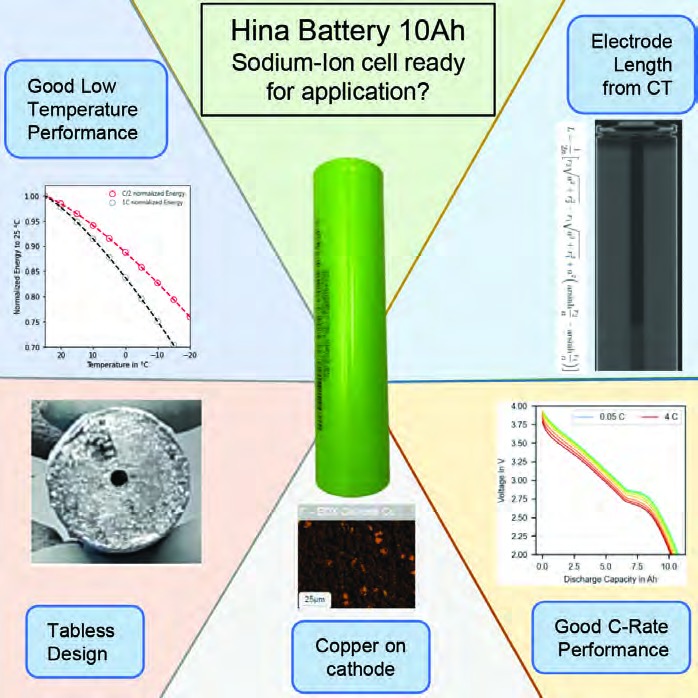 Figure 4. A summary of the structure and performance of a commercial sodium-ion battery demonstrates the following features: tabless design, copper on the cathode, the electrode length, good low temperature performance and good C-rate performance. Figure courtesy of RWTH Aachen University.
Additional information can be found in a recent article
2 or by contacting Schütte at
moritz.schuette@isea.rwth-aachen.de.
REFERENCES
1.
Canter, N. (2026), "Room temperature sodium solid-state battery electrolyte," TLT,
82 (4), pp. 12-13. Available at
www.stle.org/files/TLTArchives/2026/04_April/Tech_Beat_I.aspx.
2.
Siebert, C., Schütte, M., Rinner, J., Stahl, G., Lin, J., Quade, K., Ditler, H., Rahe, C. and Sauer, D. (2026), "Cell teardown and characterization of a Hina commercial sodium-ion battery,"
Cell Reports Physical Science,
7 (6), 103323.
Neil Canter heads his own consulting company, Chemical Solutions, in Willow Grove, Pa. Ideas for Tech Beat can be submitted to him at neilcanter@comcast.net.