HIGHLIGHTS
-
A light absorber needed to capture ultraviolet and a cocatalyst to generate hydrogen were deposited onto glass supports to convert plastic waste to hydrogen by photocatalytic reforming.
-
After hydrogen was produced in a laboratory setting, large-scale experiments were conducted using a one square meter photoreactor under natural sunlight.
-
Cellulose and polyethylene terephthalate were pretreated by an alkaline hydrolysis step, and the resulting products were then used to produce hydrogen in the outdoor photoreactor.
The use of hydrogen as a fuel and as an energy source in applications such as fuel cells has been limited due to higher production costs compared to fossil-fuels. The leading approach for producing hydrogen is still a high temperature process called steam methane reforming that involves starting with natural gas. Efforts to split water into hydrogen and oxygen are inefficient and costly.
An attractive option for producing hydrogen has been to take advantage of the large quantities of waste plastic available that is either being disposed of by landfilling or incineration. Both current disposal options are not desirable over the long term.
A previous TLT article
1 describes the use of flash joule heating to convert high-density polyethylene to hydrogen and graphene. In this process, the non-conductive plastic is mixed with a conductive material, carbon black and compressed in a quartz tube to have a resistance between 5-10 Ohm. The material is placed between a porous carbon electrode and a graphite electrode and then subjected to a 100-130-volt discharge for typically less than three seconds. Four consecutive flash joule procedures maximize the hydrogen yield up to an efficiency of 92.7%. Methane and lower molecular weight hydrocarbons were also produced. Adjusting the reaction conditions led to higher hydrogen yield and to the presence of just graphene as the carbon residue. This process is calculated to consume significantly lower emissions and less energy than incineration.
Another strategy for producing hydrogen from plastic waste is to take advantage of the presence of solar energy. Ariffin Bin Mohamad Annuar, graduate student in the Yusuf Hamied Department of Chemistry at the University of Cambridge in Cambridge, UK, says, "Solar reforming has emerged as a potential route for utilizing the sun to convert such widely available and low-cost raw materials as plastic waste and biomass to hydrogen and organic compounds that can be used as precursors to synthesize value-added materials. The benefit of this pathway compared to water splitting is that oxidizing organic compounds is more energetically favorable."
A subset of solar reforming is photocatalytic reforming. Mohamad Annuar explains, "Semiconductor photocatalysts are utilized to capture and use solar energy to convert organic compounds to hydrogen. Photocatalytic reforming can be conducted in a reactor setup that resembles a solar panel. To prepare the photocatalytic panels, we sequentially spray coat our glass substrates with a dispersion of our semiconductor photocatalyst and single-source precursor, which respectively form the light absorber and cocatalyst layers on the panels. The raw materials used are pretreated and then introduced into a reactor housing the photocatalyst panel."
Initial efforts produced only limited success due to the need for high temperatures, harsh chemicals or complicated manufacturing processes. Mohamad Annuar says, "One of the major challenges in implementing the photocatalytic reforming is the deposition of cocatalysts onto light absorbers and the subsequent immobilization of the complete photocatalyst system onto a substrate. In addition, most previous attempts have used distilled water or sacrificial reagents rather than real waste streams."
A new approach has now been developed to produce a workable photocatalytic sheet that can oxidize plastic waste.
Single-source precursor chemistry
Mohamad Annuar and his colleagues determined that a single-source precursor chemistry can be used to synthesize a cocatalyst solution, which can be deposited using various techniques. He says, "We found this process will work using several different types of deposition methods ranging from simple drop casting to high-throughput spray coating. Single-source precursor chemistry has the potential to be used in large-area fabrication for commercial use."
In this study, the researchers deposited a light absorber and a cocatalyst onto glass supports. The light absorber is aluminum strontium titanate, which was dispersed in isopropanol and then deposited. Mohamad Annuar says, "This catalyst exhibits good photo-activity particularly in the ultraviolet range. Aluminum strontium titanate is easy to synthesize, robust and can readily be immobilized on a solid support. This catalyst is capable of catalyzing the oxidation half-reaction with an appropriate organic substrate but requires a cocatalyst for hydrogen evolution."
The cocatalyst used to generate hydrogen is a cobalt-zirconium composite. Included in this cocatalyst is cobalt, which is well-known for facilitating the production of hydrogen, combined with zirconium, which acts as a robust inert matrix. The result is a mixed-metal composite that works well with aluminum strontium titanate.
Initial work was carried out by placing both catalysts on photocatalytic sheet with an area of one square centimeter under controlled conditions in an air-tight environment. Adjusting the concentration of the hydrogen generating catalyst leads to significant hydrogen evolution. Triethanolamine was used as the organic electron donor.
Additional experiments were conducted with glucose and ethylene glycol as the organic substrates. Two polymeric waste substrates, cellulose and a real-world polyethylene terephthalate (PET) bottle were then evaluated. Prior to the test, both materials underwent an alkaline hydrolysis pretreatment step to produce materials more suitable to interacting with the catalysts. Hydrogen formation was observed but was hindered by the presence of residual fragments or oligomers.
The organic oxidation products were isolated and identified as formate and acetate from pretreated cellulose, and glycolaldehyde dimer and glycolate from pretreated PET. Large-scale demonstration experiments were then conducted on a one square meter photoreactor under natural sunlight and situated outside of the researcher's building
(see Figure 3).

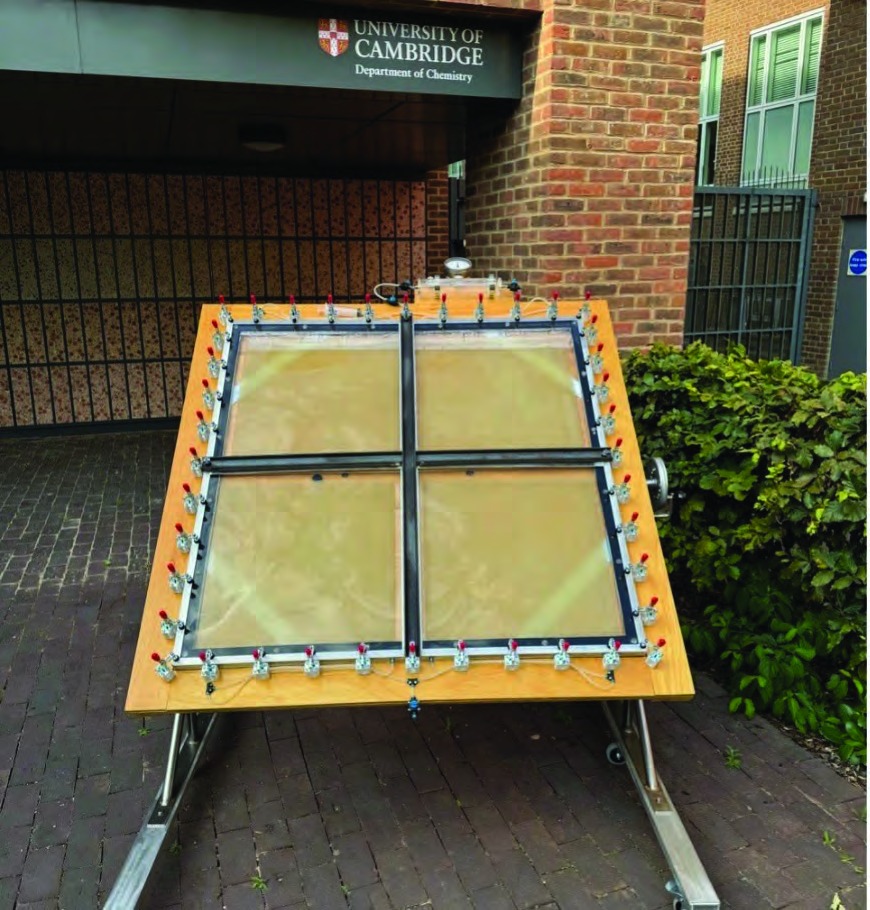 Figure 3. This large-scale photoreactor used in 1 m2 photoreforming experiments converted waste plastics such as polyethylene terephthalate to hydrogen. Figure courtesy of Ariffin Bin Mohamad Annuar and the University of Cambridge.
Hydrogen generation was achieved with the accompanying synthesis of oxidized organic compounds. Mohamad Annuar says, "Hydrogen was isolated through the use of a separate small chamber connected to the main reactor cell while the organic compounds ended up in the substrate solution. This work demonstrates the potential utility of this approach in generating hydrogen while also conceivably co-producing organic materials that can be used as building blocks to produce value-added materials."
One objective of future work will be to identify more active catalysts that can use more of the solar radiation beyond the ultraviolet range. A second approach is to develop better thermal management to enhance production rates with the ultimate goal to have a photoreactor that is commercially feasible.
Additional information can be found in a recent article
2 or by contacting Mohamad Annuar at
abm64@cam.ac.uk.
REFERENCES
1.
Canter, N. (2023), "Production of hydrogen and graphene from waste plastic," TLT,
79 (12), pp. 18-19. Available at
www.stle.org/files/TLTArchives/2023/12_December/Tech_Beat_II.aspx.
2.
Annuar, A., Liu, Y., Bhattacharjee, S., Slaughter J., Mikulska, I., Sayed, F., Grey, C., Wright, D. and Reisner, E. (2026), "Photoreforming of solid waste on 1 m
2 scale using single-source precursor-derived co-catalyst films,"
Nature Chemical Engineering,
3, pp. 351-362.
Neil Canter heads his own consulting company, Chemical Solutions, in Willow Grove, Pa. Ideas for Tech Beat can be submitted to him at neilcanter@comcast.net.