HIGHLIGHTS
-
Electrical damage represents a major core challenge and should now be one of four material degradation mechanisms.
-
Among the challenges facing end-users is that electrical damage can reduce a material's hardness and yield strength, promote thermal softening and increase plastic deformation within the surface layer at high temperatures.
-
A unique surface morphology can be created as a result of electrified damage leading to the formation of unique circular or elliptical craters. If left unchecked, these craters can eventually cause crack initiation and material removal.
The dramatic growth in electrification has led to the development of such machines as battery electric vehicle drivetrains, wind turbines, power electronic devices and microelectromechanical systems (MEMS). As a result, machinery is not only exposed to the traditional degradation processes such as chemical and mechanical, but must also now deal with exposure to electrical potential and currents, increasing the prospect for failure and prompting end-users to look beyond conventional failure modes.
STLE Past President Hong Liang, professor in the mechanical engineering department at Texas A&M University in College Station, Texas, says, "Electrified damage represents a major core challenge because end-users will not see evidence for this failure mechanism until it is potentially too late. Damage to machinery from electrons starts on the inside of a machine and is very hard to detect. It is not understood at this time and moves at such a fast rate that it cannot be controlled. We believe that electrified damage is worse than chemical damage caused by corrosion."
The growing possibility of electrical damage will now be added to the list of challenges that are faced by end-users. These include heat dissipation, lubrication, surface degradation and materials reliability. Liang says, "Electrified machinery faces operating issues such as high electrical potential, fast switching frequencies, elevated current densities and compact high-power architectures. These issues all are added to the existing degradation pathways that are faced in operating machinery."
Liang and her colleagues recently published a perspective
1 on electrified damage to highlight the need for those working in the materials field (including tribologists) to consider this issue to be one of four material degradation categories
(see Figure 1). She says, "In developing this approach, we read a lot of literature that discussed damage induced by electrical charges. This represented years of effort but did not provide an understanding of the root cause of electrified damage. This led us to propose having electrical damage as a separate and distinct material degradation mechanism."
Figure 1 demonstrates that electrical damage should now be one of four material degradation mechanisms along with chemical damage, mechanical damage and electro-mechanical damage. Mechanisms for how material degradation occurs are listed under all four categories.

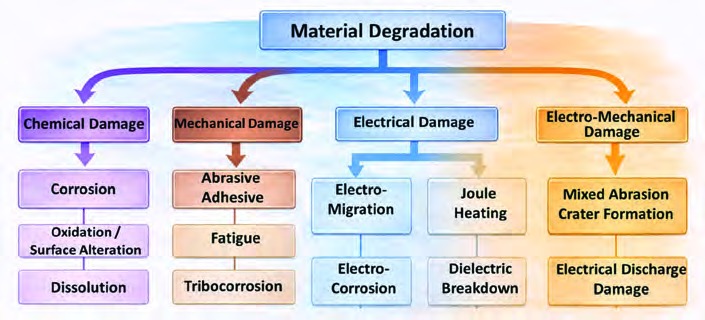 Figure 1. Electrified damage should be treated as one of four material degradation mechanisms. Degradation pathways for chemical damage, mechanical damage, electrified damage and electro-mechanical damage are shown. Figure courtesy of Texas A&M University.
Liang defines electrical damage as occurring due to pure electrification degradation processes such as electromigration, and dielectric breakdown and when electrical and mechanical energies generate new forms of surface damage. She says, "Electrified damage is a source of power that occurs due to voltage, whether it be alternating or direct current. Electrons are prompted to move and then will literally attack atoms and disrupt metallic bonding, leading to degradation."
Electrical potential and current can pass through microscopic contact spots on material surfaces, altering plastic deformation by reducing apparent flow stress, enhancing dislocation mobility and promoting softening of localized asperity contacts. This can accelerate asperity deformation, tribofilm rupture and crack initiation. An additional factor is that micro-discharge events can be triggered due to electrical potential differences among lubricants and metal oxides, leading to the formation of localized plasma and rapid thermal cycling that may produce crater-like pits, raised rims and resolidified droplets on the material's surface. Liang says, "Electrical potential and current can put a material surface in much worse shape, which may not be detected until ultimate failure."
Materials can be subjected to high thermal loads that, in the presence of electrification, can do additional damage. Liang says, "Higher temperatures create additional atomic energy-producing vibrations among metal bonds. This factor will lead to further attacks on the material."
Among the concerns that need to be evaluated at high temperatures is that electrification can reduce a material's hardness and yield strength, promote thermal softening, increase plastic deformation within the surface layer and eventually create crack initiation sites. Defect evolution and dislocation mobility can occur due to the presence of high-density current, which can lower flow stress even before the material melts.
Liang says, "An electric current may modify both the thermal state and mechanical resistance of the material, leading to accelerated wear. In effect, the combination of electrification and high thermal loads produces negative synergy."
The authors of this perspective claim that electrified damage must be treated as a distinct degradation pathway and not a variation of classical wear. Liang says, "While existing degradation pathways such as adhesive wear causing mechanical damage and corrosion can lead to pitting deep in materials, electrified damage must be treated as a main degradation pathway because it can lead to material degradation at a much faster rate by itself and by interacting with mechanical and chemical phenomena."
Another factor supporting the need to distinguish electrified damage as a degradation mechanism is the unique surface morphology that it can create in surfaces. Liang says, "Electrified damage often produces unique circular or elliptical craters, often surrounded by raised rims or resolidified material. The abrasion seen is not uniform and is often localized. No preferred orientation relative to sliding or rolling is found. These observations are in stark contrast to such degradation mechanisms as adhesive wear and rolling contact fatigue."
Of concern is that craters created due to electrified damage can grow into pits and interact with mechanical stresses to create larger defects that can cause crack initiation and material removal.
A summary of how electrical damage can impact materials is illustrated in Figure 2, which illustrates how the process starts with charge accumulation in asperities and surfaces and can eventually reach the stage of crack nucleation and damage growth. Liang says, "Tribologists will need to keep in mind the negative consequences of electrification in designing lubricants that are able to modify electrical generation by reducing the buildup of voltage. This additional factor must be included with all of the other characteristics required in a lubricant and means that the types of additives and base stocks must both be considered in developing a product for an application where electrical damage is possible."

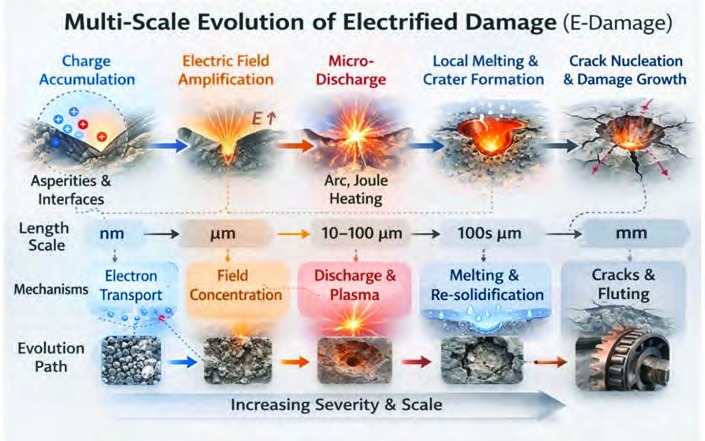 Figure 2. The extent of electrified damage is illustrated in moving from the left to the right of the image. Figure courtesy of Texas A&M University.
Liang hopes that this perspective will bring attention to the negative consequences of electrical damage by alerting the tribology field to its consequences and the need for developing corrected measures. Besides reviewing the perspective,
1 additional information can be obtained by contacting Liang at
hliang@tamu.edu.
REFERENCES
1.
Kabir, M., Nguyen, A. and Liang, H. (2026), "Electrified damage in motion systems,"
Advanced Engineering Materials, 28 (15), e71036.
Neil Canter heads his own consulting company, Chemical Solutions, in Willow Grove, Pa. Ideas for Tech Beat can be submitted to him at neilcanter@comcast.net.