KEY CONCEPTS
-
The harsh conditions of space mean that advancements and lessons learned from space tribology hold immense potential for improving the reliability and performance of products across diverse industries on earth.
-
Grease is generally the best and most widely used lubricant for space applications, but many factors must be considered before choosing a particular material.
-
All moving mechanisms and contacting surfaces require purposeful lubrication, and a lubrication strategy is needed for any moving part.
-
Past experience and practice (i.e., heritage) provide the best guidance for new problems, but new approaches are often needed for new applications. Technology is best matured through careful design, lab testing and space demonstration.
Tribology is a relatively new term, only about 65 years old. The root is from the Greek "tribos," which means to rub, while "ology" is the study of. Tribology is the study of friction, wear and lubrication in relation to bearings, gears, lubricants, friction and wear. Among the key questions often asked of a tribologist is how long something is going to last.
While the majority of tribological applications are grounded in terrestrial environments, space presents some of the harshest operational conditions imaginable. This means that the advancements and lessons learned from space tribology hold immense potential for improving the reliability and performance of products across diverse industries on earth.
In a presentation during the 2025 STLE Virtual Symposium: Application of Tribology in Astronautics, STLE Life Member Dr. Christopher DellaCorte spoke on the broad design of aerospace tribology applications. The symposium addressed the critical role of tribology in enabling and sustaining space missions. See Meet the Presenter for more information.
Extreme conditions
Space, aerospace and aeronautics applications involve extreme conditions, but they are not the same extreme conditions. The extreme conditions can exist for short periods of time in launch vehicles, but once in space have lower loads (i.e., no gravity) in a vacuum environment with solar radiation. Issues of extreme conditions that affect oil (e.g., high or low temperature applications, material challenges) are different from those found in the terrestrial world. An example of a different material challenge occurs with zinc-plated steel. In terrestrial applications zinc prevents corrosion, but in space, once in vacuum and warmed up, the zinc can evaporate and migrate, leading to the contamination of close by materials.
Extreme conditions in space also include extraordinary requirements (e.g., vacuum compatibility, absence of gravity, inaccessible locations, immersion in process fluid, unavoidable shock loads [i.e., rocket launch systems, docking space craft]) that have to be planned and designed to have success.
Designing for success in aerospace applications
DellaCorte identified the best approaches for avoiding failures in aerospace applications:
1.
If the desired function using a machine (e.g., solid state device) can be achieved with no moving parts (e.g., a digital clock in lieu of a mechanical watch), it should be. The best solution to avoid failures is to avoid a bearing, seal or sliding mechanism if possible.
2.
However, a mechanical system may be needed. If motion is required but is characterized as a small linear displacement or torsional rotation, the elastic deflection of a beam or rod can be employed in lieu of a rolling bearing or bushing to avoid tribology issues.
3.
If the significant or continuous motion (e.g., round and round or back and forth) cannot be avoided, a rolling contact bearing can be used instead of a sliding contact.
4.
If rolling or sliding contact is required, the contact must be lubricated using a grease or oil lubricant.
5.
When a lubricant is needed, a conventional solid lubricant that is compatible with the space environment (e.g., polytetrafluoroethylene [PTFE], graphite or molybdenum disulfide [MoS
2]) is a last resort only when an oil or grease cannot be used (e.g., at high temperatures).
6.
Finally, if all other options fail, use an exotic solid lubricant approach (e.g., process fluids or magnetic bearings). This is the least desirable solution as exotics require the most engineering, development and testing effort as they are at the cutting edge of technology.
The space environment varies, so knowing which particular space is the focus is important. DellaCorte identified two possible environments:
-
The iconic space environment is the hard space vacuum with atomic oxygen and ultraviolet (UV) radiation exposure with -100℃ to +100℃ temperature swings. This can include an astronaut floating in space in a low earth orbit with chemically aggressive atomic oxygen present.
-
Inside a spacecraft (e.g., space station, communication satellite) the environment can exist as a vacuum or be pressurized with a gas (e.g., air, argon) held at approximately 20℃-50℃. Radiation shielding allows for a more room-temperature environment.
In general, zero-gravity thwarts normal fluid flows (i.e., convection, drainage, etc.), meaning natural convective cooling is not present and a fan is needed to circulate fluid back to a pump.
Lubricant types
To meet the needs of a space environment, all sorts of lubricants and materials are used, including:
-
Dry film lubricants (DFL): PTFE, graphite, MoS
2, silver, lead and gold.
-
Grease: Any grease used has to be vacuum stable, can flow when cold and doesn't outgas. Greases can be used for bearings, gears and latches and are the most common lubricants used in a space environment. The oil acts as a lubricant and the grease thickener is the delivery mechanism that works even in the absence of gravity.
-
Mechanisms: Mechanisms that provide movement without the need for tribology include things like flexure springs.
When identifying the right lubricant for a particular application, even in space, the basic principles of tribology apply. When two surfaces are in relative motion, surface asperity tips touch each other, and friction forces are proportional to asperity material properties (e.g., hardness, strength). Wear occurs when asperity tips break and release wear particles. In space, these particles move to where they are not wanted. Even rolling can create asperity tip contact and micro-scale sliding. "Perfect rolling contact" does not exist; there is still sliding and material fracture and wear.
DellaCorte identifies the basic underlying principles of lubrication as:
-
Achieving friction reduction by reducing the local material strength at the contact interface.
-
Enhancing friction reduction by minimizing the number of asperities that touch, or by limiting contact area.
-
Effective lubrication occurs when something soft (e.g., lubricant) is placed between two hard contacting surfaces that are in motion.
The lubricant could be oil, grease, solid or a soft oxide layer with the lubricant selection hinging on the application.
Solid lubricants. Solid lubricants lubricate via solid state shear. They stay put and can work in both hot and cold environments; however, they tend to have a limited life and cannot easily be replenished in a space application. This means they can be suitable for low duty cycles, meaning mechanisms that only occasionally operate (e.g., door hinges that open and close, filter wheels that rotate one or two rotations on a daily basis, etc.). They are not suitable, for instance, for a fan that rotates continuously at 2,000 rpm. A concern is that the wear process can liberate particles that can contaminate the environment and other mechanisms by floating around and shorting out other circuits. Table 1 summarizes solid lubricants and some of their properties. The crossed-out row in Table 1 is a material that is not generally compatible with space applications.
Table 1. Solid lubricant key properties
| Material |
Density (g/cm3) |
Typical friction coefficient |
Environment limits |
Temperature range or limit (℃) |
Application method |
graphite |
2.3 |
0.05-0.10 |
Needs water |
330 (air); 600 (inert or vacuum) |
Solid component, coating pigment |
| PTFE |
5.1 |
0.03-0.10 |
Creep at low stress (10 MPa) |
-200 to +300 |
Coating, composite ingredient |
| MoS2 |
3.2 |
0.03-0.08 |
Degrades in air |
650 (vacuum) |
Thin film |
| Ag, Au |
10.5, 19.3 |
0.1-0.2 |
Moderate friction |
900 (air or vacuum) |
Thin film |
| Pb, In |
11.5, 22.4 |
0.1-0.2 |
Moderate friction |
250 (air or vacuum); 100 |
Thin film |
| polyimide |
2.0 |
0.1-0.15 |
Dimensionally unstable (i.e., absorbs water) |
-200 to +300 |
Solid composite, coating |
| UHMWPE |
0.93 |
0.1-0.2 |
Softens when warmed |
0-100 |
Solid composite |
Ag - silver; Au - gold; g/cm3 - grams per cubic centimeter; In - indium; MoS2 - molybdenum disulfide; MPa - megapascal; Pb - lead; PTFE - Polytetrafluoroethylene or Teflon; UHMWPE - Ultra-High Molecular Weight Polyethylene. Note: Crossed-out row is a material that is not generally compatible with space applications.
Source: Dellacorte, 2025.
While graphite is a possible lubricant, it is generally avoided in a vacuum environment because friction and wear in the absence of moisture tend to be high. Additives can mimic what the water does in a graphite lubricant, but in general, graphite is avoided in a vacuum environment. MoS
2 can work well in a vacuum environment, but if used on the ground before launch, or inside the space station where there are air and moisture, it will experience higher friction and limited life.
Liquid lubricants. Oil can have a long life and can reflow into a contact area with good heat transfer mechanisms. Wicks or pumps are needed in zero-gravity to move the oil where it is needed. Many oils can become too thick or even freeze at space temperatures, and many evaporate in the space vacuum. Also, oil vapors can contaminate other surfaces. Table 2 summarizes liquid lubricants and some of their key properties. The crossed through rows in Table 2 are materials that are not generally compatible with space applications.
Table 2. Liquid/fluid lubricant key properties*
| Material |
Density (g/cm3) |
Viscosity, shear resistance (cP) |
Typical friction coefficient |
Environment limits |
Temperature range or limit (℃) |
Applications/comments |
Air |
0.0013 |
0.018 mPa |
0.001 (hydrostatic); 0.01 (hydrodynamic) |
Low load capacity |
None |
Hydrostatic pressurization or high speed hydrodynamic |
Water |
1.0 |
0.89 |
0.001 (hydrostatic); 0.01 (hydrodynamic) |
Low load capacity; Corrosion |
32<T<100 |
Hydrostatic pressurization or compliant (rubber) surface bearings (hydrodynamic) |
Mineral oil |
0.87 typical |
5-50 |
0.05-0.10 |
Modest thermal stability |
-20 to +150 |
General purpose lube, lowest cost |
Clay-base grease |
0.9 |
N/A |
0.1-0.15 |
Stiffens at low temperatures |
-0 to +300 |
Best high temperature grease, no dropping point |
| Synthetic oil |
0.87 typical |
5-50 |
0.05-0.10 |
Moderate thermal stability |
-40 to +200 |
Highest performance, modest cost |
| Fluorocarbon oil |
1.5 |
1-30 |
0.1-0.15 |
Poor boundary lubrication |
-60 to +250 |
Vacuum stable, high cost |
| Lithium base grease |
1.1 typical |
N/A |
0.1-0.15 |
Modest thermal stability |
-20 to +150 |
General purpose lube, low cost |
| Fluorocarbon base grease |
1.9 |
N/A |
0.1-0.2 |
Poor corrosion control |
-60 to +25 |
Vacuum stable, high cost |
*must select oils and additives that have low vapor pressure. cP - centipoise; g/cm3 - grams per cubic centimeter; MPa - megapascal. Note: Crossed-out rows are materials that are not generally compatible with space applications.
Source: Dellacorte, 2025.
Anything chosen for use in a vacuum must have low vapor pressure. Air, water, mineral oil and clay-base grease generally do not apply in space; however, some synthetic oils are feasible. Fluorocarbon oils are prized as being very vacuum stable. Fluorocarbon base grease is widely used in space environments.
Process fluids (e.g., water, ammonia, carbon dioxide [CO
2]) can be lubricants in a sealed system (e.g., inside the piping of a heat exchanger). While there would be no contamination issues, most process fluids are not good lubricants, so the bearings have to be designed accordingly.
Grease is the most common space lubricant. Grease is made by combining oil with a thickener and other additives, so it can combine the best attributes of other lubricants. Grease can last for a long time, generally stays in place and can be tailored for specific attributes.
Examples of lubricant use in space
The International Space Station (ISS) is a self-contained city employing every kind of tribology:
-
Bearings: ball bearings, roller bearings and sliding bearings.
-
Gears: intermittent use, continuous duty, wet-lubed, dry-lubed, cold and hot.
-
Mechanisms: pumps, latches, fans, exercise equipment, spacesuit joints, solar-array drives, slip-rings, control moment gyros, momentum wheels, robotic arms, etc.
Despite learning on Earth, how a system will work in space is not clear until it is there. Challenging failures have occurred with all of the components listed in the preceding bullets. It is always a challenge to affect lubrication in space. Exterior locations make extensive use of vacuum compatible greases, solid film lubricants and radiation shielding. Spacecraft interiors use grease and PTFE-based solid lubricants, while recognizing fire, toxicity and odor concerns. All space locations focus on minimizing and controlling wear debris. Being maintenance free is also a key driver.
In space, having backups is critical to achieve mission success. Extensive ground testing of any new technology is needed before flight. Proven experience and historic knowledge (i.e., heritage) are relied upon. Also, when something does break, failure analyses are needed to understand why breakage occurred prior to developing a solution. Any new design must be tested extensively before major investments in space hardware. R&D is sometimes performed during space missions to expand capability in the tribology arena.
SARJ failure analysis
An example of successful failure analysis is the bearing failure of the solar alpha rotary joint (SARJ). On the ISS, the SARJ is used in the solar panel wing bearing under continuous slow rotation with one revolution every 90 minutes to keep the solar panels pointed toward the sun. It is a 3-meter diameter bearing similar to a wind turbine bearing. It is vital to ISS operation and failure is not an option
(see Figure 1). Replacing the SARJ would be an elaborate process that requires sending astronauts out on the wing, so it has challenges. To prevent vibrations inside the space station, the SARJ has to have very little torque ripple when it turns. When the space station was being designed and built in the 1980s, large wind turbines didn't exist. Research to develop the SARJ bearing likely helped the wind turbine bearing industry.

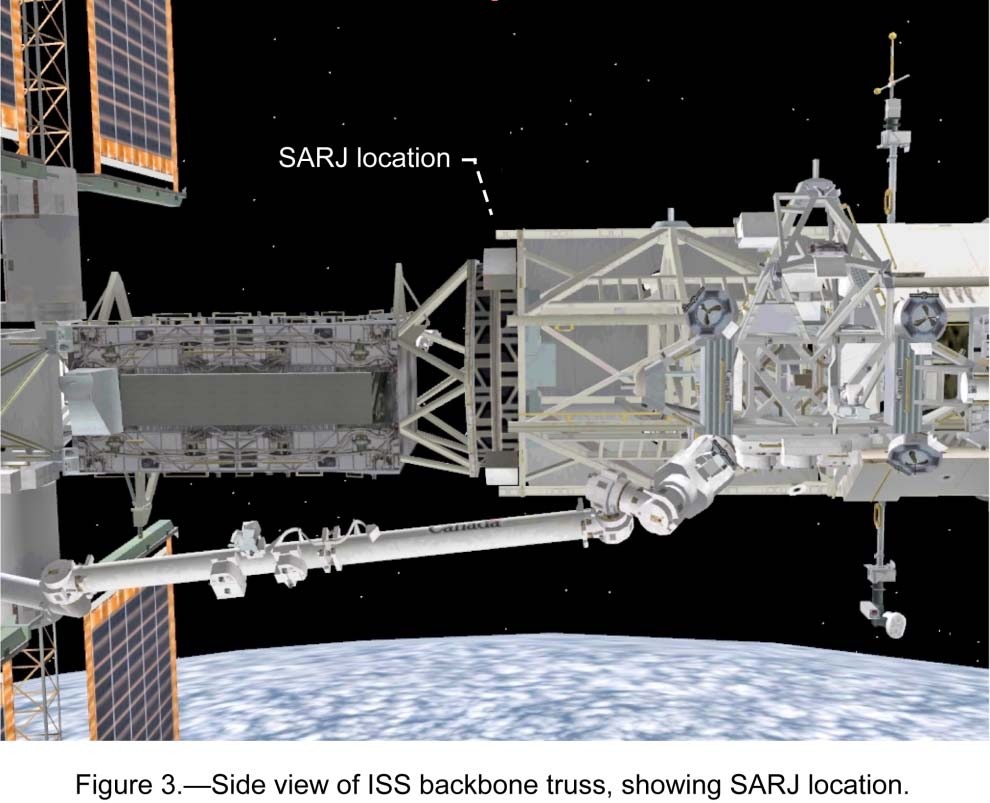 Figure 1. Side view of ISS backbone truss, showing SARJ location.
In the SARJ bearing, the race rings are unusual in that they are triangle-shaped in cross-section. The races turn inside three gold-plated solid lube rollers. Each roller contains small ball bearings with PFPE-based grease for long life. There are a dozen of the three roller trundles at 12 locations around the 3-meter diameter SARJ ring to hold it all together. After commissioning the space station, it was observed that one of the bearings was operating well, but the other was becoming difficult to turn. When astronauts went out to take pictures, they found the race/rolling surface was not smooth and clean any longer, which is a bearing failure.
Some 200 people worked on figuring out how this failure happened. They determined that the thin gold films designed as lubricant did not properly adhere to the rollers. When they wore out, a kinematic problem developed. Inadequate lubrication of the roller-race contact, combined with a kinematic mechanism design vulnerable to roller tipping and high friction, led to damagingly high roller-race surface forces and stresses.
While new parts could have been launched, instead the astronauts were trained to be grease monkeys. In pre-flight ground training, the astronauts had to learn to use a grease gun while inside the stiff and bulky space suits. Grease was added to the SARJ bearings in November 2008. NASA watches SARJ friction every minute 24/7, and over 10 years later the SARJ bearings remained working. The lessons learned include that all bearings need lubrication and grease is good.
1
Water purification system failure analysis
The ISS environmental control and life support system (ECLSS) distillation assembly purifies dirty water. Liquids (e.g., urine, sweat, spit, etc.) are collected and mixed with acids to kill bacteria, and sent through a rotating (i.e., bearings) distiller process.
In other words, the system takes toilet water, puts it through a machine and creates refreshing drinking water. The ECLSS distillation assembly is a rotating drum heated to boil dirty acid water and create steam. The rotation uses the centrifugal forces to press the water to the sides of the drum in a layer, so it can be heated. The resulting steam is pumped away, cooled, condensed and filtered to produce clean water. The environment inside the distillation assembly is warm, wet and corrosive.
The original design had stainless steel bearings but those rusted and failed. Stainless steel is corrosion resistant, but not corrosion immune. Cobalt alloy bearings don't rust, but those bearings were too soft and failed. NASA invented a new NiTi (NickelTitanium) alloy (i.e., no iron in it, so doesn't rust) that is hard and does not rust but needs lubrication. A water-resistant lithium-based grease was selected with synthetic polyalphaolefin (PAO) oil and non-toxic additives. Ground testing was performed with a simulator for 10,000 hours, indicating the bearings would work in the space environment. In the space environment, bearing material is critical but bearings also need lubrication. While grease is good, a better option would be something waterproof and acidproof.
2
 Ongoing R&D
Basic friction and wear experiments are being performed in space. A friction and wear pin-on-disc tribometer unit device was built inside a module that plugged into a material exposure experiment that is ongoing in the ISS with data transmitted back to earth. An external testing platform made up of racks of shelving is permanently mounted on the outside of the ISS called Materials International Space Station Experiment (MISSE). Lubricants being tested include MoS
2, gold, antimony trioxide (Sb
2O
3), yttria stabilized zirconia (YSZ), MoS
2 and carbon, PTFE and nanoscale aluminum oxide (nano-Al
2O
3) on different disk substrates, including 304 stainless steel, bulk PTFE/Al
2O
3 and bulk gold. These experiments are a great first step in developing space lubricants.
3
Conclusions
DellaCorte says that space presents many tribology challenges. All moving mechanisms and contacting surfaces require purposeful lubrication, and a lubrication strategy is needed for any moving part. Past experience and practice (i.e., heritage) provide the best guidance for new problems, but new approaches are often needed for new applications. Technology is best matured through careful design, lab testing and space demonstration.
REFERENCES
1.
DellaCorte, C., Krantz, T. L. and Dube, M. J. (August 2011), "ISS solar array alpha rotary joint (SARJ) bearing failure and recovery: Technical and project management lessons learned," NASA TP-2011-217116,
https://ui.adsabs.harvard.edu/abs/2011ntrs.rept15384D/abstract.
2.
DellaCorte C. and Wozniak, W. A. (May 1, 2012), "Design and manufacturing considerations for shockproof and corrosion-immune superelastic nickel-titanium bearings for a space station application," NASA TM-2012-216015. Available at
https://ntrs.nasa.gov/search.jsp?R=20130001675.
3.
Krick, B. A. and Sawyer, W.G. (2011), "Space tribometers: Design for exposed experiments on orbit,"
Tribol Lett,
41, pp. 303-311,
https://doi.org/10.1007/s11249-010-9689-y.
ADDITIONAL REFERENCES
•
Jones, Jr., W. R. and Jansen, M. J. (March 2000), "Space tribology," NASA TM-2000-209924.
-
Roberts, E. W. (2012), "Space tribology: Its role in spacecraft mechanisms,"
J. Phys. D: Appl. Phys., 45, 503001,
https://iopscience.iop.org/article/10.1088/0022-3727/45/50/503001.
-
Kannel, J. W., Lowry, J. A. and Dufrane, K. F. (November, 1991), "Lubricant selection manual, phase 3," NASA CR-184363,
https://ntrs.nasa.gov/citations/19920024392.
-
Leger, L. J. and Dufrane, K. F. (April 29-May 1, 1987), "Space station lubrication considerations," proceedings of the 21st Aerospace Mechanisms Symposium, NASA CP-2470, pp. 285-294,
https://ntrs.nasa.gov/citations/19870020446.
Andrea R. Aikin is a freelance science writer and editor based in the Denver area. You can contact her at pivoaiki@sprynet.com.