Can thin film coatings expand tribological performance in extreme environments?
By Andras L. Korenyi-Both, Contributing Editor | TLT Tribology Fundamentals October 2026
Success requires careful alignment of coating selection with operational conditions and rigorous verification of material and surface characteristics.

Extreme is a relative term and, for the sake of this article, can be thought of as a category of operational inputs that are beyond normal. As technology progresses the demand for moving mechanical assemblies to operate reliably in more difficult environments becomes the new normal, and we must find novel solutions for extreme ones. While challenging, these efforts are what keep our community vibrant across the entire machinery life cycle, from low to high Technology Readiness Levels (TRLs)
1 and Manufacturing Readiness Levels (MRLs).
2 Ideally, tribological challenges and opportunities are identified and addressed as early as possible to support a smoother transition through increasing levels of technological and manufacturing maturity.
Too often, however, limited understanding of tribology and its subtle but critical influences lead to confusion when failures occur, resulting in schedule delays, cost overruns and significant program pressure. Incorporating tribological considerations early and throughout the development process is essential to reducing risk and achieving the ultimate objective of MRL 9 with greater confidence and efficiency.
Designers use best practices to create tribological interfaces that will meet the life requirements of a product with allowable margins. Extreme conditions or environments will push tribological interfaces well beyond these margins where conventional lubrication approaches may fail. The well-familiar Stribeck curve
(see Figure 1)3 illustrates the perils of a type of extreme condition: a lack of hydrodynamic lubrication. The most severe regime or mode is called the boundary regime; this is where moving interfaces are contacting on surface asperities; this mode most often leads to high friction and high wear. A less severe but equally concerning mode is known as the mixed regime. In this mode, as the name implies, we find partial asperity contact mixed with some asperity separation from a lubricant.

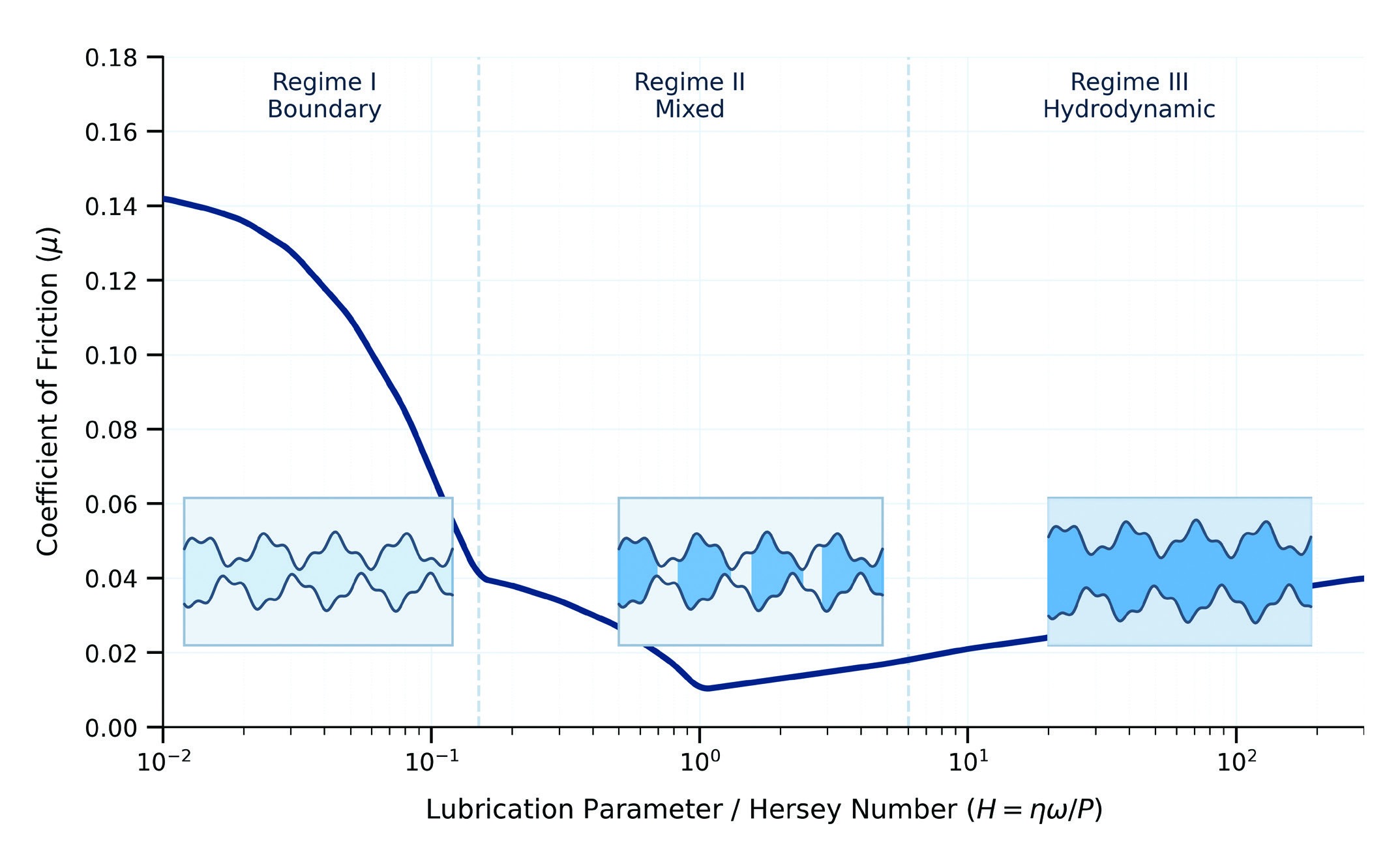 Figure 1. The Stribeck curve.
There are many reasons why a system may operate in the boundary or mixed lubrication regime, but the result is often the same: surface asperities come into direct contact, leading to elevated friction and significant wear. One common cause is operation under non-ideal speeds, loads or lubrication conditions, where the lubricant cannot be effectively entrained into the contact zone to establish a full fluid film. In other cases, the operating environment itself may preclude the use of conventional liquid lubricants, whether low viscosity oils or greases.
Extreme temperatures, high or low contact pressures or demanding operating speeds can limit the effectiveness of traditional lubrication strategies. Non-terrestrial environments, such as the vacuum of space, as well as radiation-intensive applications, present additional challenges where conventional lubricants may degrade, evaporate or otherwise fail to provide adequate protection. In these situations, direct asperity contact must be minimized through alternative means.
These are precisely the operating regimes where thin film coatings can provide an effective solution. By reducing friction, limiting wear and providing surface protection in environments where conventional lubrication is impractical or ineffective, thin film coatings enable reliable operation under some of the most demanding tribological conditions.
As the name of this technology,
thin film coatings, implies, this strategy uses a continuous layer or a coating that is considered thin in the realm of surface engineering. By definition these coatings do not exceed 10 micrometers; in some special cases they can be as thick as 25 micrometers but are often on the order of a few nanometers to a few micrometers, but most often 1 to 4 micrometers. Here in the U.S., since we unfortunately still use "standard" units of measurement, a convenient way to relate these thickness realms is to think about it on the order of a 10th of a mil or a 10th of a thousandth of an inch, or conceptually approximately a 10th of the thickness of a human hair.
These thin films typically work best if they are either lubricious, exemplify good wear characteristics and are well adherent to the surface of the material that needs to be protected. These films can be directly applied to surfaces prior to assembly, or they can be applied
in operando as a device or mechanism operates in its final intended state.
Direct application can be done by pure atomistic vacuum processing like physical or chemical vapor deposition, solution liquid coating, electrochemically or transformation processing.
In operando processing is how friction and wear modifiers in liquid lubes operate; on native machine element surfaces, a desired thin film of a useful compound is formed. Organic friction modifiers, which are highly polar, will attach easily to surfaces and subsequently provide a low shear thin film for asperities to slide on. Organometallic friction modifiers also create a thin film to cover asperities via operational decomposition and subsequent formation of lamellar structures also with low shear characteristics. Another
in situ method is known as tribocatalysis, where a catalyst such as copper is present on a functional surface, which under the right conditions of contact pressure will form thin films of carbon nano structures from available hydrocarbons.
4
So, the good news is that we have multiple strategies based on thin film technologies to fight friction and wear in extreme environments, whether these environments are intentional or non-intentional. By highlighting these strategies, perhaps we have answered the question posed by the title of this article, and we can say that thin films can in fact expand tribological performance in extreme environments. However, like most topics in materials science, the real answer is "it depends," implying that there are variables that need to be understood and also controlled. Let's start with environmental compatibility as an important variable; unfortunately there is not a single thin film that can satisfy all the requirements of a broad set of extreme environmental inputs. We may need wear protection or low friction or both and often need to prioritize based on a primary wear mode or primary environment. Luckily we have a broad base of interesting materials to choose from including lamellar structures like transition metal dichalcogenides (i.e., MoS
2 or WS
2), carbon, polymers, oxides, nitrides, carbides, fluorides or soft metals. Each of these materials will generally perform well and can equally perform poorly if used in the wrong environment. Thin graphite films can provide very low friction and wear if dangling carbon bonds are properly terminated, making terrestrial humidity a perfect environment for carbon films that can readily use hydrogen in humidity for bond termination. If we remove the source of hydrogen, the same graphite film becomes abrasive. Thin films of MoS
2 behave inversely; we can produce extremely low friction and wear in vacuum, but as soon as the environment becomes humid these films fail catastrophically. Metal nitrides have incredibly low wear rates but will buckle on soft substrates. To make the correct choice one must consult published literature for lessons learned and then verify experimentally with careful attention to covering all the operating regimes that an application may encounter.
A second important variable and consideration is the quality of the thin film. Quality encompasses several categories for both chemical and physical characteristics. Physical characteristics include the uniformity of the coating, the adhesion and cohesion, the hardness, elastic modulus and, of course, the friction and wear. Chemical characteristics revolve around the chemical composition of the as-deposited and also as-operated thin films. Thin films should provide a continuous layer with a measurable thickness often expressed as a range from minimum to maximum thickness. For directly deposited coatings representative test coupons are used to provide step heights from a masked region or cross-sectional techniques like full metallurgical cuts, calot grinds or ion milling, which can verify thickness and continuity requirements
(see Figure 2).

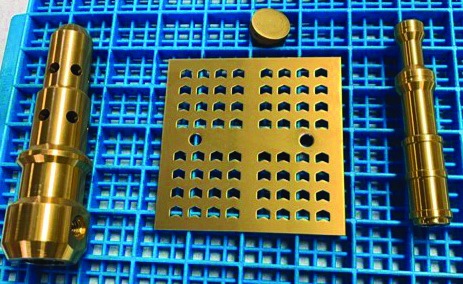 Figure 2. PVD titanium nitride thin film coated parts with test coupon.
Adhesion is of prime importance and most often depends on surface preparation and cleanliness of the substrate material to be coated. Part cleanliness prior to coating deposition is all too often not assigned as high of a priority as the deposition process itself and yet it is by far the leading cause of adhesive coating failure. As powerful as thin film coatings can be, they do not have any special abilities to perforate surface contaminations, organic or inorganic. These contaminations are best viewed as an already existing thin film and one that is not desirable for a given tribological application and therefore must be properly removed prior to depositing the desired thin film. Ultrasonic washes with multiple cascading rinses are the most effective and practical method to prepare parts for thin film deposition. Identifying the component's material chemistry, its manufacturing exposure history and any applied surface engineering or thermal processes, such as nitriding or heat treatment, enables the selection of an optimal cleaning strategy tailored to the coating application.
Cleanliness can be checked using a sessile drop tester which relates contact angle of a bead of fluid to surface energy; the flatter the bead the cleaner the surface is. Beyond this physical test, surface chemistry can be analyzed chemically by surface science techniques.
A well-prepared surface provides the highest probability for good thin film adhesion. Much like being able to verify surface cleanliness, it is important to be able to verify thin film adhesion. This is typically done on representative coupons that ride along with the coating process but can also be done on actual parts if cost and geometry allow. There are several common adhesion testing techniques, but the absolute most basic one is a simple tape test; one can apply pressure sensitive adhesive tape to the coating and then pull it off. The presence of coating material on the tape following testing is evidence of a serious adhesive failure at the coating-substrate interface or a cohesive failure within the coating itself.
Another qualitative assessment for thin film hard coatings is the Daimler-Benz indentation adhesion test.
5 This test applies a Rockwell C hardness indent to the coating and substrate system, and the severity of film cracking is assessed via a grading scale of 1-6, 5 and 6 being the most severe and considered adhesive failure. Another useful qualitative test is the calot test, which is primarily used for thickness testing, but can also reveal adhesive and cohesive film characteristics.
6 This is a ball cratering method that removes a small amount of the coating using an abrasive slurry and allows for a cross-sectional view of the coating with optical microscopy. Besides measuring coating thickness, the adhesive and cohesive nature of the thin film can be qualitatively assessed. A thin film adhesion test method that can provide quantitative results for adhesion and cohesion is known as scratch testing.
7 This technique applies a progressive load to a diamond stylus as it is dragged across the film and identifies cohesive and adhesive failure based on acoustic emission and changes in friction. These failures will occur at a given load expressed in Newtons, and these values can indicate how robust the film is. Thin film wear resistant coatings are often ceramic in nature and thus can fail via brittle fracture, thus balancing hardness to elastic modulus is important for wear resistance. The hardness and elastic modulus of the films can be checked using a nanoindenter
8 which applies a load through a Berkovich tip and analyzes the recovery by tracking force and displacement. Using a tribometer to measure a coating's wear rate and friction in a relevant environment can further elucidate the efficacy of a given coating and provide valuable insight into tribo-mechanical behavior.
Finally, the chemical composition of a coating not only needs to be properly matched to the intended environment but also needs to be verified. Techniques typically used for thin film analysis are spectroscopic techniques such as Fourier transform infrared spectroscopy (FTIR), X-ray diffraction (XRD), Raman spectroscopy, energy dispersive spectroscopy (EDS), X-ray photoelectron and Auger electron spectroscopy (XPS/AES) and glow discharge optical emission spectroscopy (GDOES). Film morphology and microstructure can be analyzed by optical or electron microscopic techniques. Each technique has its own set of benefits and disadvantages, and I plan to do a deeper dive in a future article.
In closing, it is clear that thin film coatings can significantly enhance tribological performance in extreme operating environments when all anticipated service conditions are carefully considered, and the physical and chemical characteristics of the coating are thoroughly verified. While the performance gains achievable from coatings only nanometers thick can be remarkable, their success depends on proper integration with the substrate material, component geometry, surface finish and operating conditions. When these foundational factors are overlooked or improperly specified, a thin film coating becomes little more than an expensive mistake and is often unfairly held responsible for failures that originate elsewhere in the system.
REFERENCES
1.
National Aeronautics and Space Administration (2020), "Technology readiness assessment best practices guide (NASA/SP-20205003605)," NASA Headquarters. Available at
https://ntrs.nasa.gov/citations/20205003605.
2.
OSD Manufacturing Technology Program (2024), "Manufacturing Readiness Level (MRL) deskbook," U.S. Department of Defense. Available at
https://acqnotes.com/acqnote/careerfields/manufacturing-readiness-levelmanufact.
3.
Jacobson, B. (2010), "The history of the Stribeck curve and ball bearing steels,"
Wear,
268 (11-12), pp. 1450-1452.
4.
Erdemir, A., Ramirez, G., Eryilmaz, O., et al. (2016), "Carbon-based tribofilms from lubricating oils,"
Nature,
536, pp. 67-71,
https://doi.org/10.1038/nature18948.
5.
VDI 3198, DIN 4856 or ISO 26443:2023
6.
ISO 26443, ASTM F1451
7.
ISO 20502:2016, ASTM C1624-22
8.
Oliver, W.C. and Pharr, G.M. (1992), "An improved technique for determining hardness and elastic modulus using load and displacement sensing indentation experiments,"
J. Mater. Res., 7, pp. 1564-1583, doi:10.1557/JMR.1992.1564.
Andras L. Korenyi-Both is Woodward Senior Technical Fellow Tribology at Woodward Inc. in Fort Collins, Colo. You can reach him at andy.korenyi-both@woodward.com.