HIGHLIGHTS
-
A series of steps known as switchable solvent selective extraction has been developed to directly extract lithium from brine mixtures.
-
Amines were used as switchable solvents with dipropylamine displaying the highest selectivity, and tert-octylamine the highest lithium yield.
-
The challenge in separating lithium from magnesium, which both have similar sizes and solubility properties, was overcome because these basic amines prompted magnesium to be separated by precipitation out of solution as the hydroxide salt.
The growing use of electrification in such applications as battery electric vehicles and energy storage systems is spurring higher demand for lithium. Lithium salts have been found to achieve high energy density, high power density and long cycle life. These are all essential characteristics of batteries.
The challenge is to find cost effective methods for extracting lithium from continental, geothermal and oilfield brines. Unfortunately, these brines contain complex mixtures that include metal salts such as sodium which are present in higher concentrations than lithium.
Dr. Elizabeth Dach, who completed her doctorate degree in the Department of Earth and Environmental Engineering at Columbia University in New York, N.Y., says, "There are two significant technical challenges that need to be overcome to extract lithium from nonconventional sources. Lithium is present in brines as a minor component often at concentrations that are between 1,000 and 10,000 times lower than competing salts. The other issue is that the concentration of lithium is often very low in unconventional brines, well below the approximately 500 ppm required for natural evaporation, which is the conventional method of lithium production from brines."
For extraction of lithium from continental brines in South America, natural evaporation of water is the prevailing technique which can take up to 18 to 24 months to concentrate sufficiently in ponds. Direct extraction of lithium is emerging as a viable alternative to be used to extract lithium from other ionic species without the use of evaporation.
An example of direct extraction of lithium is discussed in a previous TLT article.
1 Researchers developed a water stable aluminum-pillared vermiculite membrane containing a crosslinked structure that was able to isolate monovalent cations (sodium and lithium) from the multivalent cation (magnesium) by doping the membrane with sodium cations. To separate the two monovalent ions, the researchers adjusted the size of the transport channel in the membrane by adding more sodium cations. The result is the membrane pores decline in size allowing the smaller sodium cations to move through but holding the larger lithium cations.
Dach says, "There are a number of direct lithium extraction techniques which are based on ion-exchange, adsorption, membrane filtration, solvent extraction and electrochemical processes. Many of these technologies can handle low lithium concentrations, and significant progress is being made in the research and commercialization of several technologies. Two big challenges are separating lithium from magnesium cations and separating lithium from other singly charged cations such as sodium. Lithium and magnesium have similar sizes and solubility properties in aqueous media, and lithium and sodium have the same charge when dissolved in water, both challenges make it difficult to isolate lithium."
Dach and her colleagues are now introducing a new direct lithium extraction technique that is suitable for isolating lithium from brine mixtures.
Switchable solvent selective extraction (S3E)
The approach taken by the researchers was to take advantage of the ability of specific solvents that exhibit a change in affinity for salts based on water solubility and temperature. Dach says, "We found that lithium can be selectively recovered through a series of steps known as switchable solvent selective extraction (S
3E)
(see Figure 4). Initially, a less dense low-polarity switchable organic solvent and a higher density lithium containing brine (also including other metal cations) are mixed at a cool extraction temperature (e.g., 15°C -25°C) in step 1. A two-phase mixture is produced with lithium and water preferentially partitioning into the organic, switchable solvent phase in step 2
(see Figure 5)."

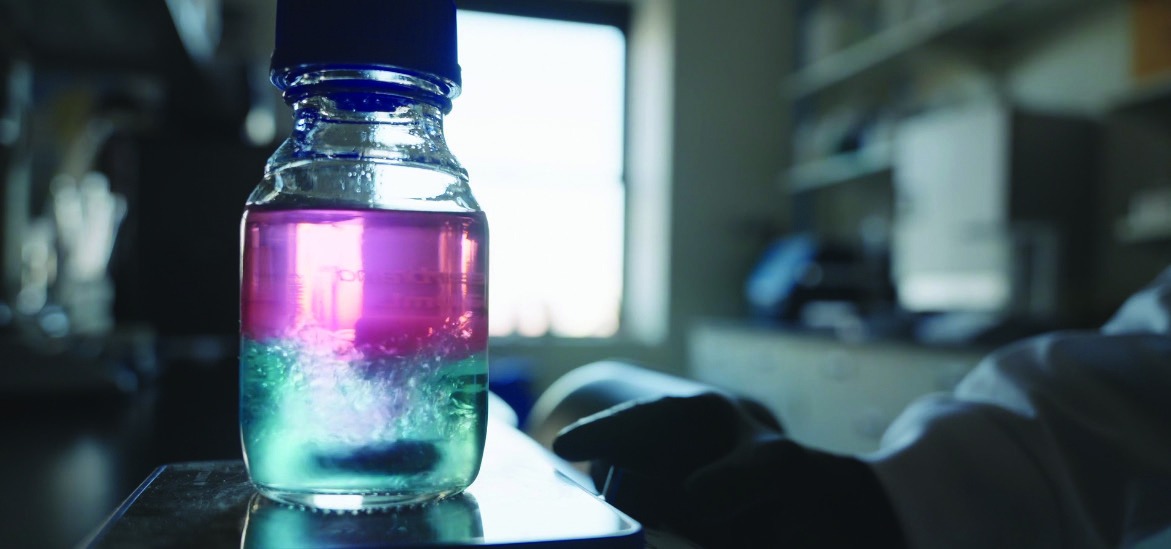 Figure 4. A two-phase mixture is formed in the second step of switchable solvent selective extraction. Lithium and water preferentially partition into the organic phase (upper, red phase). Figure courtesy of Columbia University.
Dach continues, "Lithium extraction is completed in step 3 by moderately increasing the temperature of the water-loaded organic phase (to approximately 70°C) which triggers the disengagement of lithium and water into a higher density aqueous phase. The small change in temperature facilitates the conversion of the switchable solvent from being hydrophilic to hydrophobic leading to the rejection of water and the lithium salts which move into a separate layer. The switchable solvent is then regenerated and can be reused. This small change in temperature makes S
3E feasible for commercialization."

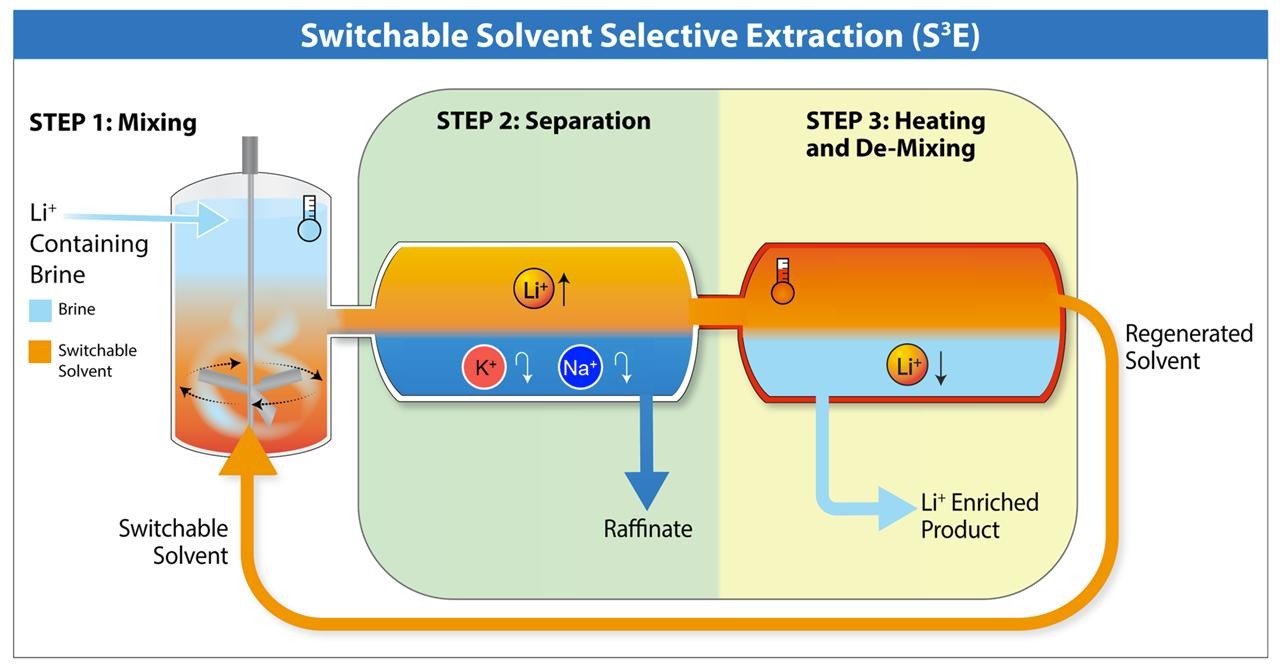 Figure 5. Schematic illustrating the working principles of switchable solvent selective extraction, S3E. A heavier lithium brine is mixed by density-driven countercurrent convection with a lighter low-polarity solvent that exhibits temperature-dependent ion and water solubility (Step 1: in-progress mixing). Ions, along with water, partition into the organic phase, with lithium preferentially extracted over competing alkali metal cations (Step 2: low-temperature settled biphasic mixture). A moderate temperature swing depresses the solubility of ions (and water) in the solvent (Step 3: high-temperature settled biphasic mixture), thus driving phase separation to yield lithium-enriched product and regenerating the switchable solvent for reuse in another process cycle. Figure courtesy of Columbia University.
The researchers identified amines as good switchable solvent candidates. Dach says, "We evaluated a series of amine structures for lithium yield and selectivity. While all amines showed selectivity for lithium over sodium, two amines stood out: dipropylamine exhibited the highest selectivity, and tert-octylamine displayed the highest lithium yield."
The use of amines as switchable solvents also proves to be beneficial in separating lithium from magnesium cations. Dach says, "Amines are basic, so when they are mixed with brines, the pH in the aqueous phase increases to approximately 10-12 (depending on the amine concentration). Magnesium cations are minimally soluble under these basic conditions and will precipitate out of solution as the hydroxide salt. Importantly, the amine is not consumed during the precipitation step and can be recovered during the temperature swing. The result is an efficient method for removing magnesium from lithium cations, which remain in solution."
Ultimately, the lithium cations selectively captured in the aqueous phase after step 3 will be isolated as a carbonate or hydroxide salt.
Dach indicates that a number of future steps can be taken to improve the S
3E process. She says, "We have ongoing work probing deeper into the fundamental mechanism of selectivity and the impact of extraction temperature, brine concentration, solvent-to-feed ratios and lithium-to-sodium ratios. The ability to tune these levers gives a lot of room to optimize for lithium selectivity and recovery yield and highlights the flexibility of the technology. Also, to date, we have used synthetic brine in evaluating solvents. A key next step is to conduct a study on a sample of a real lithium containing geothermal or oilfield brine to demonstrate S
3E under more realistic conditions."
Additional information can be found in a recent article
2 or by contacting Dr. Ngai Yin Yip, the La Von Duddleson Krumb associate professor of Earth and Environmental Engineering at Columbia University at
n.y.yip@columbia.edu.
REFERENCES
1.
Canter, N. (2025), "Lithium extraction using unique membrane technology," TLT,
81 (11), pp. 14-15. Available at
www.stle.org/files/TLTArchives/2025/11_November/Tech_Beat_II.aspx.
2.
Dach, E., Marston, J., Abu-Obaid, S., Peng, A. and Yip, N. (2026), "A novel approach for direct lithium extraction from alkali metal cations in brine mixtures using thermally switchable solvents,"
Joule,
10 (2), 102265.