HIGHLIGHTS
-
A method known as ABF-STIC (additive-free, brine discharge-free nanostructure-based direct interfacial solar-thermal crystallizer) has been developed to desalinate salt water by producing fresh water and salts.
-
The method utilizes the 'coffee ring' effect to move the salt and minerals into a position away from the superwicking black metal (SWBM) panel.
-
After successfully conducting the process in the lab, the researchers found that ABF-STIC did an excellent job of obtaining fresh water and separating salts from such sources as the ocean and the Great Salt Lake.
Freshwater remains a precious resource that is declining in supply as demand is steadily increasing for both consumer and industrial use. With the large quantity of salt water available from the oceans, the logical approach to deal with this issue is to find effective desalination approaches.
But the most widely available technique, reverse osmosis (RO), has been found to produce low recovery rates of fresh water and is energy intensive. Chunlei Guo, professor of optics and of physics and a senior scientist in the Laboratory for Laser Energetics at the University of Rochester in Rochester, N.Y., says, "The biggest issue is that RO generates large quantities of harmful brine, a mixture of concentrated salt and chemicals. Unfortunately, current desalination systems can discharge nearly half of the inlet water as waste brines to nearby water sources, injected underground or spread on land."
Coupled with finding better techniques for desalination is to identify ways to more effectively treat wastewater generated by industrial facilities. A recent TLT article
1 discussed an approach from removing hydrophobic materials from wastewater. Researchers prepared a water soluble metal-organic cage that is based on iron (II) and is in the shape of a tetrahedron. Initial testing on hydrophobic steroids that are found in wastewater successfully led to their removal. The steroids were trapped in the metal-organic cage because they have the right three-dimensional orientation and size.
An alternative to RO that was recently identified is solar-thermal interfacial evaporation. Guo says, "The problem for current solar-thermal interfacial evaporation was an extensive amount of salt clogging which required the use of water spraying before reuse."
Besides producing fresh water, a desirable method for treating ocean water must include isolating salts and minimizing brine formation. Such a technique has now been developed.
Nanostructured superwicking black metal panel
The researchers found that treating thin aluminum (200 micrometers thick) foils with single-step and scalable femtosecond laser processing produces a superwicking black metal (SWBM) panel that contains an array of parallel and micro-scale grooves and ridges. Guo says, "The net result is the formation of a superhydrophilic surface that readily attracts water. Treatment by the laser turns the aluminum surface black without the need for pigmentation."
When exposed to salt water, the superhydrophilic surface generates a superwicking effect that attracts and pulls a thin layer of water across the surface. In the presence of sunlight, the surface heats up evaporating the water. Concurrently, the remaining salt and minerals are deposited into the panel's untreated surface or "passive" region.
Figure 2 shows the effectiveness of the SWBM panel in the right image. In contrast, clogging is observed when using a conventional porous fiber-based wicking material
(left image).

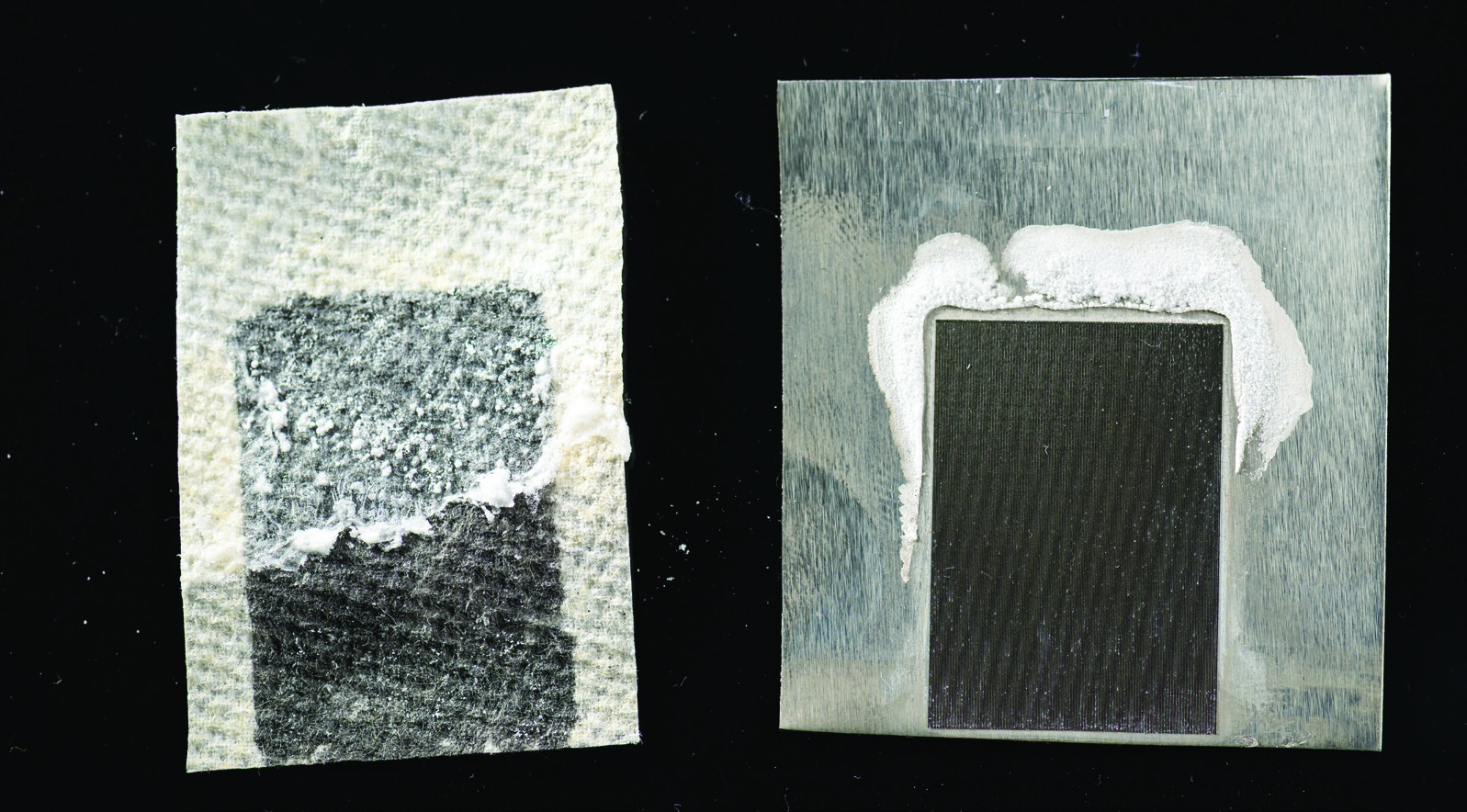 Figure 2. The effectiveness of the ABF-STIC process is shown by how effectively the SWBM panel on the right moves salt and minerals into the panel's untreated surfaces while clogging is observed in a conventional porous fiber-based wicking material on the left. Figure courtesy of the University of Rochester.
Guo says, "Our approach takes advantage of the 'coffee ring' effect to move the salt and minerals into a position away from the active section of the SWBM panel. Other benefits in our approach are that isolating fresh water, salts and minerals is conducted without the use of additives, no brine discharges and is self-cleaning. We have designated our method as ABF-STIC (additive-free, brine discharge-free nanostructure-based direct interfacial solar-thermal crystallizer)."
The researchers initially tested the ABF-STIC in the lab by mounting SWBM samples vertically on a crane structure and then lowering it to just touch the surface of the water sample. A high-speed camera recorded the rate of water running uphill through the SWBM. Depending upon the laser power used to produce the SWBM, the initial water velocity can be as rapid as eight centimeters per second with an average velocity of two centimeters per second.
Based on the success in the lab, the researchers next evaluated a series of samples from water sources such as the ocean, the Great Salt Lake in the U.S. state of Utah and solutions containing nickel sulfate and copper chloride wastewater
(see Figure 3). The ABF-STIC was run continuously over a 24-hour cycle including eight hours of solar irradiation and 16 hours of darkness. In all cases, the ABF-STIC did an excellent job of obtaining fresh water while depositing salts to the passive region.

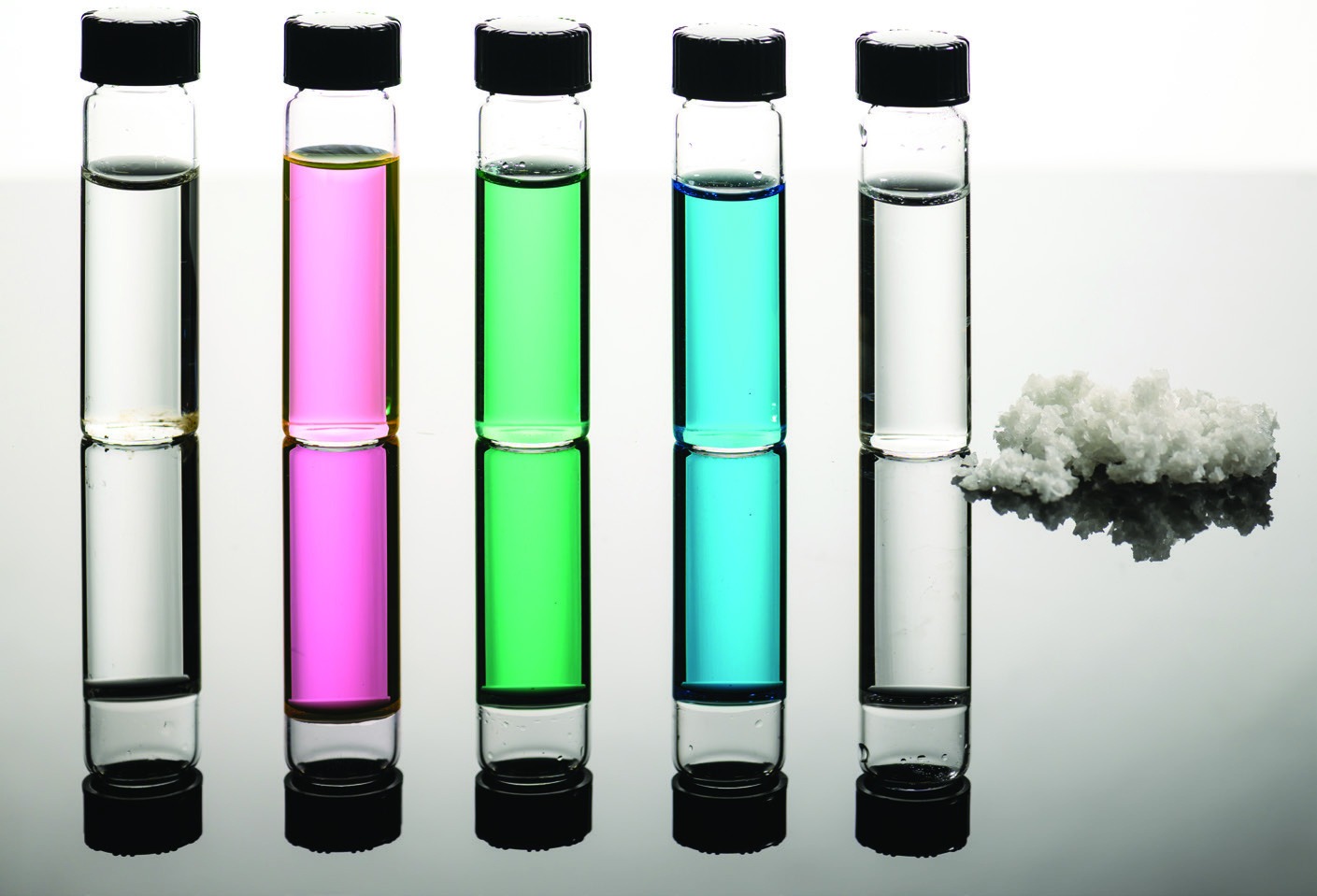 Figure 3. A series of samples from sources including the ocean, Great Salt Lake and solutions containing nickel sulfate and copper chloride wastewater were successfully treated by the ABF-STIC process. Figure courtesy of the University of Rochester.
Guo says, "We conducted durability testing by running this experiment for one week. Water evaporation and salt harvesting were stable throughout the test period. Nearly 100% of the salt harvested from the water was isolated."
Guo indicates that once the salt is pushed to the "passive" region of the SWBM, the researchers are able to scrape it off and collect it. He adds, "We believe that our method is inherently scalable and can be used commercially."
The ABF-STIC can be effective in treating any water source that contains water soluble minerals and organics. Guo says, "We can treat any industrial generated wastewater that has this characteristic."
A modification of this technique has successfully enabled the researchers to extract lithium directly from salt water. Placement of hydrogen titanate in the tiny grooves of the SWBM has facilitated isolation of lithium. In working with water samples from the Great Salt Lake, the researchers extracted about 50% of the lithium from the salts isolated during the desalination process.
Additional information can be found in a recent article
2 or by contacting Guo at
chunlei.guo@rochester.edu.
REFERENCES
1.
Canter, N. (2025), "Removal of hydrophobic materials from water," TLT,
81 (6), pp. 24-25. Available at
www.stle.org/files/TLTArchives/2025/06_June/Tech_Beat_I.aspx.
2.
Tang, L., Singh, S., Wei, R., Xu, T. and Guo, C. (2026), "Additive-free and brine-discharge-free solar-thermal desalination with simultaneous complete mineral mining from ocean water,"
Light: Science and Applications, 15, 246.
Neil Canter heads his own consulting company, Chemical Solutions, in Willow Grove, Pa. Ideas for Tech Beat can be submitted to him at neilcanter@comcast.net.