HIGHLIGHTS
-
A process has been developed to convert biomass into graphite and sustainable aviation fuel (SAF).
-
To facilitate the preparation of biographite, the PAH fraction produced during pyrolysis of glycerol was isolated, heated at elevated temperature to produce bio-coke, then underwent calcination and finally was graphitized in a furnace in a three-step process.
-
The bio-coke oil also isolated from the PAH fraction was hydrotreated to produce a hydrocarbon fraction that has a high concentration of cycloalkanes and is similar in composition to SAF.
Efforts to efficiently manufacture raw materials for use in sustainable transportation continue as a means to improve productivity and reduce costs. Biomass, a renewable raw material derived from plants and animals, has emerged as a viable feedstock.
Researchers have found that fast pyrolysis of biomass can lead to the production of bio-oil, which is a potential source of value-added chemical intermediates. In a previous TLT article,
1 fast pyrolysis was proposed in a theoretical study to be utilized to not just remove carbon dioxide from biomass through the formation of bio-oil but to plug the estimated 310,000 to 800,000 abandoned oil and gas wells in the U.S. The approach taken was to propose that bio-oil be produced in a network of small-scale pyrolysis biorefineries located throughout the U.S. Researchers estimate that between 1.7 and 2.1 kilograms of carbon dioxide per kilogram of oil could be removed.
Besides application as a solid lubricant, graphite has become a very important component as the active material in commercially available lithium-ion batteries. Production of graphite can be accomplished by natural means (extraction from geographically constrained deposits) and from high temperature processing of highly aromatic fossil carbons. Both pathways are hampered due to being expensive.
Another high-value product that is gaining in demand is sustainable aviation fuels (SAFs). A previous TLT article
2 discussed the preparation of SAFs from volatile fatty acids that are wet-waste feedstocks such as cheese, whey and brewery wastewater. An anaerobic submerged membrane digester is used to produce the volatile fatty acids which are then converted to SAFs through a sequence of catalytic reactions. This pathway was found to reduce greenhouse gas emissions compared to the conventional method for producing petroleum-based jet fuel.
Associate professor William Joe Sagues, principal investigator of the Biocarbon Utilization and Sequestration (BUS) Lab in the Biological & Agricultural Engineering Department at North Carolina State University in Raleigh, N.C., says, "Biomass-derived glycerol, a byproduct of bio-diesel production, is a promising feedstock for the synthesis of a bio-oil that contains large concentrations of the aromatic commodity chemicals benzene, toluene and xylene (BTX), and polycyclic aromatic hydrocarbons (PAHs). When subjected to Integrated Cascading Catalytic Pyrolysis, biomass-derived glycerol produces BTX and a second fraction known as non-BTX residues. The latter contains a high concentration of PAHs and an elevated oxygen content."
Non-BTX residues are difficult to process because they consist of high molecular weight components that have the consistency of tar, a thick viscous, sticky substance. Further efforts to directly convert non-BTX residues into value-added substances are limited because they are prone to charring according to Sagues.
Sagues says, "The difficulty in using biomass as a raw material in the production of biographite is that this natural material does not undergo graphitization at temperatures above 2,500°C in contrast to highly aromatic fossil carbons. Instead, heating at high temperatures generally leads to the formation of disordered hard carbon materials that exhibit lower crystallinity than commercial graphite."
Sagues and his colleagues have now developed a pathway to convert non-BTX residues into biographite without the need of a catalyst. The liquid hydrocarbon co-product has a composition that can be converted by hydrotreatment into SAF.
Three-step process
The researchers started by pyrolyzing glycerol to produce bio-oil with BTX and PAH. Once the BTX fraction was separated, the PAH oil was converted into biographite through a three-step process. Initially, the PAH oil was heated at 500°C for five hours producing a solid green bio-coke. The liquid condensate, known as coke oil, was collected and used as a feedstock to produce SAFs.
Calcination of the bio-coke was the next step and involved heating under nitrogen gas in a tube furnace at 1,000°C for four hours. Finally, the calcined bio-coke was graphitized under an inert gas in a furnace at 2,800°C for one hour. The resulting material was jet milled and compared to a calcined needle coke reference in battery testing.
The biographite was characterized by X-ray diffraction and Raman spectroscopy, which Sagues indicates are the two main approaches used. Battery testing in a half cell and in a full cell with an actual cathode produced excellent results in lithium-ion battery configurations. A 96.8% capacity rebound was achieved after high-rate battery cycling.
Sagues says, "The key challenges that need to be met in producing biographite are to reduce energy demand, be environmentally compliant and to reach a high purity level. In our approach, we have been able to produce biographite that can be used in battery applications without the need for a catalyst."
The percentage of bio-coke solid isolated from the first step of the process was 19.6% by weight. Coke oil represented 78.2% of the reaction yield and the researchers investigated the composition of this fraction to determine the potential for upcycling into a value-added derivative.
Hydrotreatment of the coke oil yielded an oil that contains cycloalkanes at a concentration above 80% with smaller percentages of aromatics, n-alkanes, isoalkanes and aromatics. A SAF fraction has a similar composition.
A simplified process diagram detailing the conversion of biomass into biographite and SAF is illustrated in Figure 1.

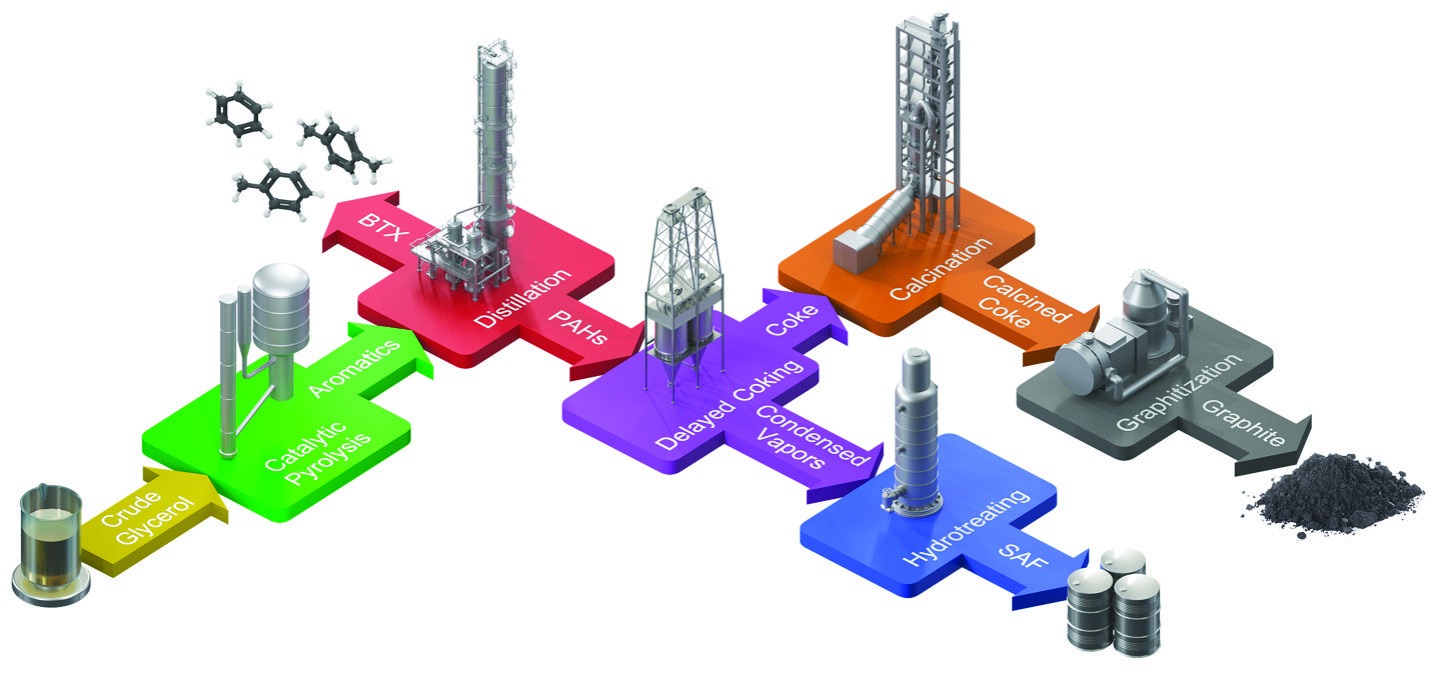 Figure 1. A simplified process flow diagram illustrates how glycerol is converted to graphite and SAF. Figure courtesy of North Carolina State University.
The appeal of this approach is that biomass-derived glycerol can be used as a starting material in a three-step process that has already proven to have commercial potential. Sagues says, "We intend to look at new biomass feedstocks to continue to identify and improve the effectiveness of this three-step approach."
Additional information can be found in a recent paper
3 or by contacting Sagues at
wjsagues@ncsu.edu.
REFERENCES
1.
Canter, N. (2026), "Carbon removal using biomass derivative," TLT,
82 (1), pp. 18-19. Available at
www.stle.org/files/TLTArchives/2026/01_January/Tech_Beat_III.aspx.
2.
Canter, N. (2025), "Sustainable aviation fuel from wastewater," TLT,
81 (3), pp. 18-19. Available at
www.stle.org/files/TLTArchives/2025/03_March/Tech_Beat_III.aspx.
3.
Lower, L., Rowland, S., Regula, M., Lisa, K., Combs, Z., Park, S., Vries, T., Nimlos, M. and Sagues, W. (2025), "Sustainable graphite and jet fuel from biorefinery residue,"
ChemSusChem,
18 (10), e202402509.
Neil Canter heads his own consulting company, Chemical Solutions, in Willow Grove, Pa. Ideas for Tech Beat can be submitted to him at neilcanter@comcast.net.