Thistle' do
By Hannah Musgrove, Contributing Editor | TLT Cutting Edge October 2026
Safflower seed oils are gaining traction (again) for reducing friction—and frying up dinner?

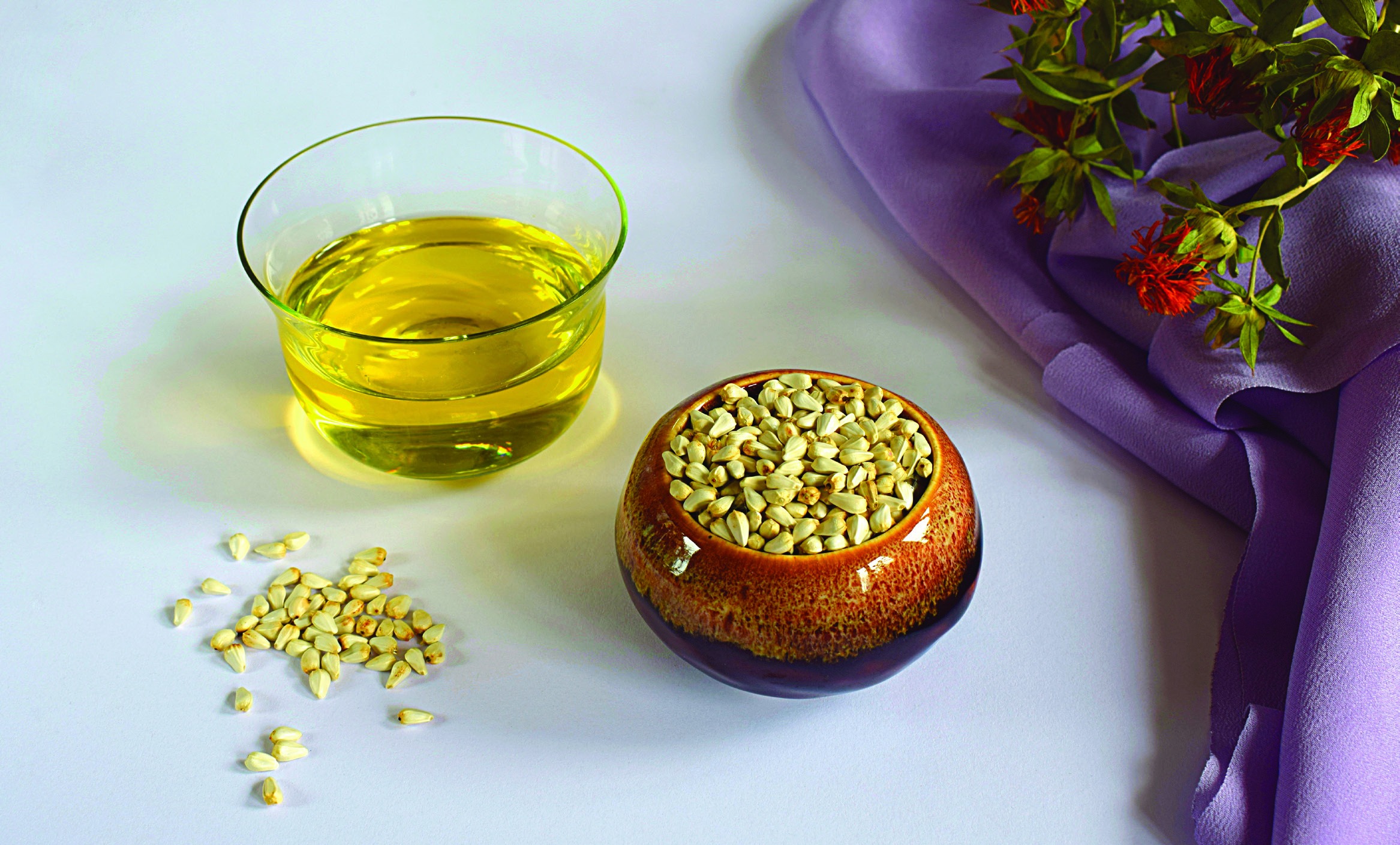
Safflower seed oil is having another mini moment as consumer demands shift slightly from calls for "no seed oils" to "more high-oleic and organic oils," especially for food and cosmetics. While the primary uptick for this oil is due to its debatable use in health and beauty spaces, it is also gaining renewed interest as an easy-to-generate resource for non-toxic lubrications and additives.
Safflower is a unique thistle plant with an ancient history as vibrant as its red, orange and yellow flowers. Various safflower parts were utilized as far back as 4,000 years ago in Egypt for applications in cloth dyeing, lamp oil and cosmetics.
1 As it spread around the world, safflower oils and seeds began to be used in medicine, feedstock and cooking.
1 Yet, the oil of safflower seeds was seen as a byproduct until recent years, due to improvements in extraction technology and research into its applications in health, beauty and other oil-forward fields. Thus, this vegetable oil is again being explored as a possible cost-effective, non-toxic ingredient for lubricants and engine oils.
The current characterization profiles of safflower seed oil are relatively similar to other vegetable oils, but the thistle seed may have some advantages. High-oleic safflower oil contains the highest percentage of mono-unsaturated fatty acids (~79%) compared to other common vegetable oils, such as sunflower and soybean oils.
2 With this composition, safflower oil can maintain a consistent viscosity over a wide range of temperatures. The oil also has a moderately high wettability, allowing for thicker film formations compared to synthetic counterparts.
2 Nevertheless, the oil on its own has a typical vegetable oil heat capacity, limiting applications of unmodified safflower seed oils to moderate temperature applications (e.g., cooking).
2 For this reason, we can find more insight into the oil from the food science field.
Recent work from Hou, et al. suggests that the extraction method of the oil can impact the oxidation stability, with subcritical fluid extraction yielding improved results over hot or cold pressed extractions.
3 This was correlated with composition changes, where linoleic acid content, phytosterols and tocopherols were all found to be greater with supercritical fluid extraction.
3 While this study was primarily aimed at increasing the nutritional value of the oil, the composition differences between methods is expected to impact tribological performance as well.
On the applied testing side, safflower oil was investigated as an engine oil additive at low temperatures, with 10%-50% safflower seed oil mixtures providing wear resistance for light engines relatively comparable to unmodified 15W40 oil.
4 However, there are still open questions regarding the ability to modify the oil's heat capacity, either by extraction or formulaic modifications. More discovery points include tribological characterization of the varied extracted oil compositions, investigating nanoparticle emulsions and exploring if safflower seed oils are an economically feasible option as a non-toxic additive in the first place. Certainly, the abundance, history and high oleic content of safflower give it a little leg up in the vegetable oil additive space (even though it rides the waves of unpredictable global trade).
In the meantime, safflower seed oil will more likely be an ingredient found in frying pans, vitamin capsules or organic moisturizers, but our journey to find new uses for the material will continue, as it has for thousands of years.
REFERENCES
1.
Pierce, S. (2022), "Learn about safflower history and uses," Gardening Know How. Available at
www.gardeningknowhow.com/tbt/safflower-history-and-uses.
2.
Saka, A., Abor, T. K., Okafor, A. C. and Okoronkwo, M. U. (2025), "Thermo-rheological and tribological properties of low- and high-oleic vegetable oils as sustainable bio-based lubricants,"
RSC Sustainability,
3 (3), pp. 1461-1476, doi: 10.1039/D4SU00605D.
3.
Hou, N.-C., et al., (May 2024), "Quality and active constituents of safflower seed oil: A comparison of cold pressing, hot pressing, Soxhlet extraction and subcritical fluid extraction,"
LWT,
200, p. 116184, doi: 10.1016/j.lwt.2024.116184.
4.
Sergek, B. and Özçeli̇K, A. E. (Dec. 2023), "Investigation of tribological analysis of safflower oil and 15W40 engine lubrication oil and their blends,"
IJEAT,
10 (2), pp. 92-102, doi: 10.31593/ijeat.1364708.
Hannah Musgrove is a postdoctoral researcher at Oak Ridge National Laboratory in Oak Ridge, Tenn. You can reach her at hmusgrove@outlook.com.