KEY CONCEPTS
-
Tribology plays a critical role in solar photovoltaic performance by improving the durability and long-term effectiveness of anti-soiling coatings.
-
The greatest challenge for anti-soiling coatings is balancing optical performance with the mechanical strength needed to withstand decades of environmental exposure.
-
Understanding and preventing cementation—the chemical bonding of dust particles to coated surfaces—will be essential for developing the next generation of durable photovoltaic coatings.
Solar power has become one of the world's lowest-cost electricity sources, but an often-overlooked tribological problem, dirt, continues to limit performance. Dust, pollen, salt, agricultural contaminants and industrial particulates accumulate on photovoltaic panels, reducing solar transmission, decreasing power output and increasing maintenance costs. In some environments, power losses can exceed 1% per day.
While anti-soiling coatings have traditionally focused on altering surface wettability through hydrophobic or hydrophilic treatments, newer research suggests that the fundamental challenge may not be keeping surfaces clean, but engineering surfaces with inherently low adhesion and high durability.
Tribology is playing an increasingly critical role in optimizing and improving power generation technologies: reducing friction losses, improving component wear/lifetime and developing high-performance lubricants.
Drew Fleming, associate professor of mechanical engineering, Arkansas State University, says, "I spent about five years working to develop high-performance optical coatings for solar photovoltaic (PV) applications before I took my current job
(see Figure 1). One of the most critical performance tests the coatings had to pass for market acceptance was IEC 62788-7-3, an abrasion standard specific to solar modules.
1 I had been trained in tribology during my doctoral studies, and while carrying out these tests, we noted a lot of similarities between the standard and some of the conventional tribology tests for measuring wear rate. In fact, some of our earliest 'proof-of-concept' tests to meet the IEC standard were performed on a conventional reciprocating tribometer."
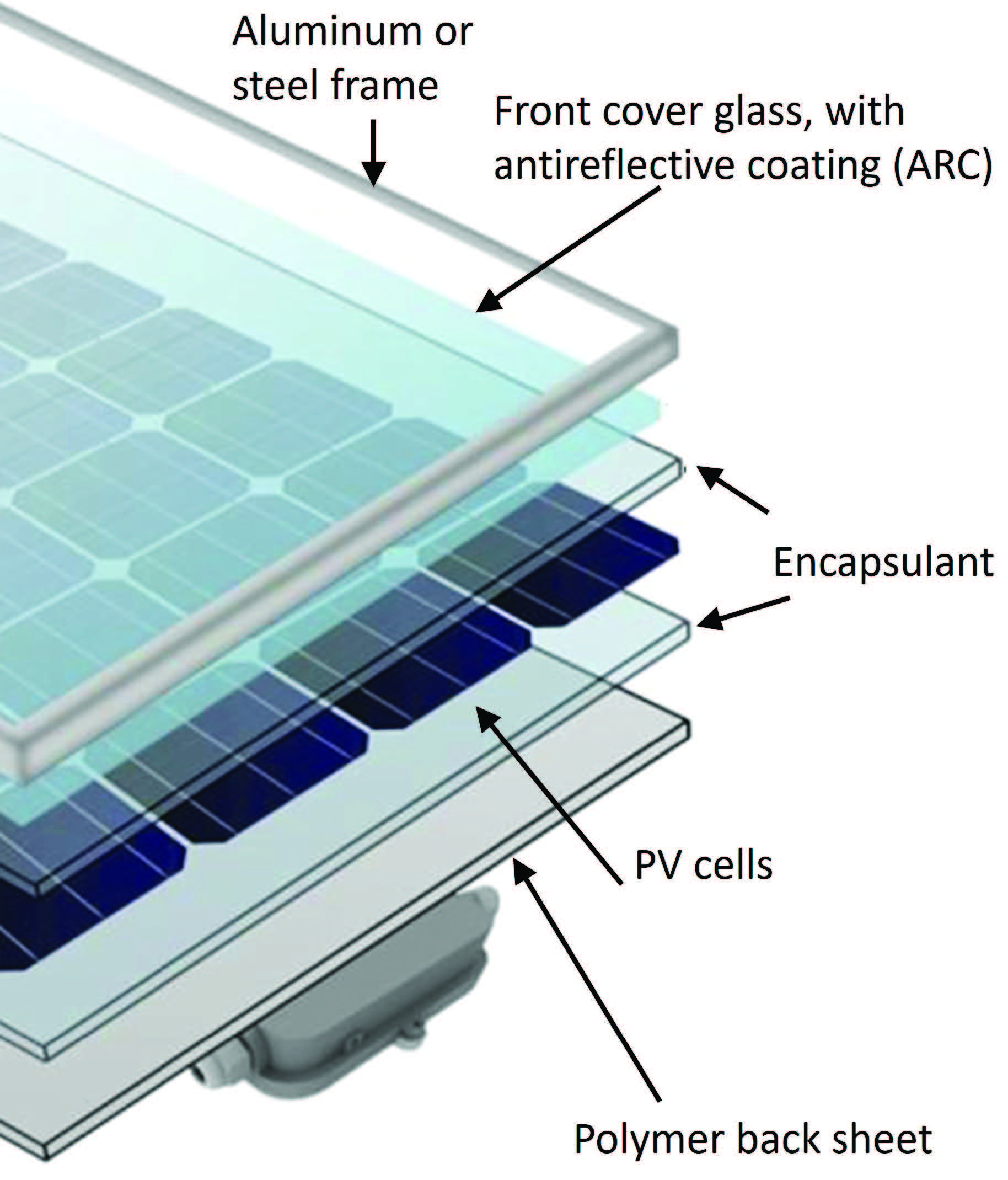 Figure 1. Structure of a photovoltaic (PV) module. Figure courtesy of Robert "Drew" Fleming, Arkansas State University.
This article is based on an ASME Tribology Division Webinar presented on Aug. 18, 2025, as an invited talk by Fleming. See Meet the Presenter for more information.
Tribology's pivotal role in solar photovoltaic performance
PV modules interact with the environment primarily through the front cover glass, which is typically a rolled, textured glass with low iron (Fe) content:
-
Bare glass reflects 4% of incident light from the front interface.
-
All commercial panels are manufactured with an antireflective coating (ARC) to reduce reflection losses, usually by about 1%-2%.
-
Nominal module lifetimes are about 25 years, with warranties that reflect this.
Since there are no surfaces in relative motion, no transient stresses and there is adequate cell isolation to protect from the environment, it's counterintuitive that tribology would play a role, but it does—a critical role in terms of the coating.
"Every solar module in production will have an ARC applied to it that ideally needs to remain functional for the entire 25-50 year lifetime of the module," Fleming says. "These coatings are very thin, usually about 100 nm (the diameter of a human hair is roughly 100 microns). Therefore, these coatings need to be highly wear resistant.
"The issue then is a tradeoff between optical performance and durability. The ideal index of refraction for a quarter-wave ARC on glass is about 1.22, which is smaller than pretty much all known solid, bulk materials. To improve the optical performance, the coatings are designed to be porous, and that porosity directly reduces the mechanical strength and durability of the coating."
Soiling: One of solar energy's biggest challenges
Soiling is ubiquitous and regionally dependent. Potential contaminants include dust, dirt, salt, pollen, mold, fungus, animal waste and agricultural matter. Accumulation of dust and particulates on the front cover glass of solar PV modules results in attenuated solar transmittance and decreased power output, more specifically:
-
Power losses exceeding 1%/day have been documented.
-
Soil composition and size distribution result in spectral filtering and angle of incidence effects.
-
There can be hot-spot generation due to spatial non-uniformity: non-localized, cell/backsheet/module damage.
-
Presence of particulate matter increases the risk of ARC damage during abrasive cleaning due to third-body wear.
The loss of device functionality that is incurred due to soiling of PV modules is a broad-ranging durability and reliability issue. "For utility scale, there is evidence in the literature of 1% power loss/day due to soiling in certain environments, which is substantial," Fleming points out. "The most severe soiling typically occurs in dry, arid regions (which incidentally happens to be where lots of solar installations are located because of the high solar yield). But soiling is pretty ubiquitous. Urban areas will have industrial soot deposits; there are areas in Japan that have issues with volcanic ash deposition; agricultural co-location will have more organic deposits, etc.
"If the soil accumulation has had enough time to cement to a level where removing it damages the underlying coating, that's the limit. PV installations have to balance the cost of cleaning versus the cost of lost production to set their cleaning schedules. More information about how often to clean to prevent cementation can help inform those decisions." When dust particles become chemically bonded to a surface over time they "cement" and are much more difficult to remove.
Up until now, soiling mitigation efforts have been limited to manual washing, which requires significant manpower, infrastructural costs and water consumption and carries the risk of third-body abrasion. Given this, there is an industry demand for effective, reliable anti-soiling coatings (ASCs)
(see Figure 2). Current strategy is to modify/functionalize the ARCs to reduce/eliminate particulate contamination, primarily by changing the way the coating interacts with water. These coatings are termed "water assisted ASC/self-cleaning coatings."
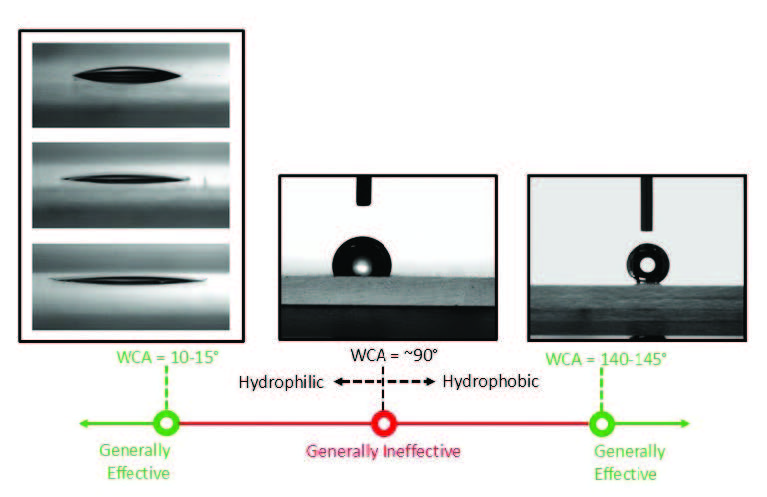 Figure 2. Contact angle regimes and anti-soiling effectiveness. Figure courtesy of Robert "Drew" Fleming, Arkansas State University.
ASCs and long-term durability
ASCs are generally acknowledged to be a hard problem without a perfect solution.
"An ideal coating needs good optical performance, high durability and high chemical stability; getting all three at the same time is easier said than done," Fleming warns. "Scientific literature may be making potentially unfounded correlative claims about wettability (e.g., superhydrophilic or superhydrophobic) resulting in self-cleaning behavior. You'll find lots of papers that claim anti-soiling (or self-cleaning) just from the wettability measurements, without formally characterizing the ability of the coating to shed dust or characterizing the mechanical adhesion.
"The biggest tradeoff right now is between the porosity needed to produce an optimal index of refraction and the corresponding reduction in mechanical integrity/durability. For industry adoption, the financial margins in solar coatings are very thin, which further complicates the engineering complexity."
Cementation: Its effect on coating performance
Cementation refers to complex chemical interactions between glass/silicate materials and mineral soils, mediated by temperature, humidity, dew cycling, pH, soil composition, specific surface area, etc.
"Cementation had been acknowledged as a detrimental mechanism earlier, but since it's time-dependent, it often would not show up in lab-based soiling tests," Fleming explains. "However, cementation has the ability to modify the surface chemistry of the coating (even if the bulk deposits are removed), and since surface chemistry influences soiling, we wanted to understand how.
"Humidity, dew cycling and a certain soil composition are necessary for cementation. There's not a single chemical mechanism, but having a soil composition with cementitious species is necessary (these are pretty common in mineral dusts). The humidity and dew cycling work together, firstly to produce condensation that leaches water soluble components from the dusts, and then the evaporation of the latent moisture leaves behind cemented deposits."
The fundamental interactions between environmental soils and functional coatings are still poorly understood. However, there is agreement that changing the surface wettability/surface free energy (SFE) is an effective way to reduce adhesion and surface chemistry and chemical interactions play a substantial role.
Artificially accelerated soiling and cementation experiments with standardized particulate dusts involves:
-
A library of standardized soils
-
Dew cycling experiments to induce cementation
-
A focus on the effects of surface wettability and surface energy and
-
Starting with bare glass controls
The following two candidate ARCs coatings have been evaluated:
-
Hydroxylated silica nanoparticles; nominally hydrophilic
-
Methylated silica nanoparticles; nominally hydrophobic
Both nanoparticle coatings have shown vastly reduced adhesion compared to bare glass controls; less dry adhesion means particles are easier to remove before cementation can even begin
(see Figure 3). However, this comes at the expense of strength; the porosity in the coating reduces the structural integrity, making it more prone to scratching, abrasions, etc. Tradeoffs can be a denser coating leading to the wrong index of refraction and the wrong spectral transmittance maximum.
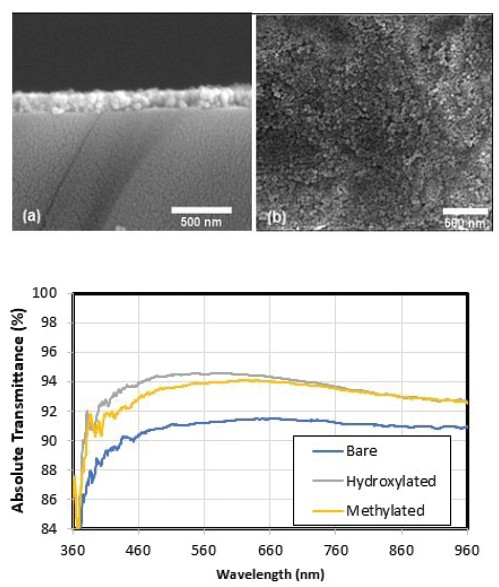 Figure 3. Structure of a functionalized nanoparticle coating. Upper left: cross-sectional view; upper right: top-down view. Lower image: Optical transmittance of a single-side coating on glass. Figure courtesy of Robert "Drew" Fleming, Arkansas State University.
The accelerated cementation chamber
Fleming and his colleagues developed an accelerated cementation chamber to facilitate coating development. "Early on, we realized that the changes in surface chemistry due to soiling were largely undetectable by more conventional chemical analysis techniques (namely, X-ray photoelectron spectroscopy)," he says. "Since the chemical stability is important for functional coatings for PV modules to last for the lifetime of the module and/or module warranty, we needed techniques with higher sensitivity. While at the National Renewable Energy Laboratory (NREL) Photovoltaic Reliability Workshop (PVRW), we made some connections some researchers at the SLAC National Accelerator Laboratory who had an interest in applying synchrotron measurements to PV materials.
"Near edge X-ray absorption fine structure (NEXAFS) spectroscopy is sensitive to the local bonding environment (not just what chemical species are present), and this gave us some unambiguous evidence that there were some small-scale changes in surface chemistry occurring.
"Modeling to understand this at the molecular level is ongoing. Synchrotron techniques were needed because the high X-ray intensity afforded by the beam line gave a much better signal-to-noise ratio to capture these changes in chemistry. We also performed small angle X-ray scattering (SAXS) at SLAC, where we were able to probe the internal porous structure of the coatings and showed that it was pretty robust in the presence of soiling (e.g., limited pore infiltration or surface damage)."
He adds, "We really just wanted a chamber where we could do the soil deposition at the same time as the dew cycling. The dew cycling is the more novel capability (but not necessarily unique to us). It was also important to have capabilities to accelerate the cementation process, since this happens slowly in the field.
"When performing the scratch testing and nanoindentation adhesion experiments, we could see that there is a lot going on mechanically, adhesion between particles/substrate, inter-particle adhesion/cohesion, the influences from the nanoscale surface roughness of the coatings, etc."
By accelerating a process that normally takes months or years in the field, the chamber gives researchers a powerful tool for understanding why coatings succeed or fail over time. Those insights will play an important role in developing the next generation of ASCs for PV applications
(see Figure 4).
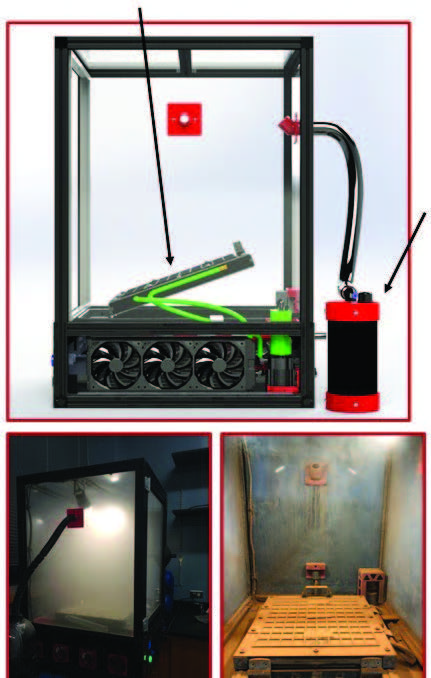 Figure 4. Design and operation of a soiling chamber. Figure courtesy of Robert "Drew" Fleming, Arkansas State University.
Evaluating solar coatings
Prior to 2022, the standard reliability metric for coated glass was EN 1096.2. EN 1096-2 is a European testing standard used to evaluate the abrasion resistance and environmental durability of coated glass surfaces. It covered artificial weathering and abrasion of coatings used in buildings, but it did not account for effects related to dust or cementation. It used a standard Taber reciprocating abraser: wool felt abrasive, 4 N normal load; defined pass/fail based only on optical transmittance, typically less than 0.5% reduction in transmittance after 1,000 cycles.
In 2022, IEC 62788-7-3 was released, aimed specifically at qualifying ASCs. Specific tests include:
-
Specialized brush abrasion testing, including dry dust or slurry abrasives
-
Falling sand test
-
Forced sand impingement
The test characteristics are coating thickness, visual appearance, surface energy/WCAs and surface. Roughness and optical transmittance is a much more robust test but very phenomenological and does not include effects of cementation.
Conclusion
While the research has improved understanding of the cementation process, Fleming believes it also highlights opportunities for tribologists to make significant contributions to photovoltaic technology. Many of the principles routinely applied to friction, wear and adhesion in traditional mechanical systems can also be used to improve the durability and long-term performance of ASCs.
The current paradigm of defining anti-soiling functionality in terms of surface wettability is insufficient. The goal should be to engineer surfaces with low adhesion with a focus on the following points:
-
Development of structurally robust, scratch-resistant, porous coatings
-
Usual solutions of coating densification or thicker coatings won't work
-
Contact mechanics/third-body wear of realistic dust compositions on glass surfaces; dynamic composition changes for water soluble versus insoluble species
-
Analogies to fretting, lubrication fundamentals, sliding wear, etc., to the mechanics of cleaning PV panels
Fleming says future work will focus on better understanding the fundamental interactions between dust particles and coated glass surfaces. By combining advanced adhesion measurements, surface chemistry characterization and synchrotron-based analysis with computational modeling, researchers hope to develop coatings that resist contamination, withstand years of environmental exposure and continue delivering maximum photovoltaic performance.
"The most important unanswered research question is the feasibility of retro-fitting existing modules with functional ASCs," Fleming concludes. "The development of highly wear resistant porous coatings (regardless of optical properties) would be a major advancement, especially if it could then be applied to optically transparent materials. There may be interest in having the tribology community contribute to the standards development of IEC 62788-7-3."
REFERENCES
1.
IEC 62788– Part 7-3:
Measurement procedures for materials used in photovoltaic modules – Part 7-3: Accelerated stress tests – Methods of abrasion of PV module external surfaces. This standard defines laboratory methods for evaluating how well the front surfaces of photovoltaic modules and their coatings withstand abrasion from particles and other wear mechanisms.
Jeanna Van Rensselar heads her own communication/public relations firm, Smart PR Communications, in Naperville, Ill. You can reach her at jeanna@smartprcommunications.com.