Bonus Content for STLE Members
20 Minutes With Dr. Vladimir Totolin
By Nicole Gleeson, Editorial Coordinator | TLT 20 Minutes September 2026
This R&D project manager discusses where surface science meets lubricant innovation - and tribofilms tell the truth.
Vladimir Totolin - The Quick File
Dr. Vladimir Totolin is an R&D project manager at the Freudenberg Group in Weinheim, Germany, where he leads multidisciplinary innovation projects focused on the surface and interface behavior of specialty lubricants. His work spans advanced lubrication for energy efficiency, material–lubricant interactions and tribological coatings used across diverse industrial applications.
He earned his doctorate in materials science from the University of Wisconsin–Madison in 2010 and has since built an international career with technical roles in the U.S., Austria, Spain, Slovenia and Germany. Dr. Totolin has published two books, more than 20 peer-reviewed articles and multiple conference papers in the fields of tribology, surface engineering and lubrication science.
In addition to his R&D leadership, he serves as a TLT Technical Editor and contributes to European innovation policy as an Independent Expert for the European Commission, supporting Horizon Europe research programs.

 Dr. Vladimir Totolin
TLT: How long have you worked in the field of lubrication, tribology and surface engineering, and how did you decide to pursue a career in this industry?
Totolin: I’ve spent more than 15 years in lubrication, tribology and surface engineering - but I didn’t start as a “tribology person” per se. My doctorate is in materials science from the University of Wisconsin–Madison, where my work centered on surfaces, interfaces and thin films. That training hardwired me to look at performance through the lens of interface phenomena, not just bulk properties. Tribology pulled me in with one simple question: what happens when two surfaces slide? The answer turned out to be far more exciting than I expected - complex tribofilms, chemical transformations, WS
2 sheets growing in real time. That mix of science and industrial relevance made this career an easy choice.
TLT: What has been your most rewarding accomplishment throughout your career in the surface technology and lubricants industry?
Totolin: One of the most rewarding accomplishments in my career has been advancing the understanding of how innovative lubricant additives interact with surfaces to form protective tribofilms. Throughout my work I have always been driven by the question of what actually happens at the interface during friction and wear. Delivering new insights in this area and translating them into practical industrial benefits has been especially meaningful.
A highlight of this journey was leading research on bio-inspired sulfur-containing additives, where we were able to visualize, at the nanometer scale, how these molecules transform under sliding to create low-shear WS
2 lamellae in mixed tribolayers containing tungsten carbide (WC) particles. The microscopy work shown here captures this perfectly: a tribolayer forming on a WC surface, and the emergence of solid-lubricant WS
2 sheets inside the film. When we correlated these structures with friction data, we saw dramatic reductions in coefficient of friction - particularly for allyl disulphide in PAO - demonstrating how chemical design and tribofilm evolution directly translate into performance gains
(see Figure 1).
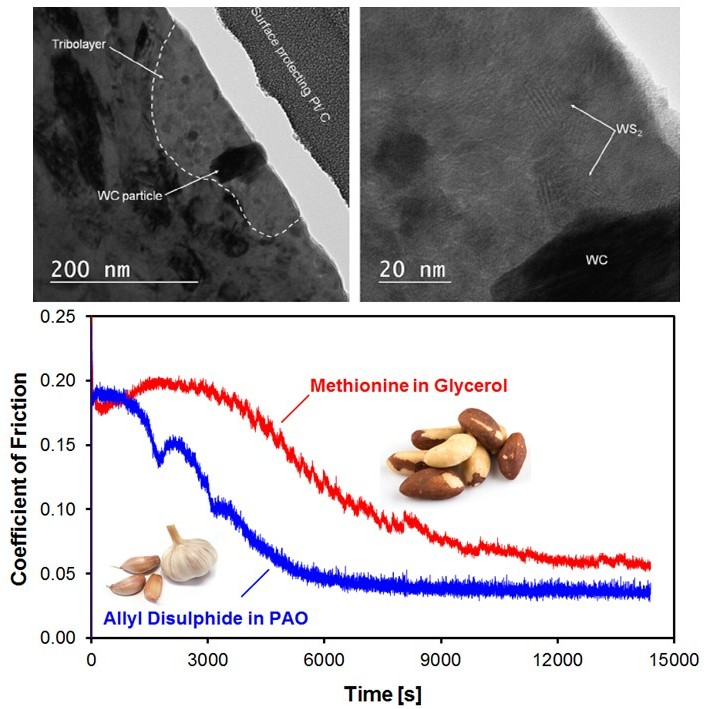 Figure 1. Tribofilm formation and friction behavior. TEM images show a WC-containing tribolayer (left) and WS2 lamellae within the film (right). The friction curves below compare methionine in glycerol (red) and allyl disulphide in PAO (blue), with the garlic-derived molecule in PAO delivering the smoothest ride. Adapted from references 1, 2 and 3.
What makes this accomplishment meaningful to me is not only the scientific insight but the impact. The work helped industrial partners understand the mechanistic pathways of their additives, guided the development of more efficient lubrication strategies and contributed to measurable improvements such as up to 67% friction reduction, enhanced wear protection and more energy-efficient components - outcomes that I continue building on in my R&D leadership role at Freudenberg.
Ultimately, connecting real-world lubrication challenges with nanoscale evidence has been the most fulfilling part of my career. Helping companies see
why an additive works - and how to make it better - is where surface science becomes both practical and powerful.
TLT: What kind of lubricant topics or problems are you currently dealing with?
Totolin: Right now, my work revolves around two major challenges that many industries are struggling with. The first is compatibility of specialty lubricants with elastomers and advanced coatings. As equipment becomes more compact and materials more sophisticated, even small incompatibilities can lead to swelling, softening, cracking or loss of sealing performance. A big part of my role is understanding how lubricant chemistry interacts with rubbers, polymers and surface treatments under real operating conditions - and then helping our partners select or design lubricant–material combinations that stay stable over long service lifetimes.
The second area keeping me busy is the search for alternative antiwear (AW) additive technologies. The traditional solutions are under pressure from regulatory, environmental and performance constraints, so we’re exploring new chemistries that provide strong wear protection without relying on legacy additive systems.
Both areas sit at the intersection of materials science, surface engineering and advanced lubrication, which is exactly what energizes me. The problems are complex, the mechanisms are subtle, and the impact on system reliability can be huge - so the work feels both technically challenging and highly relevant.
TLT: What is the No. 1 piece of advice you would give to a person who might be interested in starting a career in the surface engineering, tribology and lubricants industry?
Totolin: My biggest piece of advice is simple:
stay curious. This field rewards people who constantly ask “why?”: Why does this material fail? Why does this additive work here but not there? Why did two surfaces behave differently under the same conditions? My own career in materials science and surface engineering has shown me that the most valuable breakthroughs often come from questioning assumptions and digging deeper into mechanisms that others overlook.
Tribology, coatings and lubrication are uniquely interdisciplinary, and that’s what makes them exciting. You’ll move between chemistry, physics, materials science, mechanical engineering and even business decisions. If you stay curious - and stay open to learning across all these interfaces - you’ll find opportunities everywhere. It’s the mindset that has guided me throughout my career.
TLT: What do you think would be the major focus in the future in your area?
Totolin: The tribology and lubricants sector is moving toward cleaner chemistries, smarter materials compatibility and a deeper, mechanism-based understanding of surfaces. At the same time, new application spaces will shape the next decade: artificial intelligence (AI)-driven condition monitoring and formulation, new lubrication concepts for robotics and humanoid systems and electric vehicle (EV)-specific challenges such as high-speed bearings, e-motor lubrication and thermal management. In short, the future is about sustainable additives, durable material–lubricant pairs and solutions engineered for the fast-growing technologies that power modern industry.
REFERENCES
1.
Totolin, V., Rodríguez Ripoll, M., Jech, M. and Podgornik, B. (2016), “Enhanced tribological performance of tungsten carbide functionalized surfaces via in-situ formation of low-friction tribofilms,”
Tribol. Int., 94, pp. 269-278.
2.
Rodríguez Ripoll, M., Totolin, V., Gabler, C., Bernardi, J. and Minami, I. (2018), “Diallyl disulphide as natural organosulphur friction modifier via the in-situ tribo-chemical formation of tungsten disulphide,”
Appl. Surf. Sci., 428, pp. 659-668.
3.
Rodríguez Ripoll, M., Totolin, V., Bedolla, P.O. and Minami, I. (2017), “Methionine as a friction modifier for tungsten carbide-functionalized surfaces via in situ tribo-chemical reactions,”
ACS Sustainable Chemistry & Engineering 5, no. 8, pp. 7030-7039.
You can reach Vladimir Totolin at Vladimir.Totolin@Freudenberg.com.
LinkedIn: linkedin.com/in/vladimir-totolin-ph-d-3b21b119