Bonus Content for STLE Members
20 Minutes With Nick Garabedian
By Rachel Fowler, TLT Publisher/Editor-in-Chief | TLT 20 Minutes August 2025
This startup founder discusses data management and artificial intelligence in tribology.
Nick Garabedian - The Quick File
STLE member Nick Garabedian is the CEO of datin GmbH, a German startup empowering scientists to unlock the full potential of their research through data science and knowledge management. Before founding datin, Garabedian did his doctoral work in the group of Prof. David Burris at the University of Delaware, focusing on nanotribology and tribometer design. He continued as a postdoc in materials tribology in the group of Prof. Christian Greiner at the Karlsruhe Institute of Technology (KIT), where Garabedian received the prestigious Alexander von Humboldt Research Fellowship.
Garabedian’s passion for applying machine learning (ML) to tribological applications steered him toward developing methods that fully harness research data and scientific knowledge. He realized that scaling ML in tribology isn’t just a technological hurdle, such as the lack of infrastructure for big data management, but also a cultural one, concerning how organizations value domain expertise. He thinks that often the richest “database” of tribological knowledge resides in the minds and intuitions of individual tribologists. While seeking solutions to these challenges, Garabedian came across the concept of FAIR data (findability, accessibility, interoperability and reusability), which serves as a bridge for data collaboration and experimental reproducibility.
Driven by the belief that digitalization in tribology promises accelerated research and development (R&D) and shorter innovation cycles, Garabedian dedicates his efforts to collaborating with researchers across all branches of tribology who are open to this new form of digital collaboration. His ultimate goal remains unchanged since his initial foray into tribology: to enhance tribomaterial design and friction control by bridging our understanding of the molecular origins of friction with practical macroscale tribological applications.

Nick Garabedian
TLT: How long have you worked in a lubrication-related field, and how did you decide to pursue a career in the lubricants industry?
Garabedian: I first heard about tribology in 2014 while pursuing my doctorate degree in mechanical engineering at the University of Delaware. I was initially interested in fiber composite materials, but then Dave Burris emailed a few of us about a new project in his lab. After meeting with him, the choice was clear: tribology was the most interdisciplinary field I had encountered, even more so than composite materials, and that on its own was an opportunity and a challenge I was eager to take on.
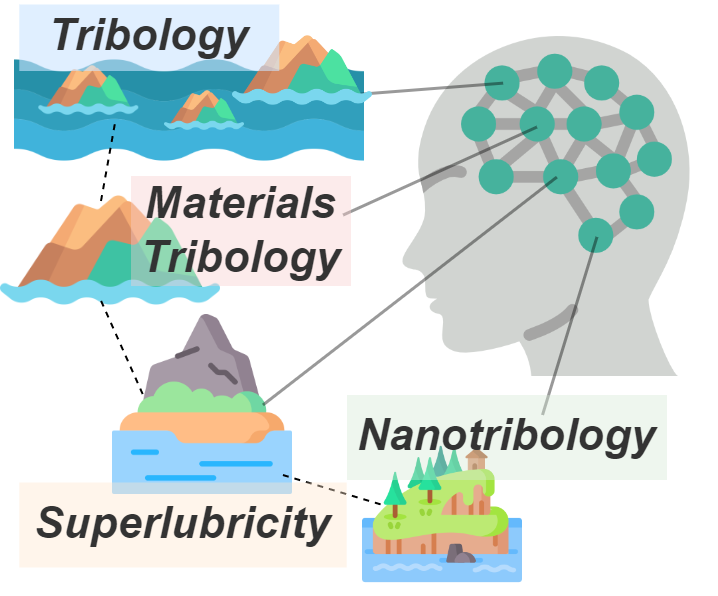 Figure 1. Today tribology is often a group of islands which precludes fast transfer of knowledge. Our field is so complex that the most scalable way to grow is via closer integration of sub-fields.
TLT: What has been your most rewarding accomplishment throughout your career in the lubricants industry?
Garabedian: Choosing just one is tough. Being part of the Nanotribology and Artificial Intelligence (AI) and Machine Learning technical committees for the STLE annual meetings has been incredibly enjoyable. Research-wise, the work on FAIR data we did was something I couldn’t have foreseen. It was particularly rewarding to publish a tribology article in Nature’s Scientific Data journal when they were averaging just one full article per month. Award-wise, receiving the STLE Early Career Award and the Elmer E. Klaus Fellowship Award stand out.
TLT: What is the No. 1 piece of advice you would give to a person who might be interested in starting a career in the lubricants industry?
Garabedian: Expose yourself to as many subfields of tribology as you can, actively engage with the community and choose a niche to master.
TLT: Throughout the different segments within your career, which one has been the most interesting, challenging and/or rewarding?
Garabedian: I believe the most exciting phase is yet to come. And, believe me, I’ve enjoyed every step of my career so far, but continually rediscovering the importance of tribology and feeling the community’s enthusiasm makes me even more excited about the field’s future.
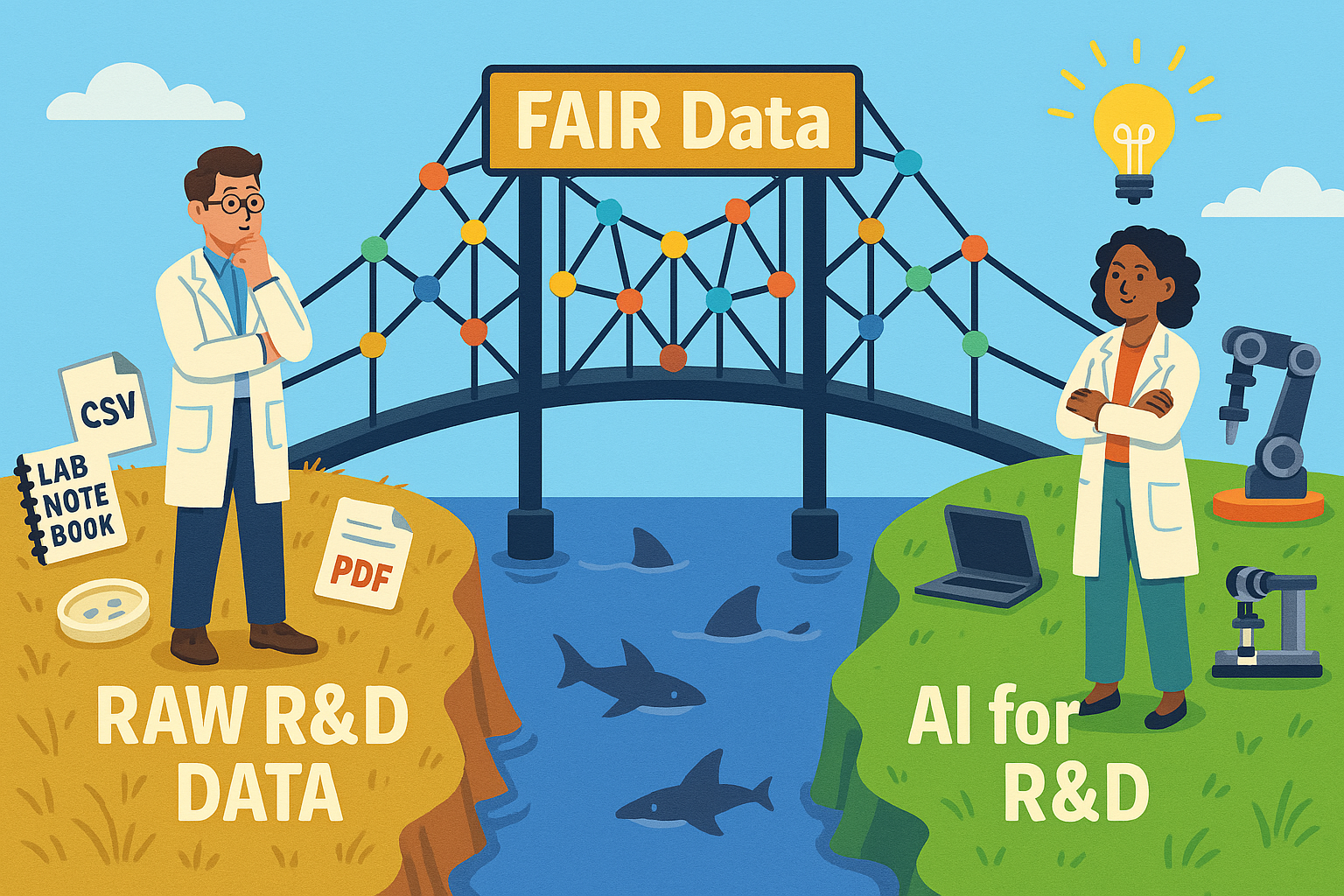 Figure 2. Almost all R&D progress is made without AI today. FAIR data is the bridge which brings every scientist, regardless of their background, to an AI-enabled workflow.
TLT: What are some of the most technical lubrication-based concepts or topics you have encountered throughout your career?
Garabedian: Although I haven’t worked extensively on lubrication in the classical sense (most of my research is in materials tribology), I’ve studied dry superlubricity and cartilage lubrication. It’s fascinating to see these areas, considered fundamental by some, pushing into practical load and length scales. Understanding how cartilage functions across various lubrication conditions offers a chance to revolutionize how we engineer lubricated systems. Nature designs the interfaces between bones with complex soft materials and lubricants, which is vastly different from industrial tribological systems that typically avoid soft interfaces. But even if we stick to hard interfaces, the advancements in superlubricity across different scales since the early 2000s are remarkable. Numerous groups are developing production techniques yielding materials that exhibit superlubricity. Coupled with new insights into the interplay between interface morphology and tribochemistry (and supported by data science techniques), I’m optimistic we’ll soon see tribological systems with extremely low friction and wear that can sustain these properties over long periods.
TLT: Why is collaboration important for solving tribology’s grand challenges?
Garabedian: I’m a firm believer in the power of communities, and I see collaboration as far more than a zero-sum game. In 2025, research isn’t about a single person finding a solution that impacts everyone. Most such discoveries have already been made. Instead, as tribologists, it’s our responsibility to combine fundamental knowledge and develop engineering systems that benefit humanity. Since engineering is often more subjective than the laws of physics, we need to gather as many perspectives as possible before building a solution. That’s the only way to ensure our individual work reaches the widest audience. And, perhaps needless to say, the domain knowledge in tribology is so vast that no single person can possess it all.
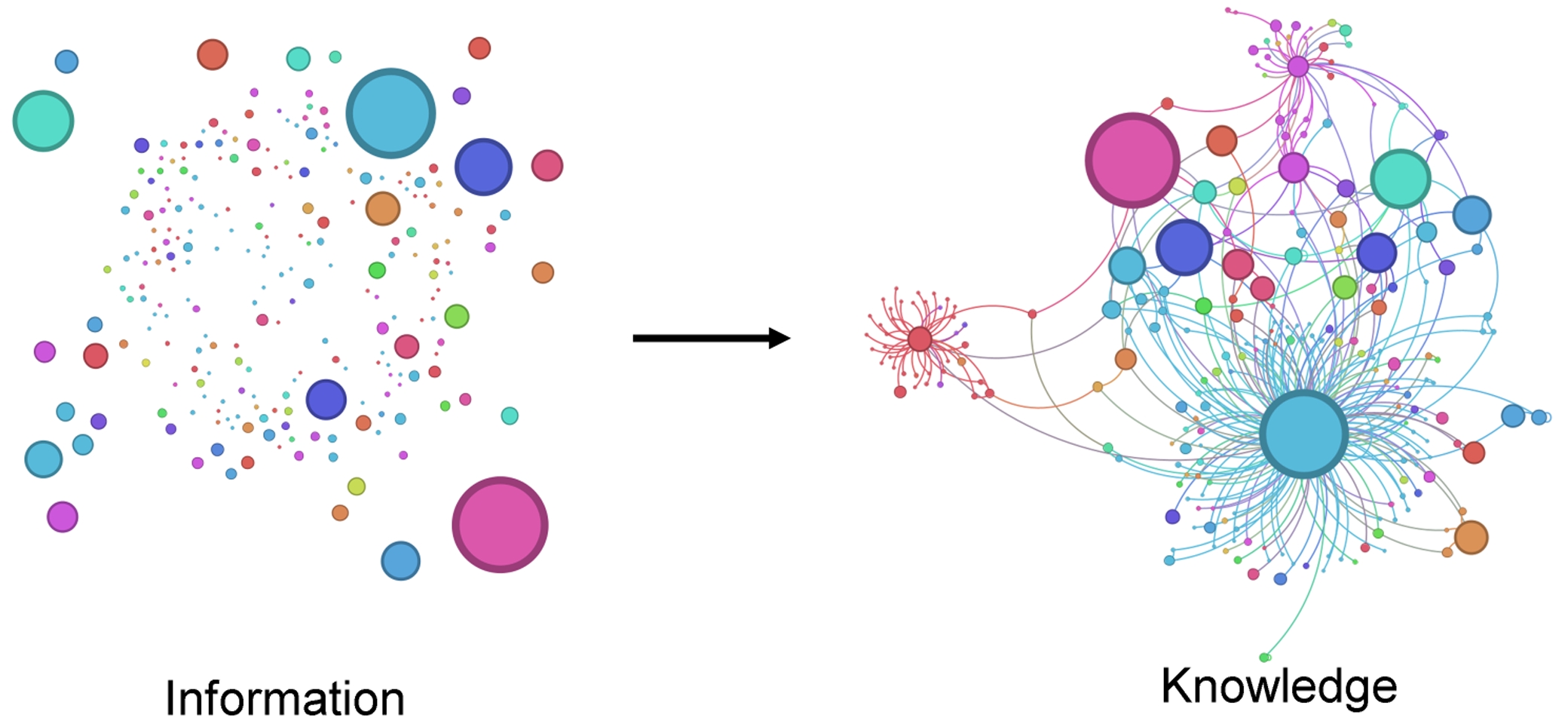 Figure 3. Perfect illustration of how currently disconnected pieces of information can form a digital network that can be used for discovery via pattern matching, something tribologists have long done analogously. Figure courtesy of Buehler, M. (2024), “Accelerating scientific discovery with generative knowledge extraction, graph-based representation, and multimodal intelligent graph reasoning,” Mach. Learn.: Sci. Technol., 5, 035083, https://doi.org/10.1088/2632-2153/ad7228.
TLT: What is the one thing you wish you would have learned earlier in your career?
Garabedian: I believe people learn new things only when they’re attuned to a particular issue, and that’s okay. However, some lessons are harder to grasp without guidance. I wish I’d known earlier just how many people in our community are willing to support others with their knowledge and experience. STLE plays a crucial role in fostering that dynamic.
You can reach Nick Garabedian at nick.garabedian@datin.io or on LinkedIn.