Bonus Content for STLE Members
20 Minutes With Hoon Kim
By Nicole Gleeson, Editorial Coordinator | TLT 20 Minutes June 2025
This research fellow at DL Chemical discusses lubrication fundamentals and his work in surface science.
Hoon Kim - The Quick File
STLE member Dr. Hoon Kim is currently research fellow for DL Chemical. His previous professional experience includes roles as application technology manager for Zschimmer & Schwarz, director of technology at Nanotech Industrial Solutions (NIS), innovation manager/senior principal R&D scientist at Chemetall-BASF, senior polymer chemist at Thermo Fisher Scientific, senior scientist at Amyris and research scientist at Lubrizol. He also worked as a scientist for Kumho Tire Co. in South Korea before moving to the U.S. He completed his doctorate degree in polymer science at the University of Akron.
Dr. Hoon Kim
TLT: How long have you worked in a lubrication-related field, and how did you decide to pursue a career in the lubricants industry?
Kim: I have been in the surface science/lubricant industry for 28 years working for various companies, including DL Chemical focusing on multifunctional oligomeric additive technologies; Zschimmer & Schwarz on biobased synthetic ester base oils and finished lubricants including biograde hydraulic fluids, transformer oils and electric vehicle (EV) lubricants; Nanotech Industrial Solutions (NIS) on water/oil-based nanolubricants and greases; Chemetall-BASF on nontoxic boron-free, biocide-free and chlorinated paraffin-free metalworking fluids (MWFs) and multi-metal corrosion inhibitor systems; Amyris Biotechnologies, Inc. on novel ecofriendly renewable base oils and finished lubricants; and The Lubrizol Corp. on high viscosity/high viscosity index (VI) synthetic base oils and multifunctional polymeric viscosity modifiers.
I completed my doctorate degree majoring in polymer science at the University of Akron, still well-known as the mecca of polymers and plastics technology, and gained robust ground on diverse polymer synthesis and applications with great passion for advanced polymeric material science. Six months before my graduation, I received three offers from different areas of adhesives, materials and lubricants, but I decided to join The Lubrizol Corp. in 2005 because I saw that opportunity as the best way to contribute to the polymer industry by introducing various multifunctional polymer technology to lubricant/tribology areas.

Hoon Kim in California.
TLT: What has been your most rewarding accomplishment throughout your career in the lubricants industry?
Kim: Throughout my career in surface science, I was able to complete multiple new product launches and achieve more than five patent applications, more than 15 publications, more than 30 presentations and five invited seminars by strong teamwork with diverse colleagues, raw material suppliers and customers. Above all, the most rewarding accomplishment would be the Frost & Sullivan Award in 2014 for innovative MWF and Boeing approval for chlorine/boron-free MWF development by introducing novel organic/inorganic hybrid corrosion/stain inhibitor systems during my work at Chemetall-BASF.
TLT: What is the No. 1 piece of advice you would give to a person who might be interested in starting a career in the lubricants industry?
Kim: Be bold to obtain hands-on experience by teamwork or collaboration, understand the gap between the lab scale development and customer site application and open your eyes and be the problem solver for customers rather than the problem finder in the lab. The company’s primary goal is to generate profits from customers. There have been numerous novel technologies developed in the lab, but not all of them have been successful for customers. Focus on customer pain, not on a small itch, and balance your lubricant formulation. Formulation is a blend of multiple performance components.
TLT: Throughout the different segments within your career, which one has been the most interesting, challenging and/or rewarding?
Kim: Collaboration has been challenging but the most rewarding. I believe one step of 10 people with low load would be more efficient than 10 steps of one person with high load. However, people are different in height, thus balance in stride length and step frequency of each team member is key for success. I have been working on various technical projects from customer troubleshooting (short-term), through new product development (medium-term) to new technology development (long-term). I learned the most important elements for the most effective collaboration or teamwork would be the passion and vision of the team leader for the project goal and the highly functional team members. Fast and clear transfer of passion and vision to each team member determines the project progress rate and success. I have been lucky to work for many successful projects with diverse business managers and technical service managers (TSM) for short-term projects, product managers and suppliers for medium-term projects and marketing managers and product managers for long-term projects.
TLT: What are some of the most technical lubrication-based concepts or topics you have encountered throughout your career?
Kim: Multifunctional polymer systems as lubricity enhancers, corrosion inhibitors, surfactants and hardwater stabilizers would be one of the most advanced technical concepts I have been working on. With this concept, diverse performances of finished lubricants could be optimized utilizing robust structure-property-performance relationship of tailor-made polymer systems. In this principle, polymer properties would be fine-tuned by controlling polymer structures including the backbone and side chain, and functional groups according to the desired performances of the finished products. The multifunctionality of the polymer system could minimize the mixing steps for final formulation by reducing the number of additive components resulting in low-cost single or minimum steps of the blending process. In addition, the ecofriendly nontoxic nature of most polymer systems could mitigate the long registration process of many individual functional additive components and alleviate the burden of costly registration expenses.
Another advanced technical concept could be organic/inorganic hybrid additive technology especially for anticorrosion and lubricity enhancement. In this concept, the inorganic part of the molecule strongly interacts with the metal surface while the organic part stabilizes the molecule in lubricant phase.
Nanosized inorganic solid particles could be one of the latest technical concepts, especially for high-performance grease applications under a broad range of lubrication conditions. In this application, the structures of inorganic solid particles are varied with different lubrication conditions, for instance, 2D versus spherical shape.
TLT: What is the one thing you wish you would have learned earlier in your career?
Kim: I wish I would have learned statistical design of experiments (DOE) and analysis of variance (ANOVA) skills earlier in my various lubricant formulation works. Since lubricant formulators deal with 10-20 functional components to optimize multiple performances of a single finished product, each component could be a factor affecting the diverse functions of the product. Thus, a new formulation development process could be a tedious and laborious journey. Having said that, use of a DOE process would provide many practical benefits for formulators minimizing the number of experiments, experimental cost and unwanted effects (or error) while maximizing information on the main effect, interaction between the different factors and correlation between factors and performances. Accordingly, formulators could speed up control of properties and performances through control of experiments by DOE. ANOVA helps formulators further fine-tune a variation of factors to optimize the final performances of the product.
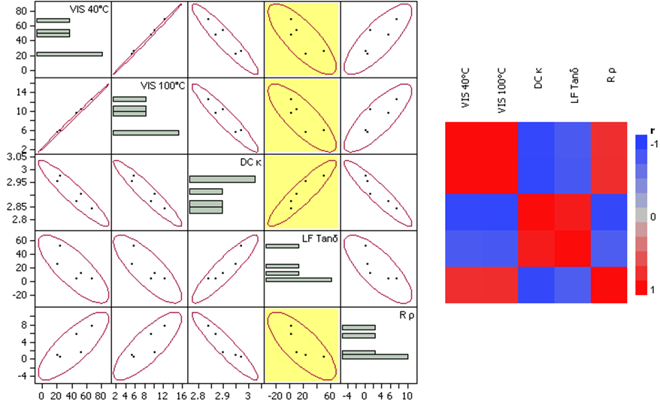
Correlation viscosity versus electrical properties.
TLT: What is the latest research and development topic you are focusing on?
Kim: With the advent of the EV era for the past decade, EV lubricants have been the latest crucial technical focus of the lubricant industry. Since electric cars run on a compact battery pack with high electrical energy density under a high-speed, high-load and high-temperature environment, EV lubricants require desirable electrical properties, low traction, better stability and better thermal control.
With that, synthetic esters and multifunctional additives could be the most promising EV lubricant components to accommodate those key requirements with their unique polar nature for proper/subtle balance between dielectricity, conductivity, fuel efficiency and durability. Along this line, my latest technical focus goes on developing and establishing robust structure-property-performance relationships of various synthetic polar additives in terms of the effect of their chemical and viscometrical properties on thermal control, electrical stability, fuel efficiency and durability performances to stand up for a zero emissions world.
You can reach Hoon Kim at hoon.kim@dlchemical.co.kr.