Bonus Content for STLE Members
Taming friction: The potential of ionic liquids in tribology
By Nicole Gleeson, TLT Editorial Coordinator | TLT Industry Insights March 2025
New research is addressing the challenges to using these liquid salts as lubricants.
Photo courtesy of Alvin Katek/Flickr, CC BY 2.0.
KEY CONCEPTS
•
Ionic liquids are liquid salts with unique and tunable properties that show potential as lubricants.
•
Challenges to using ionic liquids as lubricants include limited oil-miscibility, corrosivity, the presence of catalyst-poisoning agents, and costs.
•
Researchers have changed the synthesis procedure of a promising class of ionic liquids to address these challenges.
Meet the Presenter
This article is based on an Industry Insights presented by Filippo Mangolini on July 11, 2024, titled
Taming Friction: The Potential of Ionic Liquids in Tribology. Industry Insights is a monthly virtual event series available for free to STLE members. These events provide a forum for members to collaborate with STLE industry peers and experts on a specific topic who give a brief presentation, then facilitate conversation by asking discussion questions and providing actionable takeaways. For more information,
click here.
Dr. Filippo Mangolini earned his doctorate degree in materials science at the Swiss Federal Institute of Technology (ETH Zurich, Zurich, Switzerland) in 2011, after graduating from Polytechnic University of Milan (Milan, Italy) in materials engineering with the highest honor in 2006. Upon completion of his doctorate degree in 2011, Dr. Mangolini performed postdoctoral research at the University of Pennsylvania and then at Ecole Centrale de Lyon (Lyon, France). His postdoctoral research was supported by the European Union through a Marie Curie International Outgoing Fellowship and by the Swiss National Science Foundation (SNSF) through an SNSF Postdoctoral Fellowship. After two years at the University of Leeds (Leeds, UK) as a University Academic Fellow and Marie Curie Fellow, Dr. Mangolini joined the faculty of the Walker Department of Mechanical Engineering at The University of Texas at Austin in Spring 2018 as an assistant professor in materials science and engineering. He was recently promoted to associate professor with tenure (effective in August 2024).
Dr. Mangolini has received a number of international and national awards and honors for outstanding research and teaching achievements, including the 2022 American Society of Mechanical Engineers (ASME) Burt L. Newkirk Award, 2021 NSF CAREER Award, 2021 STLE Early Career Award, 2020 Dean’s Award for Outstanding Engineering Teaching by an Assistant Professor, 2020 Teaching Award from the Walker Department of Mechanical Engineering, 2018 Ralph E. Powe Junior Faculty Enhancement Award and the 2016 Mazzucotelli Award from the Italian Chemical Society. You can reach him at
filippo.mangolini@austin.utexas.edu.
 Dr. Filippo Mangolini
Ionic liquids (ILs) are salts that have melting points below 100°C. While most liquids are composed of electrically neutral molecules, ILs are composed solely of anions and cations. The unique and tunable physico-chemical properties of these “designer solvents” make them useful for a range of applications including energy storage, catalysis, chemical processing and lubrication. Dr. Filippo Mangolini focuses on the lubrication applications of ILs in his presentation. See Meet the Presenter for more information.
The unique physico-chemical properties of ILs include:
• Low vapor pressure
• High thermal stability
• Low flammability
• Good ionic conductivity
• Wide electrochemical stability window1-4
According to Mangolini, these properties have “opened the door for using ILs as green solvents in a variety of chemical processing methods as advanced materials. For example, in the pharmaceutical industry, electrolytes in energy storage devices as well as working fluids, including as lubricants.”
Lubrication mechanisms of ILs
When it comes to the lubrication mechanics of ILs, most of the work in the past three decades has focused on understanding what happens at the ionic liquid–solid interface upon confinement using the surface force apparatus (SFA). Mangolini explains, “This is a device that measures very accurately the separation between two crossed cylinders in the presence of ILs. The IL tends to be squeezed out discontinuously, in discrete steps.”
Mangolini continues, “The confined IL structure consists of alternating layers of excess cation density and excess anion density, and one squeeze-out event corresponds to the squeeze-out of an electroneutral ‘slab’ which can be considered, approximately, as two layers (one cation-excess and one anion-excess) together.” Research has shown that the friction response strongly depends on the number of layers; friction force increases as the number of layers decreases, but also the coefficient of friction increases as the number of layers decreases.5
SFA is limited to a maximum contact pressure of ~100 MPa. However, atomic force microscopy (AFM) allows for achieving higher contact pressures (as high as 7 GPa6), thus allowing for the in situ evaluation the lubrication mechanism(s) of ILs under contact conditions relevant to many tribological applications. Mangolini’s research group has studied what happens at the diamond-like carbon (DLC)/steel interface in the presence of a phosphonium phosphate IL by AFM.
“As we scan the central part at a very high load, we have the formation of a boundary layer a few nanometers thick, and in correspondence of the boundary layer there is a drastic friction decrease. This boundary layer is actually not the result of a chemical reaction but is due to pressure-induced change in the morphology of the IL,” Mangolini explains.
“However, this boundary layer is not mechanically stable, and at the nanoscale we have shown that if we increase the pressure above a critical pressure, in this case 5 GPa, we mechanically remove the boundary layer, which results in wearing the steel substrate. Surprisingly, though, we still observe a friction decrease due to the adsorption of phosphate ions on the metallic iron surface.”
He concludes, “The lubrication mechanism of ILs is very complex. It’s multifaceted. There are different mechanisms at play depending on the pressure and on the counter surface material.”
Limitations to use of ILs as lubricants
Despite the research advancements, there are still unknowns. Mangolini shares one of the major remaining questions, which is critical to rationally designing ILs: What is the dependence of the lubrication mechanism and performance of ILs on the IL molecular structure? Additionally, there are challenges to overcome the limitations to the use of ILs as lubricants, including limited oil-miscibility, corrosivity, the presence of catalyst-poisoning agents and costs.
Mangolini explains that most ILs are characterized by the presence of water, which can result in the formation of toxic and corrosive hydrogen halides (for the case of halogenated ILs). Most ILs also contain high levels of sulfur and phosphorus, which are detrimental for the catalyst in the exhaust aftertreatment systems. His research group is working to address these challenges.
One promising development is a class of ILs constituted of ammonium cations and orthoborate anions, known as alkylammonium orthoborate ILs (see Figure 1). Mangolini explains, “They have good hydrolytic stability, and they are very effective in lubricating steel–steel contacts. There are two challenges, though. One is still the limited knowledge of the dependence of the lubrication mechanism on the IL molecular architecture, while the second one is related to the negligible oil-miscibility of these ILs.”
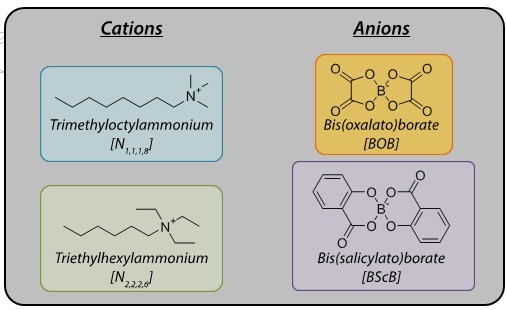
Figure 1. Cation and anion structure of alkylammonium orthoborate ILs.
Addressing limitations
To shed light on the effect of the molecular structure of ILs on the lubrication mechanism, Mangolini’s group changed the synthesis procedure, creating a series of structurally related ILs. In particular, the synthesis procedure was tuned to change the length of the alkyl chains attached to the ammonium cations, as well as the chemistry of the anion by changing the reactants. The lubricating properties of alkylammonium orthoborate ILs was found to strongly depend on the cation and anion structures, with steady-state friction response decreasing as the length of the alkyl chains in the cations increase.7-9 These ILs also exhibit low corrosivity. Mangolini explains, “There is a surface reaction of the IL as the coefficient of friction increases, which only happens when we use the IL containing the most symmetric ammonium cation.”
Based on these results, Mangolini’s group has proposed solutions depending on the type of ammonium cation. For the IL containing the asymmetric ammonium cation, “the strong van der Waals interaction between the akyl chains stabilizes a lubricious boundary layer, which is effective in reducing friction. This is in agreement with the pressure-induced morphological change of the confined IL we observed in AFM experiments.” For the IL with more symmetric ammonium cation, the reduction in the van der Waals interaction between the akyl chain does not create and stabilize this boundary layer; instead, “the hard–hard contact between the two steel surfaces in the presence of water results in the degradation and hydrolysis of the orthoborate anion, which results in the formation of borate esters which can absorb on the surface, and results in the formation of OH groups that can lead to the degradation of the ammonium cation.”
Mangolini summarizes: “By leveraging advanced characterization tools we can really understand the relationship between the structure of the IL, the lubrication performance and the lubrication mechanism, and ultimately we can come up with ways to rationally design the IL to prevent, for example, degradation of the IL or to improve fabrication performance.”
Oil miscibility
Negligible oil miscibility is another engineering challenge. Mangolini explains, “This is actually not a new problem. Most ILs have very poor solubility in nonpolar hydrocarbon fluids.” Some solutions proposed include creating oil–ionic liquid emulsions, lowering the concentration of IL in nonpolar base stock or using polar base stocks to increase the IL solubility. Mangolini’s group uses a different approach: “We took inspiration from the drug delivery approach, where the surface active ingredient is now encapsulated in a polymer shell. In our case, we hypothesized that the polymer shell breaks at the sliding interface when the 'active ingredient' is needed.”
Mangolini’s group is primarily focused on emulsion polymerization (see Figure 2), though they are doing work using other methods for encapsulating ILs as well. The capsules can be used in both polar and nonpolar base stocks, are stable and can lubricate really well under the boundary-lubrication regime. “If we use just the capsule as a control, it does not have any friction reducing ability compared to PAO. But when the capsules contain the orthoborate IL we synthesize in our lab, the coefficient of friction is remarkably low and stable for the duration of the test. Encapsulated IL is a good way to introduce IL in synthetic oil in a concentration that exceeds the solubility limit to reduce friction,” Mangolini explains.
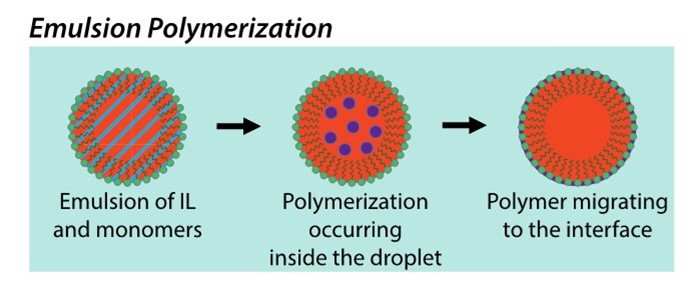
Figure 2. Emulsion polymerization process for ILs.
Corrosivity
Mangolini shares that the corrosivity of ILs is a significant problem and one that has been discussed extensively in the literature on the topic. “One of the reasons why this happens is because ILs are assumed to be pure or to have finite amounts of water. In reality, even in the case of hydrogen-free IL, the precursor salt contains halides.” The presence of water and residual halides can result in the formation of toxic and corrosive hydrogen halide. The challenge is to determine what concentration of halides is safe for a specific application.
Mangolini’s group performed a systematic study, starting with phosphonium phosphate and changing the deviation between phosphate and bromide anion in the IL in the presence of water. The tests were conducted at room temperature in the boundary lubrication regime. “When we have a zero volume percent of phosphonic bromide, so basically pure phosphonium phosphate, we have a coefficient of friction of around 0.10. As we increase the phosphonium bromide present into the mixture, the coefficient of friction surprisingly decreases. So, it appears that actually phosphonium bromide performs better than the phosphonium phosphate. However, when we look at the wear coefficient, we realize that similar improvement in wear behavior occurs.”
The results of the study show that phosphate anions act as corrosion inhibitors, so even in the presence of high amounts of bromide in an IL, the presence of the phosphate anions prevents pitting corrosion on the surface. Only in the case of pure phosphonium bromide was there significant pitting on the surface. Mangolini’s group then performed a counter experiment where they removed the water from the ILs, which prevented corrosion and confirmed the results of the earlier study. These results provide clues to strategies to design ILs and minimize their corrosivity.
Conclusion
Recent cutting-edge research has provided emerging knowledge on the interrelationship between the molecular structure of ILs and their behavior at sliding interfaces. “We can really get insights into the lubrication mechanisms using analytical tools to correlate the structure of the ILs with the lubrication performance and mechanism,” Mangolini concludes. Encapsulating the ILs is an effective way to reduce friction while minimizing some of the concerns about using ILs as lubricants. Open questions still remain, including how to overcome limitations due to costs; ILs are not the cheapest solution, but in recent years some cost effective options have been introduced. Mangolini is currently working on a project with Professor Iglesias (Rochester Institute of Technology) to explore the use of cheap bio-derived ILs based on amino acids.10
REFERENCES
1. Bermudez, M. D., et al. (2009), “Ionic liquids as advanced lubricant fluids,” Molecules 14 (8), 2888-2908.
2. Minami, I. (2009), “Ionic liquids in tribology,” Molecules 14 (6), 2286-2305.
3. Somers, A., et al. (2013), “A review of ionic liquid lubricants,” Lubricants 1 (1), 3-21.
4. Huang, G., et al. (2017), “Probing the lubricating mechanism of oil-soluble ionic liquids additives,” Tribology International 107, 152.
5. Smith, A. M., et al. (2013), “Quantized friction across ionic liquid thin films,” Physical Chemistry Chemical Physics 15, 15317-15320.
6. Gosvami, N., et al. (2015), “Mechanisms of antiwear tribofilm growth revealed in situ by single-asperity sliding contacts,” Science 348, 102.
7. Rohlmann, P., et al. (2021), “Boundary lubricity of phosphonium bisoxalatoborate ionic liquids,” Tribology International 161, 107075.
8. Smith, A. M., et al. (2014), “Molecular friction mechanisms across nanofilms of a bilayer-forming ionic liquid,” Physical Chemistry Chemical Physics 5 (22) 4032-4037.
9. Xiao, H., et al. (2011), “Film thickness of ionic liquids under high contact pressures as a function of alkyl chain length,” Tribology Letters 41, 471-477.
10. Available at https://dx.doi.org/10.2139/ssrn.5018372
You can reach TLT editorial coordinator Nicole Gleeson at ngleeson@stle.org.