Bonus Content for STLE Members
20 Minutes With Deepak Patil
By Nicole Gleeson, Editorial Coordinator | TLT 20 Minutes February 2025
This senior expert at Molex discusses the tribology challenges in the electrical connector industry.
Deepak Patil - The Quick File
Dr. Deepak Patil is the manager for the predictive engineering - tribology group in the transportation innovative solutions division at Molex LLC, Rochester Hills, Mich. In his current role, he and his group develop models to predict connector performance and enable design of high-performance products at low cost. The group focuses on studying the physics at the separable interface and crimp interface. Dr. Patil holds doctorate and master’s degrees in mechanical engineering from the University of Wisconsin–Madison. He received his bachelor’s degree in mechanical engineering from University of Pune. Dr. Patil’s doctoral dissertation focused on developing static coefficient of friction and damping predictive models. His areas of interest include tribology, contact mechanics, computational and structural mechanics. Dr. Patil has authored papers in leading tribology journals and has a patent for wear-resistant terminal fitting. He also has served on the prize paper committee and technical committee for the IEEE Holm Conference.

Dr. Deepak Patil
TLT: How long have you worked in the connector industry, and how did you decide to pursue a career in the field of tribology?
Patil: I have worked in the connector industry for over nine years. I joined Molex in March 2015 right after completing my graduate studies. I always wanted to be an engineer while I was in high school but did not plan to make a career in tribology. While pursuing my master’s degree studies I was primarily interested in computational and structural mechanics. As I was about to start my doctoral research, I had to change my advisor due to unforeseen circumstances. My new advisor had a background in tribology and had recently joined University of Wisconsin–Madison as an assistant professor. He offered me an interesting project which I felt was building on my existing knowledge but at the same time challenging me to expand my horizons, thus began my journey in tribology. Electrical connectors are not the first thing that come to your mind when one thinks of tribology. The tire industry, bearing industry and engine lubrication are some of the industries one normally associates with the field of tribology. But tribology is a multi-physics field with diverse applications, and electrical connectors happen to be one of those interesting and complex applications. Although not planned, I could not think of a better career fit.
TLT: What are the key challenges in the modeling of tribological behaviors of electrical connectors?
Patil: My work has primarily been in automotive connectors. Establishing a stable electrical contact and minimizing mate forces are the primary requirements for all automotive electrical connectors. When the blade or pin is inserted into a female receptacle, that interface is known as the separable interface, and that is where most of my responses will be focused on.
Within the automotive connector industry three primary metals are used as the top plating at the separable interface for the terminals, namely, gold, silver and tin. Of these three, tin is especially attractive for its low cost and corrosion resistance properties, and the industry has predominantly transitioned to tin plating in recent years. However, tin is very soft and can wear readily. Excessive tin wear can cause an increase in mate force and also can compromise electrical stability, both primary requirements of an electrical connector. Tin wear is a highly non-linear phenomenon and is extremely challenging to model. A slight change in initial conditions can significantly alter the final state of the interface. In addition, for an electrical connector, not only are you trying to predict mate force, but you also are trying to predict electrical contact resistance at that interface.
Summarizing what I have described above, the primary challenge with understanding and modeling the tribological behavior of electrical connectors is that it is an extremely complex multi-physics phenomenon. You are dealing with contact mechanics, tribology, electrical engineering, thermodynamics, material science and electrochemistry just to name a few. And if you are working with lubricated contacts, fluid solid interaction also needs to be understood and modeled.
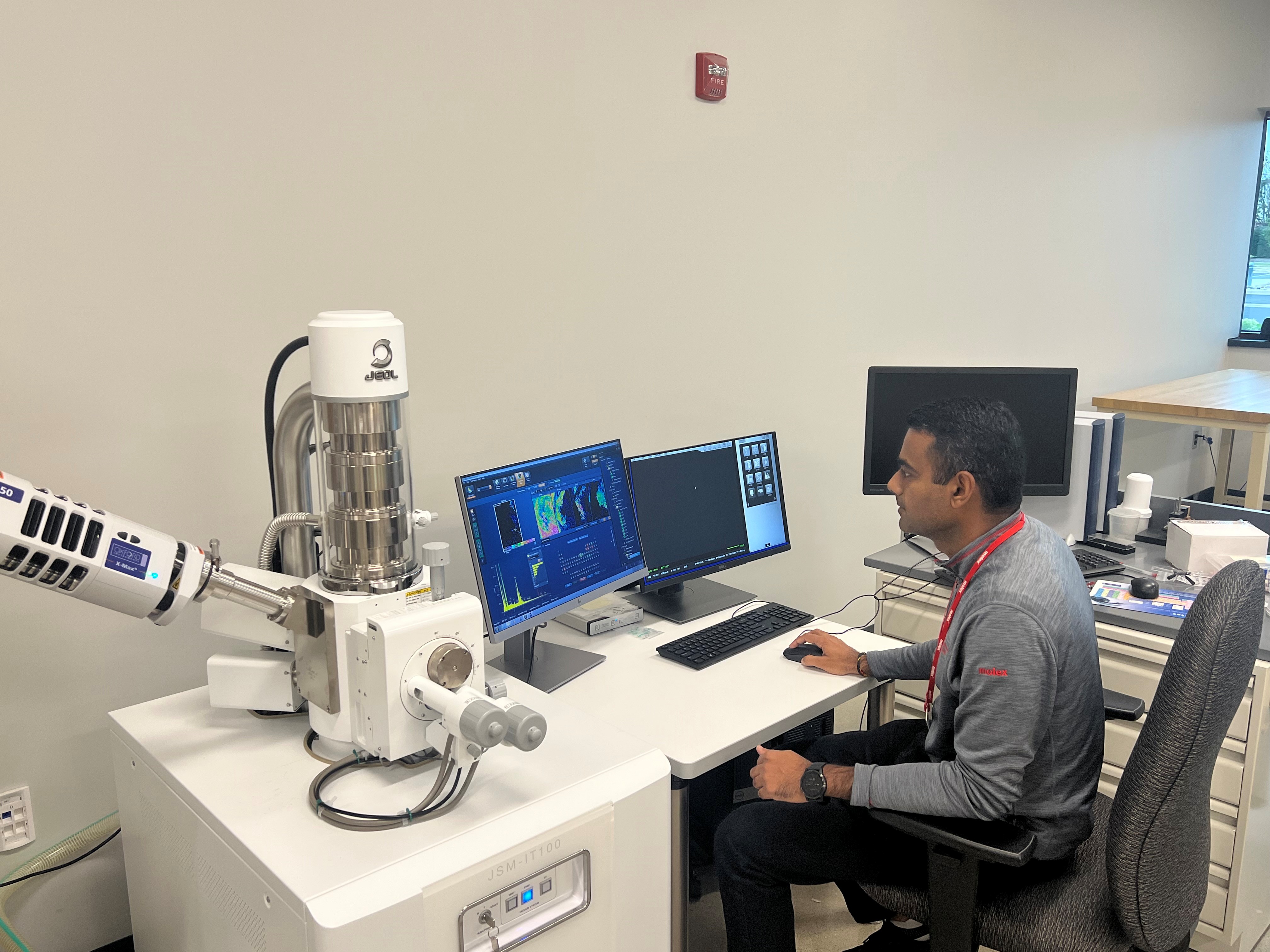
Dr. Deepak Patil performing surface analysis on an electrical component using SEM.
TLT: As the automotive industry is evolving, what role will tribology play in the next generation of electric connectors?
Patil: Tribology has a massive role to play in the next generation of electric connectors. Autonomous driving and electrification are mega trends in the automotive industry. The electrical content is rapidly increasing in the next generation of cars. However, cars are not becoming bigger or heavier. So, there is a need to fit these increased electronics in the same space without significantly increasing the weight. This is driving the miniaturization trend within the connector industry. The pins and receptacles are getting smaller, and more circuits are being fit into the same space. For example, if one goes from a 20-circuit connector to a 40-circuit connector, there are 20 additional pin-to-receptacle interfaces. If the friction coefficient is the same across all 40 circuits, the increased circuits will double the mate force and might not be an ergonomically acceptable solution. Unless the friction and wear at the interface can be reduced, miniaturization of the connectors won’t be feasible.
Another mega trend in the automotive industry is shared mobility. This trend demands cars to have increased life span, possibly doubling or tripling the number of miles from the current requirement. If the cars need to last for increased miles, the electrical connectors also need to last longer. Reducing the amount of wear at the interface will help provide robust performance through the life of the electrical connector. To meet the needs of the mega trends in the automotive industry, extensive research in lubricant and new plating material for electrical connectors is imperative.
TLT: What are the unique challenges in the electrical connectors that you would like the lubricant industry to address?
Patil: To meet the challenges described above, lubricant will be a key component of electrical connectors. Currently, the electrical industry relies on primarily hydrocarbon-based lubricants and fluorocarbon-based lubricants. Fluorocarbon-based lubricants and greases tend to provide better thermal stability and reduced friction coefficient especially while using certain type of thickeners. However, fluorocarbon-based greases also contain PFAS-based substances, which are currently under environmental scrutiny. Consequently, alternative lubricants need to be explored. Hydrocarbon-based greases (such as PAO) are likely to be more environmentally friendly compared to fluorocarbon-based greases. However, they tend to have lower thermal stability. The greases used in electrical connectors also need to be compatible with stamping oil and cleanliness process used in the manufacturing process of the terminals. There is a need for thermally stable, environmentally friendly lubricants which provides an adequate balance of lubricity and electrical stability.
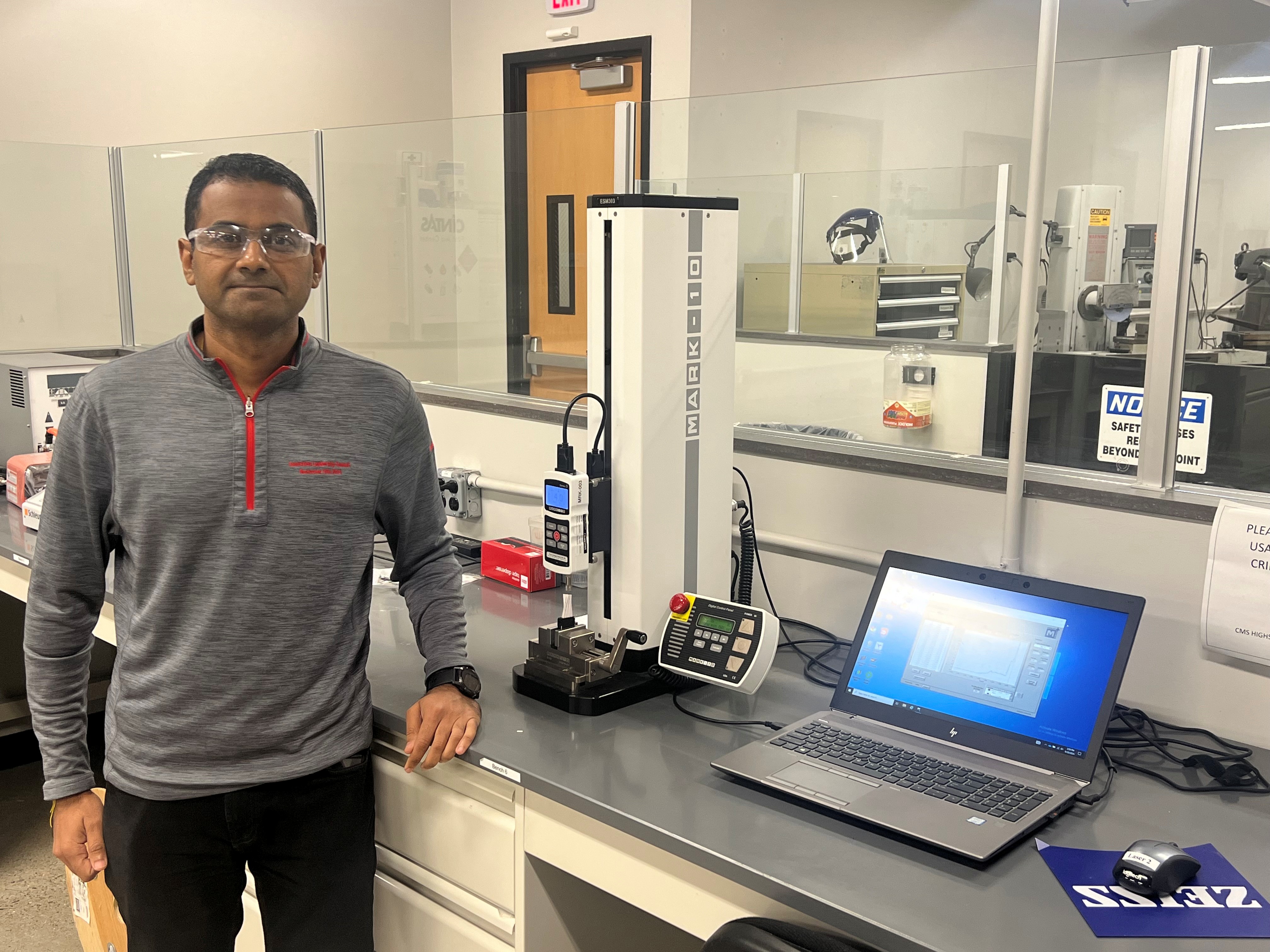
Dr. Deepak Patil standing next to a tester to measure mate force of an electrical connector.
TLT: How does computer-aided tribology help the connector industry?
Patil: Due to the complex multi-physics nature of the electrical connector interface, developing a model that can completely predict the mate force and electrical contact resistance of a connector will not be trivial. Having said that, some of the commercial computer-aided engineering (CAE) tools in the market already have robust contact algorithms. Although using these tools to model complete wear phenomenon has its own set of challenges, they can be used to understand the different wear mechanisms at play, which can then guide decisions on design parameters such as normal force, contact shape, plating type, plating thickness, lubricant, etc. Designing the connectors by incorporating the tribological behavior enables products with enhanced performance and reduced time to market.
TLT: What has been your most rewarding accomplishment throughout your career in the field of tribology?
Patil: As part of my thesis, I proposed a unified theory that explains the fundamental mechanisms during pre-sliding in both elastic and plastic regime. Previous theories mostly could explain either only elastic or only plastic regime. Under a set of assumptions the theory can predict friction coefficient under specific conditions. It serves as one tiny piece of the puzzle in the holy grail of coming up with a comprehensive predictive model for friction, something that gives me satisfaction.
However, in real world problems, a lot of the assumptions made while developing the theory and models don’t apply. Consequently, I had to shift my mental model to understand the complex tribological interactions between connector components. My focus was to understand the fundamental wear mechanisms at play and then develop techniques to minimize wear. This work resulted in a patent for wear-resistant terminal fitting. I would highlight this as the most rewarding accomplishment throughout my career in tribology.
TLT: What is the No. 1 piece of advice you would give to a person who might be interested in starting a career in tribology?
Patil: A piece of advice that I would give to someone who is thinking about pursuing a career in the field of tribology is to keep an open mind. I have come across many people who have not even heard the word tribology! And even when you explain what tribology is, which is the study of friction, wear and lubrication, it does not come across as a particularly interesting or glamorous field. However, tribology impacts our life every day in multiple ways, from walking to driving to swiping our fingers on a smartphone. As I have tried to emphasize throughout this conversation, it is a very complex area of research with no shortage of problems to solve! So, if you keep an open mind and are curious to learn and solve real-world problems, this is a very exciting field to make a career in.
You can reach Deepak Patil at deepak.patil@molex.com.