Bonus Content for STLE Members
Technology evolution in the transportation industry and the need for enhanced testing
By Nicole Gleeson, TLT Editorial Coordinator | TLT Industry Insights December 2024
Industry groups are responding to the evolving electric vehicle landscape by creating standardized testing guidelines.
Photo courtesy of Old Photo Profile/Flickr, CC BY 2.0..
KEY CONCEPTS
•
Some conditions in an electric vehicle (EV) drivetrain can be even more extreme than in an internal combustion engine (ICE), leading to new demands on fluids used in EVs.
•
Standardized fluid test methods are needed, but development is difficult and risky since the technology is still rapidly changing.
•
Meeting the demand for standardized test methods requires collaboration from industry producers, independent labs and test equipment organizations.
Meet the Presenter
This article is based on an Industry Insights presented by Greg Miiller on May 14, 2024, titled
Technology Evolution in the Transportation Industry and the Need for Enhanced Testing. Industry Insights is a monthly virtual event series available for free to STLE members. These events provide a forum for members to collaborate with STLE industry peers and experts on a specific topic who give a brief presentation, then facilitate conversation by asking discussion questions and providing actionable takeaways. For more information,
click here.
Greg Miiller has worked at an international level for the petrochemical industry over the past 28 years. With both scientific and advanced business degrees, his career progressed from engineer to vice president of new business and engineering for The Savant Group.
Miiller has been co-awarded 18 patents for designs on testing equipment and authored many technical papers. He is currently the 2nd vice chair of ASTM D02 and actively serves as an officer with standards development organizations such as The Energy Institute, the Coordinating European Council and the Society of Automotive Engineers (SAE). In 2019, Miiller formed the Global Lubricants Test Standards Team that provides a communication link between specification setting organizations, standards development organizations and trade organizations from around the world.
His background in quality assurance, “5S” and “5Y,” risk analysis, ISO 90001/17025 and customer satisfaction narratives have been instrumental in his growth as a company entrepreneur. Miiller is the founder or co-owner of four other companies within the U.S. You can reach him at
gmiiller@savantgroup.com.
 Greg Miiller
It’s an exciting time to be in the electrified vehicle (EV) industry. In recent years, EV technologies have advanced rapidly due to precision machining, lighter-weight materials, smaller motors and components and gas mileage improvements. More exciting developments are on the horizon, including turbo-charger improvements, hydrogen as a fuel source and retrofitting diesel engines for heavy duty applications. These advancements are driving demand for base stock and additives that can perform at higher levels than ever before. Cooling and lubrication are particularly important for EV technologies, and many conventional fluids cannot meet these high demands, requiring new formulations. However, the rapid pace of EV development can pose some risk for a formulator. According to Greg Miiller, changes are currently happening every week in the EV industry.
Industry groups are responding to the evolving EV landscape by creating standardized testing guidelines. One of these guidelines is SAE J3200: Fluid for Automotive Electrified Drivetrains. Miiller, who serves on SAE Technical Committee 3 (TC3) and helped develop SAE J3200, explains: “We set up the areas that we were concerned about, and then we looked at tests under those categories, albeit engine tests or bench tests, to see what is available.”
The areas of concern identified by SAE TC3 include:
• Electrical properties
• Heat transfer characteristics
• Corrosion
• Material compatibility
• Oxidation
• High speed aeration
• New wear concerns1
The collaborative efforts to address these areas of concern include industry companies working on in-house testing, independent laboratories working on test development and test development organizations. The group considered existing tests that addressed these issues, knowing that new tests would be in development concurrently and that standardization will be a constant work in progress if EV innovation continues at the current pace.
The tests selected by the committee include:
• Wire Corrosion Test
• Conductive Deposit Test
• Electronic Erosion/Pitting Test
• Fast FZG High Speed Wear
• BatteRig E-Fluid Testing
• ATF DEXRON aeration test
• EV Foam and Aeration High Speed Mechanical Test
• Materials Compatibility New Bench Test
Wire Corrosion Test (WCT)
Corrosion concerns occur in motors and electronic components when they are exposed to the drivetrain conditions and the selected drivetrain fluid. Miiller says, “We do have some issues with the fluid being immersed, sprayed or exposed to lubricant vapor, leading to the potential for corrosion in the system, but also conductive deposits.” Corrosion can form in electronic devices or components, such as wires and traces, motor windings, connectors and other electrical components. It also can affect traditional metallic surfaces like bushes, washers and bearings, especially in areas with small gaps. The WCT is a powered corrosion test that monitors current change over time. The setup involves a board with copper windings on the top and bottom, with separate wire loops in the fluid and vapor spaces. The copper wire is powered with a very low voltage and the rate of change in copper loss is continuously monitored. Copper loss leads to increased resistance, and the diameter of the copper wire is changed. It was first used in the industry in 2019, so a large quantity of data has already been collected. WCT is a very effective, accurate, repeatable test of fluid performance over time. Figure 1 shows a graph depicting the rate of change in copper loss over time as monitored by the WCT.
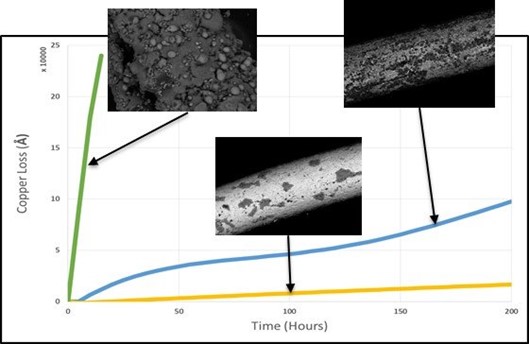 Figure 1. The rate of change in copper loss (Angstroms) over time is monitored continuously using the WCT.
Conductive Deposit Test (CDT)
This device is designed to predict the potential of conductive deposit formation, a serious concern in today’s EVs, where electronics are subject to fluid immersion and fluid vapors. Bridging deposits allow electricity to pass and can cause catastrophic failure. Oil that passes ASTM D130 can still cause motor failure—this test (ASTM D8544) looks at the potential of deposits forming between the anode and cathode. Miiller calls this “a very critical gap, this is where deposits are formed.” The purpose of the CDT is to determine what is the fail point. The test apparatus features a circuit board with a cover board that maintains the critical gap where deposits are formed (see Figure 2). According to Miiller, formulators can’t just look at soluble copper, which is why this test is so important.
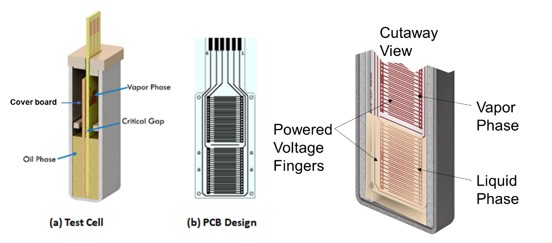 Figure 2. Configuration for CDT.
Electronic Erosion/Pitting Test
This is a modification of the four-ball test that doesn’t measure typical wear, but rather bearing impedance as a voltage is applied between the two contacts. An axial roller bearing runs at a defined speed, load and temperature, and measurements of bearing impedance, bearing voltage and bearing current are recorded. As arcing events occur, there are changes in the pattern; the results show a flat line when nothing is conducting, which is the desired result, but as arcing events occur, the voltage is distorted (see Figure 3). According to Miiller, this test provides outputs on electric discharge machining (EDM) events that are recurring events, the ohmic events that are surface contact events but also the surface analysis of the bearings.
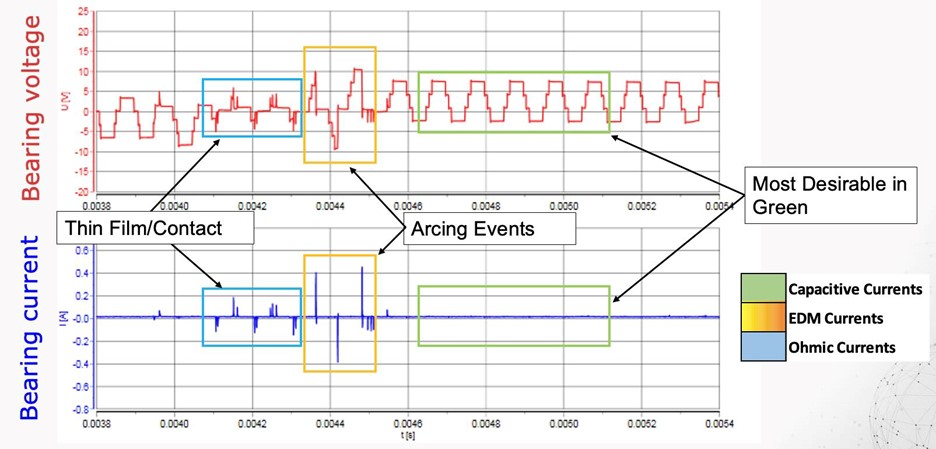 Figure 3. The example in the green box in both bearing voltage and bearing current shows the ideal example for results on this test—nothing conducting. The yellow box is starting to see problems, and the blue box is problematic—could be metal-on-metal contact.
Fast FZG High Speed Wear
This efficient high-speed wear test addresses a very difficult to monitor area. The test monitors the difference in the drive motor and load motor over time using a standard FZG box in between them (see Figure 4). Test development involved matching speeds to the tip point of the EV gearbox so that at certain points it hit the tip speeds, which led to very accurate sensors. The resulting output is the drive torque to the load torque. Using the Worldwide Harmonized Light Vehicles Test Procedure (WLTP), which goes through standardized speeds, the test monitors conditions on the load side. To get meaningful data out of these results, they are given as a relative efficiency—the test is run three times before running the candidate fluid and three times after, and the user makes sure nothing changes. “Everything is based comparatively to the reference fluid, making this a very repeatable test,” says Miiller.
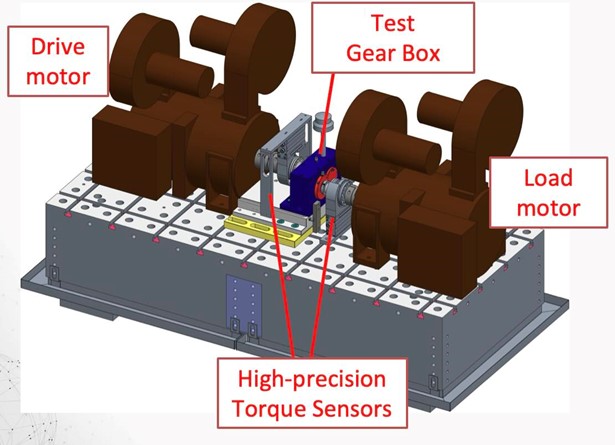 Figure 4. Setup for the Fast FZG High Speed Wear Test.
BatteRig E-Fluid Testing
This test for fuel cells focuses on cooling. The test system layout is set up just like it would be in a fuel cell, using rapid prototyping 3D printing (see Figure 5). The system monitors temperature and pressure of the fluid within actual fuel cells. Before running the test, a reference fluid is run several times, and then repeated after the test. Performance of a coolant fluid is then compared to the reference fluid. The flow geometries are very accurate, and the test provides a reliable report of the temperature changes. There are safety factors involved that are constantly monitored. The test examines thermal load and material compatibility, chemical and physical properties, electrical hardware and water content and aging. Conditions can be modified to match various hardware offered in the industry.
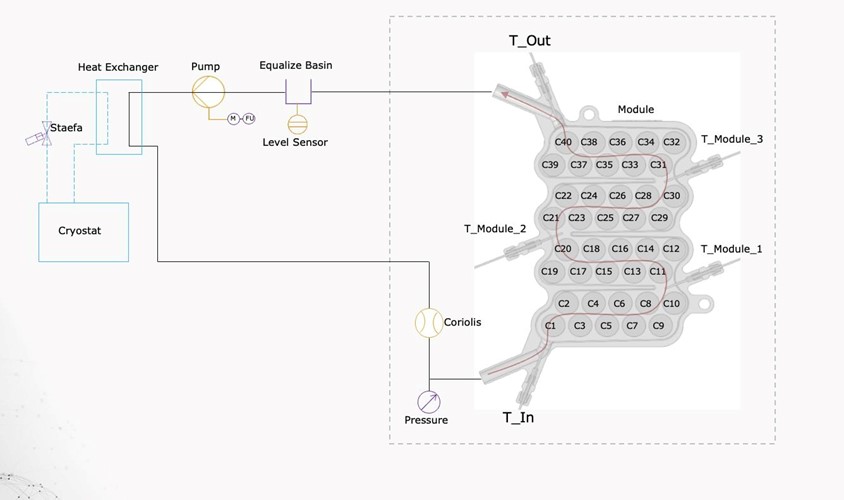 Figure 5. Setup for the BatteRig Fuel Cell Test.
ATF DEXRON Aeration Test
The ATF DEXRON test is a simulation box with a chain-driven pump to promote aeration. It evaluates aeration accumulation, de-aeration time (how long it takes to decompress) at a range of temperatures and fluid density change due to aeration. The test uses OEM parts and it currently is being used in labs throughout the industry. Miiller describes some of the clever parts of this test’s design, including a window where you can watch the fluid pumping through the chamber as the test is running (see Figure 6).
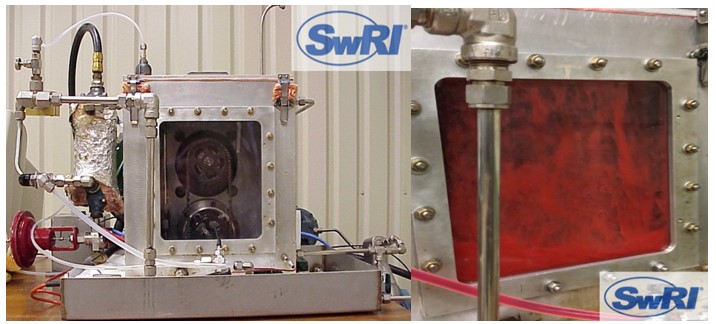 Figure 6. Setup for the ATF DEXRON Aeration Test. Figure courtesy of Southwest Research Institute (SwRI).
EV Foam and Aeration High Speed Mechanical Test
Foam and aeration are serious risks for EV’s in the industry right now, and everyone is trying to better understand these conditions and the effect on the drivetrains. Foam and entrained air can reduce the ability of a fluid to lubricate as well as to conduct heat away from bearings, gears and batteries.2 While there are many engine and bench tests in development to evaluate fluids for foam and aeration, standardized protocols are needed to increase accuracy and reliability. Temperature optimization and shear at high speeds are both important considerations, as is timing for measurements.
Many in the industry are currently working on developing new high speed mechanical tests in collaboration with OEMs. The current industry tests, D892 and D6082, are not applicable to EVs—they cannot mimic the high speed and high mechanical stresses that exist in an EV drivetrain. Other considerations that must be taken into account are cavitation, temporary shear loss and permanent shear loss. The tests in development address these concerns, evaluating the fluid at four different temperatures and taking air entrainment measurements before, during and after the test. The ultimate goal is to develop a test that is repeatable, accurate and simulates what goes on in an actual EV drivetrain.
Material Compatibility New Bench Test
High temperature degradation of materials is another major concern in EVs. To complicate this, many different materials are used in the EV drivetrain. Miiller explains, “We have high temperature degradation of the fluid that’s affecting materials over time in these conditions. We have flexible materials that are being affected: moldings, plastics, insulation, paper, polyamides.” This bench test examines fluid performance with materials in the temperature range of 130°C-160°C and involves coatings on a printed circuit board (PCB). A voltage is applied, and the user can track deterioration over a longer period of time.
Conclusion
While EV technology has moved slowly through most of its history, the current environment is one of rapidly evolving technology. Miiller notes that one of the biggest difficulties with developing standard testing for EVs is how quickly the landscape is changing: “What we’re testing today may not be what we’re testing tomorrow.” Many new tests are already on the horizon to keep up with the industry. As new technologies are developed, more testing needs will be identified, and the industry will need to respond.
REFERENCES
1. www.savantgroup.com/documents/3/STLE_Presentation_SAE_J3200_EV_Progress_November_2021.pdf
2. www.stle.org/files/TLTArchives/2024/07_July/Feature.aspx
You can reach TLT editorial coordinator Nicole Gleeson at ngleeson@stle.org.