Bonus Content for STLE Members
20 Minutes With Dehua Yang
By Rachel Fowler, Publisher/Editor-in-Chief | TLT 20 Minutes September 2024
This president for Ebatco discusses lubrication and scanning wear.
Dehua Yang - The Quick File
Dr. Dehua Yang has a doctorate degree in physical chemistry and master of science and bachelor of science degrees in physics. Yang has authored/co-authored more than 60 peer-reviewed publications on nanoscience and nanotechnology, tribology and surface science and engineering-related topics. He is a co-inventor of seven issued U.S. patents. He has given more than 80 presentations, including 20 invited talks at research institutions and scientific conferences. The products he designed and managed at Hysitron won the 2007 Micro/Nano 25 Award and 2005 Nano 50 Award, respectively.
Yang has held leadership roles and memberships at various technical professional societies. He is currently the chair of the ASM International Handbook Committee and a board trustee of ASM International. He is a board member and previous chair of the STLE Twin Cities Section and has been a TLT Technical Editor. In recent years he served as the president of Minnesota Microscopy Society. He also served many times as a U.S. National Science Foundation grant review panelist, journal referee, international conference organizer and session chair.
Yang is a Fellow of ASM International and a renowned, award-winning materials scientist and tribologist, accomplished corporate executive and founder of a successful nanotechnology development and services company. He has more than 30 years of experience spanning critical areas in higher education, research and development, national and international business development, sales and marketing, engineering, manufacturing, customer service and organizational growth. As the founder and president, he leads Ebatco’s ISO/IEC 17025:2017 accredited analytical and testing lab services. Before founding Ebatco, Yang was the vice president of commercialization for Hysitron Inc.

Dehua Yang
TLT: How long have you worked in a lubrication-related field, and how did you decide to pursue a career in the lubricants industry?
Yang: I have worked in the lubricants industry for nearly 40 years, since 1983 when I graduated from Lanzhou University with a bachelor’s degree in metal physics. As a young and ambitious faculty member of that university, I started research work related to metal surface modifications. One of the excellent applications of surface modifications of metals was to reduce friction and to alleviate wear of bearings and other parts that underwent relative motion. Since then, I have been practicing friction, wear and lubrication and have developed a satisfactory professional career in the lubricants industry. Along the way I have always considered myself a tribologist. I am happy to affirm that my tribology career has been very interesting and rewarding.
TLT: What has been your most rewarding accomplishment throughout your career in the lubricants industry?
Yang: There are two things I have enjoyed the most in my tribology career. The first thing is getting my doctorate degree from the State Key Laboratory of Solid Lubrication in China under co-advisors professor Qunji Xue, a member of the Chinese Academy of Engineering and a renowned tribologist and winner of the 2011 Tribology Gold Medal, and professor Hanqing Wang, a renowned analytical chemist. My doctoral thesis titled “Tribophysics and Tribochemistry of Ion Implanted Pure Iron and Steel Surfaces,” and several publications in internationally recognized journals such as Wear and Thin Solid Films, helped me to win the prestigious President Award for outstanding doctoral candidates, Chinese Academy of Sciences, in 1994.
The second thing I consider an accomplishment is that I coined a new tribological term scanning wear.1 Scanning wear is a unique format of wear that removes material from the surface of its wear counterpart through raster scanning a probe under controlled load over a defined area. Scanning wear differs from other traditional wear formats such as reciprocating wear, fretting wear, fatigue wear and corrosion wear by its distinct characteristics. Scanning wear involves very small amount of material loss, it typically is done under load in the nano-Newton to milli-Newton range, the contact area can be at nanometer level, and the sliding distance may be limited to a few tens of microns or less. Scanning wear may be conducted on a nanoindenter with in-situ scanning probe microscopy (SPM) imaging capability or on an atomic force microscopy (AFM). During a scanning wear test, a preselected load is applied to an indenter tip, and the tip is raster scanned by the SPM scanner over a preselected sample area at a user-defined scan rate. After a certain number of scan passes over the area, a larger area will be imaged at a much lower load in order to capture the three-dimensional topography of the wear crater as illustrated in Figure 1. From Figure 1, wear volume can be determined using an image processing software.
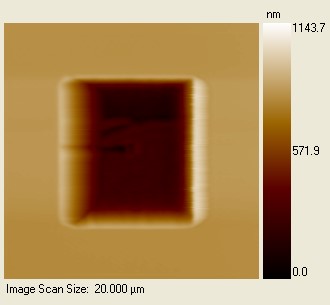
Figure 1. Center wear crater and surrounding area used for wear analysis on a polymer film on silicon substrate sample.
Because scanning wear works with very small volume of materials, small structures can be tested that would otherwise be too small or too thin for conventional wear testing methods. Other applications of scanning wear include simulation of materials or devices that undergo light load or modest wear, wear study of ultra-thin films, traditional wear mechanism investigation at nanoscale, simulation of single asperity scratch, plowing and fatigue wear, tribochemical research of wear surfaces under lubricated conditions and wear debris generation study.
Figure 1 is an SPM image of a scanning wear crater and its surrounding area. The scanning wear test was carried out on a polymer thin film on silicon substrate sample. From the scanned image, the wear volume was calculated using an imaging processing software. Knowing the number of passes, wear volume, scan size and the scan frequency, the wear rate also could be determined.
In addition to the previously mentioned applications, scanning wear has been applied to expose heterogenous microstructures of materials based on its excellent selectivity on different wear resistance of materials.2
TLT: What is the No. 1 piece of advice you would give to a person who might be interested in starting a career in the lubricants industry?
Yang: Congratulations to you if you are considering or have decided to start a career in the lubricants industry! You are going to start a thrilling and fulfilling professional career. Think about it, where you can find a more complex system than a tribological system to work with? A tribological system requires knowledge and experience on the science and engineering matters that are related to interacting surfaces in relative motion. It copes with friction, lubrication and wear, and it is highly interdisciplinary and demands understanding and coordination of physics, chemistry, materials science, mathematics, biology and engineering. You will be on a never-ending path of learning and exploration opportunities. Plus, you could have a variety of different education backgrounds and still can jump into the melting pot of tribology without any restrictions. Furthermore, it was estimated that in total, ~23% (119 EJ) of the world’s total energy consumption originates from tribological contacts.3 Working in the lubricants industry, you definitely can help to reduce impact of friction and wear on energy consumption and can help to reduce CO2 emissions, which has shown increasing significance to avert climate disaster and to humanity’s future survival.
TLT: Throughout the different segments within your career, which one has been the most interesting, challenging and/or rewarding?
Yang: Throughout my career, my current job has been the most interesting, challenging and rewarding. As the president and chief scientist of Ebatco, I am responsible not only for the overall company growth and success but also for technical program development and implementation. To be able to work with customers from all around world on the practically most useful and technically most challenging projects is a true pleasure and privilege and is only made possible by my long tribology career and numerous technology exposures.
TLT: What are some of the most technical lubrication-based concepts or topics you have encountered throughout your career?
Yang: Among many lubrication-based concepts that I have encountered and learned, a few of them are my favorites:
1. Solid lubrication. This is great for applications where liquid lubricants cannot be used such as in vacuum, at high temperatures, in oilless-required environments, on machineries for food processing, etc.
2. Boundary lubrication. This must be the most important and ubiquitous lubrication status and concept that needs to be understood. Lubricant with or without additives would fit into this category. Tribochemistry and surface tribofilm are critical for maintaining boundary lubrication conditions.
3. Elastohydrodynamic lubrication. This is an ideal condition to reach and maintain if possible in order to reach the lowest friction and energy consumption under liquid lubrication.
4. Self-lubrication. This may be put under the umbrella of solid lubrication. However, it is different from solid lubrication that typically has film and coating on the surface of the lubricated part. Self-lubrication is achieved through mixing lubricant with its matrix material for the parts made from this composite material.
TLT: What is the one thing you wish you would have learned earlier in your career?
Yang: My professional career has been filled with excitement and progression. Most of the career changes are natural and enriching my life experience. Along the way, working with the most complex scientific and technological systems, I have kept learning and expanding my knowledge and understanding in surface engineering, materials science, nanotechnology and tribology. At the current stage of my career, I could consider myself a seasoned experimentalist and published researcher. One thing I wish I could have learned earlier and more is finite element analysis and molecular dynamic simulation. I deem it a beautiful thing if I could cross-check and improve upon both experimental findings and simulated results by myself.
References
1. Yang, D., Stromberg, R., Nay, R. and Wyrobek, T. (2005), “Characteristics and nanotribological applications of scanning wear,” Proceedings of World Tribology Congress III, Sept. 12-16, 2005, Washington, D.C., U.S., WTC2005-63710, pp. 785-786.
2. Yang, D. and Wyrobek, T. J., (2006), “Method for observation of microstructural surface features in heterogeneous materials,” Patent No. US 7,107,694 B2, date of patent: Sept. 19, 2006.
3. Holmberg, K. and Erdemir, A. (2017), “Influence of tribology on global energy consumption, costs and emissions,” Friction, 5 (3), pp. 263-284.
You can reach Dr. Dehua Yang at dyang@ebatco.com.