Bonus Content for STLE Members
Designing surfaces to optimize performance and efficiency
By Andrea R. Aikin, Contributing Editor | TLT Industry Insights July 2024
Optimize performance metrics like product lifetime—not surface finish.

Photo courtesy of Thomas Claveirole/Flickr, CC BY 2.0.
KEY CONCEPTS
•
Surface finish controls product performance, product lifetime and production efficiency.
•
Manufacturers typically rely on roughness metrics such as Ra, or on the empirical judgment of an experienced machinist, to determine when the surface is “good enough.”
•
Science-guided approaches for optimizing surfaces yield quantifiable cost savings, improvements in production efficiency and better-performing parts.
Meet the Presenters
This article is based on an Industry Insights presentation titled
Designing Surfaces to Optimize Performance and Production Efficiency by Tevis Jacobs and Lars Pastewka on Oct. 26, 2023. Industry Insights is a monthly virtual event series available for free to STLE members. These events provide a forum for members to collaborate with STLE industry peers and experts on a specific topic who give a brief presentation, then facilitate conversation by asking discussion questions and providing actionable takeaways. For more information,
click here.
Tevis Jacobs is the president of Surface Design Solutions. He also is a Whiteford Fellow and associate professor of mechanical engineering and materials science at the University of Pittsburgh. He has worked in tribology and surfaces for 17 years in both fundamental research and in manufacturing. He currently leads efforts to find practical solutions to surface finish problems in electronics, medical devices and industrial manufacturing. He lives in Pittsburgh, Pa. You can reach him at
tevis.jacobs@surface.design.
 Tevis Jacobs
Lars Pastewka is the director of data science at Surface Design Solutions. He also is a professor of microsystems engineering at the University of Freiburg. His 20 years of tribology experience have been in applying modeling, simulation and data science to tribology. He is developing physics-informed machine learning to find optimal surface finish solutions. He lives in Freiburg, Germany. You can reach him at
lars.pastewka@surface.design.
 Lars Pastewka
Surfaces are critical across all manufacturing, including automotive, aerospace and defense, tooling and machinery and electronics and medical devices. Surfaces matter for gears, cylinder bores, axles and all sorts of moving parts, where friction, adhesion, wear or fluid sealing impact the overall function.1 Manufacturers typically fail to understand how surfaces control target outcomes like product performance, product lifetime and production efficiency. In other words, modifications to surface finish can directly improve key performance metrics.
Flooring is an example of a $500 billion industry where surfaces are critical. Manufacturers are seeking ways to differentiate their flooring with slip-resistant products. Shoe-floor friction is controlled by the surface topography of the flooring. To optimize shoe-floor friction, manufacturers evaluate slip resistance using a tester that slides a shoe across the flooring and measures the resulting friction. This is a slow and inexact process.
Another example is the multi-billion-dollar semiconductor manufacturing industry, where downtime can cost $3 million per day. The material deposition process involves a tool that puts down nanometer-scale films of materials. The process routinely experiences a week of downtime every six months associated with the build-up and flake-off of these coatings on tooling surfaces. The lifetime of these tools depends on their surface finish, with improvements estimated to save over $20 million per year per fabrication facility.
Powder-based metals manufacturing is another industry impacted by surface finish. The adhesion of powders to the dies and molds during production damages parts, causing scrap, rework or the premature refinishing of tooling. Poorly controlled surface finish causes up to 50% downtime in powder manufacturing on some product lines.
Modifying surfaces to optimize key performance metrics
The conventional approach to improving performance involves slow and costly performance testing. To optimize a part, manufacturers will create multiple candidate surfaces, then spend weeks assessing their performance in an R&D lab or on the production floor to determine which surface performs best. This trial-and-error process does not yield insights into why certain surfaces perform well nor does it identify how to make them perform better.
An example illustrating that conventional metrics do not yield actionable insights comes from the biocompatibility of medical devices. A recent review in the scientific literature concluded: “Overall, the effect of surface roughness (at both the nano- and micron-scales) and grain size on cell adhesion is inconclusive due to contradicting data in the literature.”2 The works cited in the review were each attempting to correlate cell adhesion to medical devices with industry-standard roughness metrics, such as Ra. Ra is the arithmetic average roughness, or the average variation among the peaks and valleys of the surface being studied. While each individual work cited in the review may have come to a conclusion on how cell adhesion correlates with Ra, the review clearly showed that, if taken together, no such correlation emerges.2
But there is a better way. Jacobs and Pastewka’s core message is that manufacturers can use surface finish as a tool to optimize key performance metrics, such as product performance, product lifetime or production efficiency. Instead of relying on conventional approaches (i.e., using standard roughness metrics like Ra, or relying on the judgment of an experienced machinist), science-guided solutions offer a path to directly improving the metrics that matter. There are two methods for using science-guided solutions to improve surfaces.
Method 1: Physics-based models
A surface can be measured using standard surface-characterization tools, like a stylus tool or an optical profiler. But instead of computing standard roughness metrics like Ra, which do not correlate with performance metrics, physical models allow the direct prediction of performance: adhesion, friction, sealing and leakage, etc. By eliminating the focus on “surface finish,” manufacturers can instead focus on “surface performance.”
An example of using this approach comes from the adhesion of robotic grippers, where roughness controls the strength of adhesion, but does not correlate with industry-standard roughness metrics (see Figure 1, left).3 In some cases, roughness increases adhesion—in other cases it has no effect whatsoever as it depends on too many factors (e.g., the material being used, the conditions of the process, etc.). Instead, roughness metrics can be replaced by science-based predictions. These science-based predictions show correlations between experimental adhesion energy and model-predicted adhesion energy (see Figure 1, right).2 This is a completely different way of thinking about surfaces; adhesion is predicted using science rather than using statistical correlations.
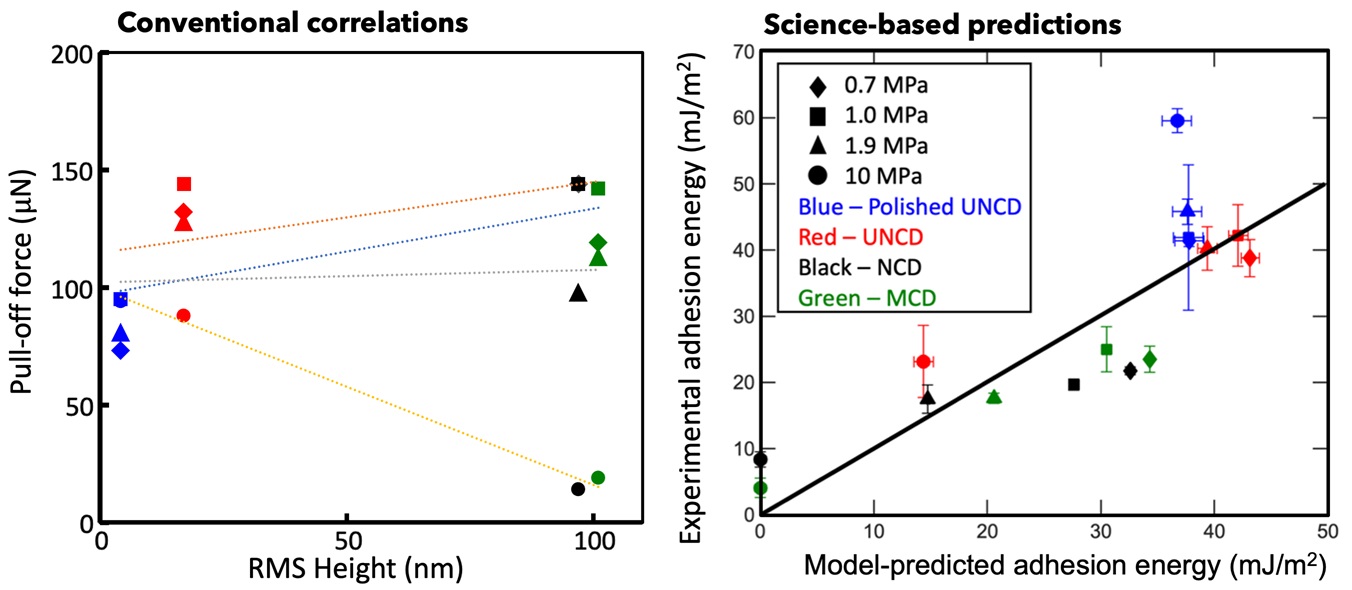
Figure 1. Science-based models predict adhesion of a robotic gripper. (Left) Pull-off forces of soft silicone spheres contacting different rough surfaces with identical chemistry show no consistent correlations with RMS height of the surface. (Right) Using a rough-surface mechanics model, the calculated adhesion energy matches accurately with the measured values, enabling prediction and improvement of performance.2,3
Method 2: Physics-informed machine learning
The second method for optimizing performance relies on physics-informed machine learning to predict key metrics. This approach enables manufacturers to draw direct connections between process parameters and the final performance metrics they value.
An example of using this approach comes from the friction of flooring, which depends on topography, but without strong correlations between industry-standard metrics and performance (see Figure 2, left). Conventional surface metrics like Ra show virtually no correlation with friction performance. However, using physics-informed machine learning, a purpose-built surface metric accurately predicted performance for 100% of parts (see Figure 2, right).
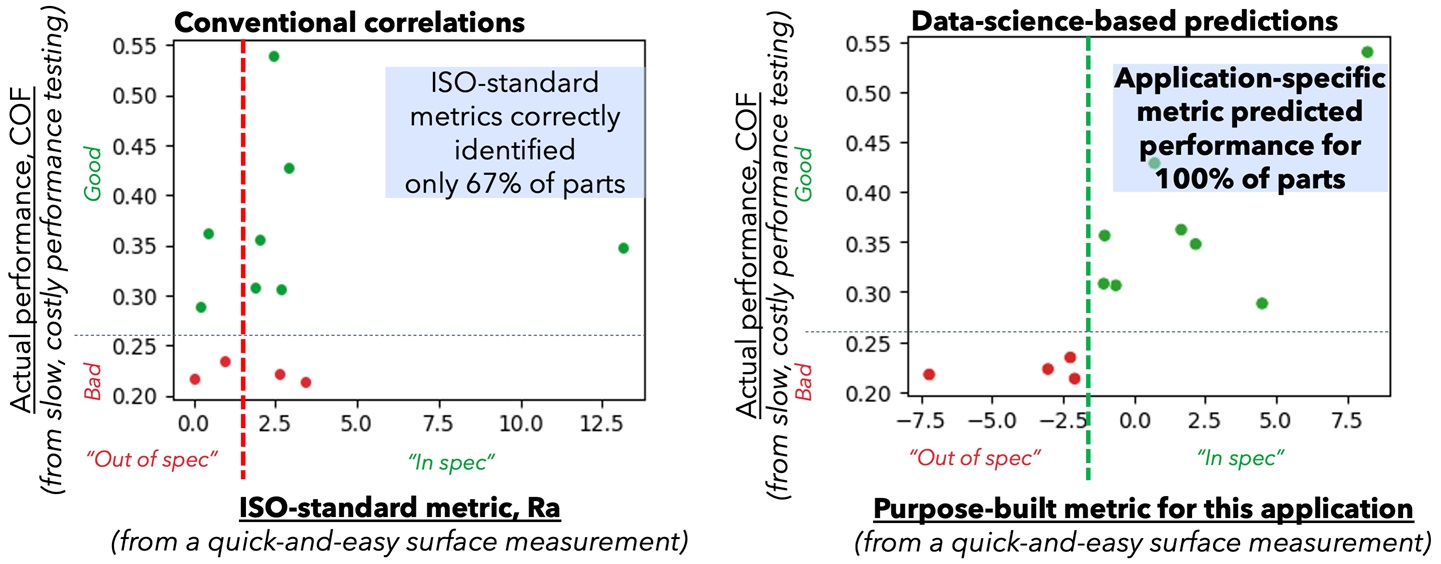
Figure 2. Data-science-based models predict friction of slip-resistant flooring. (Left) The coefficient of friction (COF) between shoes and different floors does not correlate well with ISO-standard metrics like average roughness (Ra). (Right) However, a physics-informed machine-learning approach generates a purpose-built specification that predicts performance. This approach removes the focus on roughness metrics; instead manufacturers can directly optimize their key performance metric.
Using either method, a science-guided approach to surface finish achieves the following:
• Eliminates unjustified assumptions by using raw surface measurements instead of surface metrics like Ra.
• Requires a small number of measurements, by using physical laws to guide the model, rather than relying solely on statistical correlations.
• Provides insight on how to further improve performance in the future, by revealing the physical parameters that control performance.
Applying the science-based approach to real-world product lines
For physical models, the authors have developed a freely available, open-source web application for surface analysis available at https://contact.engineering. This approach uses a digital surface twin, created based on measurements that the user uploads, then computes various surface analytics (see Figure 3).4
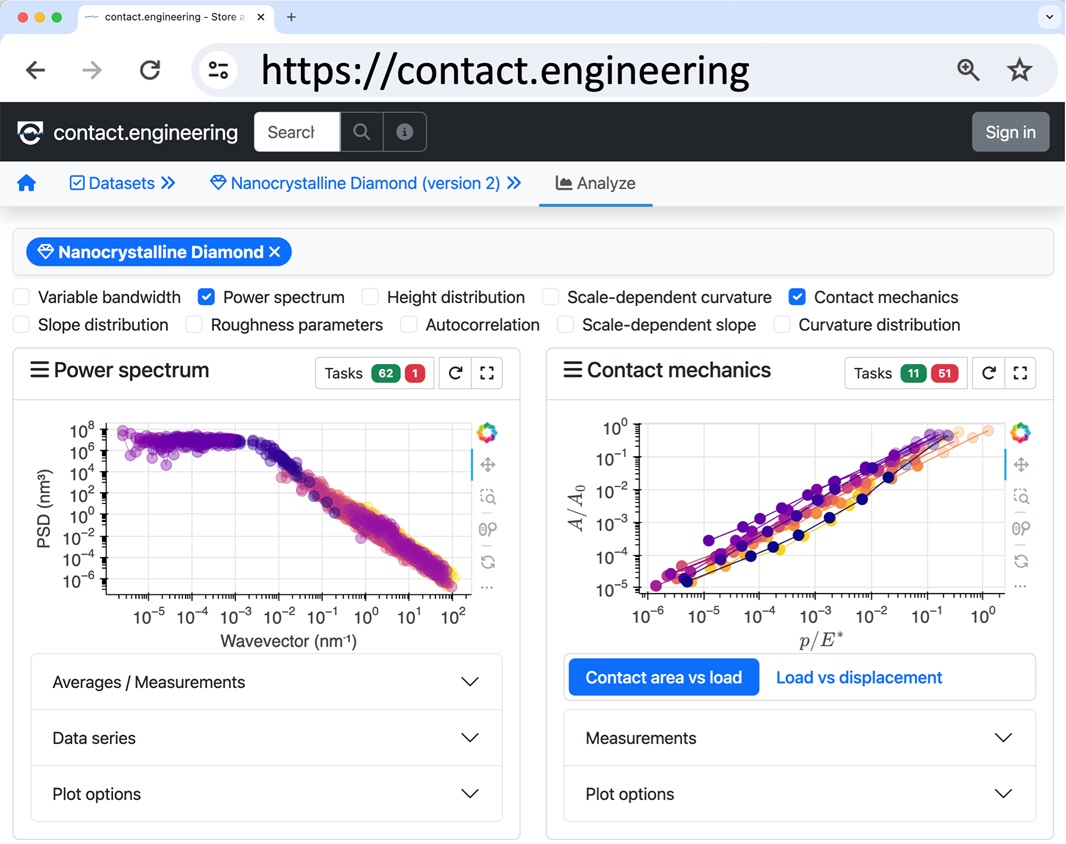
Figure 3. To facilitate the use of science-based models, the authors have created a free web-based application. This tool is available at https://contact.engineering and enables users to upload multiple measurements of a surface, creating a digital surface twin. Once created, the surface can be analyzed in various ways including: the calculation of advanced scale-dependent parameters, with metrics like the power spectrum; and the prediction of performance using a boundary-element-method model, with properties such as the true contact area under a certain load.4
Physics-informed machine learning tools also have been developed, which demonstrate how to reduce costs or improve production efficiency through the modification of surfaces. This process involves:
• identifying surface features that control a key performance metric (e.g., production yield),
• optimizing the surface for the desired performance metric,
• iterating improvement to increase savings over time and
• monitoring and controlling surface finish and performance metrics in future production.
The process is repeated as needed (see Figure 4). It comes back to avoiding optimizing surface finish, instead using surfaces to optimize performance (e.g., cost savings). In addition, the physics-informed model becomes better over time, as each iterative loop adds more data to the machine-learned model.
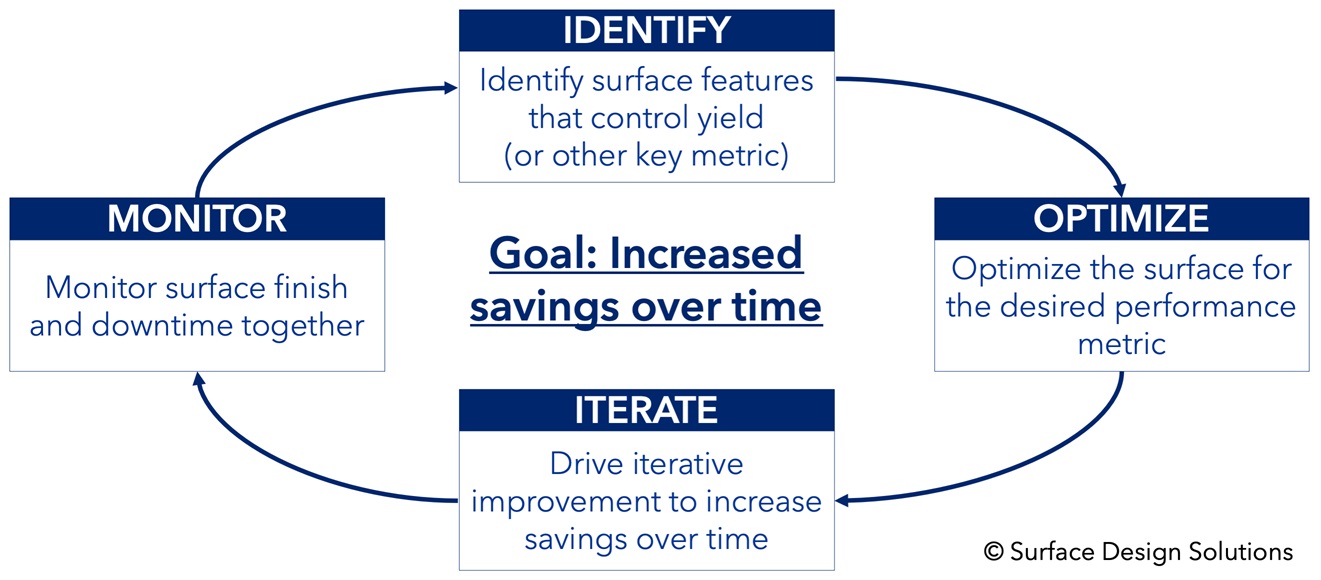
Figure 4. Manufacturers can use physics-informed machine learning to directly optimize key performance metrics. By combining physics-based models of surfaces with artificial intelligence (AI), an iterative approach can be used to identify the unique surface features that govern performance in a specific application. This approach generates actionable guidance for manufacturers to achieve cost-reduction and add value for their customers. This figure is used courtesy of Surface Design Solutions.
Conclusions
Surfaces control performance, but conventional approaches to optimize surfaces are ineffective. Instead, science-based approaches offer a path for manufacturers to optimize performance metrics using fundamental science and easy-to-use software tools. This approach changes how to think about surfaces, eliminating the focus on roughness metrics and instead optimizing surface performance.
REFERENCES
1. Jacobs, T. and Pastewka, L., et al. (2022), “Surface topography as a material parameter,” MRS Bulletin, 47, pp. 1205-1210.
2. Samavedi, S., Whittington, A. R. and Goldstein, A. S. (2013), “Calcium phosphate ceramics in bone tissue engineering: A review of properties and their influence on cell behavior,” Acta Biomaterialia, 9, pp. 8037-8045.
3. Dalvi, S., Gujrati, A., Khanal, S. R., Pastewka, L., Dhinojwala, A. and Jacobs, T. (2019), “Linking energy loss in soft adhesion to surface roughness,” Proceedings of the National Academy of Sciences, 116, pp. 25484-25490.
4. Röttger, M., Sanner, A., Thimons, L. and Junge, T. (2022), “Contact.engineering—Create, analyze and publish digital surface twins from topography measurements across many scales,” Surface Topography: Metrology and Properties, 10, 035032.
Andrea R. Aikin is a freelance science writer and editor based in the Denver area. You can contact her at pivoaiki@sprynet.com.