Bonus Content for STLE Members
Current market drivers and the future of e-mobility development
By Jeanna Van Rensselar, Senior Feature Writer | TLT Industry Insights April 2024
Rapidly evolving electric vehicle technology is pushing the lubricant industry to develop new chemistries more quickly than ever.
Photo courtesy of Kārlis Dambrāns/Flickr, CC BY 2.0.
KEY CONCEPTS
•
The rapid pace of electric vehicle (EV) design is putting pressure on electric transmission fluid (ETF) formulators to quickly create compatible fluids.
•
Every 1% increase in energy efficiency adds up to $250 more value to each EV.
•
ETFs need to be a balanced synergy of the additive components, viscometrics and base oil chemistry.
Meet the Presenters
This article is based on an Industry Insights presentation titled
Current Market Drivers and the Future of E-Mobility Development by Christopher Cleveland and Brent Brennan on Sept. 27, 2023. Industry Insights is a monthly virtual event series available for free to STLE members. These events provide a forum for members to collaborate with STLE industry peers and experts on a specific topic who give a brief presentation, then facilitate conversation by asking discussion questions and providing actionable takeaways. For more information,
click here.
Christopher Cleveland is R&D technical director at Afton Chemical Corp., where he has worked for 15 years in transmission fluid research and development. Currently he works with a global team of chemists and engineers, which is responsible for the development of performance additives for the next-generation transmission fluids, automatic transmission (AT), dual clutch transmission (DCT), continuously variable transmission (CVT) and EV, in collaboration with key customers and OEM partners. You can reach Cleveland at
chris.cleveland@aftonchemical.com.
 Christopher Cleveland
Brent Brennan is the Americas senior marketing manager for ATF and eMobility at Afton Chemical Corp.. Brennan has been in the industry for nearly 30 years, beginning his career with Castrol Industrial and later Evonik. He has worked for Afton Chemical for 17 years, spending time in global business in industrial and fuels before beginning his current role in January 2020. You can reach Brennan at
brent.brennan@aftonchemical.com.
 Brent Brennan
Leaders in the EV market are continuing to develop hardware technology at an ever-accelerating rate, even though the industry is only now beginning to adopt true first-generation ETFs. This is pushing the lubricant industry to create and apply the chemistry for the next generation of ETFs more quickly than it has ever done before.
While traditional lubricant properties such as corrosion prevention and gear protection are still essential, the following new properties are shaping the formulating strategy for ETFs in electric and hybrid vehicles.1
• Electrical properties. The lubricant must prevent static electricity from building while serving as an insulator. In order to keep electrified parts safe, it also must not harm conduction metals and be compatible with coatings. In addition, electrical qualities need to be taken into account for transmission efficiency, dependability and user safety.
• Cooling capacity. The lubricant’s maximum temperature increases significantly when it cools e-motors. Finding the best and most efficient technique to remove that heat from the e-motor is key. This means the lubricant needs to have high thermal conductivity and heat capacity along with enhanced oxidative stability.
• Compatibility. There are more electrical components and electronic controls. Metal components, which include copper, tin and silver, are susceptible to corrosion. The chemistry usually applied to protect gears and bearings can be problematic for these metals. In addition, new polymers and coatings need to be safeguarded.
Market trends and observations
According to the presenters, the following global megatrends have an ongoing effect on the considerations that go into formulating ETFs:
1. Climate change and resource scarcity. The demand for a clean, green tomorrow will advance energy and conservation. The growing global population will demand 35% more food, 40% more water and 50% more energy by 2030.
2. Demographic and social change. Longer lifespans and modern lifestyles will change consumer habits, future jobs/skills, immigration and priorities of Generation X, Millennials, Generation Z and Generation Alpha.2 By 2030, the world’s population is projected to rise by more than 1 billion.
3. Rapid urbanization. Mass migration to cities will require new business models and infrastructure investment; 1.5 million people are added to the global urban population every week.
4. Technological breakthroughs. These will rapidly impact how most people live, work and invest in the coming years. Adoption of innovative technologies could increase GDP in developed economies by 1%-1.5% annually until 2030.
5. Shift in global economic power. Emerging and developing countries have established themselves as important markets and make a significant contribution to global economic growth. By 2040, the economic power of E73 economies could double the size of the G7,4 after being the same size in 2015.
Given all this, there are three key challenges that will influence the market for EVs—slowing the transition from internal combustion engine (ICE) to hybrid to full electric:
1. Adequate infrastructure. This includes at-home and mid-journey charging availability and also the pace of battery manufacturing and availability of lithium.
2. Consumer buy-in. Consumers still have concerns about the range, the total cost, battery life and recharging times.
3. Energy demand. There needs to be sufficient capacity for all other uses, a viable network for energy storage and distribution and a reliable source of renewable energy.
Brent Brennan, the Americas senior marketing manager for ATF and eMobility for Afton Chemical Corp., says that efficiency is the key to energy conservation, range extension and hardware life.
While the range has been increasing, much of this is due to the fact that the batteries are getting bigger but not necessarily more efficient. The presenters estimate that every 1% increase in energy efficiency adds up to $250 more value to each EV.5 A larger battery drives even greater value in commercial vehicles. Thus, focusing on efficiency is a winning path for collaboration between vehicle OEMs and lubricant formulators.
Christopher Cleveland, R&D technical director at Afton Chemical Corp., adds, “Our philosophy is based on what we are hearing from our customers and OEMs. The industry is asking us for efficiency and the durability to be able to deliver that efficiency.”
Building the efficient ETF
There are many requirements that go into the development of all ETFs; these include the following:
• Materials compatibility: elastomers, engineering plastics, copper
• Friction: single/multi-speed clutch, synchro performance
• Electrical properties: fresh electrical conductivity, electrical conductivity after aging, dielectric breakdown voltage
• Sustainability: lifecycle analysis, cradle-to-gate and cradle-to-grave
• Mechanical protection: extreme pressure, pitting, wear (gear and bearing)
• Cooling performance: thermal conductivity, specific heat capacity, oxidation DKA6
• Foam and aeration: fresh and aged, high speed conditions
• Efficiency: thermal properties, friction/traction, viscometrics.
Brennan says, “Performance is a balanced synergy of all components: the additive technology, viscometrics and base oil chemistry (see The Evolution of ETFs).”
The Evolution of ETFs
• Early 2000s-2015: First application of ETFs designed for hybrids and EVs
• 2015-2023: 1st generation ETFs were the first step in efficiency, providing ETF-style gear and bearing protection.7
• 2023 and beyond: 2nd generation ETFs have made a significant step in efficiency and a big step in mechanical performance.
The focus of 2nd generation ETFs needs to be on durability in terms of mechanical performance, foam/aeration control and efficiency. Fluid properties that will drive efficiency include:
• Thermal properties. The base oil structure and uniformity raise thermal conductivity.
• Friction and traction. This should be driven by surface-active additive components and also by base oil structure and uniformity.
• Viscometrics. Churning losses need to be reduced. Additive technology makes viscometric and base oil choices viable.
“The candidate fluid needs to exhibit reduced churning losses, improved thermal properties and reduced traction/friction versus the industry reference,” Cleveland says. “Our role here is to help remove heat as much as possible and build more life into that battery.”
More uniform and linear base oil structures provide improved thermal properties. An approximate 2.5% increase in cooling capacity can be gained by lowering the fluid viscosity along with an approximate 0.8% increase when changing from Group III to linear synthetic base oil because there is a more uniform and linear structure. This provides lower traction friction.
Figures 1-4 provide insight into the ETF testing process.
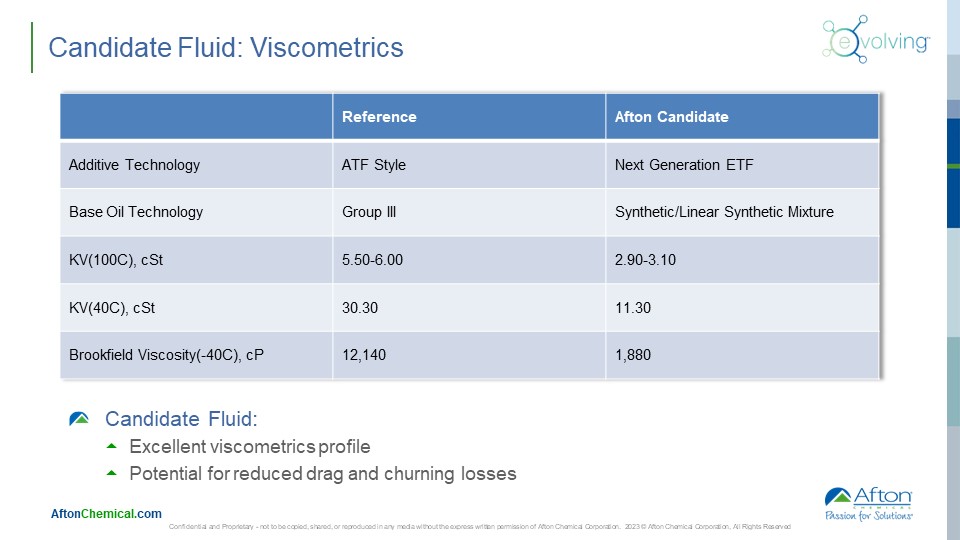
Figure 1. Candidate fluid: Viscometrics: Candidate has an excellent viscometrics profile and the potential for reduced drag and churning losses. Figure courtesy of Afton Chemical Corp.
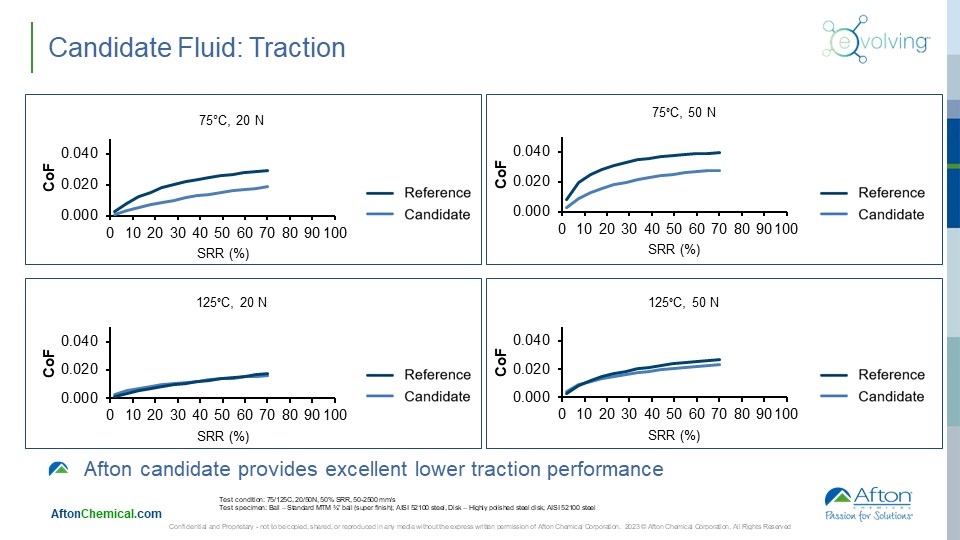
Figure 2. Candidate fluid: Traction: Candidate provides excellent lower traction performance. Figure courtesy of Afton Chemical Corp.
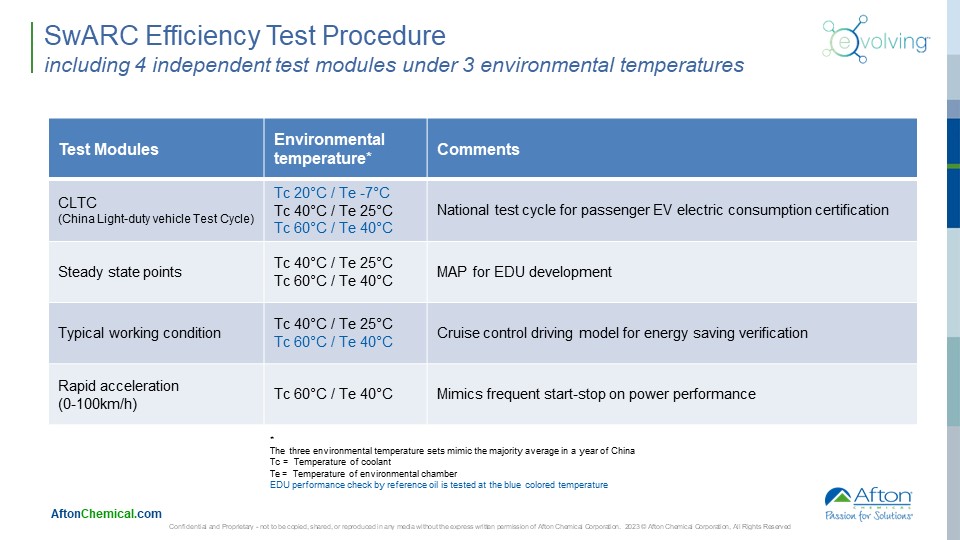
Figure 3. SwARC Efficiency Test Procedure: Four independent test modules under three environmental temperatures. Figure courtesy of Afton Chemical Corp.
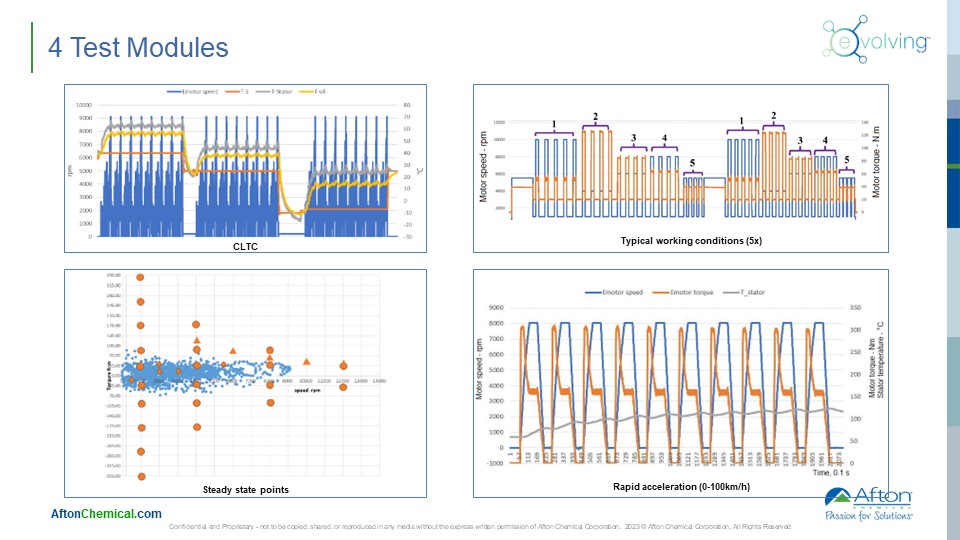
Figure 4. Four test modules. Figure courtesy of Afton Chemical Corp.
Researchers have learned they can improve efficiency by 1.5% with coolant at 20 C. This enables EVs to achieve longer driving distances in the spring, autumn and winter. They also can improve efficiency by 0.4% with coolant ranging from 40 C to 60 C, enabling EVs to achieve longer driving distances during those three seasons. This new ETF technology also enables electric oil pumps to work at 40% lower current with coolant at 20 C.
Ultimately, it is the synergy between the additive formulation and the base oil technology that makes the fluid design viable for the targeted efficiency.
Conclusions
Market demands will continue to drive electrification and the ETFs that support them at an ever-increasing rate. With a focus on efficiency, key fluid properties for these next-generation ETFs, such as thermal, friction and traction and viscometrics, must be understood and implemented with the right balance.
The additive and base oil technologies are key to the best formulation, with the additive technology providing optimized performance in other key areas to make the desired viscometrics and base oil technologies viable.
REFERENCES
1. Available here.
2. Generation Alpha: born 2013-2025.
3. E7 = China, India, Indonesia, Brazil, Russia, Mexico and Turkey.
4. G7 = U.S., UK, France, Germany, Japan, Canada and Italy.
5. Assuming 200 kWh battery that costs $25,000.
6. DKA Oxidation Stability Test (CEC L-48-A-95).
7. During the first two stages, the chemistry was milder to be compatible with 1st generation materials. Because of this, there were compromises in performance.
Jeanna Van Rensselar heads her own communication/public relations firm, Smart PR Communications, in Naperville, Ill. You can reach her at jeanna@smartprcommunications.com.