KEY CONCEPTS
•
Because ZDDPs tend to form tribofilms, researchers are interested in learning why and how they can extend those properties to other substances.
•
Solution decomposition and surface decomposition can both be precursors to tribofilm development.
•
While tribofilms impart some wear protection in most instances, the degree of protection varies.
The term “tribofilm” is often used to refer to a protective film, such as a phosphate tribofilm, which reduces component wear. Confusingly, it also is used to refer to a deposit that forms as a byproduct of corrosion of the metal surface; for example, iron sulfide that forms in the presence of sulfur-containing additives. In addition, Langmuir-Blodgett
1 films of friction modifiers can be called tribofilms. Given this, among the many important aspects of the study of tribofilms is arriving at a common terminology.
STLE member Dr. Darryl Williams, senior scientist Afton Chemical Corp., says, “A translation of the term could be ‘a film formed during sliding’ but chemically there can be a great deal of nuance, so I have a personal definition of the term which is more specific. Simply put, it is: A strongly bound protective film deposited on the contacting surface while sliding under significant orthogonal pressure applied to the contacting surfaces. Films can appear on a surface simply by forming a material which is insoluble in the fluid present in the contact.”
He goes on to clarify that a useful tribofilm will have both good adhesive strength (a strong chemical bond between film and substrate) and good cohesive strength (the bulk of the film itself has a significant modulus).
“For a practical reason, I prefer to think of lubricant tribofilms as comprising phosphate and poly-phosphate films—the reason being that these provide useful wear protection,” he says. “In contrast, the presence of significant amounts of sulfur on a surface is frequently associated with the chemical abrasion that is sometimes observed from sulfur-containing compounds.”
Williams observes that, among other attributes, tribofilms can be characterized by:
•
Physical characteristics such as thickness, roughness, hardness, etc.
•
Chemical composition such as what elements are present, what amorphous or crystalline phases are present and any observable chemical in-homogeneity in the film.
STLE member Dr. Marc Ingram, Ingram Tribology Ltd., describes a tribofilm as a chemical adsorbed, reacted or deposited film placed there by design. “This would exclusively come from the chemical additives in a lubricant,” he notes. “Some chemicals will simply adsorb to a metal surface; others will decompose to form a layer on the surfaces, and some will undergo a simple reaction and become chemically bonded to the surfaces. The different types of tribofilms will all vary in their nature by the circumstances that the oil encounters in service. This will affect things like packing density, thickness, shear stress—and crucially for tribologists—all these things will affect sliding friction and wear
(see Research into the Effects of Shear Stress and Hydrostatic Pressure).”
Research into the effects of shear stress and hydrostatic pressure
Both shear stress and hydrostatic pressure can have an effect on tribofilm formation.
STLE Life Member Hugh Spikes, professor, Tribology Group, Imperial College London, notes that in 2015, N.N. Gosvami used atomic force microscopy (AFM) to show that the ZDDP tribofilm formation rate increased exponentially with applied pressure. But at constant friction coefficient, shear stress is proportional to pressure and since the friction coefficient was constant, it was not possible to say whether the rate of growth increased with pressure or with shear stress.
Then in 2016, Jie Zhang, a research associate at Imperial College London, showed that ZDDP tribofilm could be formed in full film elastohydrodynamic (EHD) conditions given the pressure/shear stress was high enough. This meant that by using base oils with different friction coefficients, Zhang could decouple shear stress from pressure effects. He showed that the rate of tribofilm formation increased exponentially with increasing shear stress. However, he saw a negligible effect of pressure on the tribofilm growth rate. In 2023, Lu Fang, a member of the Carpick Research Group at the University of Pennsylvania, extended this to show that there was a very small effect of pressure and that film growth rate decreased as pressure increased, but this was a much smaller effect than that of shear stress.
Williams adds that tribofilm formation can occur when:
1.
there are contacting (metallic) surfaces,
2.
there is relative motion of the two surfaces with respect to each other and
3.
when the load or pressure bringing the two surfaces together provides enough energy for the active material(s) in the fluid to form the tribofilm.
Ultimately, most researchers agree that, because there are so many applications where tribofilms are important and/or observable, it is difficult to arrive at a consensus definition.
Tribofilm formation
STLE member Rob Carpick, John Henry Towne Professor, Mechanical Engineering and Applied Mechanics Department, University of Pennsylvania, explains, “In our experiments, we use fluid-immersed atomic force microscopy (AFM) or a tribometer, namely a mini-traction machine (MTM)—a ball-on-disc device for measuring frictional properties of lubricated and unlubricated contacts under a range of rolling and sliding conditions—to apply forces to cause the reaction. The AFM is in the boundary regime; so, for AFM experiments and for MTM experiments in the boundary regime, we believe the reactions all involve at least one of the reactants being surface bound.”
He continues, “For the MTM experiments in the full film elastohydrodynamic lubrication (EHL) regime, inspired by an elegant paper by Zhang and Spikes,
2 we think there is no solid-solid contact, but the tribofilm does end up growing on the solid substrate. We think that there could be a combination of solution-phase decomposition products and surface-bound precursors that are reacting. However, we can’t be certain of that, since these techniques don’t have
in situ spectroscopy to tell us what the precursors are exactly. Perhaps with novel instrumentation that has
in situ spectroscopy capabilities, this could be determined.”
Precursors to tribofilm development
Spikes says that the most unambiguous way to detect precursors is to use in-contact spectroscopy to analyze inside the contact during sliding. He defines
in-contact as looking directly into a rubbing contact, while
in situ is looking at out-of-contact rubbed surfaces within a test rig.
“In-contact analysis is usually achieved by making one or both surfaces transparent to visible light, so as to enable in-contact Raman spectroscopy (an analytical technique using scattered light is used to measure the vibrational energy modes of a sample), or infrared to enable in-contact IR spectroscopy,” he explains. “If one can observe chemical changes starting from under composed material within the contact that’s pretty good evidence that it is happening there. However, this is rarely possible; in-contact spectroscopy is difficult and the very small amount of material inside a contact is difficult to analyze.”
An alternative is to use chemical analysis to show that tribofilm precursors do not form in solution unless there is rubbing, but this is difficult since concentrations might be very low.
“A better approach is to use conditions at which precursor formation is very unlikely to occur in solution but at which we still see tribofilm development,” Spikes says. “For example, we can see that ZDDP tribofilms form at room temperature on rubbing surfaces, while solution analysis suggests that ZDDPs are wholly stable in solution at this temperature. So, reaction must take place wholly on surfaces due to rubbing. Another related approach is to show that tribofilm development is dependent on the conditions (shear stress) in the rubbing contact, implying that any precursor formation occurs there.”
ZDDPs and tribofilm formation
The chemical composition of ZDDPs tends to facilitate tribofilm formation, but not equally across all ZDDPs. “The strongest differentiator is the structure of the alkyl/aryl group in the ZDDP and whether the carbon atom attached to the oxygen atoms in the ZDDP is primary, secondary or aryl,” Spikes explains. “The secondary ZDDPs form tribofilms faster than primary ones, while aryl ZDDPs form tribofilms only quite slowly. This originates mainly from the strength of the C-O bond, which must be broken in the sequence of reactions that forms a phosphate film. This is weakest in secondary ZDDPs and strongest for aryl ZDDPs.”
Spikes and colleagues are currently synthesizing new ZDDP structures in an effort to determine the precise molecular reaction sequence. Apart from this, low molecular weight ZDDPs having a significant proportion of C3 and C4 alkyl chains generally form tribofilms faster than those with more C atoms in the chains, especially for the secondaries. Spikes observes that there does not seem to be much difference between neutral and basic ZDDPs.
“An important question is whether rules/insights similar to those of ZDDP apply to ashless P additives such as phosphate/phosphite esters,” Spikes says. “We have found evidence of a similar response to shear stress of the phosphites in full film EHL conditions. But another factor here is the availability of a suitable metalion (e.g., Fe3+ [ferric ion]) to stabilize a phosphate tribofilm.”
The ZDDP mechanism that contributes to tribofilm formation is still an active area of debate. “The sulfur certainly helps the initial binding to the surface, and phosphate groups love to crosslink to form the film,” Carpick says. “Our contribution is to emphasize that the mechanical stress accelerates the tribofilm-forming reactions very effectively, and that it is shear stress in particular that is especially effective. Whereas compressive stress (found normally in all tribological contacts) inhibits tribofilm formation. That suggests strongly that the rate-limiting step is one that involves some aspect of bond-breaking. That would explain why the reaction is slowed down (modestly) by compressive stress. The shear stress, we think, promotes bond-breaking since shear applied to a molecule that is tethered to a surface will stretch it, leading to tensile bond rupture. More work, including theory, is needed to determine which chemical structural features are driving the mechanochemical reactivity.”
Williams says that, in many cases, tribofilm formation from chemical precursors involves multiple bond-breaking and bond-forming events, depending on the precursor used. Reaction rates will generally be controlled by the step with the highest activation barrier. Also, significant changes in conditions (temperature, pressure, stress) can result in a different step in the process becoming rate-limiting. Understanding chemical mechanisms for tribofilm formation can thus be complicated.
The SATA model for ZDDP tribofilm formation
Per Carpick, the stress-assisted thermal activation (SATA) model is, in its simplest form, just a modification of the Arrhenius rate law (formula for the temperature dependence of reaction rates) for chemical reactions, which states that the rate constant
k of a reaction is given by:
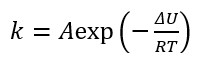
with
A the pre-exponential factor,
U the reaction’s activation barrier,
R the molar gas constant and
T the temperature.
Carpick adds that work by Eyring
3 (in the 1950s and 1960s) and others proposed that when a normal stress is then applied
σ, the activation barrier becomes
∆G‡ =
∆U +
σ∆Ω‡ where
∆Ω‡ is called the activation volume; it can be positive or negative. (For bond-breaking reactions it is often [but not always] negative.) The reaction rate then becomes:
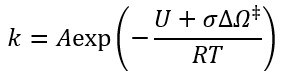
Carpick explains that this equation shows tribofilm formation can be accelerated
exponentially by the applied stress
σ. “Stress can be very powerful in driving reactions, or inhibiting them,” he says. “Using an extended version of Eyring’s model, we found that the activation volume for the reaction driving ZDDP tribofilm growth is different both in magnitude and sign for compressive stress (from the Hertzian pressure in the EHL contact) than shear stress (from shearing the fluid in the EHL contact). This is new and exciting, because it gives us useful information for understanding the mechanism and indicates that stress can be potentially used to control mechanochemical reactions in predictable ways.”
According to Williams, observations that lower molecular weight ZDDPs, those with C3 or C4 alkyl chains, form tribofilms faster than those with longer alkyl chains, are consistent with the stress-assisted model. Presumably, smaller molecules will have a smaller activation volume and thus a smaller total activation barrier compared to larger molecules.
Testing tribofilm formation using the SATA model
To test tribofilm formation with AFM or MTM, the focus is on concentrating the forces into a single contact spot. With MTM in the boundary regime, there will be multiple asperities even with ultra-smooth surfaces. Even though it’s not truly a single asperity contact, it still pinpoints the action and mean stresses.
“With AFM, as long as our tip is sharp, we have a single asperity contact and can use that to develop a good sense of the stresses and forces in the contact,” Carpick explains. “The AFM has the advantage of being able to alternate between driving tribofilm growth (including measuring the local friction force between the tip and the tribofilm, which itself is interesting), and passively imaging the tribofilm to get both its thickness (to determine the growth kinetics) and morphology (to see how uniform the growth is, to interrogate the origins of tribofilm patchiness and so on). We also can get at the friction and mechanical properties of the tribofilms with high lateral spatial resolution. This is a big step forward for locally determining tribofilm kinetics and properties in one shot.”
Carpick adds, “By varying the applied normal stress and/or the temperature, and with the MTM, we can vary the shear force independent of the normal force; we can see if and how the kinetics follow the predictions of the SATA model. We also can probe the composition of the tribofilm afterward with techniques like Time-of-Flight Secondary Ion Mass Spectrometry (TOF-SIMS) or scanning auger, which others have shown, too.”
Lubricants and tribofilm formation
Tribofilm formation attributed to lubricants is often evaluated in specialized tests in order to understand how they may perform in the target application. “In lubricant applications where surface wear can be a problem, for example, on the contact surfaces in an engine camshaft, tribofilm formation can be an important aspect of lubricant performance. In cases like these sliding surface contacts, the tribofilm can reduce or eliminate wear on the contacting surfaces.
Tests and test development
Per Ingram, there are not currently any standard tests for evaluating tribofilm formation from lubricants. “There are some commonly used methods, such as the spacer layer image mapping technique, which is very useful to view tribofilm formation,” he says. “Techniques such as AFM and scanning electron microscopy (SEM) can be used to view metal parts in order to analyze the tribofilm and get information such as its thickness, its morphology and its basic chemical composition. Normal white light microscopy also is surprisingly useful to get some basic photos of the tribofilms, if used correctly.”
Tribofilms normally form in boundary conditions since asperity contacts produce high shear stress, high temperature, exposure of active metal, etc., needed to promote chemical reaction. Spikes and colleagues have shown that tribofilms can form in full EHL conditions if the stresses present are high enough to drive chemical reaction of molecules on the surfaces.
Ingram advises that any mechanical test that measures friction and wear will be affected by the tribofilm. Lab scale tribometer tests in the form of Stribeck and traction measurements are particularly affected by tribofilm formation.
Spikes adds, “We generally think of tribofilms forming mainly from deliberately used additives (extreme pressure/antiwear, molybdenum dithiocarbamate [MoDTC]). However, we now know that most organic base oil molecules (hydrocarbons/esters) can be broken up in rubbing contacts by the large stresses present to form free radicals. These often then combine form carbonaceous tribofilms on the rubbing surfaces, especially if there is little or no oxygen in the atmosphere to react with them.
He clarifies that tribofilms do not have to form via chemical reactions. He uses the example of overbased calcium detergents that are based on tiny colloidal calcium carbonate particles. In very thin film (boundary) rubbing conditions they form films of calcium carbonate on the rubbing surfaces since the particles are too small to pass unscathed through the contact and are squeezed flat and adhere to the surfaces. They have a significant effect on friction and wear and are tribofilms since they are formed by rubbing but are formed physically rather than chemically.
4
Academic research
Williams notes that while academic research can be very relevant to the development of lubricants, significant topics of fundamental interest can be too far removed from the needs of time-bound commercial product development plans to warrant focused study in lubricant labs.
Even so, he cites historical contributions of high importance and relevance, for example, the thermal decomposition studies of ZDDPs from the 1960s-1980s. “Research into methodologies for generating, identifying and characterizing tribofilms using well-defined and repeatable laboratory testing methods have advanced the field tremendously over the last few decades. In some cases, the relative importance of a tribofilm for wear protection can be clearly identified by these fundamental tests,” he says.
He adds that the focus of many excellent academic researchers in the field on significant topics such as how tribofilms form, how to characterize them and how they can be degraded helps all labs develop better products more quickly. “As a last point, it is often the case that research carried out in corporate research laboratories cannot be communicated outside the company,” Williams says, meaning academic research is crucial from the perspective of sharing learnings and, in many cases, work on joint academy-industry projects that advance the field.
Applications impacted by tribofilms
Any machine component that is operating in the boundary or mixed lubrication regime can be affected by the tribofilm. However, most of the work in tribofilms has concentrated on the lubricants with the highest volumes, such as engine oils, automotive transmission oils, hydraulic oils, etc.
Ingram reports, “More recently our attention has turned to renewable energy solutions such as wind turbines and electric vehicles. For wind turbines, the tribofilm must protect the gears and bearings over a large range of operating conditions. In electric vehicles the challenge is one of optimization, where any reduction in friction between the metal surfaces can translate into greater vehicle range. So, although most machine components can be affected by tribofilms, it is the lubricants with the largest volumes which receive the most attention and where formulators optimize the tribofilm for the best performance.”
Tribofilms also provide wear protection in certain applications. While some tribofilms provide better wear protection than others, according to Ingram, all tribofilms will provide wear protection to some degree. “The tribofilms that provide the best wear protection would be the ones that form a robust and complete tribofilm—a chemical layer that will provide a barrier to the contact of the metal surfaces,” he says. “Ideally this tribofilm will have complete coverage where needed, can remain in place during all machine operating conditions and last for a long time.”
“There are many lubricant applications where forming a tribofilm is a key aspect of good performance from a lubricant,” Williams says. “In the automotive world, for example, phosphate tribofilm formation can be important for reducing wear in certain engine parts, in wet clutches, in gears and in bearings, depending on the circumstances. In lubricants like these, testing is sometimes used to evaluate the effectiveness of candidate fluids in providing the desired tribofilm protection.”
Williams cites the example of the Sequence IVA Low Temperature Valvetrain Wear Test (ASTM D6891). The presence of phosphate tribofilms on contacting surfaces post-test has been related to low average camshaft wear values in this test. Absence of such tribofilms is related to high average camshaft wear values.
Conclusions
Carpick and colleagues are excited about coupling what they’ve learned about tribofilms with the field of mechanochemistry, where stresses are used to synthesize molecules through mechanochemical reactions. “Really, these are tribochemical processes since often the synthesis is taking place through forces applied by contacting surfaces, like balls colliding in ball mills, or surfaces shearing in twin-screw extruders,” he says. “There is a lot of potential to make breakthroughs by bringing chemists, tribologists and mechanics of materials researchers together.”
REFERENCES
1. Langmuir-Blodgett films are formed by the deposit of an insoluble monolayer of molecules or micro-particles, floating at the liquid-gas interface, onto a solid substrate.
2. Zhang, J. and Spikes, H. (2016), “On the mechanism of ZDDP antiwear film formation,” Tribology Letters, 63, pp. 1-15.
3. Henry Eyring was a theoretical chemist whose primary contribution was to the study of chemical reaction rates and intermediates.
4. Topolovec-Miklozic, K., Forbus, T.R. and Spikes, H.A. (2008), “The film-forming and friction properties of overbased calcium sulphonate detergents,” Tribology Letters, 29, pp. 33-44.
Jeanna Van Rensselar heads her own communication/public relations firm, Smart PR Communications, in Naperville, Ill. You can reach her at jeanna@smartprcommunications.com.