Bonus Content for STLE Members
Six varnish myth busters
By Jeanna Van Rensselar, Senior Feature Writer | TLT Industry Insights October 2023
Persistent misinformation can sabotage efforts to prevent varnish.

Photo courtesy of Greg Livingstone, Fluitec.
KEY CONCEPTS
•
Soluble varnish is just as problematic as insoluble varnish.
•
There is no foolproof way to prevent varnish—regular testing is a necessity.
•
There are 3 basic ways to mitigate varnish—none is a magic bullet.
Meet the Presenters
This article is based on an Industry Insights presentation titled
Varnish MythBusters by STLE members Elaine Hepley, Greg Livingstone and Matthew G. Hobbs on Nov. 15, 2022. Industry Insights is a monthly virtual event series available for free to STLE members. These events provide a forum for members to collaborate with STLE industry peers and experts on a specific topic who give a brief presentation, then facilitate conversation by asking discussion questions and providing actionable takeaways. For more information,
click here.
Moderator: Elaine Hepley CLS, OMA, data analysis manager, POLARIS Laboratories
Elaine Hepley currently serves as chair of STLE’s Oil Monitoring Analyst (OMA) Committee and recently joined Matt Hobbs as the paper solicitation chair (PSC) of STLE’s Power Generation Technical Committee. Hepley specializes in varnish analysis and manages the program. She recently released new varnish testing techniques and has published an article about it in Lube Magazine. She also is an active member of the STLE Lower River Valley Section. You can reach Hepley at
ehepley@polarislabs.com.
 Elaine Hepley
Greg Livingstone, chief innovation officer, Fluitec
Greg Livingstone has three decades of industrial lubrication experience focused on how lubricants degrade and how to mitigate the risks associated with oil failure. He’s developed oil analysis tests, filtration technologies, solubility enhancers and other technologies used to increase the life and performance of industrial lubricants. He also has expertise in life cycle assessment to measure lubricant decarbonization efforts. Along his journey, he’s published over 70 papers and one book on these subjects and has helped clients in more than 50 countries. He has volunteered in multiple industry organizations such as STLE, International Council for Machinery Lubrication (ICML) and ASTM. You can reach Livingstone at
g.livingstone@fluitec.com.
 Greg Livingstone
Dr. Matthew G. Hobbs, manager, technical services, research & development, EPT Clean Oil
Before joining EPT, Matthew G. Hobbs obtained his doctorate degree in synthetic chemistry from the University of Calgary and was the general manager of a national oil analysis laboratory. Hobbs is an active member of the ASTM D02.C01 Committee for turbine lubricants, and was recently recognized by ASTM with an Award of Merit for his contributions. Matt also is the chair of STLE’s Power Generation Technical Committee and contributed to the creation of ICML’s Varnish Deposit and Prevention Badges. You can reach Hobbs at
mhobbs@cleanoil.com.
 Matthew G. Hobbs
Myth 1: The switch from Group I to Group II base oils is the cause of widespread varnish problems today.
Greg Livingstone: I have heard that “the switch to Group II and III formulations is the primary reason for today’s varnish problem” a thousand times. It is hard to have a conversation about varnish without this topic coming up. It is true that many new turbine oil formulations using Group II base stocks were introduced in the early 2000s, around the same time that varnish became turbo-machinery engineers’ leading reliability challenge. However, a lot of other things were occurring concurrently, such as the switch to dry low emissions to reduce NOX and the introduction of next generation turbines requiring advanced control systems, with significantly more sensitive servo valves. Many turbines were designed to use the same fluid to cool bearings, provide hydraulic lift, act as a seal oil and energize valves, which caused more oxidized oil to be used in low-flow, critical parts of a turbine.
To vet this myth, we developed an accelerated oxidation test that we refer to as the “Turbine Oil Performance Prediction” (TOPP) test. It uses the same stressing procedures as the Dry TOST test. We’ve tested dozens of different formulations over the years, and one can see that there is a tremendous difference in performance between formulations. However, one thing that remained consistent in our testing regardless of the formulation is that Group I oils produced a tremendous amount of varnish. Our TOPP testing has busted this myth—the varnish pandemic is not because of the switch from Group I to Group II base oils (see Figure 1). Our testing also has revealed that the latest formulations are an order of magnitude better than older formulations. If you’re using the latest technology of turbomachinery, match this with the latest generation turbine oils for optimum performance.
Verdict: Myth Busted
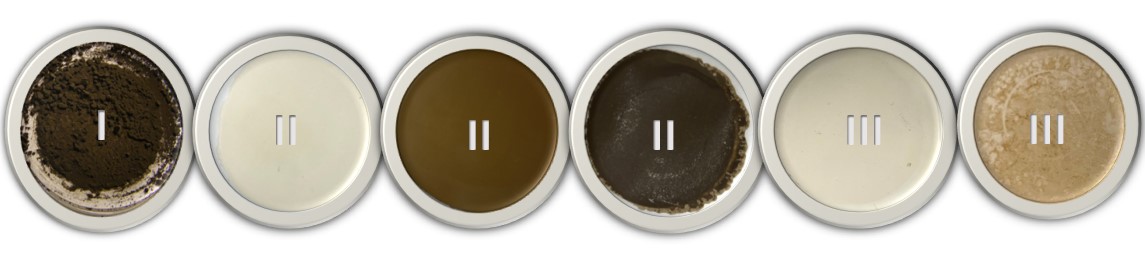
Figure 1. Varnish formation in Group I, Group II and Group III base oils. Figure courtesy of Fluitec.
Myth 2: Turbine oils can be formulated with specialty base fluids and/or additives to make them non-varnishing.
Greg Livingstone: It would be nice if everyone could just buy one oil and never have to worry about varnish—if there was a silver bullet that would, in all cases, solve all varnish problems. The introduction of synthetic base stocks (such as polyalkylene glycols [PAGs]), specialized solubility enhancers and even some detergent/emulsifier packages has resulted in turbine oil formulations with much greater deposit control performance. However, if you exert enough thermal stress on the fluid, it will produce deposits. A recent paper demonstrated this, which tested the Membrane Patch Colorimetry (MPC) of three turbine oils and one PAG-based turbine oil, once they had reached 25% remaining value during the RPVOT test. All four oils tested at critical varnish levels, showing that under the right circumstances, deposits can be created. As of today, there’s no such thing as a varnish-free turbine oil (see Figure 2).
Verdict: Myth Busted
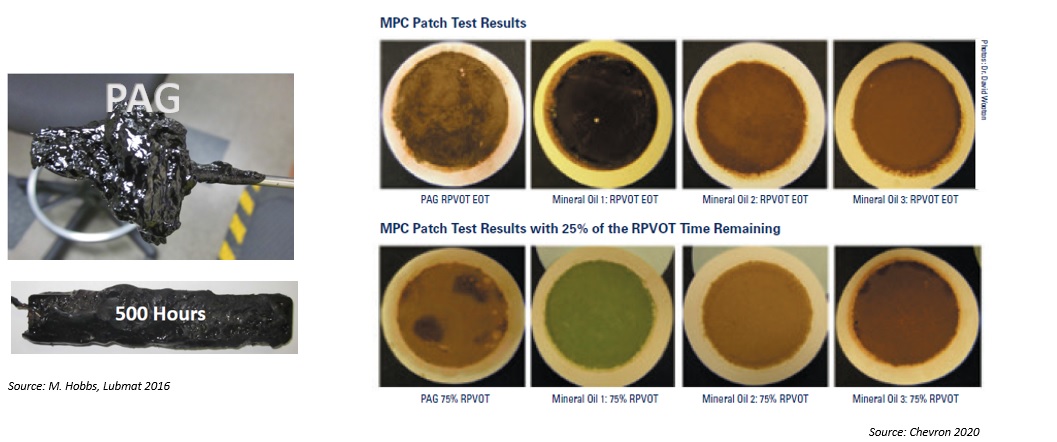
Figure 2. This illustrates the fact that “varnish free” oils do not exist. Left side of the figure courtesy of EPT Clean Oil. Right side of the figure courtesy couresy of Chevron.
Myth 3: My oil’s MPC delta color is low, so I don’t need to worry about varnish.
Elaine Hepley: Among the things that we have seen when we analyze MPC samples through micro patch analysis are a lot of non-compatibility product problems—so chemical degradation. What we might see is additive fallout—some kind of alloy composition or degradation due to some type of chemical reaction.
Another thing that we will see is contaminants that typically would otherwise go undetected.
They can serve as catalysts to the formation of varnish, but you typically won’t pick up any of these catalysts or byproducts of varnish or contributors to varnish formation in a true traditional MPC analysis. Sometimes you will be able to find some of these other catalysts or byproducts of varnish through different analysis, micro patch being one of them.
Another thing that we could see is incompatibility where the customer switched from a synthetic to mineral oil or vice versa, and the oil wasn’t completely drained. The sump will have a mixture. Any time you change oil, there is anywhere from 10% to 20% residual of the previous product in the sump. There is often incompatibility between synthetic and mineral-based oil.
It’s best to take the oil sample while the system is operating. Varnish has a tendency to adhere to surfaces—especially the cool areas. That’s where it bonds and agglomerates. So, we have seen where customers have taken pictures of the sump, and it is caked in varnish. And then we see an MPC value that is less than 15; it looks white. It could be that the customer took the sample when it was cold. When the system and the oil heat up, that activates the varnish to bond and become solubilized in solution. This allows us to best capture the varnish in the system.
So, there are two different kinds that we are going to look into, and one of them is cold varnish oil degradation. The accumulation of the degradation products tends to form and deposit in a corner or in the heat exchanger. We’re not always going to capture that if the sample is taken cold. So, this is associated with bulk degradations.
The next type of varnish is hot varnish, which is localized in a hot spot or bearing. All of this forms when varnish falls out of solution and onto the surfaces of the system. It acts as a heat insulator, generating hot spots. So that’s where we could see varnish in a localized area, as the oil is circulating. And if that area is very hot, we’re going to see that formation of varnish accelerate as well. So it does impair reliable operation. It also can affect bearing life.
We typically cannot detect this through oil analysis MPC; detection is typically through temperature or vibration analysis.
Regarding our internal method to detect soluble varnish, when varnish starts to form, it has a tendency to start off as micro-agglomerations, and we have been able to detect soluble varnish. If you’re able to detect soluble varnish, you’re more than likely going to be able to prevent varnish from continuing to form. A sample can have a high soluble MPC value along with insoluble varnish that we’re detecting through ASTM D7843 (MPC). What we want to do is provide you with another alternative to be able to detect the formation of varnish early, and we can do that through detecting the soluble varnish.
Over time, as the varnish continues to form, the oil solubility becomes saturated; it can no longer hold the varnish in suspension, and over time it will tend to plate out. That’s where we can start detecting the soluble and insoluble. So, when you do have a high amount of insoluble, just know that it already had gone through a process where it oversaturated the oil and then started to form agglomerations.
So, my oil’s MPC Delta E is low, and I don’t need to worry about varnish? Not true. You want to further investigate and do additional testing.
Verdict: Myth Busted
Myth 4: I can get MPC results from my lab with a one or two day turnaround.
Elaine Hepley: According to ASTM D7843, samples must be baked in an oven at 60 C for 23 to 25 hours. What happens is we’re baking the sample in the oven to allow the varnish molecules to reactivate, come back into solution and bond together. Then after it’s been in the oven for 24 hours, we take the sample out, and it gets placed in the dark for 68 to 76 hours—ideally three days. It has to be placed in the dark, so that UV light doesn’t have a negative impact or artificially inflate the MPC value. Then once the oil is cold, varnish formation starts to take place, and we get a true reading of the potential for varnish in the system. If we were to shorten the incubation time, you might get a lighter color reading because you’re not giving the oil and the varnish enough time to settle out and produce an accurate reading. If any lab tells you that they can get results in one or two days, I would question their methodology.
Verdict: Myth Busted
Myth 5: Varnish is only a problem when it becomes insoluble.
Matthew Hobbs: To see where the confusion came about, you need look no further than the ASTM definition of varnish. If you look up ASTM D7843 (the MPC test), it defines varnish as an insoluble deposit, so it’s setting us up to think of varnish as being insoluble right away. Insoluble varnish is an obvious manifestation of a deeper underlying problem, and that deeper underlying problem is soluble (dissolved) varnish.
One way that I like to look at this is that soluble varnish and oil breakdown are like a disease, whereas insoluble varnish is the symptom. Of course, it’s a lot easier to spot a symptom than it is to diagnose the disease that caused it. This is why so many people feel that varnish is only a problem when it becomes insoluble.
This also explains why there are so many issues with some varnish removal systems. How do you deal with insolubles? You use conventional filtration. Unfortunately, as we’ll see this isn’t ideal when it comes to dealing with varnish. For instance, I know of one user who chose high-efficiency filters that were marketed as being varnish removal filters to address a varnish problem they were having with an actuator in their system. They installed those filters and they were pulling insoluble varnish out of solution (see Figure 3). They could physically inspect the filter and see varnish on the filter after it had been in use for some time. They pulled samples upstream and downstream of these new filters and ran a quick patch test on site.1 When they simply took this oil and passed it through a patch upstream of their varnish filters, you could clearly see that there was insoluble varnish in the fluid. Downstream of these new filters, the patch looked white. No varnish was apparent. So, by this result, and by the fact that they were seeing varnish all over the filters themselves, one would certainly think that the insoluble varnish was removed.
But the problem is that the valve kept sticking. So, they removed insoluble varnish, which they thought to be the problem, but the problem persisted. The reason that that problem persisted becomes obvious when you take that same oil sample upstream and downstream of the oil filter and run a full MPC test instead of a quick onsite patch test.
The onsite patch test was only capturing insoluble varnish. When you do this, there’s still varnish dissolved in the oil, and because that varnish is dissolved in the oil, it passes right through the lab filter patch; you don’t catch anything; you don’t detect anything. But, by subjecting that same oil sample to actual MPC methodology, you can see that there was soluble varnish in that fluid.
Another thing that really becomes apparent in this particular case study is the impact of installing high-efficiency filters. Certainly, the oil is cleaner. The end -user removed some insoluble varnish, and the particle count definitely improved. These are all really good things, so I’m never going to say enhanced filtration is bad. But what became quite apparent is that it didn’t really have any impact on the fluid’s MPC varnish potential. The reason for this is that the varnish potential of this particular fluid was dominated by the soluble varnish component (which passes right through onsite filter patches and onsite varnish filters). It was this soluble varnish that was to blame for the actuator-sticking issues, so removing insoluble varnish only had very little impact unfortunately.
Again, insoluble varnish is a symptom of the greater underlying disease, which is soluble varnish and oil breakdown in general. To cure a disease, you have to do more than treat symptoms.
Obviously, this case study proves that varnish is problematic in both its soluble and insoluble states.
Verdict: Myth Busted
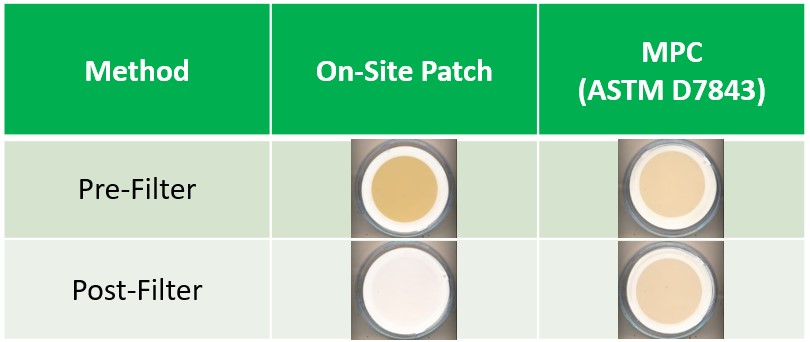
Figure 3. MPC shows even high-efficiency filters have little impact on soluble varnish. Figure courtesy of EPT Clean Oil.
Myth 6: All varnish removal systems are equally effective.
Matthew Hobbs: There are a lot of varnish removal systems available on the market, and these employ a lot of different technologies. This is a result of the fact that varnish problems are prevalent within industry. We always talk about turbines, but it is certainly not limited to turbines. So, because of the fact that varnish problems are so prevalent, there are many different technologies and lots of different vendors and suppliers with their own solutions to these problems.
Regardless of what technology you choose to mitigate your risk of varnishing, that technology will rely on one of three key strategies:
1. A solubilizer or a solvency enhancer. This is an additive that promises to increase the oil’s saturation point, increasing its ability to hold varnish and to keep it dissolved and soluble within solution. These solubilizers can allow you to defer varnish problems. There is a time and a place for them, and they can be very useful products when used in an appropriate way, but they don’t solve varnish problems; they defer them. They allow you to increase the oil’s saturation point to keep that varnish in solution longer. If you only have a month until your next outage and you’ve got to change your fluid at that point anyway, these might be the perfect product for you. For longer term use, however, I suggest consulting with the fluid manufacturer to ensure the product's suitability and long-term performance.
2. Conventional filtration. This can take a variety of different forms including depth filters, high-efficiency filters or electrostatic systems. The one thing that these all have in common is that they are relying on some sort of sieve-type filtration, which I will refer to as conventional because this is what everyone is using to some degree. I don’t really need to belabor this point because, in the previous myth, we talked about how the filters effectively removed insoluble varnish, but that didn’t solve the problem. That underlying soluble varnish was still pervasive in that system and is, ultimately, the root cause of varnish problems.
3. Ion-exchange resins. These are useful as chemical filtration systems. They are engineered to remove things that are dissolved (soluble) within the oil. Continuous filtration through an ion-exchange resin removes oil breakdown products as they form. This prevents them from accumulating and prevents the oil from ever becoming saturated. Essentially, you are preventing a varnish problem further down the line because the first stage of oil breakdown is always the formation of dissolved breakdown products. If you’re in a situation where you have a varnish problem and you need a solution, this is the best option.
There are positives to any of these technologies, but only ion exchange addresses the root cause of varnish problems. This makes it the most effective varnish removal solution (see Figure 4).
Verdict: Myth Busted
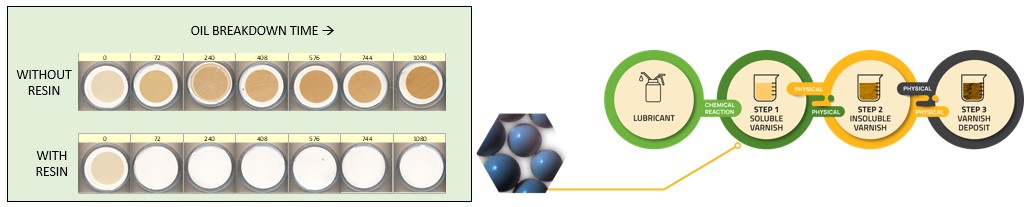
Figure 4. Ion-exchange chemical filtration does prevent varnish from accumulating as oil degrades. Figure courtesy of EPT Clean Oil.
Audience Questions
1. Does soluble varnish always precede insoluble varnish?
Matthew Hobbs/Elaine Hepley: Soluble varnish is in equilibrium with insoluble varnish. The two are shape shifters, and any change in condition throughout the system can lead to one turning to the other rather quickly. So long as you have any soluble varnish in your fluid, you still have a problem. It’s best to detect the problem at the beginning stages and prevent it from further forming and causing issues that lead to downtime.
2. How do you incorporate ion exchange in a filtration system, or are some filters equipped with it?
Matthew Hobbs: To use ion-exchange-based filters, you want to install kidney loop-type filtration, which continuously treats a small volume of your reservoir at a time through the ion-exchange resin. This removes oil breakdown products as they form and allows you to get ahead of breakdown.
3. Is there an oil temperature limit for varnish potential? I’m assuming that this depends on oil formulations (question is coming from the bearing design perspective)?
Matthew Hobbs: It’s very formulation dependent. Some oils are stable for a very long time at 90 C—others are not. But at 120 C they all degrade. The temperature limit is going to be more dependent on the oil’s specific formulation; if you’re running hotter, you need to have a more robust oil.
REFERENCE
1. The customer just passed the fluid through a filter patch, without doing the considerable sample prep (mentioned earlier) required for the D7843 MPC test.
Jeanna Van Rensselar heads her own communication/public relations firm, Smart PR Communications, in Naperville, Ill. You can reach her at jeanna@smartprcommunications.com.