KEY CONCEPTS
•
Physics-based learning can assist algorithms in identifying patterns and trends, a useful capability for generating accurate predictions in a data-sparse environment.
•
Machine learning makes it feasible to sort through large datasets and multiple friction-related parameters to identify the most tribologically useful 2D materials.
•
Bayesian optimization can generate process parameters that produce high yields of a specified product from a variety of poorly characterized feedstocks.
Two-dimensional materials are a relatively new arrival on the lubricant additive scene. Two-dimensional materials, of course, aren’t truly 2D—even an atomic monolayer has a finite thickness. The term refers to crystalline materials that consist of a single layer or a few layers of atoms with properties (tensile strength, electrical conductivity, band structure, etc.) that differ from those of the bulk material. Graphene is already used as a lubricant additive, and research on producing 2D molybdenum disulfide (MoS
2) additives is well underway because of the ease of shearing between layers in these materials, coupled with the strength of the chemical bonds within a single layer. Could other 2D materials also make effective lubricant additives? If so, is it practical to make them on an industrial scale?
Searching a broad candidate field
Topology-based algorithms have produced estimates of exfoliation energies for bulk materials with layered crystal structures, identifying numerous materials that could produce stable monolayers. Coming from the other direction, bottom-up computations that systematically substitute elements from across the periodic table into known structures have discovered a host of thermodynamically stable 2D materials. Together, the two approaches have identified more than 6,000 novel 2D structures and compositions.
1 Sorting through all these to find the most tribologically useful ones presents a massive challenge. That’s where machine learning (ML), and artificial intelligence (AI) in general, come in.
STLE member professor Prathima Nalam (Department of Materials Design and Innovation, The University at Buffalo) heads a research group that has used AI to screen 2D materials for their potential to reduce friction. She notes that in tribological studies, any phenomenon is likely to be influenced by multiple parameters, some of which come into play at different times. Experimental examination of all of these interacting parameters is often not feasible. Typical laboratory studies examine a few parameters at a time (e.g., temperature and pressure), but this approach might miss out on important processes and interactions. Further, subjecting a few representative candidate materials to laboratory testing using even a limited number of parameters could require exorbitant amounts of time and resources.
Fortunately, various types of AI are especially well suited to sorting through large databases and exploring large parameter spaces. Nalam notes that, although the field of tribology lags other fields (notably biomedical research) in implementing AI in big-data studies, it’s not for lack of input data. Rather, she noted in a 2022 interview,
2 tribologists have not yet made a concerted effort to archive their data in a centralized database form that is amenable to use in AI applications. However, this lack need not be a showstopper, she says. ML experts have developed a variety of statistical methods for generating accurate predictions in a data-sparse environment.
Nalam’s group data-mined 15 material properties that they believed were highly relevant to friction.
1 Although they only had experimental and density function theory (DFT) friction data on five or six materials, they applied these properties as descriptors to a set of 15 well-known 2D materials to calculate the effects of these properties on friction
(see Figure 1). Nalam notes that a descriptor set of 15 is too small for employing Bayesian modeling (more on this later), but they were able to enhance the accuracy of their ML model using physics-based learning to inform their chosen descriptors. That is, they incorporated the physical principles behind the energy dissipation mechanisms into their model rather than relying entirely on the machine to identify patterns and trends.
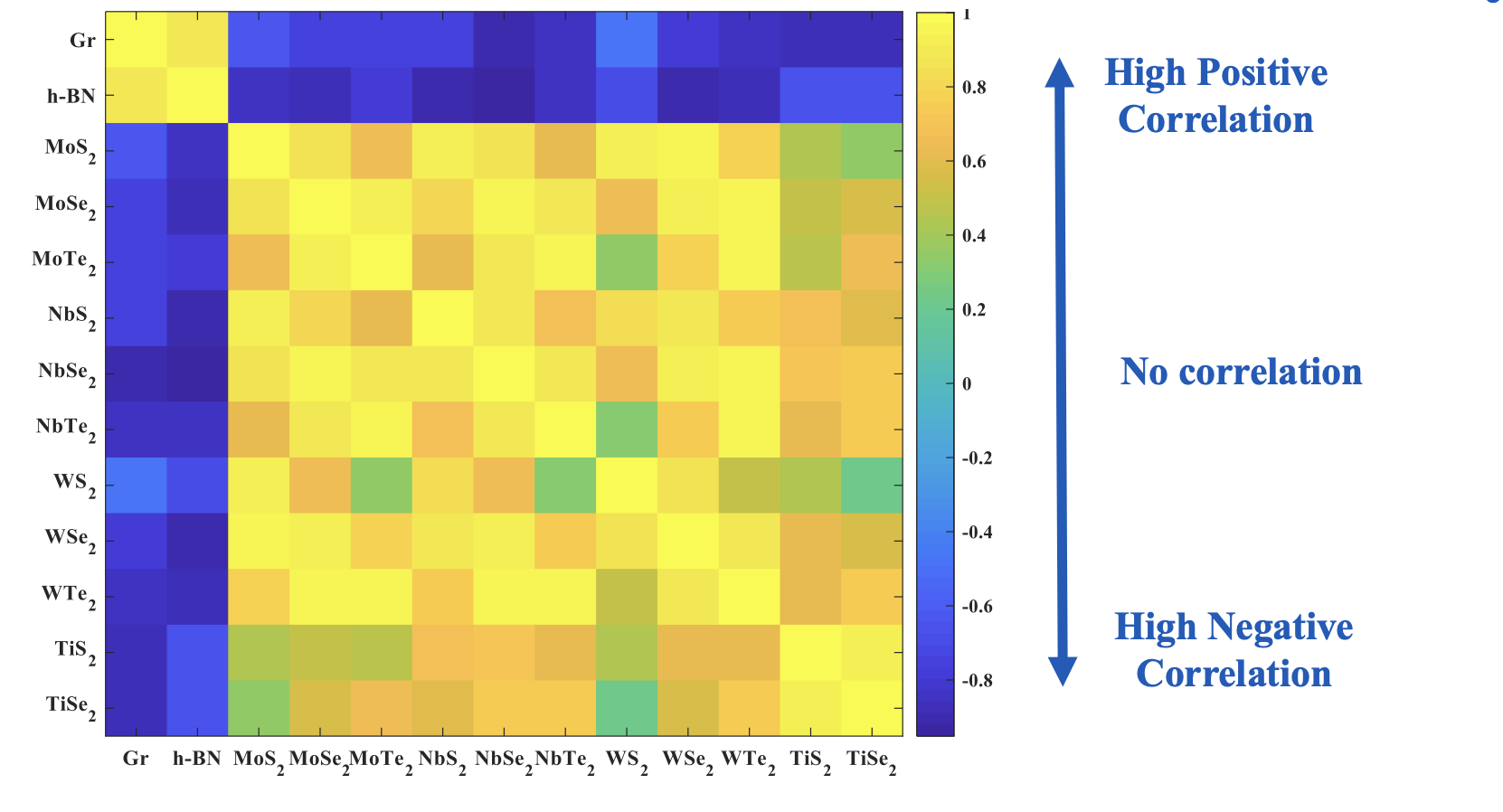
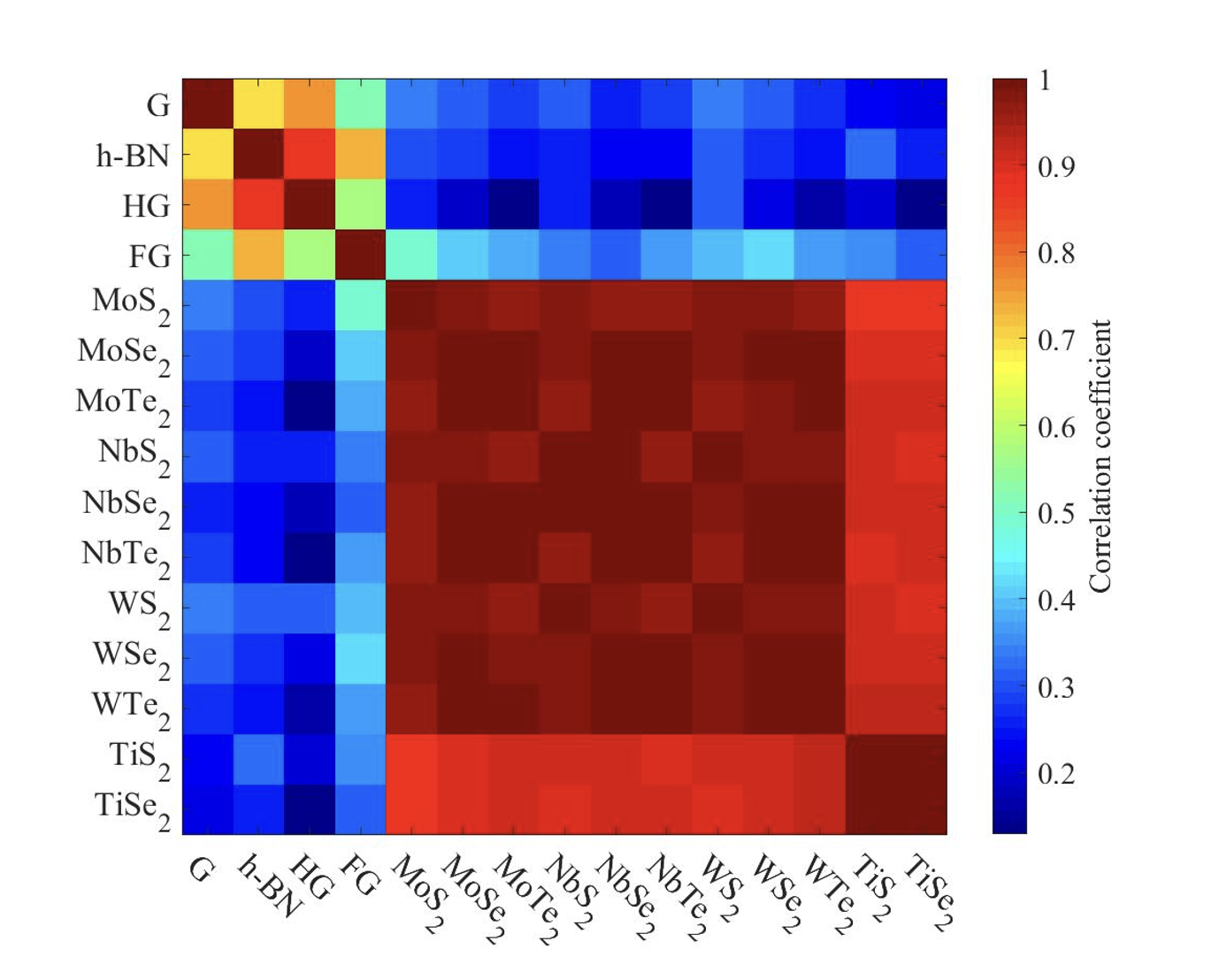 Figure 1. Descriptors related to structures and bond strengths revealed strong correlations between 2D materials within the same structural families. Left: Graphene (Gr) and hexagonal boron nitride (h-BN) represent the graphene structural family, and 11 transition metal dichalcogenides represent the TMD family. Right: Adding hydrogenated graphene (HG) and fluorinated graphene to the covariance matrix shows the effect of atomic substitutions on property correlations. Figure adapted from Ref. 1.
Nalam’s group applied their modeling approach to predict the maximum energy barrier (MEB, which is correlated with intrinsic friction) at the onset of sliding of a single-layer material against a similar layer in an inert environment
(see Figure 2). Literature values of MEB were available for graphene, boron nitride and three transition metal dichalcogenides: MoS
2, MoSe
2 and MoTe
2. Nalams’s group calculated MEB values for hydrogenated graphene, fluorinated graphene and eight previously unexplored transition metal dichalcogenides.
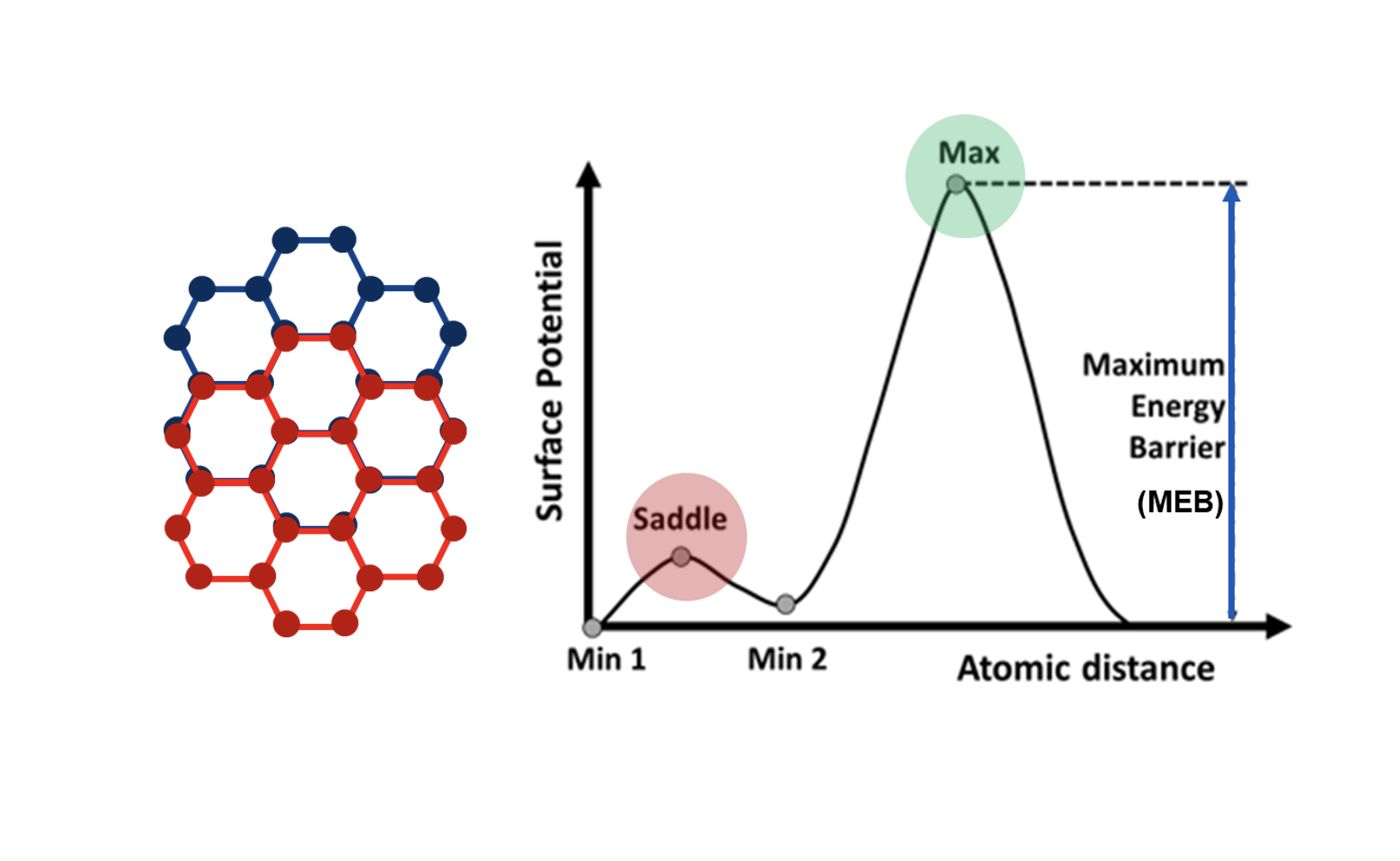 Figure 2. The energy required to slide layers of 2D materials relative to each other (blue and red hexagons at left) depends on the potential energy surface, which maps the relationship between structural geometry and energy. Energy minima in the plot at the right indicates adhesion, and the derivative of the energy required to slide across the maximum energy barrier (MEB) indicates the energy of separation at the onset of sliding. Figure adapted from Ref. 1.
The next step was to generate potential energy surface profiles using molecular dynamics simulations for hydrogenated graphene and tungsten disulfide to validate the findings obtained from the ML model. Interlayer friction in 2D materials depends on the amount of separation energy required to slide the layers relative to each other across a corrugated (sinusoidal) potential energy surface. Thus, mapping variations in this energy surface showed how these variations were related to atomic types, structural arrangements, local charge distributions and lattice vibrations. The minimum and maximum energy potentials and the energy required to cross between them provided information on the adhesive and static friction forces for each material.
Their study enabled them to identify which material properties were most sensitive to the corrugated potential, which in turn points the way toward design routes for synthesizing 2D materials with optimal tribological properties. The descriptor sensitivity analysis showed that observed intrinsic friction is sensitive to lattice spacing, atomic mass and the cohesive energy of the 2D materials, among other factors. For the dichalcogenides, they found a direct correlation between MEB values and polarizability of the chalcogenide atoms.
Newer databases for 2D materials contain at least 30-50 descriptors, Nalam says. Existing tribological models contain a wealth of empirical, thermodynamic and other types of physical properties that help to compensate for the sparsity of experimental data in AI-usable form.
How to make a lot of graphene
Just as AI and ML help to sort and find patterns for material composition screening and basic research efforts, they also assist process development researchers in sorting through multiple interacting parameters.
Jacob Beckham, a graduate student working in James Tour’s research group at Rice University, and his colleagues have developed a Bayesian analysis method for optimizing graphene yields using flash Joule heating—a method discovered in Tour’s lab—and a variety of feedstocks.
3,4
Bayesian optimization is especially suited to problems where the processes that occur between input and output are complex, noisy and computationally expensive. The method finds relationships among multiple variables, even when doing a complete search of the parameter space isn’t feasible.
This effort has two goals: reducing the cost of large-scale graphene production to enable wider use and facilitating the use of low-value feedstocks like plastic and rubber waste. This method could be scaled up to produce enough turbostratic flash graphene (tFG) for use as an inexpensive additive for commercial lubricants. What’s more, tFG products are more stable against oxidation than reduced graphene oxide synthesized using chemical processes.
5
Flash Joule heating passes a jolt of electricity through a given feedstock—in this case, carbon black, pyrolysis ash from plastic waste recycling, pyrolyzed rubber tires or metallurgical coke—to form turbostratic graphene
(see Figure 3). (The research group also has used flash Joule heating to make mixed-phase MoS
2 and WS
2, nanoparticles of high-entropy alloys and other nanomaterials.) Turbostratic graphene particles consist of a few atomic layers, each containing carbon atoms arranged in a honeycomb pattern. The alignment of the individual layers with respect to each other is disordered like a messy stack of papers, rather than a graphite-like ordered AB arrangement.
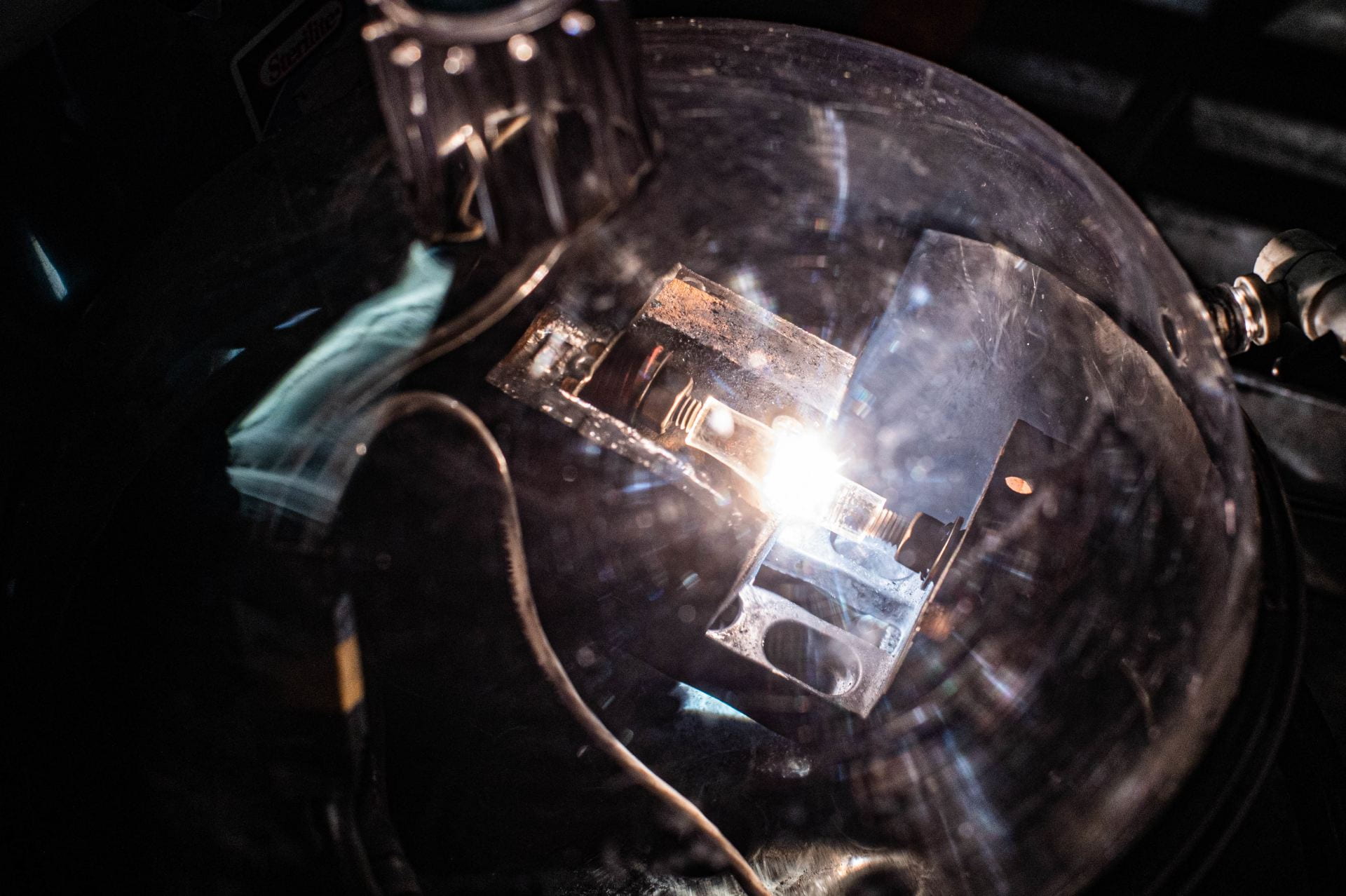 Figure 3. Flash Joule heating passes a jolt of electricity through amorphous carbon to form turbostratic graphene. Figure courtesy of Jeff Fitlow, Rice University.
For his yield optimization study, Beckham adapted a Bayesian optimization platform called mlrMBO that another research group was using for laser-induced graphene (a precursor to flash graphene). He explains that this method takes a target parameter and optimizes it over several iterations using knowledge of the process itself rather than characteristics of the material used. The target parameter can be the particle size or layer stacking of the product material, or the ability of the process to produce single particles
(see Figure 4).
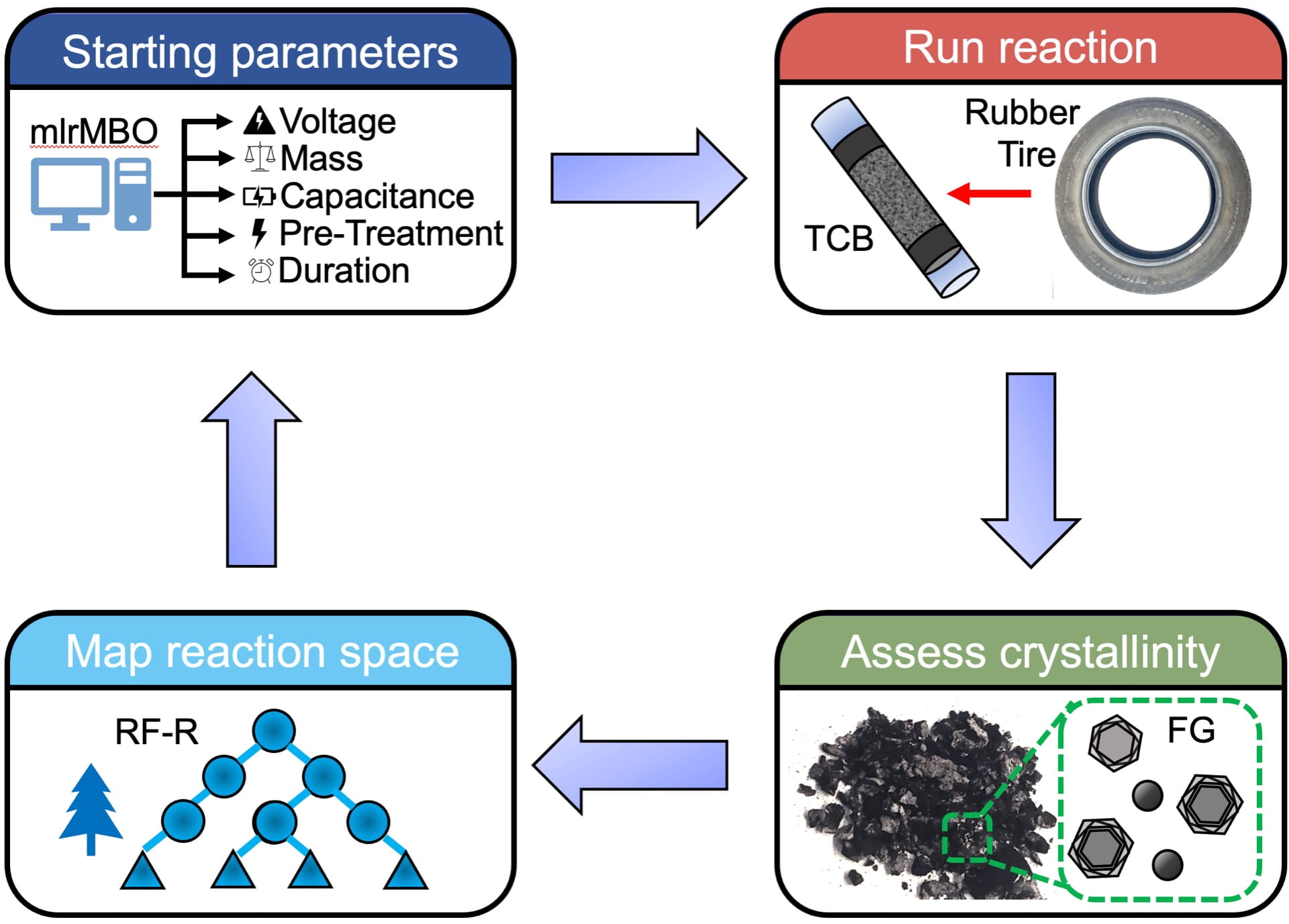 Figure 4. Iterative calculations were performed using the software package mlrMBO and ML to optimize the yield of flash graphene made from tire carbon black (TCB) under a given set of process parameters. The algorithm generated predictions based on an RF-R surrogate model to suggest improved parameters. Figure courtesy of Jacob Beckham, Tour Group, Rice University.
The research group focused on optimizing a scalable method for making graphene from low- and negative-value feedstocks like household waste. The heterogeneous nature of these feedstocks and the dependence of the material characteristics of the resulting graphene on feedstock characteristics and reaction conditions pose a complex challenge. The cost of customizing a new set of production conditions for every batch of starting materials and every set of product specifications could quickly become exorbitant, but this is where AI comes in.
The research group showed that the disordered stacking of the layers in tFG increases its dispersion in two Group IV base stocks (PAO 6 and PAO 9) by a factor of 5 to 14 times over AB-stacked commercial graphene, depending on the feedstock used. Unlike turbostratic graphite, dispersions of tFG reduce the coefficient of friction as much as 23% and wear scar diameter as much as 14% in four-ball tribology tests, and tFG dispersions decrease surface roughness as much as 38%. Compared with conventionally produced AB-stacked graphene, producing tFG requires as little as 1% as much water and 2% of the energy, and the process emits about 1% to 2% of the greenhouse gases.
5
One obstacle to making commercial quantities of tFG using flash Joule heating is the variability and unpredictability of the crystalline characteristics of products made from various feedstocks under various reaction conditions. Studying the process in the lab is difficult because the conversion of amorphous carbon to graphene goes from start to finish over a span of hundreds of milliseconds. Also, although the flash Joule heating reactors now in use can offer good control over the current discharge profile, resulting in predictable outputs, there are many process parameters that would be hard to optimize collectively.
Beckham constructed ML models to explore the factors that drive the transformation of amorphous carbon into graphene nanocrystals during flash Joule heating. Among the factors he examined were charge and current density as predictors of crystallinity. Other factors related to charge and current densities make smaller, but significant contributions to the graphene yield, and these were used to train the model as well. The ML algorithm, based on known properties of the Joule heating process, was trained using more than 20,000 Raman spectroscopy results that measured the degree of crystallinity of the products made using various starting materials, under various conditions. He applied the ML model using Bayesian meta-learning algorithms to automatically improve the bulk crystallinity of the tFG products over multiple Joule heating reactions.
Beckham used open-source software to build his models and run his optimization algorithm. He says, “Computer science is the coolest field for that. Everyone’s like, ‘Oh, I did this thing here. Everyone, use it.’” He notes that any time he ran into a problem, he could find someone who had dealt with a similar problem on a popular public technology Q&A platform. “There’s typically workarounds that people have found,” he adds, something that might not be available from a proprietary software package.
Applying the algorithm repeatedly improved the calculated graphene yield (the percentage of crystalline graphene in the end product). In this case, the Bayesian optimization algorithm was able to perform calculations starting with waste materials with no prior identification or characterization as input and come up with a process for producing high-quality flash graphene.
The study showed that carbon black made from used tires produced highly crystalline flash graphene. Human-selected parameter values for the flash Joule heating produced a mean graphene yield of 36% from this feedstock. However, using parameters suggested by the Bayesian optimization algorithm, the researchers achieved a mean graphene yield of 79%.
In contrast, graphene made from metallurgical coke (a form of coke used in steel production) had low calculated crystallinity, even when high charge densities were used in Joule heating reactions. This result was somewhat surprising, since metallurgical coke’s low resistance typically generated higher currents during the reaction compared with other feedstocks. However, metallurgical coke particles are larger than those of the other feedstocks, which may have hindered their complete conversion to graphene.
These results not only shed light on graphene crystallization processes, but they also provided a guide to using ML for designing and optimizing production processes for other feedstocks and products. Depending on the application, the Joule heating parameters can be adjusted to produce different sizes of graphene flakes, various levels of disorder in the stacking of the layers and various degrees of purity.
Applying this knowledge in the lab, Tour’s group has made as much as 10 grams of graphene per flash. They produced a kilogram of graphene in an hour and a half using an automated system they built for the Department of Energy. Tour and his colleagues expect to be able to produce one tonne of graphene per day by summer 2023. “Since lubricants only use about 1% solid additives, this could go a long way,” he says.
Research using AI for 2D lubricant additives is still in the very early stages, but the results are encouraging. The high-volume number-crunching capabilities and the ability to tease patterns out of large datasets and parameter spaces make AI especially suited for exploring the periodic table for novel compositions and ramping up real-world production of the most promising candidates.
References
1.
Baboukani, B. S., Ye, Z., Reyes, K. G. and Nalam, P. C. (2020), “Prediction of nanoscale friction for two-dimensional materials using a machine learning approach,”
Tribology Letters, 68: 57, available
here.
2.
McGuire, N. (2022), “Artificial intelligence for real-world mechanical systems,” TLT,
78 (2), pp. 32-43. Available
here.
3.
Beckham, J. L., Wyss, K. M., et al. (2022), “Machine learning guided synthesis of flash graphene,”
Advanced Materials, 34 (12), 2106506, available
here.
4.
Falk, J. (Jan. 31, 2022), “Machine learning fine-tunes flash graphene,” Rice University News and Media Relations press release. Available
here.
5.
Advincula, P. A., Granja, V., et. al. (2023), “Waste plastic- and coke-derived flash graphene as lubricant additives,”
Carbon, 203, pp. 876-885 available
here.
Nancy McGuire is a freelance writer based in Albuquerque, N.M. You can contact her at nmcguire@wordchemist.com.