KEY CONCEPTS
•
The purposes of detergent additives in lubricants range from maintaining engine cleanliness to using overbasing to inhibit corrosion and decreasing engine emissions.
•
Since the 1940s, detergent chemistry has continued to change and improve to meet the demands of new applications and of new market trends, while meeting the requirements of increasingly stringent regulations.
•
Satisfying those new and evolving health, safety and environmental regulations on detergent chemistry and its applications will be the key technical issue moving forward.
Detergent additives play a primary role in lubricant formulations with purposes ranging from maintaining engine cleanliness to providing neutralization and inhibiting corrosion. These additives are widely used in transportation lubricants (e.g., automotive engine oils, marine cylinder lubricants) and industrial lubricants (e.g., metalworking fluids, corrosion inhibitors).
1
The 1940s saw the development of the first detergent additives, which have undergone continuous improvement in parallel with the development of new engine technologies. Recently, new detergents have been developed to improve performance and to meet new regulatory requirements (e.g., emission control of sulfur, carbon dioxide, etc.). Examples of new detergents include hybrid salicylates and low ash/ashless detergents.
Types of detergents
Typical detergents include sulfonates, salicylates and phenate, which can either be neutral or overbased
(see Figure 1).2 These detergents can be further categorized by other features such as metal type (e.g., calcium, magnesium, sodium, barium in amorphous or crystalline forms), varying alkyl group molecular weight, chain length and alkylate composition. All of these categories have determining factors on the resulting detergent performance. Currently, sulfonates dominate the detergent market.
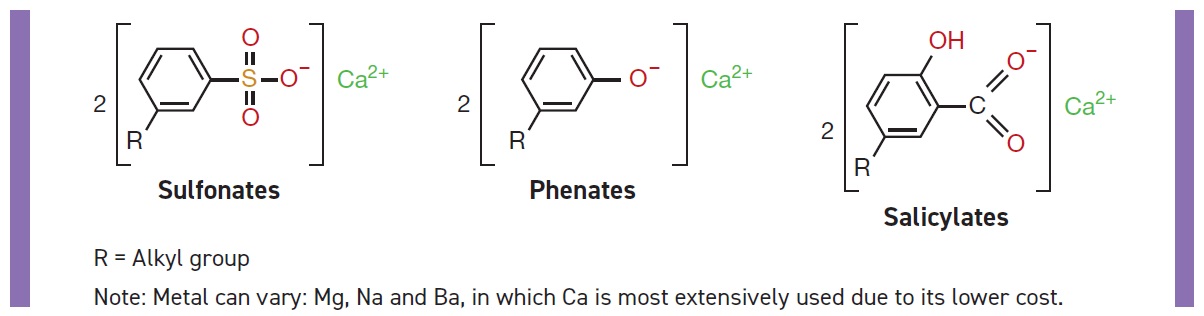 Figure 1. Typical detergents. Figure courtesy of LANXESS.2
STLE member Wayne Mackwood, head of detergent and grease technology at LANXESS in Ontario, Canada, says, “The most common detergents in the lubricant marketspace are sulfonates, phenates and salicylates (and other carboxylates).” Other chemistries and hybrids exist, but those three are the most common. He notes, “The vast majority are metal-based with the most common metals being calcium, magnesium, sodium and barium.”
Mackwood further categorizes detergents “into ‘neutral,’ typically having a base number (BN) of less than 50, and ‘overbased,’ having BNs above that.” Neutral detergents are prepared by reacting an acid with a stoichiometric amount of base.
2 Overbased detergents are prepared by reacting an acid with an excess amount of base in the presence of carbon dioxide (CO
2), forming metal carbonate.
2
STLE Life Member Stephen Hsu, professor at George Washington University in Washington, D.C., notes, “All detergents have the option to attach overbased micro- and nanoparticles of calcium or magnesium carbonate micelles to neutralize acidic species.” This option is important in heavy-duty diesel engine and railroad locomotive engine applications where the BN can be used to monitor the useful life of the lubricant. Hsu says, “Phenates are often paired with sulfonates in heavy-duty applications to enhance the detergent capacity on some severe applications.”
Hsu notes, “The main function of detergent additives is to clean lubricant reaction products that have adsorbed on the engine surface.” The bulk lubricant is typically composed of dispersant additives and detergent additives. The dispersant additives clean up the oil soluble products, while the detergent additives remove adsorbed products from the surfaces. Hsu notes, “Typically, calcium sulfonates are used in higher temperatures while magnesium sulfonates are used in lower temperature applications.” He says, “The salicylates are relatively higher cost but are more effective in higher temperature conditions.”
Detergent applications
Detergent applications range from automotive and marine engine oils to metalworking and industrial lubricants, and beyond. Hsu says, “The detergent additives are currently used in automotive lubricants, heavy-duty diesel and locomotive engines and construction and agricultural engines.” In contrast, neutral detergents are often used in small engines and in other light-duty applications.
Mackwood notes, “Detergents are used extensively in transport lubricants for marine (2-stroke [light crude oil (CL)] and 4-stroke [truck piston engine oil (TPEO)]) engine oils, passenger car motor oil (PCMO) and heavy-duty diesel engine oils (HDDEO).” In addition, he says that detergents can be used in “industrial lubricants, rust preventatives, industrial cleaning solutions and metalworking and metal-forming fluids, as well as in lubricating grease.” Detergents “also can be gelled to form rust preventative bases, as well as lubricating greases.”
Functions and acting mechanisms
Detergents can have a multitude of functions depending on their design. They can provide excellent high temperature detergency and neutralization, while also providing oxidation stability, antiwear performance, some dispersancy and even friction reduction.
2
Mackwood lists detergent functions as providing “detergency, corrosion protection, acid neutralization, antiwear, extreme pressure (EP), dispersion and even antioxidation.” Another function is viscosity build (e.g., calcium phenate in marine cylinder lubricants). Of all the lubricant additives, he finds detergents to be the most multifunctional.
Hsu notes that the detergent molecules function similarly to dispersants. The detergent molecules “are polar molecules operating in micellar solution
(see Figure 2).” The detergent molecule with the metal atom at the center on the right side of Figure 2 will absorb onto the surface and remove the particles into the solution phase. Hsu says, “Depending on the alkyl chain length and the size of the particles to be removed, the detergent structure can be modified to provide optimum efficiency.”
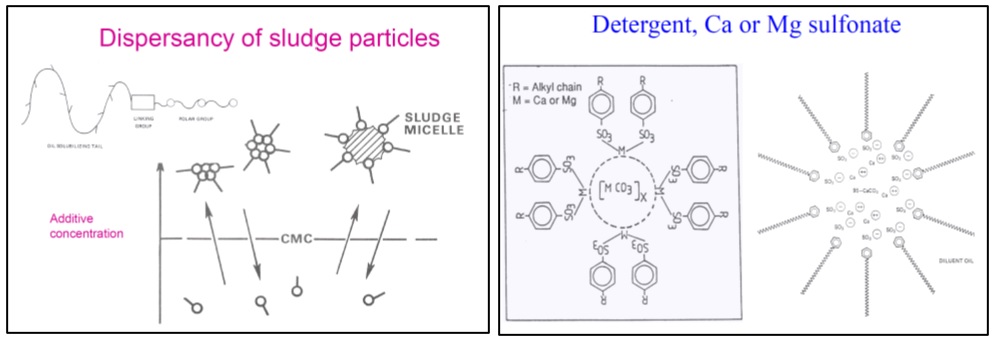 Figure 2. Colloidal micelles of additives in solution showing on the left how dispersants attach themselves to micro-sized particles, while the detergent molecule on the right will adsorb onto the surface and move particles away from the surface.3
Mackwood agrees, and says, “Detergency and corrosion inhibition come from the sulfonate, phenate or salicylate ‘soap.’” The “soap” molecules are polar and “preferentially adhere to the metal surface to prevent deposits, remove deposits and prevent corrosive materials from getting to the metal surface.” He observes that another way of controlling corrosion and deposits is from “the neutralization of acidic byproducts in the combustion process,” which comes from the residual hydroxide (i.e., fast, initial neutralization) and the carbonate (i.e., a large reserve of alkalinity for neutralization).
Mackwood notes, “The calcium carbonate acts to provide antiwear, EP, as well as assisting in corrosion protection.” In contrast, the antioxidant properties “can come from salicylate chemistry and possibly from the phenates as well.” He observes, “Finally, overbased phenates, given their very high viscosity, are a good example of a detergent that can significantly contribute to the final viscosity of the lubricant, as found in marine cylinder lubricants.”
Detergent interactions with other additives
Mackwood says, “There can be both desired and undesired chemical interactions between detergents and other chemistries.” He provides an example of a negative interaction occurring when “the free hydroxide found in both neutral and overbased detergents reacts undesirably with acidic components found in the lubricant blend.”
In another example of negative interactions, Mackwood observes, “Overbased products are the result of oil-insoluble calcium carbonate being encapsulated and stabilized in solution, through the inverse micelle structure of the calcium sulfonate.” These micelles can sometimes “be disrupted through undesired interaction with other detergent micelles, such as phenates and salicylates.” When this happens, excess sedimentation of solids from the oil or gelling of the material can result. He notes, “Proper selection and design of the soap structures can avoid this negative interaction.”
Mackwood provides an example of a positive interaction as “the known synergistic interaction of sulfur EP compounds and overbased sulfonates, and in particular, crystalline carbonate containing sulfonates.” The EP performance is several times better when those compounds are combined than it is when the components are kept separate.
Hsu observes, “In terms of additive-additive interactions, detergent molecules, especially overbased detergent molecules, are large.” This means that the first interaction occurs in the micellar dispersion process. Using the dynamic light scattering (DLS) technique, Hsu and his group measured “the hydrodynamic radius, which reflects the individual micellar aggregation size
(see Figure 3).” Since the aggregation size was rather large, they started to measure mixtures of sulfonates and phenates, which were often used together. Under some concentrations, the phenate and sulfonate formed unstable aggregation, and the size continued to grow until the aggregations dropped out of the solution
(see Figure 4). This phenomenon had been observed during oil blending when the wrong concentration of additives was used. Hsu states, “The interaction is due to some physical and chemical interactions between the two molecular species.” This means that additive interaction is important in formulation development.
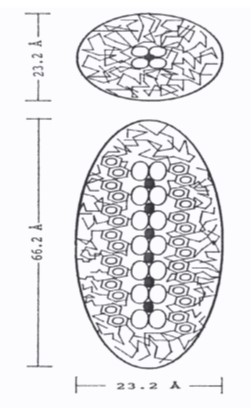 Figure 3. Calcium sulfonate detergent micellar aggregation structure. The top structure is without overbase, and the bottom one is with large overbase structure aggregate of CaCO3. Figure courtesy of Hsu, S. M. and Nagarajan, R., “Calcium sulfonate aggregation micellar structure,” unpublished data.
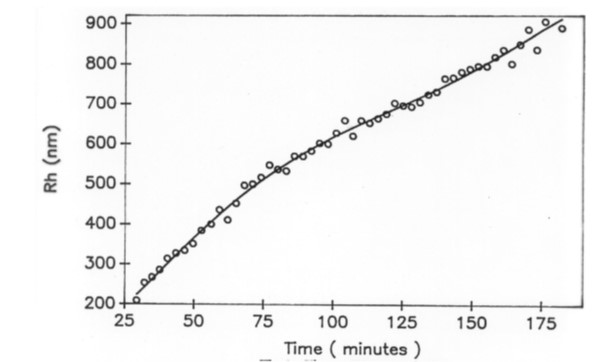 Figure 4. When phenate (2% in hexadecane) is added to calcium sulfonate (1.6% in hexadecane), the aggregation continues to grow. As the size of the aggregate spirals out of control, it precipitates out of solution. Figure courtesy of Hsu, S. M., Hu, Z. S. and Sun, J. X., “The interaction between phenate and calcium sulfonate,” unpublished data.
Low-speed pre-ignition
Low-speed pre-ignition (LSPI) can occur in gasoline engines when the main fuel charge ignites prematurely. LSPI can negatively impact engine performance and even result in engine damage.
Mackwood notes, “Calcium metal can negatively interact with residual unburnt fuel and/or degradation products within the cylinder rings causing the pre-ignition event.” Metals and other components also could be involved in the LSPI event, although magnesium metal has been shown not to be a source for LSPI. Therefore, Mackwood says that while “magnesium sulfonate may not eliminate the problem, it does not appear to contribute to it.” Because of this, switching in part or in entirety to magnesium sulfonate can help eliminate LSPI.
Hsu agrees, explaining, “In LSPI, both calcium sulfonate and magnesium sulfonate will be present on the hot surface.” As “the temperature continues to rise, magnesium will boil off first (i.e., boiling point 1,090 C), followed by calcium (i.e., boiling point 1,484 C).” Therefore, as Mackwood states, magnesium is better than calcium for LSPI.
Will EV coolant need detergents?
Mackwood notes, “Work is still underway on the development of electric vehicle (EV) powertrain fluids, which will both cool and lubricate the electric motors as well as the transmission components.” He projects that a high BN detergent is not likely to be required, but a corrosion inhibitor would still be needed. This corrosion inhibitor “is more likely to be a log-to-no superabsorbent polymers (SAPS) material.” He notes, “Copper corrosion performance will be critical, given the contact with the electrical windings at high temperature, so the presence of sulfur will probably not be desirable.” The metals content of the lubricant may need to be controlled given that the electrical properties of the fluid will be important. He says, “Deposits that would be formed in these fluids might best be controlled with good antioxidants.”
Hsu agrees that an EV would not require overbasing as there is no combustion. However, “the lubricant has to have electrical conductivity to avoid corrosion and maintain close surface contacts.”
Regulation changes and detergent market trends
In the industrial lubricant market segment, Mackwood says, “The use of traditional detergents, in particular sulfonates, will likely continue using what is currently available and proven.” Given that detergents are such multifunctional additives, replacing them seems unlikely, although work will continue to improve their sustainability.
Mackwood expects the biggest changes to be in the transport lubricant market where the two primary drivers are “the move to EV for on-road vehicles and the move to very low sulfur fuels in the marine market.” He expects the market for PCMO to remain strong, “but the switch to EV will have to have an impact on the need for and the consumption of these lubricants.”
Mackwood observes, “In the marine market, the move to lower BN cylinder lubes, from 70 BN to 40 BN, is well underway.” The requirements for very low sulfur fuels are driving these requirements. This drive toward lower BN means there will be less demand for overbased detergents. Mackwood notes, “Some of that detergent will be replaced with neutral material in order to maintain engine cleanliness.” He says that while higher BN formulations (i.e., 70 to 140 BN) will remain to control cold corrosion and for engines with scrubbers running on high sulfur fuel, “the drive will still be toward 40 BN.” He also notes that the consideration for alternate fuels to power large ships in the future (e.g., e-methanol, ammonia, hydrogen) “may ultimately require something completely different in terms of detergents, versus what is currently being used.”
New detergents and future development trends
Mackwood suggests, “The future for oil soluble detergents appears headed toward lower to no sulfated ash and lower to no sulfur content.” In addition, “exploration toward more sustainable chemistry and formulations will be a hot topic in the coming years, as it will be with most lubricant additive chemistry.”
Hsu states, “Detergents are a mature technology.” He projects that moving forward, the trend may focus on “the development or emphasis on metal-free detergents, such as the salicylates type, which are much more expensive.”
The key technical issue facing detergents involves the impacts of satisfying new health, safety and environmental regulations on detergent chemistry and its applications.
REFERENCES
1.
Rizvi, S. Q. A. (2009), “A comprehensive review of lubricant chemistry, technology, selection and design,” ASTM International, Baltimore, Md.
2.
Sniderman, D. (2018), “Introduction to detergents,” TLT,
74 (4), pp. 40-46. Available
here.
3.
Sun, J. X., Hu, Z. S. and Hsu, S. M. (1997), “The effect of concentration, solvent, and temperature on aggregation of a commercial calcium sulfonate additive as studied by FTIR and light scattering techniques,”
Tribology Transactions, 40, pp. 633-638.
Andrea R. Aikin is a freelance science writer and editor based in the Denver area. You can contact her at pivoaiki@sprynet.com.