KEY CONCEPTS
•
Testing and studying complex systems at different scales, from nano to micro to macro, is important to understanding and guiding real-world applications of sliding.
•
Reducing friction impacts can lead to improved design and lubrication engineering in many industries yielding reductions in energy consumption, heat generation, noise, scratching, scuffing, plastic deformation and part failure.
•
While there are limitations in translating findings from one scale to another, tribologists, lubrication engineers, machine and system design engineers, material scientists and other practitioners will be needed to advance tribological research in these areas.
Tribological testing and study at different scales (i.e., nano, micro, macro) and scale connectivity are important to modern nano- and microscale manufacturing industries (e.g., computer hard drives, microelectronics, microelectromechanical systems [MEMS], nanoelectromechanical systems [NEMS]) and to conventional industries that seek to maximize the economical values of nanotechnology. The findings of tribological testing and study at both atomic and nanometer scales connect to real-world macroscale phenomena.
Tribology at different scales
STLE member Dr. Dehua Yang, president of the Exponential Business and Technologies Co. (Ebatco) in Eden Prairie, Minn., cites Peter Jost’s 1966 definition of tribology as “a study of rubbing.”
1 Yang expands the definition to “a study of two surfaces undergoing inclining and/or actual relative motion.” He defines tribology as “a multilength and multitime scale and multidisciplinary complex system study as partially illustrated in Figure 1.”
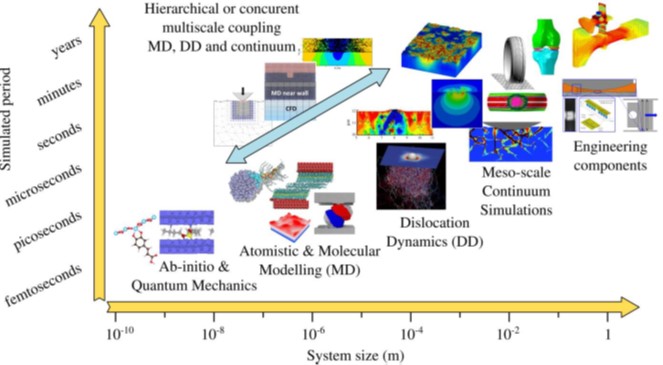 Figure 1. A time- versus length-scales map of models developed in tribology highlighting the intrinsic link between multiscale/physics that needs to be captured to provide predictive tools for engineering applications.2
Yang finds that testing and studying complex systems at different scales (i.e., from nano to micro to macro) is significant to understanding and guiding real-world applications of sliding. How materials interact with each other and with the environment starts at the atomic and the nanoscales. By studying different scales, scale-related and scale-specific phenomena can be identified and addressed. In addition, Yang notes that studying what occurs at different scales will allow understanding of the “breakdown of continuum theory at micro- and nanoscale, the mechanical property size effect, superplasticity, the quantum effect, the dramatically increased surface to volume ratio associated with nanomaterials, etc.” Finally, Yang notes, “Testing and study at different scales will provide scale connectivity for obtaining a relatively complete picture of tribological performance, behavior and failure.” As an example, Yang references a study of “atomic attrition as a wear mechanism for a silicon probe sliding against a diamond surface in a vacuum and under low loads.”
3
STLE Life Member Dr. Stephen Hsu, professor in the Department of Mechanical and Aerospace Engineering at The George Washington University in Washington, D.C., defines tribology as “a discipline that focuses on the study of friction, wear and lubrication of two interacting surfaces under load.” Industrial applications include bearings, gears, transmissions, tires, machining, engines and power generating machines (e.g., compressors, pumps, turbines, etc.). The goal of lubricants is to prevent damage when two surfaces rub together. Hsu notes, “As technology moves forward, new tribological testing will need to be invented, developed and correlated with the actual working cycles of the systems.”
Hsu says, “Since tribological related devices exist in nano-, micro- and macroscale devices and components, testing at these scales is necessary to ensure performance and reliability according to the progression from bench scale to field trials.” To advance the science of tribology, “multiscale tribology testing is necessary to understand the mechanisms of tribological processes,” and to make progress developing lubrication chemistry and additives. He says, “With proper use of multiscale testing, we can trace the molecular origin of chemical reactions and tribochemistry between additives and surfaces.”
Connections between different scales
Hsu notes, “There are misconceptions regarding the data obtained at various length scales.” While practical tribological researchers who develop new products, materials and additives rarely perform nanoscale testing, there is the misconception that data from different scales have to be linked in some way. Hsu says linkage is not necessary.
While many studies have looked into scaling laws, Hsu find the results inconclusive. Hsu says the issue is that the instrument and measurement technology used at each scale tends to be different, resulting in the specific mechanisms identified being dominated by the equipment or instrument used. When researchers try to predict macrosystem performance using smaller scale data, Hsu finds that “the correction tends to be vague or absent.” The findings at each scale can depend on the instruments used, so that a specific mechanism dominates the outcome. Hsu notes, “A nanoscale result may have a different mechanism and condition, and the results may not link to the macroscale outcome.”
Yang lists the impacts of friction on complex systems as including friction induced energy consumption, excessive heat generation, noise release to the environment, wear caused scratching, scuffing, plastic deformation and part failure. Understanding tribological systems at different scales can lead to improved design and lubrication engineering. At the microscale, testing and study can address topics related to the tribology of thin films, coatings and other engineered surfaces, boundary lubrication, asperity contact, friction transfer films and friction, wear and lubrication mechanisms. The beneficiaries of macroscale tribological testing and study could include aerospace, automobile and other transportation vehicles, earth-moving and construction, manufacturing and fabrication machineries industries.
Yang observes: “Microscale testing and study would be directly beneficial for applications under lighter load, having slower speed and working in milder environments.” At nanoscale, testing and study are necessary for nanoscale fabrication, MEMS and NEMS devices, inkjet nozzles, computer hard drives, microgears, micro-electrical switches, self-assembly monolayers for MEMS lubrication, understanding of stiction associated with flat and smooth surfaces and nanoscale tribochemistry phenomena.
Challenges facing nano- and microscale tribological testing
Yang identified six challenges facing the industrial use of tribological testing at nano- and microscales:
1.
Many industrial practitioners “may not know that these tools and approaches could help them to solve challenging issues faced at macroscale and in day-to-day operations, or they lack knowledge and experience to adopt these cutting-edge techniques.”
2.
Lack of access is a challenge to the testing and analysis instruments, which can be expensive to acquire and use.
3.
The costs of performing the tests and analyses is a challenge.
4.
The equipment required for these tests “may require personnel with advanced degrees for operation and interpretation of testing and analytical results.”
5.
The complexity of the tribological system itself may make it difficult “to connect micro- and nanoscale findings with macroscale phenomena without significant and systematic efforts and time to study.”
6.
Finding a sample that is representative of the issue and environment can be challenging. Also, Yang notes, “It is not easy to zoom in three to six orders of magnitude from macro to micro to nano and still land on the correct target of the root cause of issues.”
Table 1 lists typical testing parameters and conditions for tribological testing at the nanoscale.
Table 1. Typical testing parameters and conditions for tribological testing at nanoscale
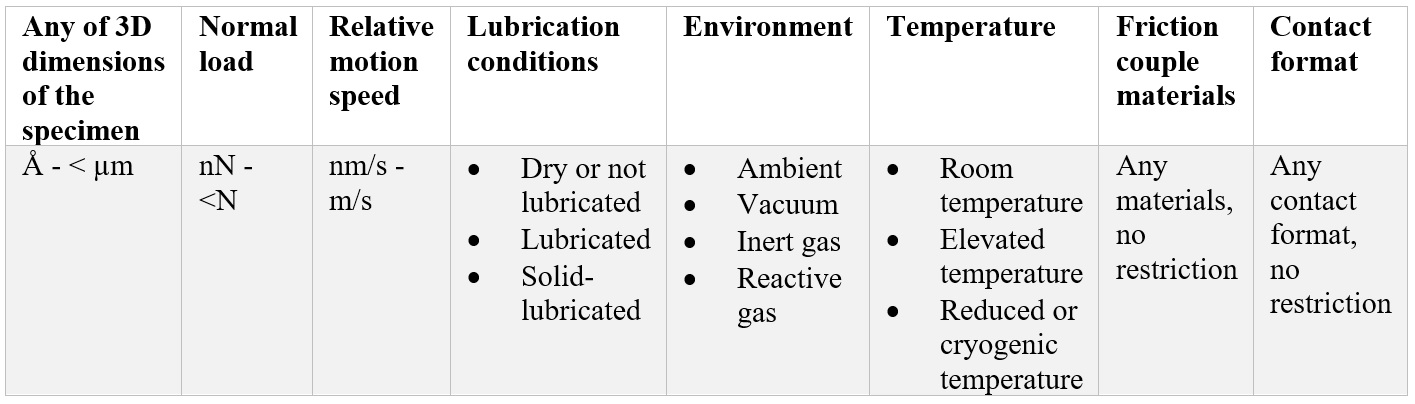 Table courtesy of Dehua Yang.
Important surface and interface analytical tools
Yang lists the surface and interface analytical tools used to study tribology at the nanoscale as including atomic force microscopy (AFM), scanning electron microscopy (SEM), X-ray photoelectron spectroscopy (XPS) and optical profilometry. Instruments that are surface sensitive and can detect compositional and chemical changes from a single nanometer to a few nanometers in surface depth include Auger spectroscopy, XPS and secondary ion mass spectrometry (SIMS). Yang finds “instruments such as AFM, SEM and the optical profilometer to be critical in profiling surface contours in three dimensions (3D), in measuring surface roughness and asperity shape and in observing friction and wear tracks, as well as wear particles, debris, cracks, plastic deformation and fracture, with nanometer or sub-nanometer resolutions.”
Another less expensive technique Yang includes as an important tool is the contact angle measurement technique, which also can be useful for tribological study at the nanoscale. Yang has seen contact angle measurement useful at nanoscale “due to its single molecular layer sensitivity and its capability of detecting contamination, studying tribochemical film formation and direct quantification of lubricant wettability to the lubricated parts and its capability of measuring surface free energy of solid surfaces.”
Using nano- and microscale tribological study to solve macroscale problems
Yang has identified how nano- and microscale tribological study could solve macroscale industrial problems by:
•
Pinpointing the root cause of issues, problems and failures in tribological systems. This study “could provide insights from atomic attrition to particle generation and aggregation to transfer film formation.”
•
Identifying and understanding different wear mechanisms (e.g., simple abrasive, adhesive wear, plowing, oxidative wear, delamination wear and fatigue wear).
•
Providing reference and guidance on material selection, part and machine design, the use of correct environments and application conditions and parameters.
•
Monitoring and diagnosing working conditions to detect early signs of part deterioration to prevent catastrophic events and line shutdowns.
•
Reducing energy consumption through understanding and developing novel tribological systems and materials with low friction coefficient or superlubricity.
4, 5
Studying friction across scales
Hsu defines friction as measuring “the resistance to motion when one surface (i.e., the tip) moves across the other surface (i.e., the flat)” as shown in Figure 2. Instruments used to measure nanoscale friction include the atomic force microscope, nanoindenter and nanoscratch tester, among others.
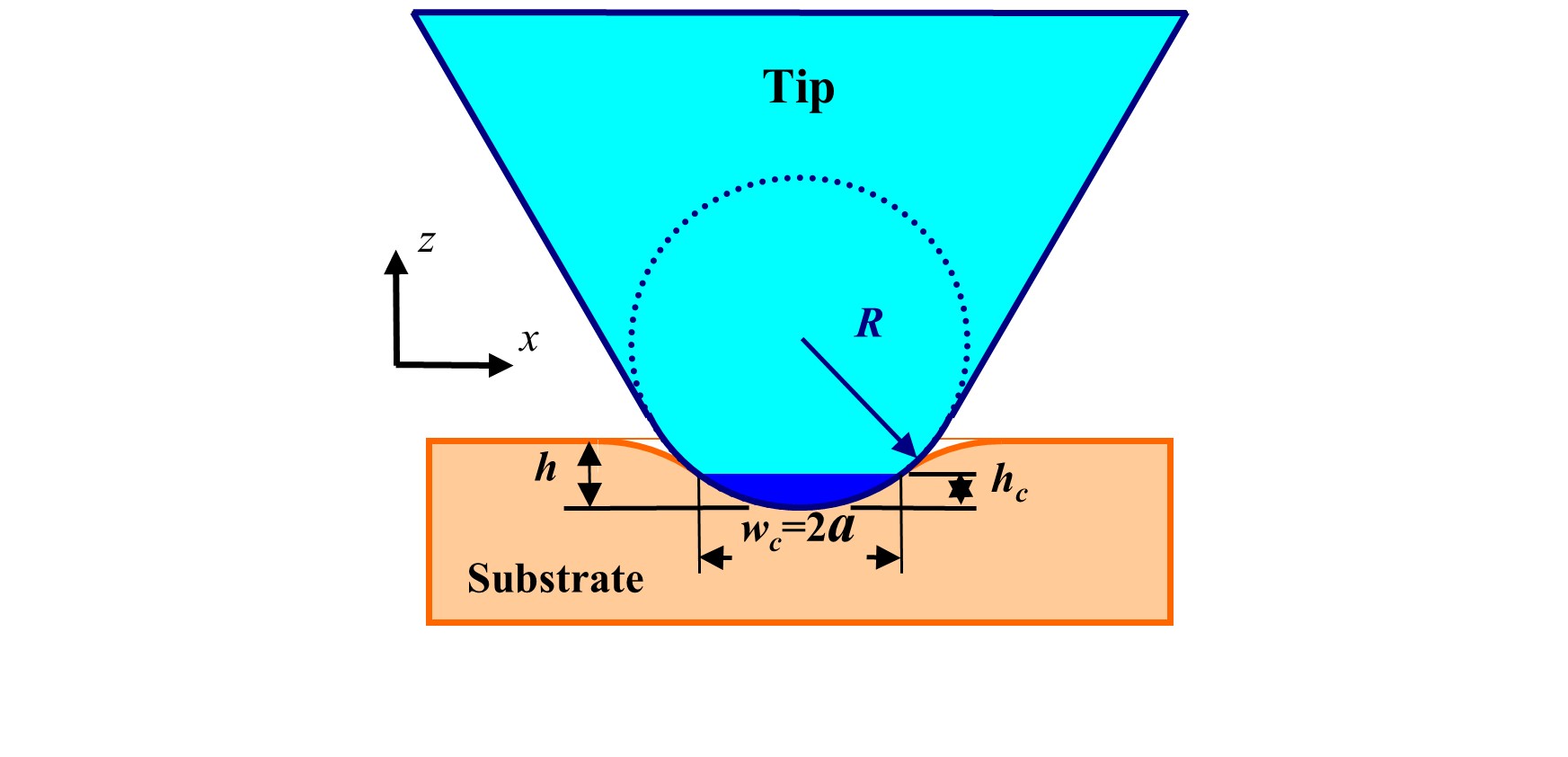 Figure 2. Geometry of an ideal tip for adhesion and friction measurements. Figure courtesy of Stephen Hsu.
Hsu lists “nanoscale frictional forces as including chemical bonding forces (e.g., hydrogen bonding forces), electrostatic forces, meniscus forces if sufficient water vapor condenses on the surface and rarely adhesion force, if the two materials have molecular interactions as a function of separation distance.” The friction mechanisms at this scale can vary from surface forces to plowing. The difference in mechanism can make scale connectivity difficult.
At the microscale, friction issues are occurring in MEMS devices, sensors, actuators and biomedical devices. Hsu notes, “Real device surfaces have curvature and roughness, and the contact geometry can be complex.” At the microscale, plastic deformation, wear and fatigue breakage may be encountered. Hsu finds: “Calibration of the friction measurement (i.e., tip shape, cantilever, spring constants) is time consuming, and the presence of meniscus or capillary force, if present, will need to be taken into account.”
At the macroscale, Hsu has found the objective in studying friction “is to simulate the actual operating conditions to measure the transient, steady state and failure mechanisms.” At this scale, “oftentimes the testing progresses from laboratory testing (i.e., simulating individual failure mechanism and conditions) to rig testing (i.e., actual components with similar load and speed conditions) to actual equipment testing and field trials.”
Macroscale testing, Hsu says, “can be expensive and time consuming and heavily rely on establishing models and correlations with the actual field trial data.” Hsu notes, “It is often difficult to identify the key indicators that will point to the beginning of failure.” Single aspect parameter bench tests (e.g., hot temperature, high load, reactive lubricant, non-reactive lubricant, presence or absence of vibration, etc.) can help simplify the search for the dominant failure process.
Connectivity across scales
Hsu says that if connectivity across the various scales is defined “in terms of predicting tribological properties based on testing at one scale, this may only apply to chemistry (i.e., lubrication chemistry), as both friction and wear will not be able to predict values at other scales.” For example, Hsu notes that in the study of friction across different scales, the friction producing mechanism changes. At the nanoscale, surface forces can be measured, but it is difficult to measure high loads accurately. Moving into microscale and macroscale, Hsu finds “plowing and plastic deformation take place overwhelming the tangential force.” By moving scales, the friction producing mechanism changes, meaning that the connectivity of friction is broken.
Hsu notes other areas where multiscale research is occurring include wear connectivity (i.e., the quantity of mass loss due to sliding under load) across the scales and lubrication (i.e., both solid and liquid lubricants) and in tribochemistry and additive chemistry. In tribological testing, Hsu sees, “The current use of multiscale testing is focused on probing a specific mechanism.” However, Hsu also reports, “Multiscale multifunctional surface design has emerged in materials engineering as biomimetic surfaces consist of designed features at all three scales in order to achieve specific goals of friction reduction, drag reduction or even self-healing and self-sustaining.” In this situation, “The testing will need to be conducted at all three scales to understand, use and troubleshoot issues to maintain the desired performance.”
Hsu identified several hot topics where multiple scale tribological study would be beneficial for friction, wear and lubrication, including drag-reduction swimsuits and textured skis for gaining speed. Hsu notes that both swimsuits and skis “have multiscale designs similar to a lotus leaf to achieve hydrophobicity.” Sports offer areas for new material innovations.
Surface texturing to reduce friction is another hot topic. Hsu says that in engines, research is occurring on surface texture to improve engine efficiency. He provides the example of engines where “the ring contact area is small and rough, so the size of the texture will need to be small and deep; in the case of bearings, the contact area is relatively large, and the surface is smooth, so the dimple size will be large and shallow.” Without multiscale testing, engine efficiency improvements will be hard to prove in this area.
Conclusions
Yang notes while this article has focused on testing and analysis at different scales, another “important aspect of tribological study that has been gaining attention and showing promise is the modeling and simulation study of tribology.”
2
Advancing tribological research will require the joint efforts of “tribologists; lubrication engineers; part, machine and system design engineers; material scientists; and many different field practitioners and users of systems and devices with relative motion.” Yang notes, “
In situ and multiple technique tribometers (i.e., tribometers with optical microscopy, AFM, Raman, etc.) will be very handy and advantageous to conduct tribological testing and study at different scales.”
REFERENCES
1.
Jost, P. (1966), “Lubrication (tribology) - A report on the present position and industry’s needs,” Department of Education and Science, H. M. Stationery Office, London, UK.
2.
Vakis, A.I., et al., (2018), “Modeling and simulation in tribology across scales: An overview,”
Tribology International, 125, pp. 169-199.
3.
Jacobs, T.D. and Carpick, R.W. (2013), “Nanoscale wear as a stress-assisted chemical reaction,”
Nature Nanotechnology, 8 (2), pp. 108-112.
4.
Meng, Y., et al., (2020), “A review of recent advances in tribology,”
Friction, 8 (2), pp. 221-300.
5.
Stoyanov, P. and Chromik, R. (2017), “Scaling effects on materials tribology: From macro to micro scale,”
Materials, 10 (5), 550.
Andrea R. Aikin is a freelance science writer and editor based in the Denver area. You can contact her at pivoaiki@sprynet.com.