KEY CONCEPTS
•
In addition to the overall projected capacity increase in wind energy, the trend is for the size of wind turbines also to increase, especially offshore, with corresponding increases in operations and maintenance costs.
•
In this article, wind turbine drivetrain reliability research and development (R&D) focuses on white etching cracks (WECs) and axial cracks related to both gearbox and main bearings.
•
Steel cleanliness, electrical currents and lubricant chemistry all can impact WEC formation.
Meet the Presenters
This article is based on an Industry Insights presentation titled
Wind Turbine Lubrication Challenges by Dr. Selim Erhan and Dr. Aaron Greco on Dec. 13, 2021. Industry Insights is a monthly virtual event series available for free to STLE members. These events provide a forum for members to collaborate with STLE industry peers and experts on a specific topic who give a brief presentation, then facilitate conversation by asking discussion questions and providing actionable takeaways. For more information, click
here.
Dr. Selim Erhan is the director of business development at Process Oils, Inc., an Ergon company, focusing on using the advantages of vegetable oils and derivatives in industrial applications. Erhan has a doctorate in organic-polymer chemistry from Western Michigan University. He worked as a research scientist at the National Center for Agricultural Research Service of the U.S. Department of Agriculture on finding industrial applications for vegetable oils in areas such as rubber, paper, agricultural sprays, pharmaceuticals, food, lubricant and oil field application. He then worked as a research scientist formulating lubricants at D.A. Stuart Co., Georgia Pacific, Polartech, Afton and Elevance Renewable Sciences. He also has worked on finished metalworking formulations, additive packages for metalworking fluids, oil field drilling products, cleaners and lubricant formulations.
You can reach him at
serhan@processoilsinc.com.
 Dr. Selim Erhan
Dr. Aaron Greco is the manager of the Interfacial Mechanics and Materials Group at Argonne National Laboratory in Lemont, Ill. He leads a team of scientists and engineers on research related to the investigation of drivetrain failure mechanisms, advanced materials and manufacturing technology, development of advanced coatings and investigation of the fundamentals of materials tribology. Previously, he worked at the U.S. Department of Energy Wind Energy Technology Office and the National Academies as a Science Policy Fellow. He has more than 14 years of experience in the field of tribology, specifically in the areas of contact failure analysis, surface engineering and nanoparticle lubricant additives.
Greco has been involved with STLE since 2004 and has served on the Tribology Frontiers Conference Planning and Awards Committees. He has been an STLE Annual Meeting technical session chair and is an associate editor of the STLE-affiliated Tribology Transactions journal. He has received STLE honors for publishing excellence and poster presentations, a scholarship from the STLE Chicago Section and the ASME Burt L. Newkirk Award. He is currently on the STLE Board of Directors.
You can reach him at
agreco@anl.gov.
 Dr. Aaron Greco
At of the end of 2020, the world’s total annual wind energy-installed capacity was 92,910 megawatts (MW), with U.S. annual capacity at 16,836 MW.
1, 2 The world’s cumulative capacity at the end of 2020 was 742,327 MW, with the U.S. cumulative capacity at 121,955 MW.
1, 2 The focus, both globally and in the U.S., is for much of that increase to occur through offshore wind turbines. For offshore wind energy, 145,460 MW has been announced as planned through 2026, with much of that occurring in China.
3,4
In addition to the overall projected capacity increase in wind energy, the trend and plan are for the size of wind turbines also to increase, especially offshore.
3 There are challenges in maintaining these larger machines. As size increases, repair becomes correspondingly more expensive with cranes needed to lift gearboxes into place. While direct drive generator systems (not requiring gearboxes) are increasingly being deployed, a far majority are geared systems and present tribological concerns.
As rotors vibrate, lubricant is pushed out from where it is most needed. Additional harsh conditions, such as lightning or other sources including electrical current, grid interruptions, emergency stops, etc., can result in premature equipment failure. Lubricants are needed that can rise to these challenges.
Greco leads a team studying these drivetrain failure mechanisms. Team members include Nick Demas; STLE member Cinta Lorenzo-Martin; and collaborators at the National Renewable Energy Laboratory (NREL): Jon Keller, STLE member Shawn Sheng and Yi Guo.
O&M costs
Operations and maintenance (O&M) costs are an important part of the cost of energy, accounting for 25% to 35% of the levelized cost of energy (LCOE) in the U.S. This represents $5 billion in the annual market in the U.S. These O&M costs are higher than have been expected. There is an estimated opportunity for reducing LCOE by 10% for land-based turbines and by 50% in offshore turbines by reducing downtime costs and repairs.
The wind turbine drivetrain reliability research and development (R&D) work conducted at Argonne is focused on five areas:
•
White etching cracks (WECs) and axial cracks related to both gearbox bearings and main bearings,
•
main bearing wear through micropitting,
•
pitch bearing fretting wear,
•
journal bearing wear and
•
advanced lubricant technology.
WECs and axial cracks
WECs cause premature bearing failures through spalls and cracks in the bearings. These failures can occur at 1%-10% of the realized capacity factor (RCF) L
10 design life. L
10 design life is a calculation of how long a bearing will last under a given load and speed. Figure 1 shows examples of WECs.
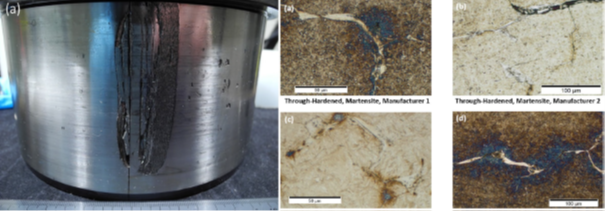 Figure 1. Different examples of white etching cracks (WECs). Figure courtesy of Argonne National Laboratory.
WECs are characterized by irregular microstructural alteration in the subsurface material.
Main bearing WEC failures have similar characteristics to WECs observed in high-speed shaft gearbox bearings, for example, in the sectioned main bearing shown in Figure 2.
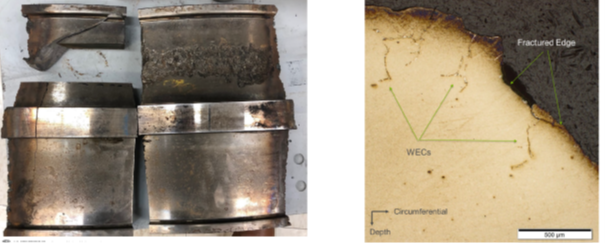 Figure 2. A sectioned main bearing. WEC failures here have similar characteristics to WECs observed in high-speed shaft gearbox bearings. Figure courtesy of Argonne National Laboratory.
While the causes are unclear, research is ongoing. Electrical current is one driver that has recently been shown to cause WECs and also was measured up-tower across the main bearing and gearbox bearing contact.
Synchrotron X-ray analysis has been used to examine below the bearing surfaces to identify both inclusions in the metal and where WECs occur. Also, bench-top testing has been used to enable the study of WEC drivers independently of each other (e.g., load, slip, lubricant chemistry, stray electrical currents, etc.). Bench-top testing provides an accelerated, low-cost method for testing mitigation technologies (e.g., lubricants, coatings, advanced materials). An example of a bench-top rig is shown in Figure 3.
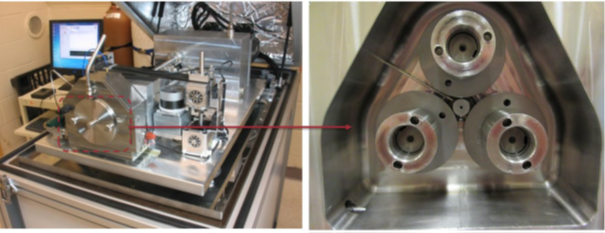 Figure 3. A bench-top rig. Figure courtesy of Argonne National Laboratory.
Wind turbine gear oils with wind turbine-grade bearing steel
WEC tests were performed using test samples extracted from wind turbine bearings with commercially available wind turbine gear oils. Several commercial wind turbine gear oils showed the formation of WECs in relation to inclusions in the bearings. These results were not repeated when clean steel lacking inclusions was tested, implying that steel cleanliness could be a factor for WEC formation. A correlation also was observed between friction and WEC formation: Higher friction oils yielded a higher probability of WEC formation.
5 This implies that certain mechanical loading conditions (including sliding) absent other drivers (i.e., use of “bad reference oils” or applied electrical current) can lead to the formation of WECs.
Electrical current
Stray currents in wind turbines have a number of potential sources, even though attempts are made to electrically ground the machines. The wind turbine blades may even be electrostatically charged as they move through the air. Currents as high as 1 ampere have been recorded in up-tower measurements. While the electrical conditions experienced by the bearings in operation may vary between different turbines, benchtop testing has been performed in a range of current levels, frequencies and voltages to show the correlation between these electrical conditions and WEC formation.
The bench-top test rig was modified to enable the application of controlled electrical current across the contact. This modification accommodated testing in both oil and grease.
6 This testing showed that WECs are significantly accelerated for wind turbine gear oils when electrical current is applied. A strong dependence of electrically driven white etching cracks (e-WECs) on current level was observed in gear oils (>75mA).
6 An increase in current correlates with a decrease in bearing life.
The effect of electrical current on lubricant also was studied and found to be capable of influencing how the wind turbine gear oils behave and perform. Increasing current was observed to impede the tribofilm formation on surfaces with some lubricants, while other oil chemistries showed increased activation.
6 An example was shown for one commercial oil where there was measured friction reduction seen with increased current, likely due to the tribofilm formation.
6
Lubricant chemistry
Lubricant additive chemistry is another approach to resolving or accelerating WEC issues, depending on the additive chemistry. This approach allowed for reverse engineering of “bad reference oil.” As an example, zinc dithiophosphate (ZDDP), a common antiwear additive, has been linked to accelerated WEC failures with research showing oils containing only ZDDP cause failure earlier than any combination of additives.
7 Oils containing only ZDDP have the highest friction, resulting in higher frictional heating. However, while ZDDP has been used in earlier wind turbine gear oils, most modern formulations do not include it.
In the tests conducted with applied electrical current using six modern wind turbine gear oils, all showed e-WECs.
6 Oils 1-5 were commercial wind turbine gear oils, while oil 6 was a perfluoropolyether (PFPE) oil that did not contain hydrocarbon molecules, a possible source of free atomic hydrogen during the test that could lead to embrittlement of the steel samples. It was, therefore, noted that hydrogen may not be required to form WECs. Oils 1-4 had the same base oil chemistry but different additive chemistry; these tests showed varying time to failure indicating that the additives may have a role in delaying WECs. Initial results showed coatings can be effective but are not preventative when it comes to e-WEC formation.
6 Coatings (e.g., black oxide, DLC) can prolong life but still can lead to WEC failure.
Grease e-WEC testing was similar to oils. Tested greases also showed a strong dependence in time to failure rates on formulation. Lubricants that are designed to mitigate fluting may show no improvements for e-WEC failures.
Questions asked
A question was asked if spheres were seen in the oil samples. Spheres are caused where metal-to-metal contact creates spheres of metals as wear debris, noting that the presence of spheres can indicate eddy currents or show water invasion. Greco indicates that wear debris has not yet been analyzed as part of this research.
During the Industry Insights presentation, discussion ensued regarding the presence of water in the oil and how that correlates to bearing life. While efforts are made to reduce the presence of water in lubricants, water is especially difficult to control in offshore wind turbine environments.
This work is occurring internationally among industry, universities and governments.
REFERENCES
1.
Office of Energy Efficiency and Renewable Energy, Wind Energy Technologies Office. (Aug. 31, 2021),
Land-Based Wind Market Report: 2021 Edition Released. Available
here.
2.
Asia Wind Energy Association, Country Overviews: Japan. Available
here.
3.
Office of Energy Efficiency and Renewable Energy, Wind Energy Technologies Office. (Aug. 30, 2021),
Offshore Wind Market Report: 2021 Edition Released. Available
here.
4.
The White House Briefing Room. (March 29, 2021),
FACT SHEET: Biden Administration Jumpstarts Offshore Wind Energy Projects to Create Jobs. Available
here.
5.
Gould, B. J., Demas, N. G. and Greco, A. C. (2019), “The influence of steel microstructure and inclusion characteristics on the formation of premature bearing failures with microstructural alterations,”
Materials Science and Engineering: A, 751, pp. 237-245. Available
here.
6.
Gould, B. J., Demas, N. G., Erck, R., Loreno-Martin, M. C., Ajayi, O. and Greco, A. (2021), “The effect of electrical current on premature failures and microstructural degradation in bearing steel,”
International Journal of Fatigue, 145. Available
here.
7.
Gould, B. J., Demas, N. G., Pollard, G., Rydel, J. J., Ingram, M. and Greco, A. C. (2019), “The effect of lubricant composition on white etching crack failures,”
Tribology Letters, 67, 7. Available
here.
Andrea R. Aikin is a freelance science writer and editor based in the Denver area. You can contact her at pivoaiki@sprynet.com.