KEY CONCEPTS
•
Global escalation to a sustainable economy has raised raw materials availability concerns for environmentally acceptable lubricants production.
•
Standardization of environmentally acceptable lubricants is necessary to overcome misperception of their sustainability.
•
Mainstream research and development of environmentally acceptable lubricants is restricted by commercial feasibility and raw materials contingency.
Meet the Presenter
This article is based on an Industry Insights presentation titled
Environmentally Acceptable Lubricants and Sustainability by Dr. Bill Tuszynski on Jan. 18. Industry Insights is a monthly virtual event series available for free to STLE members. These events provide a forum for members to collaborate with STLE industry peers and an expert on a specific topic who gives a brief presentation, then facilitates conversation by asking discussion questions and providing actionable takeaways. For more information, click
here.
Dr. Bill Tuszynski of The Unami Group, LLC, led and moderated an open discussion of the drivers and benefits of the adoption of environmentally acceptable lubricants (EALs) and the impact on all segments of the industry and supply chain. Participants were asked to share their perspectives on the issues surrounding the widespread adoption of EALs and how the industry can take steps to spur their development in the market. You can reach Tuszynski at
w.Tuszynski@unamigroup.com.
 Dr. Bill Tuszynski
There are many drivers and benefits of EALs, but there also are many technical and commercial challenges to consider. Laws, regulations and market forces keep changing, which could create more opportunities for EALs. Many questions linger, including: Is technical performance, customer acceptance or availability of supply the biggest issue? Are some segments of the industry more receptive than others? What are the long-term prospects for EALs, particularly renewables? The purpose of this article is to share thoughts and knowledge on these topics and questions.
The following individuals are contributors to this article:
•
Doug Adams, RSC Bio Solutions
•
Tyler Housel, Zschimmer & Schwarz
•
Samantha Allen, Oleon
•
Dr. Gareth Fish, The Lubrizol Corp.
•
Salvatore Rea, LANXESS Corp.
•
Dr. Ann Fenech-Andersen, Danfoss
•
Hamed Eksiri, Chevron
•
Dr. John Fang, Chevron
•
Mike Woodfall, Biosynthetic Technologies
•
John Burke, Consultant.
Bill Tuszynski, partner, the Unami Group, shares EAL’s historical timeline (
see Figure 1): “Green chemistry started in the 1980s but was not competitive on performance or price. In 1997, professor Paul Anastas (Yale University) founded the Green Chemistry Institute, largely to replace solvent chemicals with more sustainable and green options. In 2005, the Green Chemistry & Commerce Council was founded, which is a consortium of companies with a goal to develop and commercialize sustainable and safe equivalents. Today, clean, green solutions are competitive on cost and performance.”
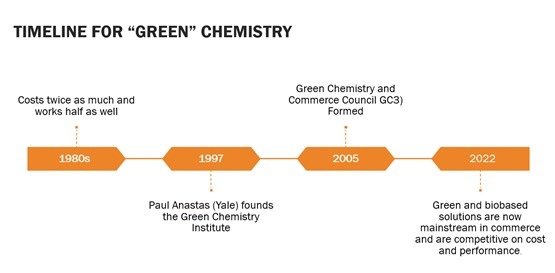 Figure 1. Timeline for green chemistry.
Tuszynski continues that within the lubricants industry, there are some regulations that are driving green products:
•
USDA BioPreferred®: U.S. government purchasing preference for biobased products
•
U.S. Vessel General Permit (VGP)/Vessel Incidental Discharge Act (VIDA): Regulation of shipboard lubricants
•
European (EU) Ecolabel: Rating system for base stocks and additives. Tied to LuSC-list
•
LuSC-list (Lubricant Substance Classification list): Registration of environmentally acceptable substances, base stocks and additives
•
Others: Nordic Swan, Blue Angel, etc.
Doug Adams, senior product development chemist, RSC Bio Solutions, shares some insights: “Environmental legislation initially focused in on the marine industry since vessels operating within U.S. territorial waters were polluting to such an extent that the 2013 VGP was adopted. The first generation of EALs were not oxidatively stable, but the technology used to formulate EALs has improved. There are now oxidatively stable base fluids used to develop high performance EALs; however they are more expensive than mineral oil-based lubricants.”
Tyler Housel, sales director, Zschimmer & Schwarz, adds: “Synthetic esters can be made from a choice of raw materials: some biobased and some petroleum based. For the longest time, biobased synthetic esters performed well, and no one thought about them as being biobased. They were just the right product for the right application. Nowadays, biobased products are getting favorable treatment in many industries—not just lubricants. With this growing demand, we are starting to see a lot of raw material shifts and tightness in the biobased feedstocks. For example, C8-10 acids were traditionally a byproduct of the coconut industry, with no demand from anyone. The lubricants industry found them to be a cheap and effective starting material. But now there is a lot of demand from other industries seeking their own sustainable solutions. This leads to shortages and price increases for the lubricants industry.”
Samantha Allen, account manager, Oleon, concurs: “We are, too, seeing an ever-increasing demand for multiple biofeeds, for example, for tallow. What used to be a primary ingredient for us now is being taken out by the hydrogenated vegetable oils (HVOs) market, and it is blended with aviation fuels to lower the overall carbon footprint. This is starting to limit availability of the traditionally inexpensive tallow fatty acids.”
Dr. Gareth Fish, technical Fellow, The Lubrizol Corp., shares: “We were looking at buying high erucic acid rapeseed oil, and one major supplier stated that nothing will be available for at least two or three years due to the increased demand and availability of the crops.”
Allen agrees: “Some of these specialty vegetable oils that are planned out projected a certain demand for the next year and, as such, only a certain amount of crops are planted. If the increase in demand happens, like, for example, coming from a higher performing EAL market, then there isn’t enough crops available in the short term to support immediate demand. It does take several years to expand the suitable cropland to grow plants suitable for specialty vegetable oils.
“Additionally, weather plays a role,” Allen says. “For example, when a massive storm hit the Midwest and took out a certain number (7%-8%) of soybean crop, it impacted the soybean price dramatically. It goes back to the shift in demand where higher performing lubricants are needed for EAL applications, but the raw materials required are more difficult to obtain in the short term.”
Salvatore Rea, technical service manager, LANXESS Corp., says, “Two themes mentioned previously: one is the supply chain, and the other is crops yield. I think we’re always going to have these challenges. Plus, indeed, the competition outside of the lubricant industry is growing, and it will continue growing. Good news is that quality of the products has improved, so performance isn’t an issue, but with the great performance comes a higher price. It seems that end-users are willing to spend the money but sometimes only if they’re forced by regulation. The law and regulations keep changing, but in general, the world is going green sooner or later.”
Rea continues: “For example, regulations on palm oil. There is a roundtable for sustainable palm oil (RSPO) that partners with the EU Ecolabel scheme. This organization requires companies to track the palm oil from a plantation, all the way to the end product. There is a fee to be paid by the supplier to be RSPO listed and certified, and if not done by the supplier, then the end-user must pay a fee to RSPO for usage of uncertified palm oil (this payment is enforced by the EU Ecolabel administrative body). This tracking of sustainable palm oil increases the cost to do business, with the cost increase being passed to end-users (either directly or indirectly). I think that other potentially sustainable product types (e.g., canola oil, rapeseed oil, etc.) will be as highly regulated very soon. In summary, the market trends are: tight supply and availability, increasing costs and prices, but, in parallel, performance is improving and competitors are trying to discriminate from each other. Finally, marine applications will continue to see increasing movement toward EAL fluids.”
Dr. Ann Fenech-Andersen, materials and analysis laboratory manager, Danfoss, adds: “We use lubricants without manufacturing them. We have two general concerns with environmentally acceptable products, and one of them is, are they actually a sustainable choice? Are we going from non-sustainable to still non-sustainable? For example, for plant-based sources, are the resources taken away from food? Is biodiversity preserved? And also, we often see a lower lifetime of the bioproducts. Metalworking fluids, for example, often have significant microbiological growth. This requires us to change the fluid more often, which means higher volume is used, and this also is not good for the environment from our perspective. We prioritize that our actions not only appear to be sustainable, but that the evidence also backs this up.”
Dr. John Fang, staff scientist industrial lubricants, Chevron, responds: “Indeed, there is a gap in the performance, longevity and pricing of the EAL products.” Fang explains: “The majority of the products that are biodegradable by nature of their chemical build-ups are more prone to either hydrolyze, oxidize and/or thermally degrade, leading to more biodegradable yet shortened product life and potentially seal compatibility and other performance concerns. There are new technologies that have potentially addressed these performance gaps, especially in terms of hydrolytic stability, thermal and oxidation stability, as well as pertinent product longevity.”
Hamed Eksiri, driveline fluid formulator, Chevron, asks: “Are there regional government driven regulations on emissions, or any other new initiatives that either make technology accelerate or have some financial or monetary barriers in regard to electric vehicle-related technologies?”
Adams says, “Right now, the 2013 VGP is going through a transition into VIDA; if approved, the U.S. Coast Guard will be the enforcing body. Once VIDA is enacted, commercial vessels 79 feet or larger entering the U.S. territorial waters could be subject to inspection by the U.S. Coast Guard, and fines could be imposed if violations are detected. Currently we don’t know exactly when VIDA will be finalized; it’s supposed to be enacted before 2024, but, at this point, there is no exact date.”
Housel asks a follow-up question: “Does VGP also address fuel discharges and spills?”
Adams answers: “The 2013 VGP standard covers fuel spills and other discharges including ballast water. The primary lubricant that leaks from ships is in the area that propeller shaft comes out of the ship. The propeller shaft is lubricated with stern tube oil (STO), and STO has been reported to leak into our oceans at 2.6 liters a day per ship; that translates to a global loss of 80 million liters annually.”
Tuszynski asks a follow-up question: “Is there an issue for people with different feedstock being available—palm oil in Asia, maybe soy-based materials in the U.S. or rapeseed oil in Europe? Are there some subtle differences between these materials, and do they affect a worldwide use?”
Allen explains: “From an oleochemical provider, the answer is yes, in certain cases, and in other cases, the answer is no. It depends on the raw material sources. It would be great to be able to use any base stock interchangeably. But, for example, a pine oil derivative is not easy to interchange with something like a palm oil or a soybean oil.”
Adams adds: “There are different types of biobased fluids that can be used to formulate EALs. The least expensive are vegetable oil-based fluids like canola oil or rapeseed oil that oxidize to a greater extent when compared to other environmentally acceptable base fluids and have to be changed out frequently. There are new environmentally acceptable base fluids that are engineered to a higher level to improve characteristics like oxidation stability, and still meet the same biodegradability, toxicity and bioaccumulation requirements as vegetable-based fluids. These new oxidatively stable base fluids can be used in marine applications since oceangoing vessels typically have a “dry dock” interval of five years, which is when seals and lubricants are replaced.”
Fenech-Andersen shares: “We see current technology as a steppingstone to something that is really environmentally sustainable. Our challenge is, do we change now, or do we wait? It’s difficult to convince a production technician that they should switch over now, as it is a possibility that they will have higher tooling costs, higher cost for changing the fluid, etc. It can be a hard sell when there isn’t clear evidence behind the sustainability benefit.”
Fish explains: “The big challenge with biofluids is the demands on unsaturation. The more unsaturated they are, the less oxidation stable they will be. These vegetable oils rich in unsaturates are good for food and lubricate well, but we want to have that division. But it doesn’t mean that if you happen to use unsaturated vegetable oils, that will stop them from breaking down, becoming rancid, decomposing etc. It will be required to use antioxidants, preservatives, etc., and to stop them now from falling apart in use rather than at the end of use.”
Fenech-Andersen says, “I don’t disagree that these fluids maybe are sustainable, but we have limited data that compares sustainability of different products.”
Fish suggests: “The only way to do it properly is to do a life cycle analysis (LCA) from cradle to grave. You start from the crops and even from seeds to plant the crops. You work out the impact of your biobased lubricants and then compare it to the performance behavior and everything else of a mineral-based fluid. Thus, you analyze what the total environment impact is first, and then you need to compare different products and select the one that has the lowest total environmental impact including use and disposal—that’s a solution to a more environmentally friendly position.”
Fenech-Andersen adds: “We have looked at life cycle assessments, but that requires data from our suppliers, which is not easily available, if it at all exists.”
Allen adds: “To speak to the comment on the lifecycle analysis and on point about the data needing to be there—I do know that there’s something members of ILMA are looking into—how to provide members guidance and how to generate that data and provide framework of the different standards that are out there. The topic of EAL traditionally has been okay for you get your product listed on a certain list, whether it be VGP or the EAL list in the U.S., and you formulate a product, and it is screened and it meets that criteria, but we are seeing a shift in the industry where that data to generate those lifecycle analyses are becoming more important, because end-users and customers are wanting that data—and it does take some time to generate—but that may become an ever-increasing topic when you’re speaking about EALs to have the data readily available so you can then make those decisions on the overall sustainability of what you’re buying.”
She continues: “The big challenge is, how do we harmonize how we’re all doing this calculation to give the best, most realistic number that we have available to us to where the data is meaningful and not greenwashed?”
Fish shares: “There are a number of independent consultants available to analyze the LCA. Also, there are some OECD (The Organization for Economic Co-operation and Development) guidelines on LCA, and you can follow their methodology. But it is still a good step to have your data independently verified so the information you gathered, and you are going to present, has some basis and some traceability, etc.”
Tuszynski states: “There’s the issue of how transparent as a supplier you can be toward your customer without compromising your intellectual property, which is wise to have a third-party verification.”
Allen says, “We have the same challenges; there are certain products that we can provide LCA data for; we can work with a consultant and an external body that can review the data for us, but then there are some products that we can’t share the chemistry of, so it becomes challenging. Particularly for EALs, chemistries tend to be confidential where we do want to protect our intellectual property.”
Housel shares: “I think that is true in a lot of cases—like I said previously, fully saturated synthetic esters have been used for years because they give good performance, good oxidation stability and hydrolytic stability. Some people associate “sustainable” with the simple fats and oils you might find in a restaurant. But we know that further refining is necessary to make bio oils suitable for lubricating industrial equipment. You don’t pump crude oil out of the ground and put it in your engine—you refine it! The bio oils community continues to develop more sophisticated refining techniques, which leads to increasingly better quality and performance.”
He continues: “One thing we haven’t touched on yet is what the non-traditional chemistry companies are now doing with biobased feedstocks. Instead of using the oils and fatty acids directly, they are using biocarbon to create estolides, hydrocarbons, polyethers and other precursors, which can be converted to biobased lubricants with properties identical to petroleum-based synthetic lubricants such as polyalphaolefins (PAOs) and polyalkylene glycols (PAGs). There is no longer a simple line between vegetable oil and mineral oil. Today it is possible to get biobased oils that compete broadly in areas that were once exclusively limited to petroleum products.”
Mike Woodfall, sales leader, Biosynthetic Technologies, shares: “The bigger question is, how do we define sustainability? As an industry, I think we can do better. An EAL is one thing, but a sustainable lubricant can be totally different, and it depends on the application. That is probably the hardest thing to define; even if we look into LCA, lubricants are a pretty complex mixture, so you need to have an LCA for every component. So, I think that’s where people struggle with any lubricant formulation and trying to define its sustainable nature. We can do better setting categories as an industry to better define what are sustainable lubricants.”
Tuszynski says, “I think the point about differentiating EAL and sustainable is good because you can have a biodegradable PAO-based lubricant, which can be considered environmentally friendly but not necessarily sustainable.”
Rea explains: “Non-palm oil derived base oils or components can be used to get Ecolabel approval. If its palm oil based, it has to be sustainable palm oil based, but if it’s non-palm oil based, it doesn’t have to be sustainable. Only if you use palm oil derived base oil or componentry, you have to get RSPO certification, but if your product is not palm oil based, then it can be sustainable or non-sustainable.”
Fish adds: “It is deforestation, areas that grow palm oil… It’s a bad thing. So, if you’re deforesting to grow palm oil, that’s bad, but if you’re using sustainable sensible production methods for your palm oil, it’s okay. But there is a lot of palm oil in the market that isn’t sustainable even though they claim it is. Policing allows users aware that what they’re buying is sustainable.”
Housel comments: “To get RSPO, you pay a fee, and a third party determines that the certified portion of your palm oil was sustainably produced. However, the converse statement is not necessarily true. Non-RSPO doesn’t imply that you are destroying the rainforest. It simply means you haven’t paid the fee.”
John Burke, consultant, adds: “I’d like to make a comment about the disposal aspect of some of the synthetic and natural esters. I spent a lot of time in the industry on the disposal side, and the problem I see is that ultimately the EALs are going to get mixed with petroleum products. We have a beautiful infrastructure in the world for re-refined oils, but we do not have an infrastructure for re-refined oils with esters mixed into it, and, in some cases, it interferes with the re-refining process.
Burke elaborates on the issue of disposal, noting the contradiction in “saying something is sustainable when you can grow it properly, and it works well in the intended lubricant field, but then when you go throw it away, you find out there is no avenue for it. You can’t just mix petroleum oil with esters and give it to a re-refiner because it will interfere with the re-refining process. I don’t think this has been adequately addressed. I’ve seen some product shipments where there is a significant amount of ester mixed with petroleum oil, and the waste haulers have rejected the hauled waste residuals, so the only thing left to do with it is burn it, which is not environmentally friendly,” he says.
Fish says, “Back to LCA questions: We did a comparison of life of premium synthetic oils versus mineral oils versus biofluids a few years ago. For a lot of these high temperature applications like electric drive motors, where high temperature grease is needed, the vegetable oils will not be able to run at some temperatures under high speed, high temperature motors, so you’re having to use fully synthetic blends to get through those systems. So that is one of the issues. Yes, you want to use biobased fluids in those applications, but today, I don’t think it’s a biobased fluid that can be used in anything like electric drive motors. In fact, most mineral oils fall short as well.”
Summary
Popularity of EALs is growing, propelled by increasing number of sustainable initiatives within the industry. Challenges continue to remain such as properties, performance, availability of raw materials, research and development and the cost of production, etc. Moreover, LCA, in terms of sustainability, needs to be developed and standardized in order to gain end-user acceptance. Furthermore, for EALs to become more mainstream products, numerous other variables must be evaluated and addressed including legislation and compliance, to new a few. Nevertheless, there is a promising future for EALs with advent of focus on innovative solutions development to combat any challenges for a sustainable industry altogether.
Dr. Yulia Sosa is a freelance writer based in Peachtree City, Ga. You can contact her at dr.yulia.sosa@gmail.com.