TLT: How long have you worked in a lubrication-related field, and how did you decide to pursue a career in the lubricants industry?
Grebe: I’ve been in tribology for 27 years now. During my mechanical engineering studies, I took the elective called Tribology and Lubrication, which was offered for the first time by professor Feinle, by chance. He had just accepted an endowed professorship at the Mannheim UAS, which was financially supported by numerous industrial companies in the fields of lubricants, additive chemistry and mechanical engineering.
Like so many others, I had never heard of tribology before and found the topic to be quite interesting. At the time, however, I couldn’t imagine working in this area. Instead, I became interested in databases and computer applications. During my diploma thesis colloquium on the topic of database applications for CAD systems, I happened to see the job advertisement for an assistant position at the newly founded institute. Building a completely new institute from the very beginning seemed, to me, to be an exciting task for a young engineer, so I applied and got the job. Originally, I wanted to do it for a few years and then switch to industry. Due to the wide range of opportunities that arose, the exciting research topics and the strong industrial orientation, I never let go of my work, so I stayed at the university despite numerous offers from industry. Today, I am very happy that I have remained loyal to the university and, thus, to science. Constantly new topics and challenges are demanding but also very inspiring and exciting.
TLT: Throughout the different segments within your career, which one has been the most interesting, challenging or rewarding?
Grebe: Every phase of my career has been exciting. At the beginning, it was a matter of building a new institute and considering which direction it could have. We had to think about how we would optimally use the available resources, which machines and devices we would like to purchase from them and which focal points we would like to work on. Since the institute was founded relatively late in comparison to large mechanical engineering institutes in Germany, we had to find niches that were not yet occupied by the top dogs.
We found this in an application- and mechanism-orientated tribological test technique known as tribometry. The use of the latest testing technology and measurement technology to simulate and investigate practical tribological problems is still the focus of the work today.
After getting started, the first research projects had to be acquired and successfully completed in order to build up a certain reputation. In these first years, we only had one or two projects per year, about five tribometers and a maximum of one additional research assistant.
Over the years, the reputation, number of test rigs and size of the institute, which we now call the Competence Center for Tribology Mannheim (in German,
Kompetenzzentrum Tribologie Mannheim – KTM), grew. Today, the KTM is one of the largest tribological institutes in this field in Germany.
Over the years, and with the increasing size of the institute, my tasks also have changed. Today, I rarely stand on a tribological test bench. One of my main tasks is to create and apply for new research projects and staying in permanent contact with our industrial partners. During the research projects, I support the young academic staff. With a certain amount of experience and a certain age, committee work also increases. I also hold courses on various topics and try to pass on my knowledge and enthusiasm for tribology. I also work as a freelance consultant for numerous industrial companies. This, too, is very satisfying work, as you can often solve problems with your knowledge and, thus, help your industrial partner.
Although my tasks have changed significantly, I am still enthusiastic about tribology due to its interdisciplinarity and diversity.
TLT: What has been your most rewarding accomplishment throughout your career in the lubricants industry?
Grebe: The more experience you gain in tribology, the more you realize how much knowledge you are still missing. I do believe that, over the years, I have acquired a very good general knowledge in mechanical engineering and especially in tribology. In many areas, however, I always look enviously at real professionals.
Nevertheless, I believe that I have done really good scientific work in two areas. On the one hand, this is the subject of my dissertation: false brinelling and standstill marks in rolling bearings. Here I was able to help distinguish different cases today. So, it is essential whether the contact point between the rolling element and the raceway is revealed by a pivoting movement or a vibration movement or whether it is permanently closed (the so-called x/2b ratio, which indicates the path of the rolling element based on doubled Hertzian contact width).
Another topic that has always been very close to my heart is the applied tribological test technology, so-called tribometry. A lot has happened here in the last few decades. If you look at old test stands such as the four-ball-tester, it can hardly be compared to modern multifunctional tribometers. In particular, the measurement options have improved significantly, and, together with today’s chemical analysis, enable completely new statements to be made about the performance of a tribological system. The most important goal today is to understand a tribological system and not simply to generate characteristic values for an advertising brochure.
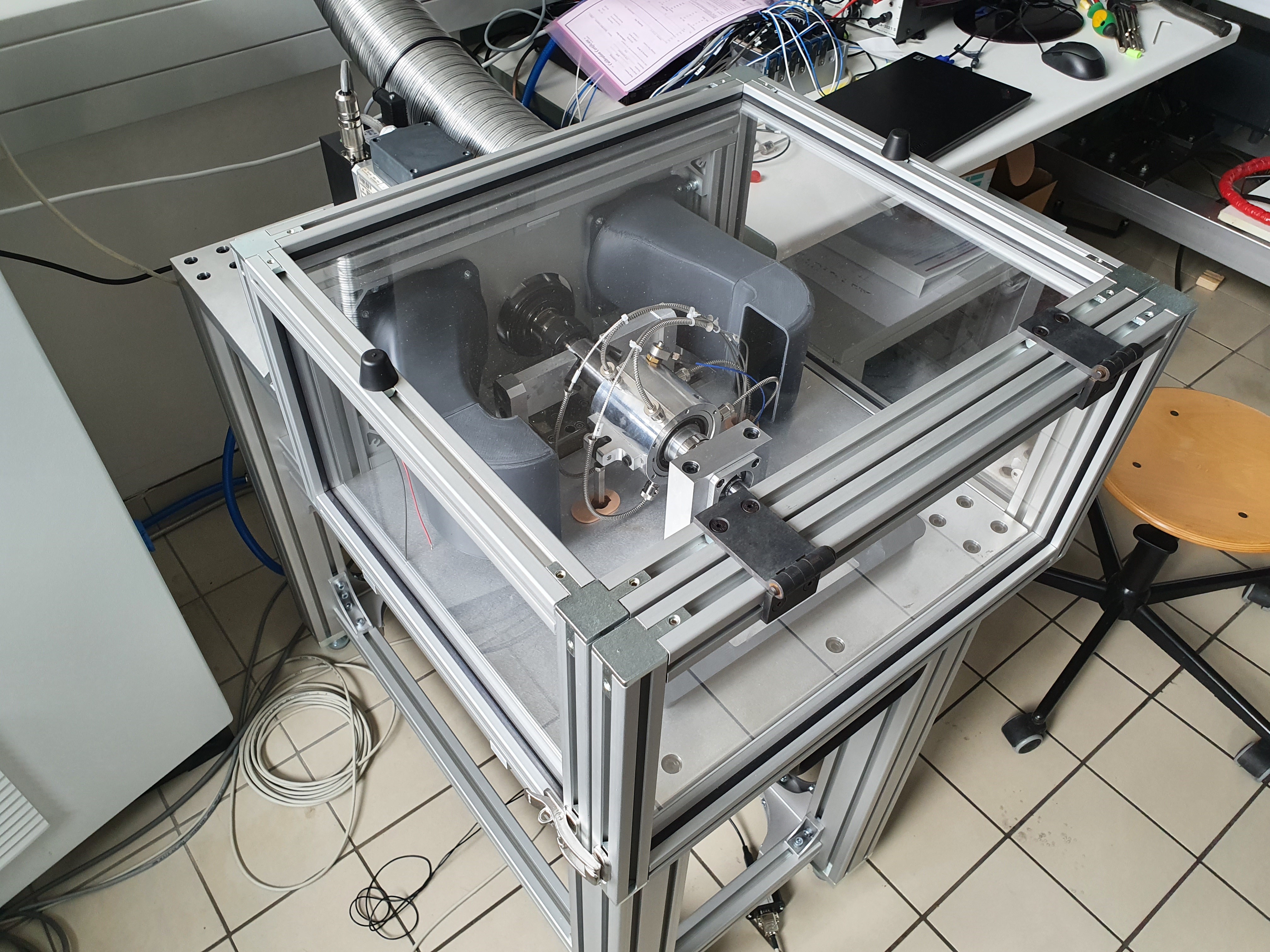 Newly developed test rig to investigate the formation of standstill marks on rolling bearings and their influence on the service life of the bearings.
TLT: What is the No. 1 piece of advice you would give to a person who might be interested in starting a career in the lubricants industry?
Grebe:
As part of my work as a laboratory manager, I now have numerous job interviews to conduct. One of the most important things I try to find out is whether the applicant is curious and interested in a specific topic. I think school grades are not very informative. Instead, I expect applicants and employees to be interested and enthusiastic about science. Unfortunately, a good school grade often only means that the person is good at memorizing. In my opinion, grades do not say how well this person can apply the knowledge and transfer it to new questions. Certain knowledge can be largely Googled today. With the expansion of artificial intelligence, computers will increasingly help us to have the right knowledge at hand. What is important, then, is what you do with this knowledge and how you apply it to new questions and technical problems.
The great thing about tribology is that it is so diverse and interdisciplinary. For a newcomer, however, it is difficult at first to acquire the diverse specialist knowledge. I can, therefore, only recommend young engineers to always be curious, ask a lot of questions, take part in many conferences and get involved early on in associations such as the GfT in Germany or STLE and, thus, establish contacts and build a network. Ultimately, no one can fully understand the entire field of tribology. It is, therefore, absolutely essential to have good contacts with other scientists and to look for and find solutions together.
TLT: What are some of the most technical lubrication-based concepts or topics that you have encountered throughout your career?
Grebe: As strange as it sounds, the most important thing about a lubricant is that it is there where it should be (in the tribological contact zone). Over the many years as a consultant, I have often seen that the cause of a tribological problem is the lack of the lubricant or an unsuitable lubricant. There are various reasons for this: On the one hand, it may really have been forgotten to lubricate a component or to re-lubricate it adequately. Another reason may be that the lubricant was initially correct but then lost its function, e.g., due to aging, spinning off or pushing away, in the case of grease, due to excessive oil release and/or degradation or hardening of the thickener. As a third point in this category, one can count the many cases in which the wrong lubricant was used that does not meet the requirements and is not able to fulfill its job due to a wrong viscosity or wrong chemistry.
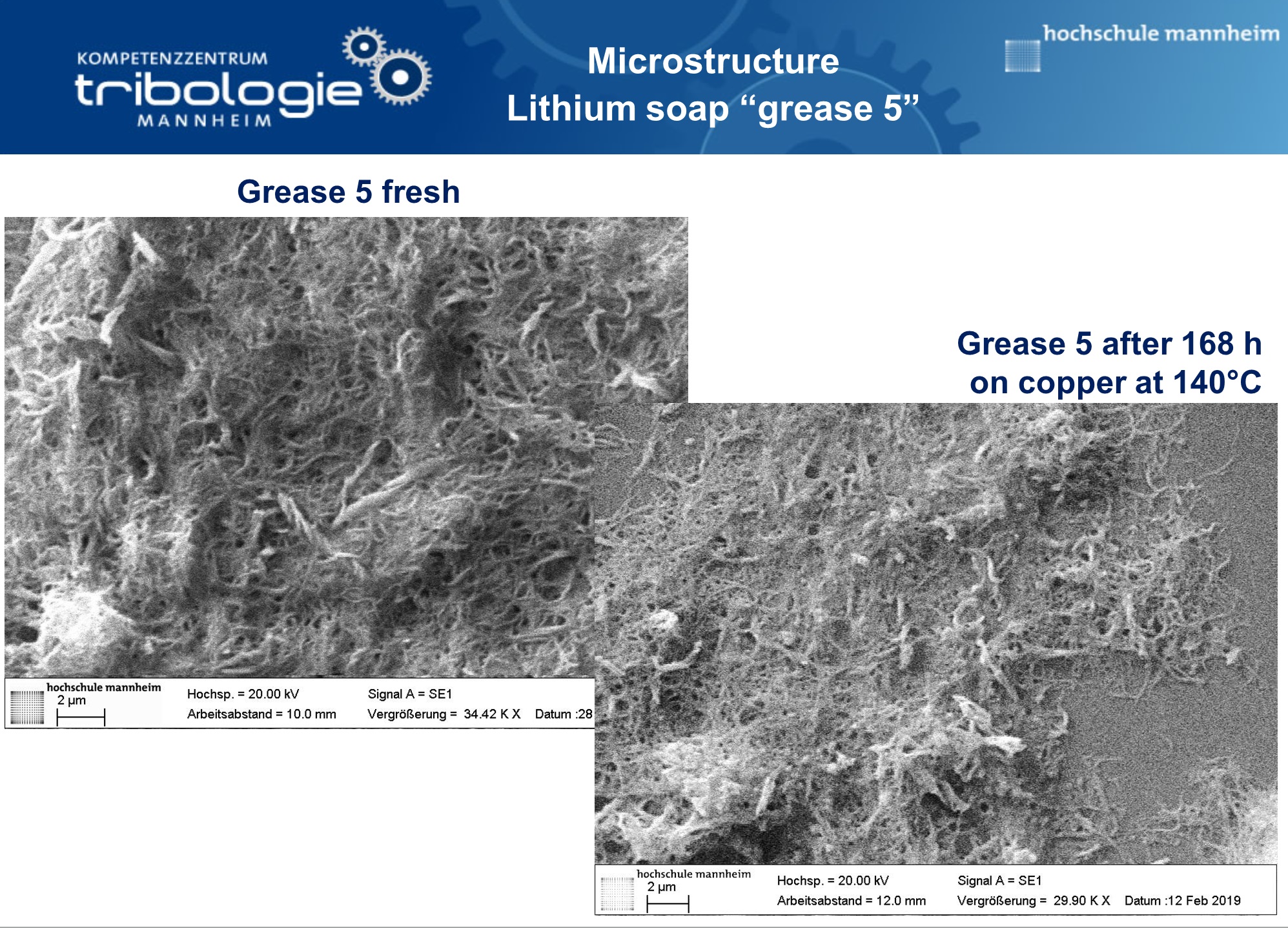 Change of the thickener structure of a lithium grease.
TLT: What is the one thing that you wish you would have learned earlier in your career?
Grebe:
I don’t think there is one single thing in my career that I would have wanted to learn earlier. Rather, I keep noticing that I would like to have more specific detailed knowledge. However, at some point, you have to acknowledge that you can never know everything. Nevertheless, this is a permanent internal dichotomy. By reading a lot of scientific literature, attending many conferences and talking to experts, I try to absorb more and more knowledge (unfortunately I can’t remember everything, but luckily I still know where to look or who to ask).
There is one thing that I do regret: I only realized the importance of the English language late. I would be happy if I could speak more fluently and better today.
TLT: What topics are you and your team currently researching?
Grebe: Many of the current questions arise from the challenges of e-mobility. High speeds, energy efficiency and the issues of noise and electrical current require new test stands and test methods, which we are currently developing with numerous industrial partners. We then use these to examine and characterize new and more powerful lubricants (mainly lubricating greases), materials and coatings. In the case of lubricating greases, the focus is on thickener degeneration, i.e., the change in the rheological properties as a result of thermal, oxidative, catalytic and mechanical stress. In addition, there is still a lack of sufficient understanding of how a lubricating grease supplies the highly stressed contact points with lubricant and how this can be ensured and optimized under critical contact conditions. Such critical boundary conditions are, for example, very small oscillating movements (fretting) or very long strokes in which the grease is pushed away from the friction point. In terms of materials, we are investigating high-performance plastics that can increasingly replace metallic components.
You can reach Dr. Markus Grebe at m.grebe@hs-mannheim.de.