TLT: How long have you worked in a lubrication-related field, and how did you decide to pursue a career in the lubricants industry?
Dubbert: I have been in the industry for 22 years. I started as a lab technician with the intention of working for Engineered Lubricants Co. (EL) for one year to add bench work on my resume. While looking for my next job and returning to school, I started working closely with the founder of EL, Don Wachter, on various projects. His infectious excitement for the industry and the extensive testing laboratory I had access to kept me at EL, much longer than I ever imagined! Wachter’s enthusiasm for creating solutions for the customer, no matter what, was such an intriguing way of doing business that I was completely drawn in. We would spend days and weeks going “up and down the ladder” as he always said. There are so many facets to the lubrication industry, I honestly never saw a reason to leave EL.
TLT: What has been your most rewarding accomplishment throughout your career in the lubricants industry?
Dubbert: Developing a lubricant for a specialized original equipment manufacturer (OEM) part was one of the most rewarding projects I have worked on over the years. I learned so much from the year-plus long project. We worked closely with the OEM engineers. Many days we would wait for their call at 7 p.m. after they tore down their test rig, take tons of notes and run back to the lab to try to recreate what they were seeing in their rig with our instrumentation. The experience was a crash course in the trials and tribulations of bench-to-field trials. The project was very successful, and the product we developed was used for 10 years, until the part was obsoleted. Working with an OEM also provided the opportunity to learn about and develop Production Part Approval Process (PPAP) documentation and how to navigate large corporate customers and the pace at which they work versus a small company.
Passing the CMFS exam also was very rewarding!
TLT: What is the No. 1 piece of advice you would give to a person who might be interested in starting a career in the lubricants industry?
Dubbert: Learn as much as you can about the different aspects of the industry to stay nimble. There is a big space for innovation in the industry. While it is changing and some may believe contracting, I believe a lot of opportunity still exists. The green incentives and shrinking formulator toolbox open the door to so much opportunity in both the additive and finished fluid markets. A wide berth of knowledge can help to bring innovation to companies looking to optimize new, green or multifunctional chemistries.
I want to encourage women to look into our industry as a serious career. The lubrication industry was traditionally male dominated, but in the 20-plus years I have been involved, more and more women play a large role in the industry. Many top positions throughout the industry are held by women and always have been. It is common to see woman engineers in plants, running lubricant companies and in every other aspect of the STLE community. This is a welcoming and diverse field that will provide a great career to those who are willing to learn the industry.
TLT: Throughout the different segments within your career, which one has been the most interesting, challenging and/or rewarding?
Dubbert: Learning about and developing products for applications I am unfamiliar with was, and still is, the most rewarding, challenging and interesting part of my job. I love the research aspect of new applications. Unfortunately, I do not have as much time for that as I used to. The innumerable number of videos on YouTube has made it much easier to learn about a new process, quite often from multiple viewpoints. There is always a new challenge to be met.
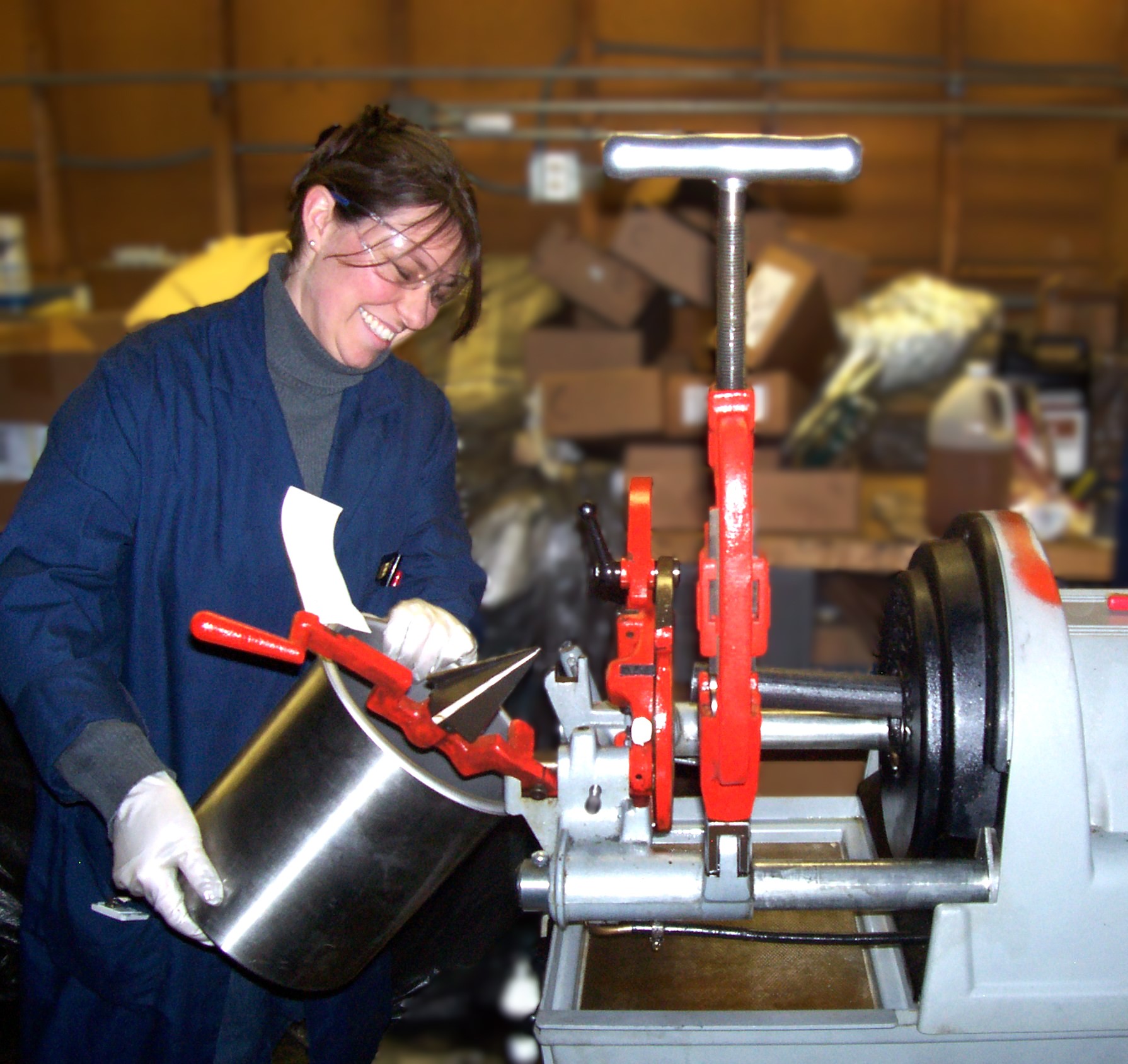 Bridget Dubbert running a thread cutting machine to test out newly developed threading oil for specialty applications.
TLT: What are some of the most technical lubrication-based concepts or topics that you have encountered throughout your career?
Dubbert:
Designing bench tests that match field performance has always been a challenge. A majority of my career has been spent on metalworking fluids, forming, cutting and grinding. Since these applications do not have the standardized testing available like engine, hydraulic or gear lubricants, it can be a challenge to reliably screen metalworking fluids before going to the field. When a presumably or historically reliable test method fails to predict the outcome in the field, trying to learn why and what the next step is can be very challenging.
For example, for years we could rely on pin and vee testing to predict if a lubricant would work or fail in the field for a particular application using a standard ASTM method. A new opportunity arose and, using the years of conventional wisdom, we applied the standard method, our product looked 100% better than the competitor and we confidently went to the field test. We were shocked with a failure! We had to pivot and went to a different instrument armed with data from the customer and our recent failure (an important piece of data). The new testing shed light on the differences in the two products, allowing us to develop a significantly improved formula. At the time of writing this article, we were waiting for that next trial. Using data from pin and vee and other instrumentation together, along with the field data, we found we need to rely on a piece of data that always has been overlooked. When using bench testing, the answer does not always lie in the traditional data set, such as lowest wear. Test results can be misleading, flushing that information out before a failure is technically very challenging.
TLT: What is something you are excited about in the lubrication and metalworking industry?
Dubbert: I am excited to see more alternative testing occurring in our industry. Metalworking operations and machinery are quickly evolving, and we are finding that standard test methods are not providing the critical information we need to improve and meet fluid demands. Lubricant and metalworking fluid companies have always had internal test methods used to develop new products, but many customers prefer to see standardized test results. Additive companies, lubricant suppliers, instrument manufacturers and end-users are all relying on more non-standard test methods to tease out the differences in products that were previously not identified (
see graphs).
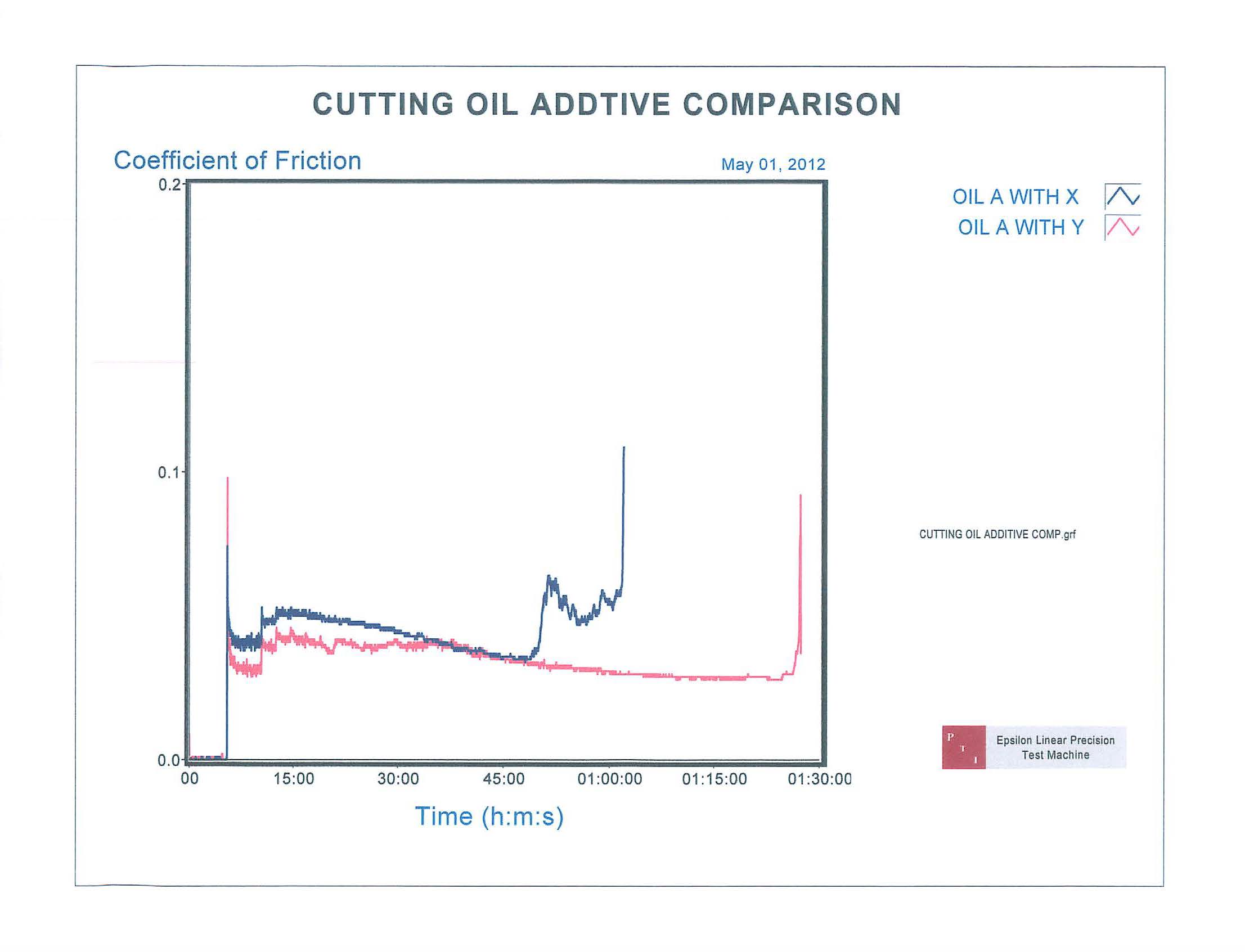
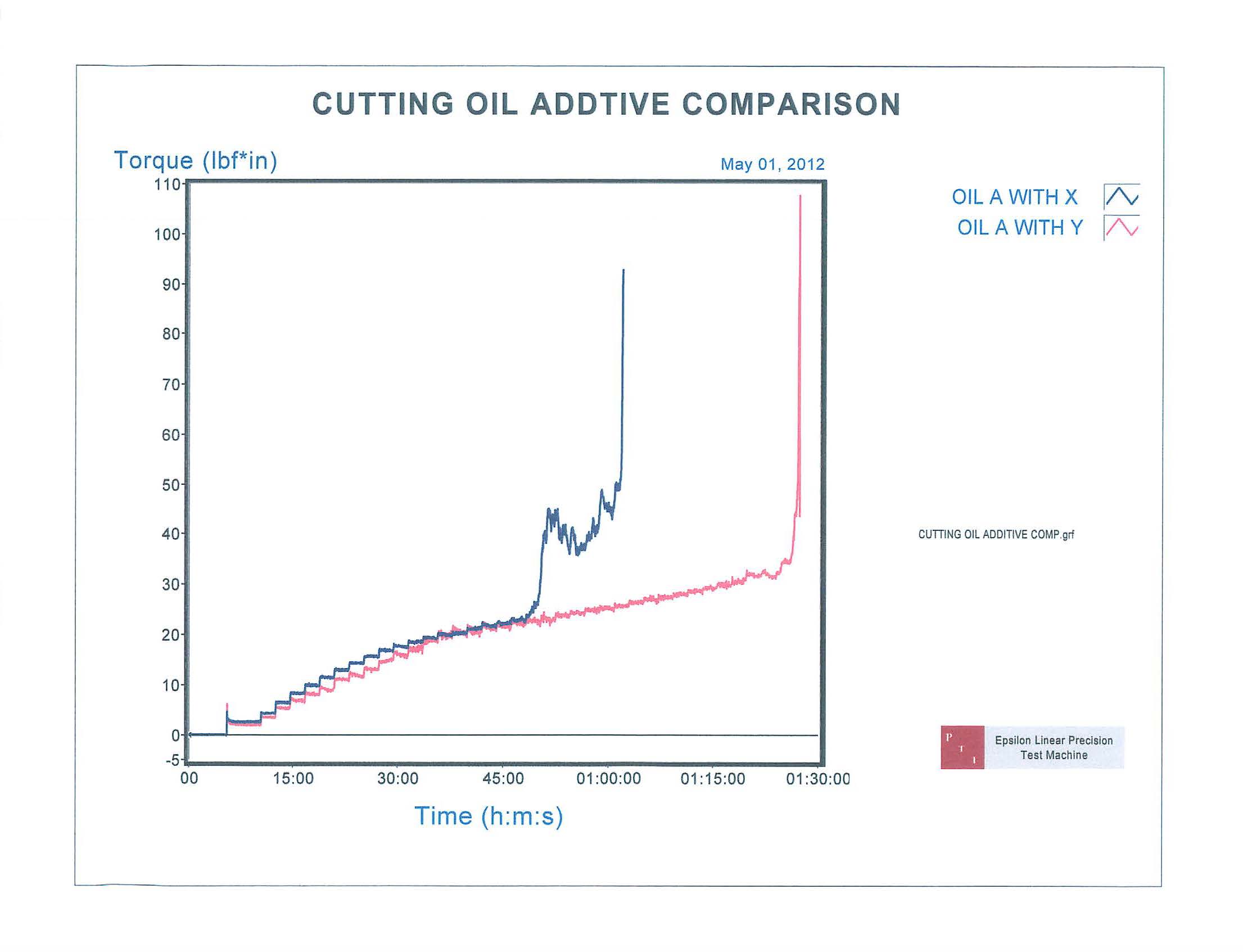
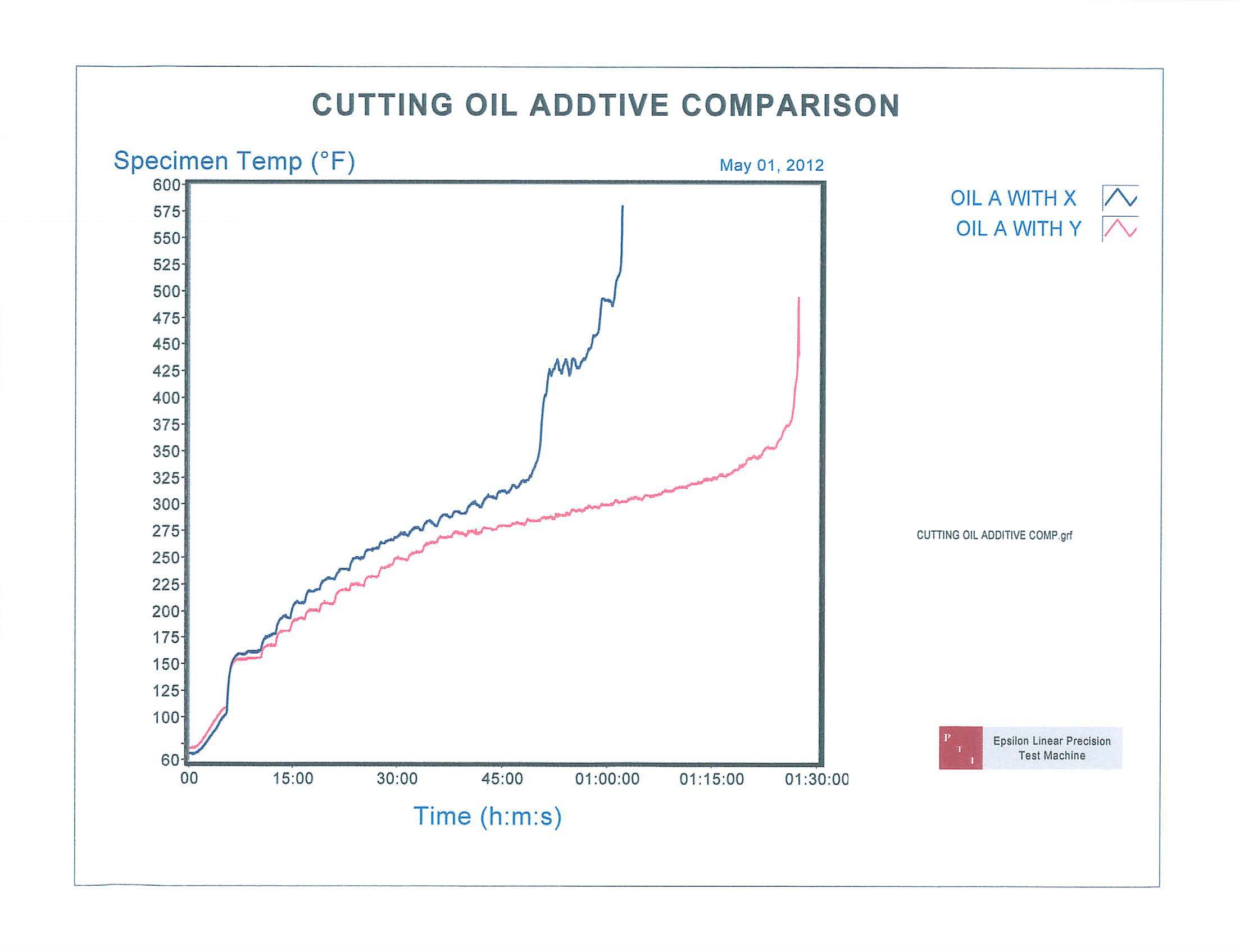
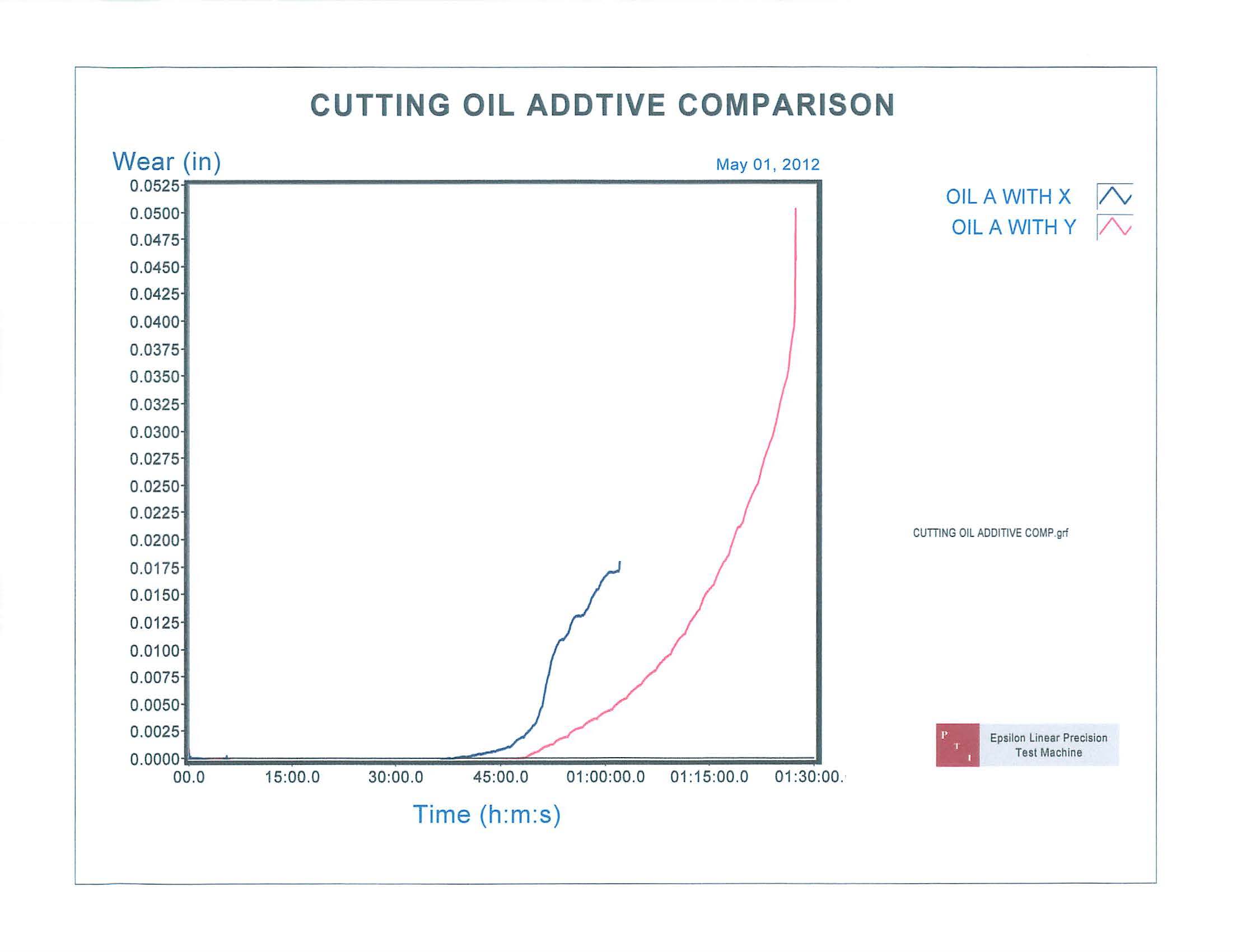 The graphs show the difference in two additives that are presented as equals. The standard test method ended within 15 minutes. The data shows no significant difference between the two products at that point in the test. Extending the test out significantly showed the failure the customer was seeing in the field.
Machines being built now are more demanding of the fluids than ever before. Designed to meet the needs of today’s factories, machines run faster, have smaller reservoirs and perform more functions than ever before. Taking bench testing to the field has always been an almost insurmountable challenge. Careful analysis of well-designed laboratory testing can be combined with field data to put together a very good picture of the outcome of bench to field testing. The graphs included in this article demonstrate this point very well. A standard ASTM pin and vee test showed two additives to be equal in performance—one was replacing a discontinued product. The customer did not see equal performance once the formulation with the replacement additive was in his machine. By extending the test, the differences in the two additives became obvious, with the customer agreeing!
TLT: What is the one thing you wish you would have learned earlier in your career?
Dubbert: It is hard to think of just one thing! Systematically ask salespeople questions when they come to you with a project. Significant information can be lost going from the field into the R&D lab. Without clearly defined data, critical information will be lost. It is easy to get caught up in the excitement of a new opportunity. If the project is not clearly laid out, at the minimum, time will be lost—at the worst, the new product will not perform.
You can reach Bridget Dubbert at bdubbert@englube.com.