HIGHLIGHTS
•
The mechanical properties of lithium dendrites were studied in an effort to determine why they can break much harder solid-state electrolytes.
•
In situ tensile testing using a customized nanomechanical testing device determined that lithium dendrites are brittle with no obvious plasticity, and fracture at a much higher tensile stress than bulk lithium metal.
•
Based on this testing, lithium dendrites are believed to contain a lithium core that is covered by a solid electrolyte interface.
The growing use of batteries in both transportation and storage applications is leading to better performance and durability. But operating problems still remain that can lead to reduced output and in specific circumstances, failure and even fire due to a short circuit.
One of the causes of battery failure has been directly connected to the formation of needle-like structures known as dendrites. In a lithium metal battery with the metal in use as the anode, dendrites can start growing off of the anode during charging as lithium ions move from the electrolyte to that electrode. Dendrites can then grow during battery use, penetrate the separator and, if left unchecked, can reach the cathode causing a short circuit. In addition, the fading of lithium battery capacity may be related to the formation of “dead lithium,” which has lost electrical contact with the anode.
In a previous TLT article,
1 researchers studied how adjusting the rate of ion flow impacts the growth of dendrites. Their focus was on how to minimize the phenomenon of electroconvection which enhances ion transport that allows lithium ion to be reduced and to deposit on the anode surface at a greater rate than their mass transfer rate. To study electroconvection, the researchers turned to studying of the motion of fluids in small volumes that is known as microfluidics. By adjusting the cross-flow of ions during electrodeposition, the researchers measured the growth of dendrites. An inverse relationship between flow rate and dendrite growth was found, which means that increasing ion flow rate is important in restricting dendrite growth.
While measures are underway to figure out how to restrict dendrite growth, research on their mechanical properties has not been reported. Dr. Hua Guo, shared equipment authority research scientist at Rice University in Houston, Texas, says, “Battery research has been moving to replace liquid with solid electrolytes in an effort to reduce the growth of lithium dendrites. But past work has demonstrated that solid-state electrolytes exhibiting high-modulus do not suppress lithium dendrite growth as effectively as expected. Instead, dendrites have been found to break stiff solid-state electrolytes indicating they still play an important function in the operation of solid-state batteries.”
The problem is that researchers have not been able to understand how dendrites, which supposedly are based on the soft and deformable metal, lithium, can break much harder solid-state electrolytes such as lithium lanthanum zirconium oxide. Guo says, “Lithium dendrites, which are only hundreds of nanometers in diameter, more than 100 times thinner than a standard human hair, consist of a lithium metal core surrounded by a solid electrolyte interface (SEI) layer that is tens of nanometers thick. But due to their very small size and inherent sensitivity to air, there is much difficulty in understanding the mechanical properties of lithium dendrites resulting in no clear answer about how they compare to lithium metal. In the absences of robust experimental evidence, it is generally assumed that the mechanical properties of lithium dendrites are similar to those of lithium metal.”
Guo and his colleagues have now published a study
2 that measured the mechanical properties of individual lithium dendrites providing further insight into their composition.
Nanomechanics
To study the mechanical properties of dendrites at the nanoscale (nanomechanics), the researchers needed to handle this air-sensitive material and evaluate it in an inert environment, such as a glovebox or a vacuum chamber. After lithium dendrites were grown in a coin cell, they were then transferred to a customized nanomechanical testing device where in situ tensile tests were conducted.
Guo says, “We used a nanomanipulator in a scanning electron microscope to transfer the dendrites to the testing device. Preparation of this approach took us one year to figure out.” Figure 2 shows an image of the sample transfer system.
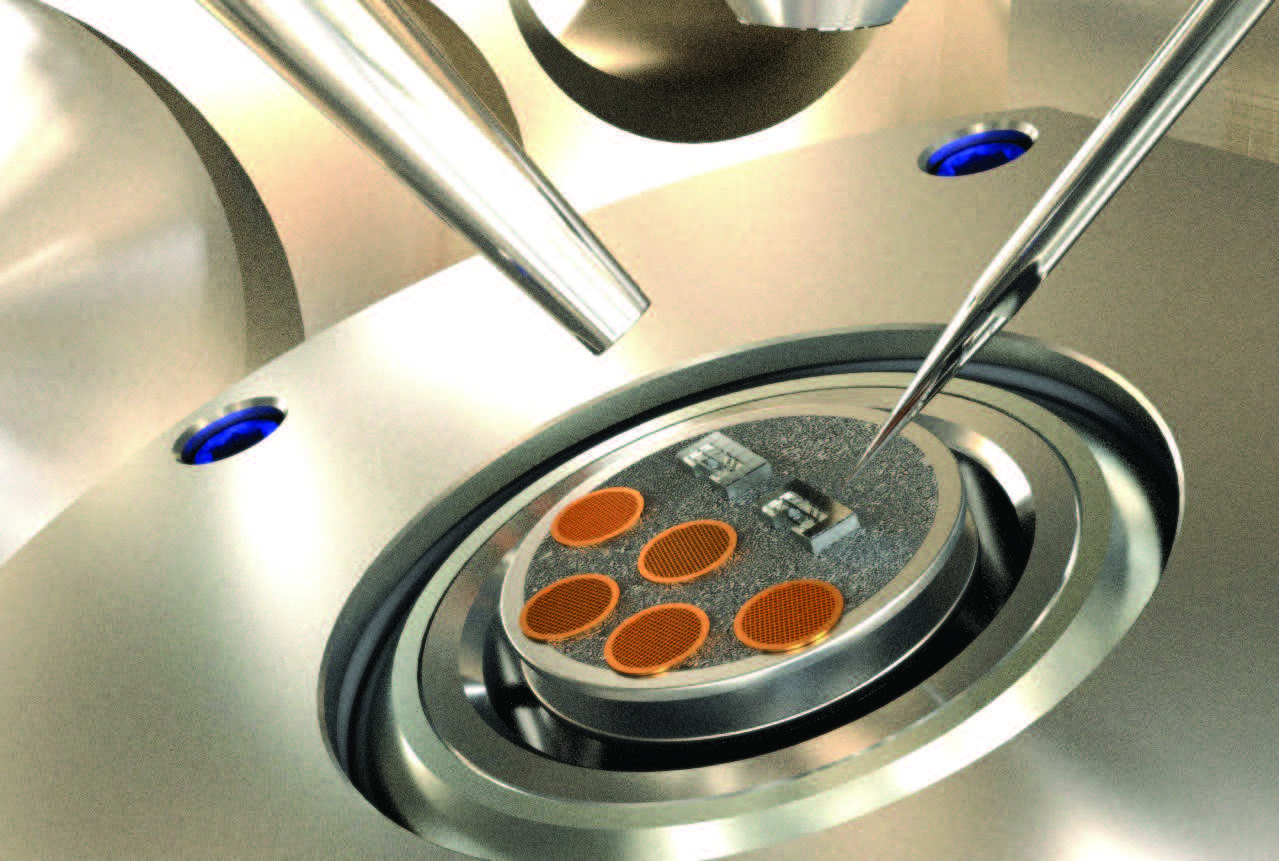 Figure 2. A nanomanipulator in a scanning electron microscope was used to transfer the dendrites to the testing device. Figure courtesy of Rice University.
In situ tensile testing generated stress-strain curves and fracture observations that determined lithium dendrites are brittle with no obvious plasticity. They fracture at a tensile stress greater than approximately 150 megapascals. This result is much higher than bulk lithium metal that produces a much lower tensile stress (approximately 0.6 megapascals) along with elongation exceeding 30%.
The experimental set-up for the in situ tensile testing is illustrated in Figure 3.
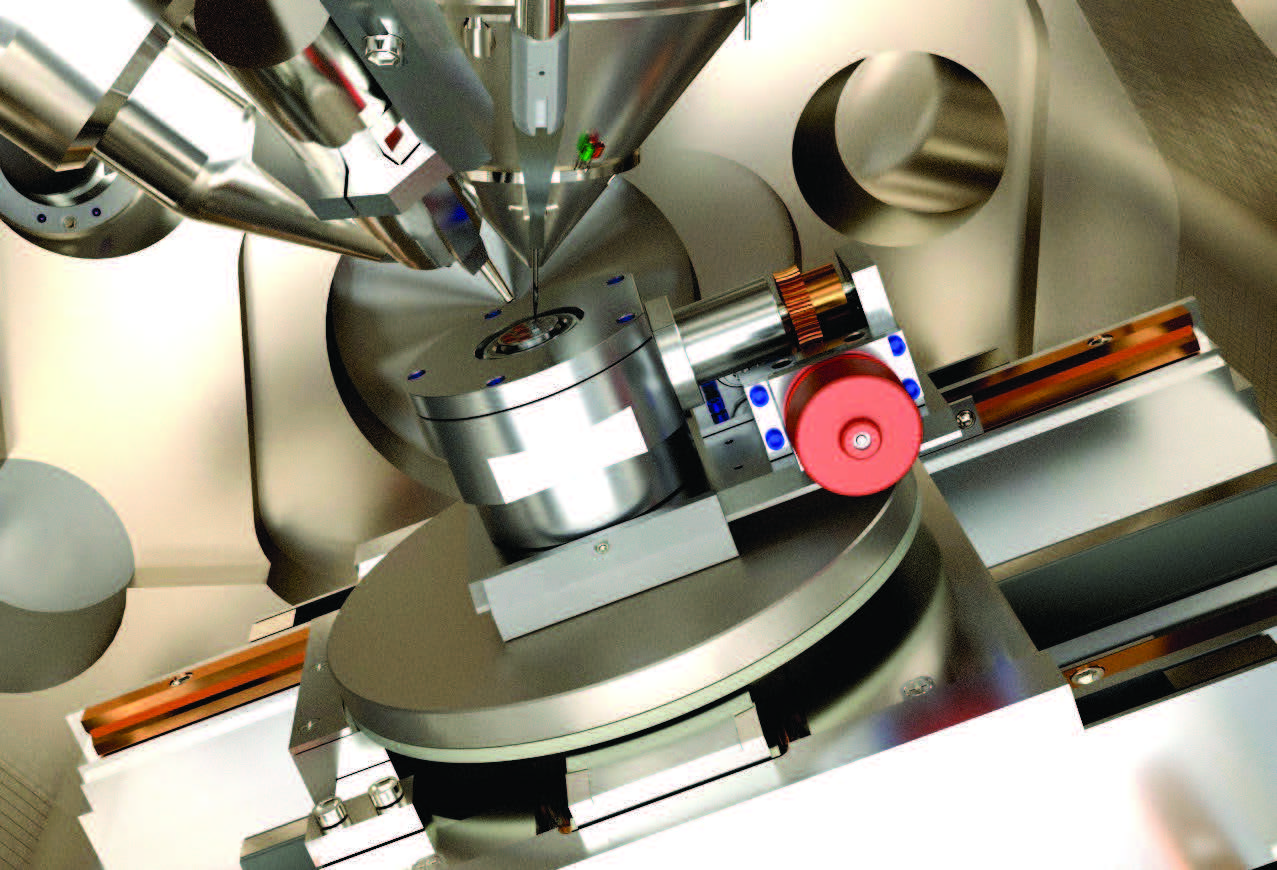 Figure 3. In situ tensile testing of the lithium dendrites was conducted using this experimental setup. Figure courtesy of Rice University.
Cryo-transmission electron microscopy was needed to image the individual lithium dendrites to better understand their composition. Guo says, “We could not use conventional electron microscopy because the lithium dendrite samples would be damaged easily by the energetic electron beam. Lower temperature conditions were needed to keep them stable.”
Based on their analysis, the researchers believe the lithium dendrites contain a lithium core that is covered by a SEI that has a thickness of 15 nanometers. The metal core contains body-centered cubic single crystals that are surrounded by an amorphous SEI.
Guo says, “We found that the SEI also contains small crystalline domains (2 to 5 nanometers in size) that are surrounded by an amorphous matrix which is probably composed of organic components formed from carbonate electrolyte decomposition.”
The researchers then conducted a finite element modeling and dislocation mechanics analysis to better understand why lithium dendrites appear to be 100 times stronger than bulk lithium metal. This analysis found that the energy barrier of dislocation mechanics is lowest for lithium metal at the free surface. For a lithium dendrite, the presence of the SEI on the lithium metal core moves the lowest energy barrier of dislocation to the bulk interior. Dislocation nucleation is resisted causing back stress to the lithium core, which enhances the mechanical strength of the lithium dendrite.
The brittle nature of dendrites means that they are vulnerable to snapping under stress which may lead to the presence of “dead lithium” fragments in the battery. Such fragments can reduce the performance of the battery.
Guo says, “Our hope is that this study will encourage designers to prioritize potential dendrite formation when developing new types of solid-state batteries. They will need to rethink the assumption that the mechanical properties of polymer-based electrolytes are sufficient to withstand the push of dendrites moving from the anode to the cathode.”
The researchers will be following up on this study by determining the composition of the SEI. Guo says, “We also intend to study the impact of dendrites in other batteries such as those prepared with sodium. Our objective is to build a database on the effect of dendrites on various battery types to assist developers.”
Additional information can be found in a recent article
2 or by contacting Guo at
hg23@rice.edu.
REFERENCES
1.
Canter, N. (2021), “Inhibition of dendrite formation: Ion flow,” TLT,
77 (6), pp. 32-33. Available at
www.stle.org/files/TLTArchives/2021/06_June/Tech_Beat_II.aspx.
2.
Ai, Q., Zhang, B., Liu, X., Shin, B., Guo, W., Gao, G., Zhao, L., Weng, X., Fang, Q., Zhai, T., Steinbach, D., Zhu, Y., Liu, Y., Wang, F., Tian, X., Guo, H., Zhang, Y., Zhao, X., Han, Y., Tang, M., Yao, Y., Zhu, T., Goa, H. and Lou, J. (2026), “Strong and brittle lithium dendrites,”
Science, 391 (6790), pp. 1125-1129.