Meet the Presenter
This article is based on a webinar presented by STLE Education on July 29, 2024. Proposals in the Use of Chlorinated Paraffins is available at www.stle.org: $39 for STLE members, $59 for all others.
Andrew Jaques is the executive director of the Chlorinated Paraffins Industry Association (CPIA), based in Washington, D.C. He has been working with the CPIA for 15 years and has more than 30 years of experience managing a broad range of environmental health and safety programs for the chemical and petroleum industries. In addition to managing CPIA, Jaques also manages the Acrylonitrile Group with the Polymer and Polymer Additives Council and the Vinyl Acetate Council.
From 1998 to 2008, Jaques managed a variety of chemical panels for the American Chemistry Council covering products such as hydrocarbon and oxygenated solvents, aromatics and petroleum additives. From 1991 to 1998, he worked with the American Petroleum Institute in several positions addressing occupational and environmental health, hazard communication, industrial hygiene, safety and fire protection for the petroleum industry. He attended Drew University in Madison, N.J., for his undergraduate studies and the George Washington University School of Public Health in Washington, D.C. for graduate studies.
You can reach Andrew Jaques at andrew@chlorinatedparaffins.org.

Andrew Jaques
KEY CONCEPTS
•
For many metalworking fluid applications, no workable substitute for chlorinated paraffins has been found.
•
Metalworking operations recirculate cooling fluids and dispose of spent fluids as hazardous waste, minimizing their exposure to the outside environment.
•
Decisions have been made on chlorinated paraffin restrictions and allowable uses, but implementing them will take years.
Chlorinated paraffins (CPs, also known as chloroalkanes) have a long history of use as extreme pressure additives in metalworking fluids (MWFs). Despite concerted efforts to find effective substitutes, this class of chemicals remains unmatched for cost effectiveness, long service life and the ability to provide lubrication across a wide range of temperatures.
However, the past two decades have seen regulatory and treaty-related bans on short-chain CPs, and similar bans or usage restrictions for medium-chain CPs are in the works. These regulatory actions are centered on concerns that CPs may persist in the environment and bioaccumulate in various organisms.
This article is based on an STLE webinar titled Proposals in the use of Chlorinated Paraffins presented by Andrew Jaques, executive director of the Chlorinated Paraffins Industry Association. See Meet the Presenters for more information. This article outlines the current state of CP regulations around the world and current discussions on how MWFs might qualify for exemptions from these regulations.
Biodegradable? Bioavailable? Or persistent organic pollutants?
The Stockholm Convention on Persistent Organic Pollutants, a global treaty organization, defines persistent organic pollutants (POPs) as organic (carbon-based) chemical substances having physical and chemical properties that prove problematic when these substances are released into the environment. POPs remain intact for “exceptionally long periods of time (many years).” Natural processes involving soil, water and air distribute these substances widely throughout the environment. These substances also accumulate in living organisms (including humans), they are found at higher concentrations at higher levels in the food chain and they are toxic to both humans and wildlife
1 (see Glossary of Abbreviations).
Glossary of abbreviations
CAPG
Chloroalkane Product Group (Cefic)
CAS
Chemical Abstracts Service
CEPA
Canadian Environmental Protection Act
CO Consent Order
CP
chlorinated paraffin (chloroalkane)
CPIA
Chlorinated Paraffins Industry Association
ECCC
Environment and Climate Change Canada
ECHA
European Chemicals Agency
ICAIA
International Chloroalkane Industry Association
LCCP
long-chain chlorinated paraffin
MCCP
medium-chain chlorinated paraffin
MWF
metalworking fluid
PBT
persistent, bioaccumulative and toxic
PMN
pre-manufacture notice
POP
persistent organic pollutant
REACH
Registration, Evaluation, Authorisation and Restriction of Chemicals
SCCP
short-chain chlorinated paraffin
SNUR
Significant New Use Rule
SVHC
substances of very high concern
TSCA
Toxic Substances Control Act
(U.S.) EPA United States Environmental Protection Agency
vLCCP
very long-chain chlorinated paraffin
vPvB
very persistent and very bioaccumulative
Classifying specific chemicals as POPs requires laboratory and field testing to quantify specific properties. “Persistent, bioaccumulative and toxic” (PBT) and “very persistent and very bioaccumulative” (vPvB) values are obtained by measuring biodegradation in specific environmental media (e.g., water, sediment, soil or air) over a specified period of time
(see Figure 1). Criteria vary among regulatory bodies, including the U.S. Environmental Protection Agency (EPA), the European Union (EU) and the Stockholm Convention.
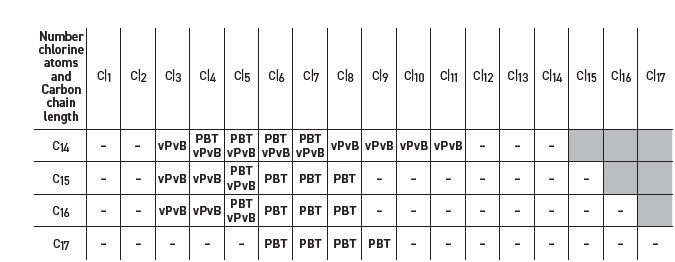
Figure 1. Medium-chain CP congeners with environmental hazard designations. PBT is “persistent, bioaccumulative and toxic,” and vPvB is “very persistent and very bioaccumulative.” Figure courtesy of the European Chemicals Agency.
“Readily biodegradable” substances degrade very quickly in the environment and require no further testing. “Inherently biodegradable” substances eventually degrade in the environment on their own but at a slower rate. Bioaccumulation studies measure the degree of concentration of a substance in a given organism over time, and toxicity studies measure adverse health effects caused by a substance.
“When you test these CPs in relevant systems at relevant concentrations—that is, very low concentrations,” says Jaques, “you actually see quite a decent amount of biodegradation.” What’s more, MWFs containing CPs have very limited exposure to the environment, he adds. CP use for MWFs occurs mostly in North America, where spent fluids are managed as hazardous wastes.
Short-chain CPs (SCCPs) were added to the Stockholm Convention’s POPs list in 2017 (decision SC-8/11). Although suppliers in the west had already stopped making SCCPs, this listing met with resistance from several countries, particularly in Asia. The Asian countries got a five-year exemption to continue manufacturing using SCCPs, followed by another three- to five-year exemption for specific countries and applications (additives in transmission belts, rubber conveyor belts, leather, lubricant additives, tubes for outdoor decoration bulbs, paints, adhesives, metal processing, plasticizers).
In 2023, China added SCCPs to its chemical restrictions list, specifying a 12-month phase-out period. China completed implementation of this phase-out in 2024, effectively completing global participation in the SCCP phase-out effort. There is some confusion as to whether the Chinese regulations ban all C10 to C13 CPs or only those with greater than 48% chlorination by weight. Data shows that less-chlorinated products are readily biodegradable and not persistent.
In 2021, the UK proposed a similar POPs listing for MCCPs, covering C14 to C17 CPs with 45% or more chlorination by weight, based on the UK’s interpretation of biodegradation data. China had only recently implemented restrictions on SCCP compounds, and they met the UK’s proposal on MCCPs with resistance because of its potential to affect Chinese industries. On the other hand, the EU and Switzerland have advocated listing all C14 to C17 CPs, regardless of the level of chlorination. The UK proposal has been discussed at numerous contentious meetings, resulting in a members-only session that completed a draft decision to list MCCPs with a large list of exemptions
(see Chlorinated Paraffin Categories).
Chlorinated paraffin categories
Regulators today focus almost exclusively on carbon chain lengths when classifying chlorinated paraffins. This is the classification scheme most commonly used in the U.S., Canada and Europe.
Short-chain chlorinated paraffins (SCCP): C10-C13
phased out in North America, the EU and China
Medium-chain chlorinated paraffins (MCCP): C14-C17
regulatory changes have been proposed, implementation is in varying stages of progress
Long-chain chlorinated paraffins (LCCP): C18 and greater
research on environmental effects is underway
Very long-chain chlorinated paraffins (vLCCP): C21 and greater
research on environmental effects is underway
In 2025, at the 12th Conference of the Parties of the Stockholm Convention, a new list of POPs that included MCCPs was added to Annex A to the Convention (decision SC-12/10).
2 According to the decision, specific exemptions allow production of MCCPs “as allowed for the Parties listed in the Register in accordance with the provisions of part XIII of Annex A,” and exemptions for acceptable uses were specified “in accordance with the provisions of Part XIII of Annex A.”
3
Narrow selection and interpretation of the available data drove the decisions to add SCCP and MCCP to the POPs list, Jaques says. All CPs, at least up through C17, are fairly biodegradable, he adds, but the measurements depend on the type of test system and other factors.
Although the Stockholm Convention defines SCCPs by their Chemical Abstracts Service (CAS) numbers, the MCCPs are defined as those that fit either or both of two types of definitions, to accommodate the methods used in various nations
(see Stockholm’s Definitions for SCCPs and MCCPs). One definition of MCCPs is based on congener groups—molecules with the same carbon chain backbone, but with differing numbers of chlorine atoms. This definition was not universally accepted by the Stockholm Convention members, so the MCCP listing also includes a definition based on carbon chain length and chlorination by weight. Jaques notes that the definition based on carbon chain length and weight percent chlorine is simpler to verify. The congener analysis required for the other definition requires analysis methods that are not as widely available.
Stockholm Convention’s definitions for SCCPs and MCCPs
The Stockholm Convention targets classes of chemicals for elimination, restriction or reduction of unintentional releases. Annex A specifies chemicals targeted for elimination, including certain chlorinated paraffins. Parties to the Convention “must take measures to eliminate the production and use of the chemicals” listed in this annex. Specific exemptions apply only to the parties to the treaty that have registered for them.
For the purposes of the Stockholm Convention: SCCPs are defined according to their CAS numbers: 85535-84-8; 68920-70-7; 71011-12-6; 85536-22-7; 85681-73-8; 108171-26-2.
MCCPs are defined as those that meet either or both of two definitions:
•
(i) Substances or mixtures that contain linear chloroalkanes with carbon chain lengths in the range C14-17 and chlorination levels at or exceeding 45% chlorine by weight
•
(ii) Substances or mixtures that contain linear C14–17 chloroalkanes with molecular formulae:
C
14H
(30−y)Cl
y where y ≥ 5;
C
15H
(32−y)Cl
y where y ≥ 5;
C
16H
(34−y)Cl
y where y ≥ 6;
C
17H
(36−y)Cl
y where y ≥ 6.
Sources: Refs. 2, 3.
The current CP situation
Paraffins (alkanes) and alpha-olefins (1-alkenes) are common feedstocks for producing CPs. The chlorination process does not change the length of the feedstock’s carbon chain. It is not practically possible to distill or otherwise separate CPs having various chain lengths after manufacture.
Globally, most CPs are used as flame retardants and secondary plasticizers in polyvinylchloride (PVC), other polymers and synthetic rubber. Other uses include sealants and caulks. MWFs are a less-common use outside of North America, which produces a significant fraction of the world’s metal parts. Critical uses of MWFs containing CPs include grinding titanium aerospace bolts and tapping titanium nuts, drawing stainless steel wire, machining high-nickel alloys and drilling and tapping aluminum parts.
4
North America is a major consumer of CPs for MWFs, but Europe is driving much of the regulatory environment for CPs, says Jaques. The major users of CPs today include North America (the U.S., Canada and to some extent, Mexico), the UK, the EU nations, China and India. Mid-level users include Japan and nations in Southeast Asia. Several nations in the Southern Hemisphere are parties to the Stockholm Convention on Persistent Organic Pollutants, but they are not major users of CPs, Jaques says
(see CP Associations and Consortia).
Chlorinated Paraffin associations and consortia
Worldwide, several associations are involved with chlorinated paraffins. Several product-specific research consortia are currently addressing regulatory issues for medium- and long-chain CPs.
North America
Chlorinated Paraffins Industry Association (CPIA), Andrew Jaques, executive director
CPIA is a nonpolitical organization, and the positions it takes are based on science.
Europe
Cefic’s Chloroalkane Product Group (CAPG), Richy Mariner, manager
Cefic is the main trade association for the chemical industry in Europe.
CPIA’s MCCP and LCCP REACH Consortia, Andrew Jaques, consortium manager
REACH (Registration, Evaluation, Authorisation and Restriction of Chemicals) is a comprehensive EU regulation, enforced since 2007, to protect human health and the environment from chemical risks.
Global
International Chloroalkane Industry Association (ICAIA)
This is an ad hoc affiliation of CAPG, CPIA and Indian and Chinese producers.
The Stockholm Convention on Persistent Organic Pollutants
A global treaty that came into force in 2004, with the intention of reducing, and where feasible, eliminating the release of POPs. Parties to this treaty meet every few years to negotiate updates to chemical lists, allowable exemptions and implementation timelines.
Asian countries produce more than 90% of the CPs worldwide, some 1.5 to 2 million metric tons (tonnes) annually, and production has grown significantly over the past 20 years. China is the largest CP producer, with India rapidly rising in second place. Even though 2020 was a low-production year for China, it produced almost one million tonnes, with the largest amount in the 52% chlorinated category. Europe and the UK produce about 50 to 100 kilotonnes annually, and the U.S. produces some 20 to 25 kilotonnes annually.4
China uses a CP classification system based on weight percent chlorination levels (e.g., CP-52 is any CP having 52% chlorine by weight). These classifications often contain products with very wide carbon ranges (e.g., C10-C21).
As of Jan. 1, 2024, China officially banned the production, processing, use, import and export of short-chain chlorinated paraffins (SCCPs).5 These compounds were targeted for elimination under the 2017 Stockholm Convention meeting, Jaques says, but China had obtained an exemption. China tends to be quick about implementing the measures they have agreed to, he says, but it is not known what timeline the Asian nations will follow with respect to implementing restrictions on the list of POPs agreed to at the 2025 meeting.
Regulatory actions in the U.S. and Canada
In the U.S., Chlorinated Paraffins Industry Association (CPIA) members have added more than a dozen new CAS numbers to the Toxic Substances Control Act (TSCA) chemical inventory, announced using a pre-manufacture notice (PMN) (see Figure 2). Over the past decade, almost everything added to the U.S. inventory via a PMN incurs significant new use rules (SNURs).
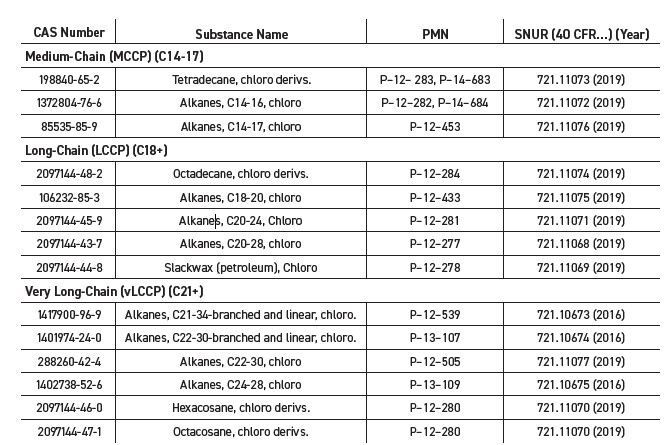
Figure 2. New CP substances on the TSCA inventory. Figure courtesy of Chlorinated Paraffins Industry Association (CPIA).
Some importers still occasionally use “legacy” CP substances listed on the TSCA inventory. In her presentation at the FABTECH 2015 conference in Chicago, Dr. Maria Doa, director of the U.S. EPA Chemical Control Division, Office of Chemical Safety and Pollution Prevention, noted that any companies using these legacy CP products were doing so illegally. An enforcement action was resolved using a no-fault settlement; all of the “new” chemicals are now regulated under consent orders (COs)—direct agreements between the manufacturer or importer and the EPA—or via SNURs. Both of these arrangements vary by substance, but they require recordkeeping and new testing.
When the U.S. EPA approved the MCCP-related PMNs, it required testing to address concerns about their potential persistence and bioaccumulation in the environment. The three companies involved in the PMNs consolidated their efforts under CPIA to perform a testing program, and the resulting data have been developed and submitted to EPA. At this time, CPIA is not doing any new testing on MCCPs, but more could be done at some future time. The EPA New Chemicals Office has given no timeline for completing its review of MCCP, and companies in the U.S. can continue production and importation of MCCPs for the time being.
In 2012, the U.S. EPA began using “long-chain chlorinated paraffins” (LCCP) to refer to C18-C20 chloroalkanes and “very long-chain chlorinated paraffins” (vLCCP) to refer to C21 and greater, but this distinction was not based on any clear physical or chemical dividing line. In the U.S., C18-C20 products are not common, but several products that would otherwise be classified vLCCP include some C20 content.
The EPA was still evaluating the MCCP and LCCP PMNs in 2013, when the vLCCP PMNs were approved. The PMNs for vLCCPs contained a tiered testing program that focused on chemical analysis and measurements of soil and sediment biodegradation and bioaccumulation. Testing on LCCPs and vLCCPs originally focused on C21 and longer CPs. Later, the EPA extended its approval to C18-plus CPs. Going forward, testing on these CPs may be affected by the EPA’s final decision on MCCPs. Requirements under the vLCCP PMN CO were suspended in 2017, pending EPA’s completion of the evaluation of MCCPs.
This situation may change pending the results of the 2023 effectiveness evaluation of the Stockholm Convention.6 CPIA, which works on behalf of U.S. industry, worked with the EPA to develop some proposed exemptions for certain applications of MCCPs, including for MWFs used in aerospace, defense and other critical industries. Although the U.S. never ratified the Stockholm Convention Treaty and thus is not bound by its terms, EPA representatives attend meetings as observers, and they present positions on issues that are informed by industry, nongovernmental organizations and other interested parties.
Europe has proposed a 10-year phase-out of MCCPs, Jaques says, and European nations are aggressively implementing the terms of the Stockholm Convention. Canada might implement the new terms in 2026, but it is doubtful that the U.S. will act that quickly, he adds.
In 2023, the Canadian Parliament authorized an updated version of the Canadian Environmental Protection Act (CEPA), which includes dividing CEPA Schedule One toxic substances into two parts. Part 1 lists chemicals slated for prohibition, including C10 to C13 chloroalkanes, which have already been prohibited since 2012, but also extends listing to C14 to C20 chloroalkanes. This prohibition would include MCCP and LCCP products in the C19 to C20 range, and it includes consideration of the cumulative effects of these chemicals. The bill also creates a new “watch list” of substances deemed capable of becoming toxic, and it includes provisions for confidential business information.
Environment and Climate Change Canada (ECCC), a department of the Government of Canada, appears open to discussing exemptions to any future regulatory prohibitions of C14 to C20 chloroalkanes or extended phase-out periods for key applications, and it has requested information on key uses of these chemicals.
CPIA has expressed an interest in working with any Canadian users or industries that would be affected by new restrictions, and it has already organized discussions on exemptions or phase-out extensions for certain polymer applications.
European Union and the UK
In Europe, MCCP compounds were formally added as candidates for designation as substances of very high concern (SVHC) in July 2022. This list is unique in that it lists CPs as congeners. This approach is controversial because evidence shows that less-chlorinated MCCPs are biodegradable and should not be considered “persistent, bioaccumulative and toxic” (see Figure 3).
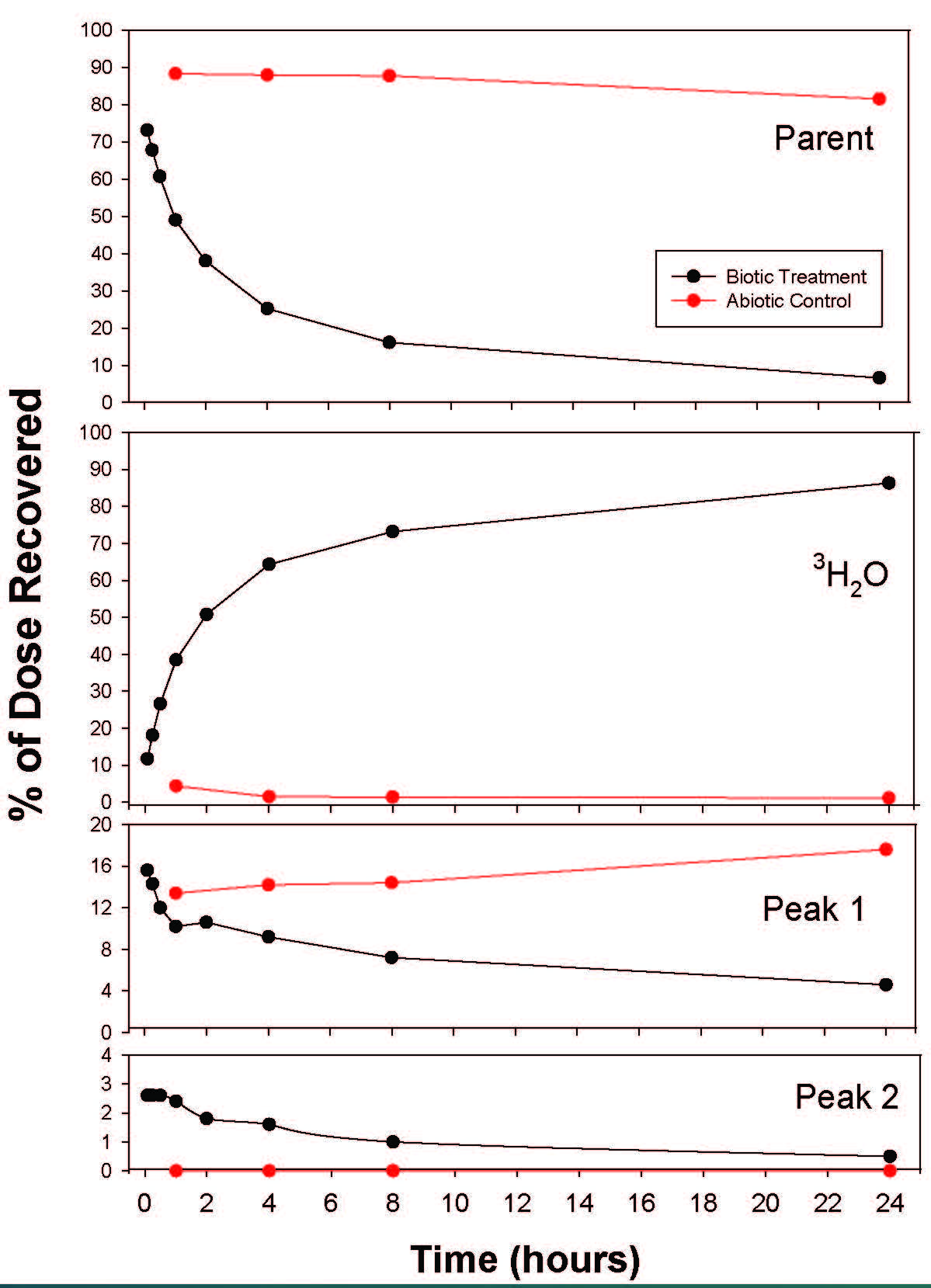
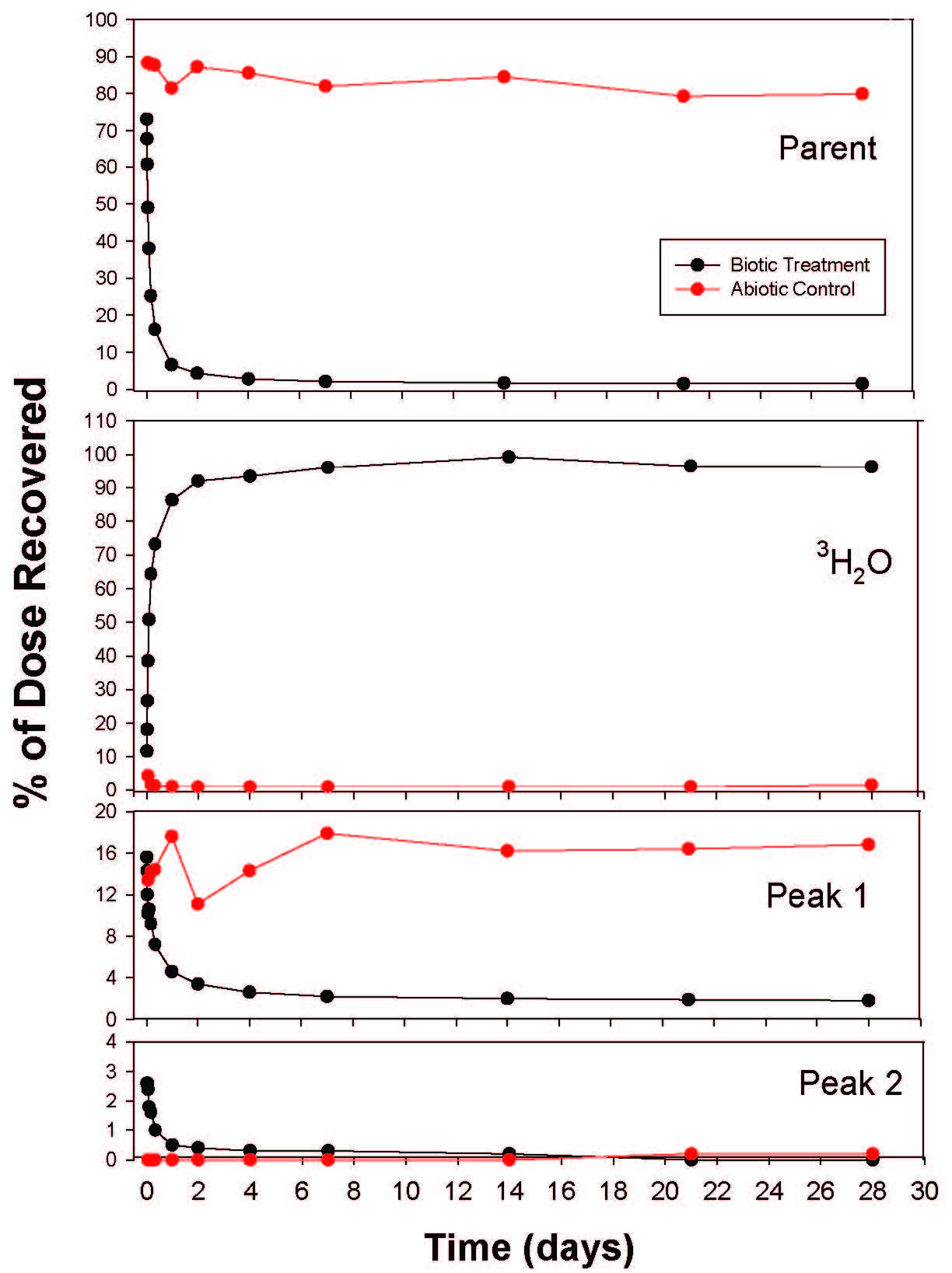
Figure 3. Biodegradation tests for MCCP using simulated wastewater. Figure courtesy of Chlorinated Paraffins Industry Association (CPIA).
Based on the December 2025 Stockholm Convention decision on MCCP, the European Commission has proposed to restrict most uses of MCCP as of December 2026. The EU will, however, still allow a 10-year phase-out period for using MCCPs in MWFs, ending in 2036.
The UK and the EU are working independently to test LCCPs for environmental fate and toxicology, and this process is expected to take four to five years from 2025. Much of this work applies to aquatic effects in water and sediments. “Very persistent in sediment” bioaccumulation conclusions for MCCPs have been applied to LCCPs in the EU, even though LCCPs are less soluble in water and less bioavailable than MCCPs.4 LCCPs’ potential for bioaccumulation is currently under study. Jaques notes that it is likely that LCCP will also be classified as vPvB or PBT in the EU and UK.
Implementing the changes
Jaques says that methods of implementing the terms of the Stockholm Convention vary by country and by industry. He adds that MCCPs, which were added to the POPs list in 2025, have been granted an exemption for MWF use until 2036. Although the Convention has no means of enforcing its terms, the parties who have signed the Convention have agreed to abide by its terms. European nations are proposing accelerated implementation of the new terms for MCCPs, but their industries don’t use as much of these compounds as other nations do, he adds.
Downstream users who cannot find adequate replacements for CPs continue to provide information and be involved in the process. For example, several new case studies on MCCP use for MWFs in the aerospace industry were presented at the 2024 Independent Lubricant Manufacturers Association (ILMA) MWF conference and a subsequent update to the ILMA MWF Committee.4
Because the discussions on restricting CP use focus on their environmental impacts, applications like metalworking operations that release little to no CPs to the environment have a stronger case for exemptions and extended phase-out periods. “These products don’t get admitted into the environment like some have claimed,” Jaques says. “There are very good control practices at these established and well-regulated parts manufacturing facilities. They have, in fact, looked for chlorine alternatives, and sometimes it’s possible and sometimes it isn’t. From our perspective, we’re trying to support those users and formulators who have a critical use. We want to continue to use this.”
The case for CP exemptions, Jaques adds, can be defended both based on the characteristics of the material and on the best practices being employed. “The decision is done, but the implementation will take years.”
REFERENCES
1. Stockholm Convention on persistent organic pollutants (POPs): What are POPs? Available at www.pops.int/TheConvention/ThePOPs/tabid/673/Default.aspx.
2. The new POPs under the Stockholm Convention (2025). Available at www.pops.int/TheConvention/ThePOPs/TheNewPOPs/tabid/2511/Default.aspx.
3. Stockholm Convention on persistent organic pollutants (POPs): Text and Annexes (revised in 2025). Available at www.pops.int/TheConvention/Overview/TextoftheConvention/tabid/2232/Default.aspx.
4. Jaques, A. (2024), “Chlorinated paraffin update for the ILMA MWF Committee,” Chlorinated Paraffins Industry Association. Available at https://ilma.org/wp-content/uploads/2024/10/AM24-MWF-Committee-CPIA-Update.pdf.
5. SCCPs phase-out: How to navigate China’s ban and global regulatory challenges. REACH24H, May 28, 2025. Available at https://en.reach24h.com/news/industry-news/chemical/china-sccp-ban.
6. Outcomes for the effectiveness evaluation of the Stockholm Convention (2023). Available at www.pops.int/Implementation/EffectivenessEvaluation/Outcomes/2023Outcomes/tabid/9559/Default.aspx.
Nancy McGuire is a freelance writer based in Albuquerque, N.M. You can contact her at nmcguire@wordchemist.com.