HIGHLIGHTS
•
A modified low-temperature differential Stirling engine was used to demonstrate the potential for radiative power coupling at night.
•
A steady temperature difference of 10℃ was obtained between the bottom plate of the modified Stirling engine in direct contact with the Earth's surface and the top plate radiatively coupled to the sky.
•
The resulting mechanical energy generated due to the temperature difference between the plates is equivalent to 400 milliwatts of mechanical power per square meter.
Concerns about cost, availability and environmental impact are leading researchers to seek alternative approaches for power generation that can address each of these issues. The result has been the growing use of renewable energy sources such as solar and wind power.
But each of these approaches has limitations due to the sun not shining during the night and the wind not necessarily blowing in a consistent manner. For these reasons, other ways to generate energy on a small-scale that are more linked to smaller energy-producing sources are also under evaluation.
For example, a past TLT article
1 discussed the development of a triboelectric device that when attached to an individual’s finger can produce electricity in response to bending. Electricity was generated as a result of friction generated when an individual bent their finger leading to crumpled gold and polydimethylsiloxane layers coming together. The resulting friction produced a flow of electrons. A maximum power density of 0.22 milliwatts per centimeter that was sufficient to light 48 red LEDs simultaneously.
Another strategy for identifying a power source is to take advantage of the difference in temperature between two materials. Dr. Jeremy Munday, professor of electrical and computer engineering at the University of California, Davis in Davis, Calif., says, “A possible way to generate power is to take advantage of the temperature difference between the Earth’s surface and outer space. The reason for exploring this possibility is that there is a significant temperature difference between the earth (27℃) and outer space (-270℃).”
Munday indicates that the earth undergoes radiative cooling at night particularly when the sky is clear due to the emitting of heat from the ground into space in the form of infrared light. He says, “This release of heat is also a strategy for reducing the increase in global temperatures.”
Munday envisions that this temperature difference can be exploited to produce power by a process known as passive radiative coupling. He says, “To achieve this result a device can use heat from the earth but needs to exhibit a strong enough emissions signature to allow the radiation to pass through earth's atmosphere and directly couple to space.”
Earlier efforts have shown that radiative power generation can be achieved but they require the use of low band-gap semiconductor devices or thermoelectric generators that are not commercially feasible because power-output is low and cost is a challenge due to the need to pursue rare-earth elements. Munday and his colleagues are now proposing a new approach to produce mechanical power through radiative coupling.
Stirling engine
The researchers demonstrated the potential for radiative power generation by developing a modified low-temperature differential Stirling engine
(see Figure 2). Munday says, “The Stirling engine was invented in the 1800s and is effective in applications where there is a small temperature difference (10℃) between the materials used to generate mechanical power.”
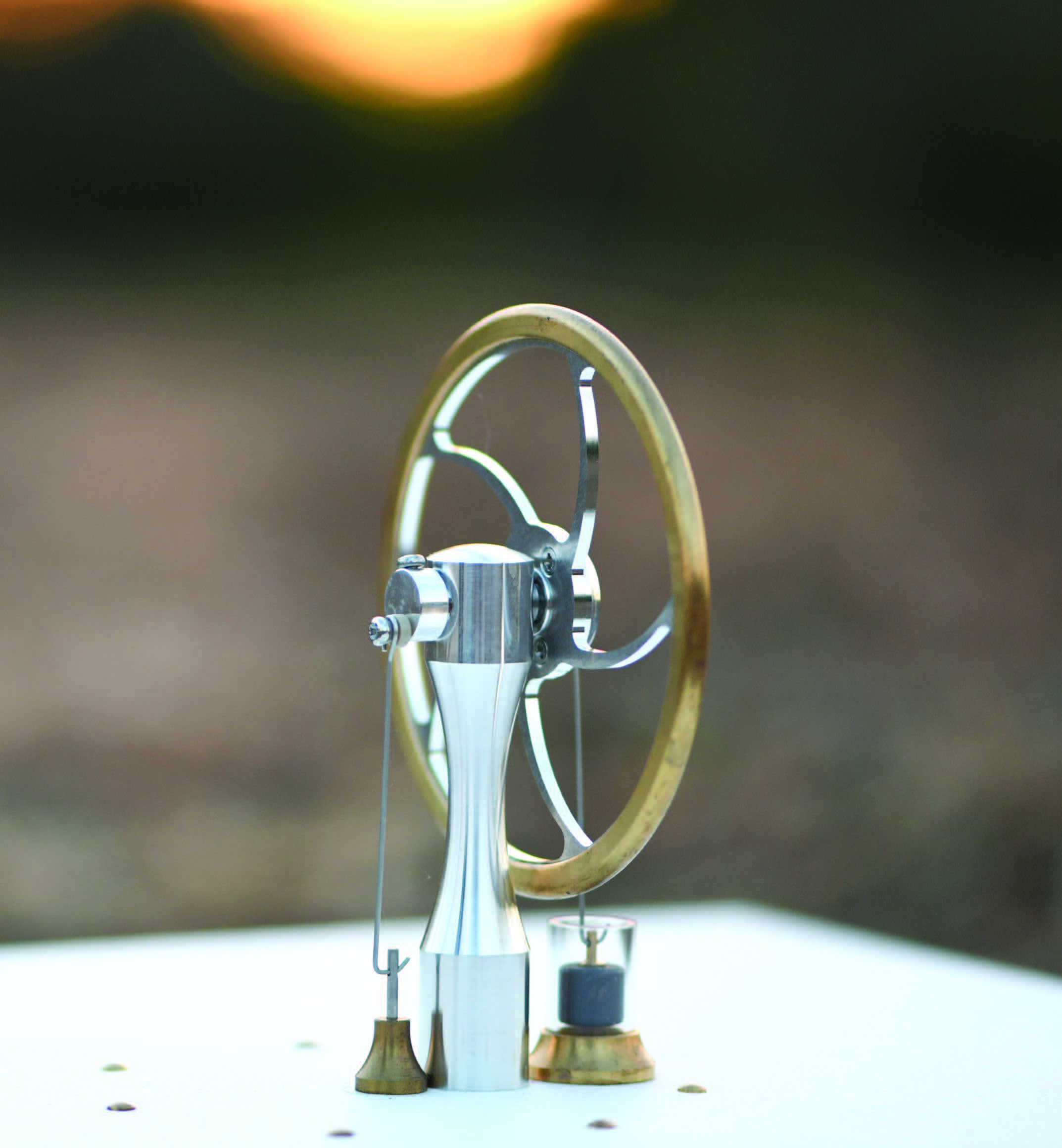 Figure 2. The temperature difference between the Earth’s surface and atmosphere was used by a modified low-temperature differential Stirling engine to generate sufficient mechanical power to enable a one hertz rotation of the engine’s flywheel. Figure courtesy of the University of California, Davis.
The bottom plate of the modified Stirling engine is in direct contact with the Earth’s surface while the top plate is radiatively coupled to the sky. An aluminum mount, pressed into the soil to a depth of five centimeters, thermally connects the bottom plate to the Earth. The top plate is painted with an infrared emissive paint to facilitate radiative emission to the sky-facing side.
Munday says, “Initial trials were conducted by placing the modified Stirling engine in a field. The temperature difference between the top and the bottom plates of the engine developed after sundown when incident solar radiation dropped to zero and a steady temperature difference of approximately 10℃ occurred between the plates. The modified Stirling engine emits most strongly in the infrared range at a wavelength ranging from 8 to 10 microns. The resulting mechanical energy generated led to approximately a one hertz rotation of the engine’s flywheel. This is equivalent to 400 milliwatts of mechanical power per square meter.”
Munday noted that while there are seasonal differences regarding temperature and atmospheric conditions, the engine temperature differential and frequency remain relatively consistent throughout one year of testing. Further testing was conducted by evaluating 25 different temperature differentials under laboratory conditions.
Munday says, “For each experiment, the engine frequency and temperature were monitored to enable the flywheel to achieve a constant rotation (steady state). Once readings were taken, friction was manually applied to the engine to slow it to a near stall. Then the next experiment was initiated by ramping the engine back up recording how quickly the flywheel reached steady state.”
The researchers found a direct relationship between temperature differential and power output. Replacing the flywheel with a custom 3D-printed fan blade led to the use of the modified Stirling engine in air circulation. This set-up is able to move air at a speed between 0.15 and 0.2 meters per second which is recommended to maintain thermal comfort inside buildings. At temperature differentials above 30℃, the modified Stirling engine can generate a volumetric flow rate approaching 5 cubic feet per minute.
A second potential application is to modify the engine by including a small DC motor so that electrical power can be produced simultaneously. When using this engine, Munday points out that mechanical power is more efficiently produced than electricity.
The outcome of this project is the development of a radiative heat engine based on Earth-sky coupling, and for that, a modified Stirling engine turned out to be a great engine due to its ability to operate with small temperature differentials. Munday says, “The engine’s power output can be increased by using a specifically designed radiative cooling material instead of commercial paint, optimizing surface area and making mechanical changes to improve the engine output. One other modification is to enclose the engine to minimize the presence of dust and other contaminants that can impair performance.”
Additional information can be found in a recent article
2 or by contacting Munday at
jnmunday@ucdavis.edu.
REFERENCES
1.
Canter, N. (2018), “Bend your finger, generate electricity,” TLT,
74 (5), pp. 18-19. Available at
www.stle.org/files/TLTArchives/2018/05_May/Tech_Beat_I.aspx.
2.
Deppe, T., and Munday, J. (2025), “Mechanical power generation using Earth's ambient radiation,”
Science Advances, 11 (46), eadw6833.