A dispersion of graphene nanoplatelets in 4 cSt PAO was evaluated in a modified mini-traction machine test rig that allowed for evaluation of lubricants under electrified conditions.
At low rolling speeds, reduced traction coefficients were found due to the influence of graphene nanoplatelets. While at higher speeds, more severe wear under electrification was seen than with a 4 cSt PAO control.
The more severe wear at higher speeds may be due to the formation of abrasive carbonaceous debris under mixed lubrication conditions.
Graphene has been widely evaluated as a lubricant because this material has demonstrated excellent lubricity by achieving low coefficient of friction values. While graphene has been successfully used as a solid lubricant, finding approaches for using it in a fluid which is a requirement for many applications has been challenging.
In a previous TLT article,
1 researchers recognizing the limitations for dispersing graphene in a base stock evaluated a new form that is known as crumpled graphene balls. This form of graphene is produced by taking graphene oxide sheets suspended in nebulized, aerosol water and then squeezing them in all directions by using a process called capillary compression. During this process, heat is applied to facilitate the reduction of graphene oxide to crumpled graphene balls. The net result is sonicated crumpled graphene balls that exhibit better dispersibility in 4 cSt polyalphaolefin (PAO) than graphite platelets.
The researchers discovered that the van der Waals attraction between crumpled graphene particles is weak reducing the potential for agglomeration. As a result, crumpled graphene balls dispersed in PAO display better friction and wear performance over a longer time period than other types of graphene dispersions.
As the use of electric vehicles (EVs) increases globally, there is now recognition that traditional automotive lubricants used in internal combustion engines do not meet all of the requirements of an EV because they must withstand certain electrified environments coming from shaft currents. Dr. Leonardo Israel Farfán-Cabrera, research professor of mechanical and automotive engineering at the Tecnológico de Monterrey in Monterrey, Mexico, says, “Lubricants used in an EV must display excellent thermal conductivity and stability, a high dielectric constant for specific EV driveline architectures, polymer compatibility and resistance to copper corrosion in addition to superior lubricity. As a two-dimensional material, graphene has shown potential for use in electric vehicles due to exhibiting many of these characteristics.”
A form of graphene that is easier to work with is graphene nanoplatelets, according to Farfán-Cabrera. He says, “We have been working with graphene nanoplatelets for about eight years and have found them to be very effective at modifying the tribology of surfaces. Graphene nanoplatelets have demonstrated the ability to reduce friction and wear, including under conditions involving electrical loading.”
Graphene nanoplatelets are prepared by exfoliating graphite into thin layered graphene stacks that are tens of nanometers thick. This process is a more practical and cost-effective approach for potentially utilizing graphene in commercial applications.
Past research has demonstrated the potential for using graphene nanoplatelets as a lubricant additive in electrified sliding conditions but that does not represent actual operating conditions in EV gears and bearings. Farfán-Cabrera says, “Bearings and gears from electric vehicle drivelines are very susceptible to operate under electrified rolling-sliding conditions due to unpredictable shaft current produced through highly variable driving cycles. We have now conducted a new study to gain a better understanding for how graphene nanoplatelets dispersions perform in a situation that more accurately reflects the operating conditions of electric-drive components.”
Modified mini-traction machine (MTM)
The researchers prepared a 0.5% by weight dispersion of graphene nanoplatelets in 4 cSt PAO by magnetic stirring agitation at 300 rpm for four hours followed by 45 minutes of sonication in an ultrasound bath. Farfán-Cabrera says, “We selected graphene nanoplatelets with a specific surface area of 750 square meters per gram because they exhibited superior performance in previous studies under electric sliding conditions compared to nanoparticles with other specific surface areas.”
For comparison purposes, the graphene nanoplatelet dispersion was compared in testing to neat 4 cSt PAO. A modified MTM test rig
(see Figure 1) was used that allowed for evaluation of the lubricants under electrified conditions by precisely controlling the flow of electric current through rolling-sliding contacts. The study was conducted at two temperatures (20℃ and 75℃), and under non-electrified and electrified conditions (0 and 1.5 amperes) in order to have a general insight into the effects of electricity on the traction response.
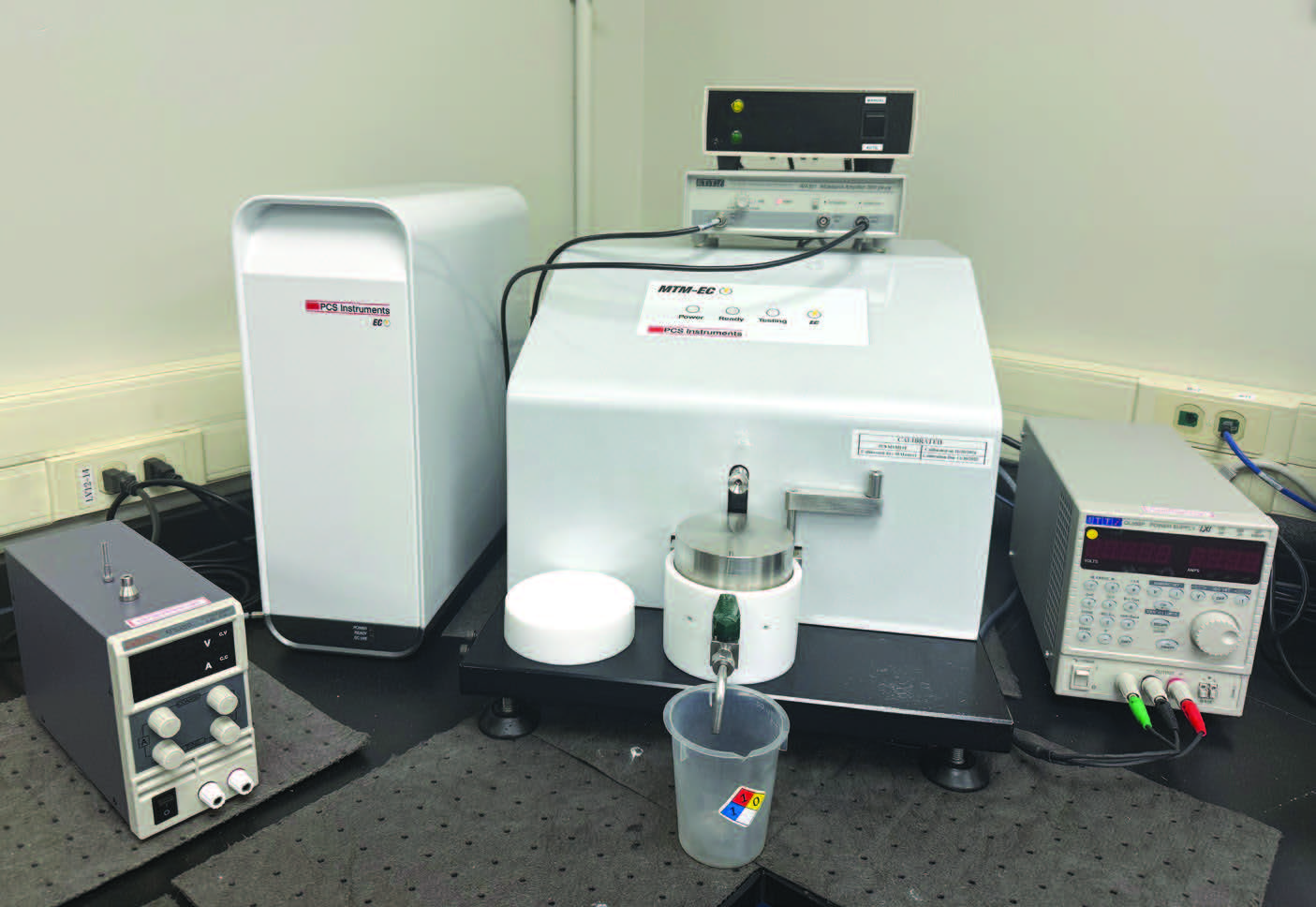 Figure 1. The modified MTM test rig was used to evaluate a dispersion of graphene nanoplatelets in 4 cSt PAO under electrified conditions. Figure courtesy of Southwest Research Institute.
A series of traction and speed experiments at both temperatures were carried out using a specific test matrix and then wear analysis was conducted by optical profilometry. The researchers also conducted rheometer studies to assess potential changes in oil viscosity due to the applied electrical fields.
Farfán-Cabrera says, “We found that the influence of graphene nanoplatelets under low rolling speeds demonstrated reduced traction coefficients that indicates good interfacial sliding under boundary conditions. But at higher speeds, the graphene nanoplatelets generate more severe wear under electrification than the 4 cSt PAO control.”
Optical transmitted light images of the graphene nanoplatelet derived fluid shows that the nanoparticles align once the electric field is imposed leading to the formation of chain-like structures. Farfán-Cabrera says, “Under mixed lubrication condition in the presence of an electric field, we believe the increase in wear may be due to the formation of abrasive carbonaceous debris that may also include the presence of nanoparticle agglomeration. Supporting this position is the slight drop in the fluid's viscosity which may be an indication of disruption of the weak aggregated nanoparticles. No such viscosity loss is detected just with the 4 cSt PAO control.”
Raman spectroscopy also showed a difference in the wear scars formed between the 4 cSt PAO control and the fluid with graphene nanoplatelets under electrified conditions. Wear from the control was controlled by iron oxide formation while the graphene nanoplatelet based dispersion produced carbon-rich tribofilms.
In the absence of electrification, the graphene nanoplatelet based fluid exhibited shallower wear scars that are an indication of a protective tribofilm under mixed and boundary lubrication.
Farfán-Cabrera indicates that use of the electrified MTM rig provides an excellent empirical approach for studying lubricant performance in an electrified environment, in particular those electro-sensitive lubricants. He says, “We started with a relatively simple approach but will now need to prepare a more complex lubricant formulation that can minimize graphene nanoplatelet agglomeration. Other nano-additives that can reduce friction and wear such a metal oxides and carbon nanotubes will also be studied.”
Additional information can be found in a recently published paper
2 or by contacting Farfán-Cabrera at
farfanl@tec.mx.
REFERENCES
1.
Canter, N. (2016), “Evaluation of a new lubricant additive: Crumpled graphene balls,” TLT,
72 (4), pp. 12-13. Available at
www.stle.org/files/TLTArchives/2016/04_April/Tech_Beat_II.aspx.
2.
Farfán-Cabrera, L., Lee, P., Sanchez, C., Lee, S., Erdemir, A., and Pérez-González, J. (2026), “Electrified-traction testing of a graphene-based nanolubricant across different rolling-sliding conditions,”
Wear, 591, 206610.