A history of polyalkylene glycol lubricants
By Dr. Cindy Liu | TLT STLE History July 2026
This base oil offers a synthetic lubricant chemistry of tunable hydrophilicity.
STLE History Interest Group
STLE has started the History Interest Group to share historically important topics with the readership. The STLE History Interest Group explores the people, discoveries and events that have shaped STLE and the field of tribology and lubrication engineering. By sharing historically significant topics, the group helps preserve our community’s rich technical heritage and highlight innovations that continue to influence the industry today. Watch for occasional articles from the group in TLT.
Polyalkylene glycols (PAGs) are among the earliest synthetic lubricant base oils and remain a unique class of engineered fluids. PAGs are built by ring-opening polymerization of alkylene oxides (e.g., ethylene oxide [EO]), propylene oxide [PO] and butylene oxide [BO]), sharing a polymer backbone of alternating oxygen atoms every two carbons
(see Figure 1). Their properties are versatile and tunable by chemical structure, including hydrophilicity, which marked their commercial debut with fire-resistant hydraulic fluids.
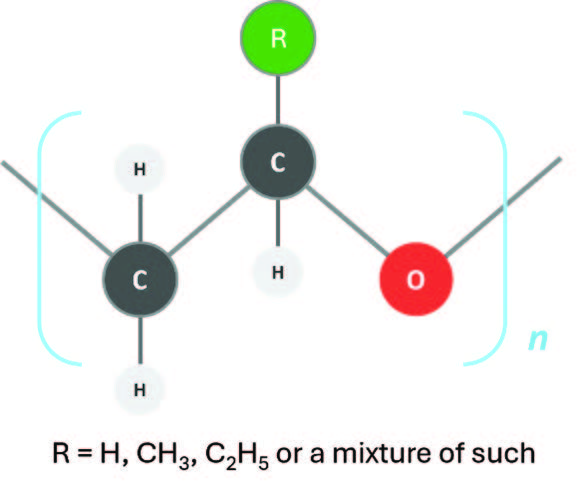
Figure 1. Repeating unit of a polyalkylene glycol (PAG) polymer, showing the alternating carbon-oxygen backbone with pendant R groups that enable tunable hydrophilicity.
In the 1940s after World War II, the U.S. Navy launched research into fire-resistant hydraulic fluids, driven by the need to reduce ship and aircraft fire caused by hydraulic line rupture and ignition of spraying mineral oil.
1 This resulted in water-glycol hydraulic fluids. It passed the Navy fire-resistance test at the time, which involved firing an incendiary bullet, passing through a steel baffle and then through a gallon of test fluid.
2 The formula closely resembled today’s HFC type hydraulic fluids, containing water, glycol, functional additives and an essential water-soluble PAG.
The water-soluble PAGs were among PAG polymers of fundamental study and technological development from early 1930s, under a university-industry collaboration program. Notable contribution was made by Harvey R. Fife, a researcher in the fellowship program at Mellon Institute of Industrial Research, along with scientists at the Union Carbide and Carbon Corp. that sponsored the joint development. The inventors received three U.S. patents in 1947-1948, covering PAGs compounds and methods of making them.
3 Random copolymerization of EO and PO, with EO more than 50%, resulted in water solubility. The copolymers remained liquid with a wide range of viscosity and low pour points, which overcame solidification of polyethylene glycol at molecular weights above 600 with limited operational temperatures. Water-soluble PAGs efficiently thicken water-glycol mixtures for hydraulic fluid and provide shear stability and lubricity. Besides military use, fire-resistant hydraulic fluids expanded into industries, e.g., aluminum and steel milling, casting and foundries where hydraulic systems were operated at high temperature and/or high pressure. Additionally, anhydrous and biodegradable fire-resistant hydraulic fluids with water-soluble PAGs
4 had been developed and approved by Factory Mutual according to Spray Flammability Parameter (SFP) criteria in FM Standard 6930.
Water-soluble PAGs were also found useful in a variety of applications that favor non-staining contact and ease of wash-off. Examples include textile fiber lubricants, textile machine lubricants and plastic and rubber molding lubricants. Metalworking fluids, usually aqueous formulas, also exploit the inverse solubility of PAGs. At higher temperatures above the upper critical solution temperature, PAGs separate out and form protective films on the working parts.
A pivotal milestone was in the 1980s when water-insoluble PAGs lubricants were commercialized for rotary screw air compressors. The highlighted performance was varnish resistance and deposit control, giving longer lube change intervals and improved machine reliability. The benefits resulted from the fact that PAGs oxidation products are chemically unlike hydrocarbon oils’ and remain dissolved in the polar and high-solvency PAGs. Besides, PAGs have marginally higher thermal conductivity and help run cooler, which also alleviates oxidation and elongates lube life. In addition to air compressors, different PAGs were chosen for industrial gas compressors, as they could be modified for gas insolubility relevant to lower viscosity dilution and better compression efficiency.
Driven by regulation from the Montreal Protocol in 1987, PAG lubricants gained traction with refrigeration. The phase out of ozone depleting chlorofluorocarbons (CFCs) prompted the adoption of hydrofluorocarbon (HFC) refrigerants (e.g., R-134a), and PAG refrigeration lubricants were commercialized, especially for automotive air conditioning, for their miscibility with the liquid R-134a, ensuring reliable circulation through components and return to the compressor. A few decades later, however, high global warming potential of HFCs led to their phase down under the 2016 Kigali Amendment. Furthermore, recent concerns over fluorinated compounds on environmental and human health impacts are reshaping the landscape. Next-generation refrigeration systems will likely be co-defined by new refrigerants, machine designs and lubricants, and PAGs are among the top lubricant candidates to take on the challenge.
Conventional PAGs saw limited use as co-base oils in hybrid formulation because of their immiscibility with mineral or PAO oils. It also requires thorough cleaning or flushing for conversions. To address these, oil-soluble PAGs were developed with breakthroughs using BO building blocks.
5 Oil-soluble PAGs maintained the hallmark deposit control characteristics while increasing hydrophobicity, and they showed excellent friction control at additive levels. Beyond their adoption in compressor, industrial gear and turbine oils, they were explored as performance additives in transmission fluid and motor oil for auto racing. As specialty fluids, oil‑soluble PAGs continue to offer significant opportunities for further exploration to fully establish and justify their value proposition.
In conclusion, over the course of nearly a century, PAG lubricants have experienced continuous evolution driven by technological advances and market needs, securing their role in the modern lubrication applications. Their enduring relevance stems from the exceptional tunability of PAG chemistry and properties, enabling adaptation to performance, regulatory and sustainability requirements that shape industrial trends. PAGs will remain a cornerstone of synthetic lubricants for the foreseeable future.
REFERENCES
1.
Totten, G. and Bishop, R., (1995), “Historical overview of the development of water-glycol hydraulic fluids,” SAE Technical Paper 952076,
https://doi.org/10.4271/952076.
2.
Matlock, P. L., Brown, W. L. and Clinton, and N. A. (1999), “Polyalkylene glycols,” in
Synthetic Lubricants and High-Performance Functional Fluids (eds. Rudnick, L. R. & Shubkin, R. L.), pp. 159-193, CRC Press.
3.
a) Roberts, F. H. and Fife, H. R., U.S. Patent 2,425,755, 1947; b) Toussaint, W. J. and Fife, H. R., U.S. Patent 2,425,845, 1947; c) Fife, H. R. and Roberts, F. H., U.S. Patent 2,448,664, 1948.
4.
Totten, G., Webster, G., Bishop, R. and Sloan, W. (2000), “Anhydrous polyalkylene glycol hydraulic fluids,” International Off-Highway & Powerplant Congress & Exposition, Milwaukee, Wisc.,
https://doi.org/10.4271/2000-01-2557.
5.
Greaves, M. R. (2011), “Oil soluble synthetic polyalkylene glycols,”
Lube Magazine, No. 104,
www.lube-media.com.
Dr. Cindy Liu is research scientist at The Dow Chemical Company. You can reach her at cindyliu@dow.com.