Meet the Presenter
This article is based on a webinar titled 2D MXenes: Tunable Mechanical and Tribological Properties, hosted by the American Society of Mechanical Engineers’ (ASME) Tribology Division and presented by Prof. Dr.-Ing. Andreas Rosenkranz on March 31, 2025. Courtesy of STLE, this article captures the core insights from this ASME-organized event. For more technical content from the ASME Tribology Division Webinar Series, visit the ASME Tribology Division’s website at www.asme.org/get-involved/groups-sections-and-technical-divisions/technical-divisions/technical-divisions-community-pages/tribology-division.
Andreas Rosenkranz is a professor for materials-oriented tribology and new 2D materials in the Department of Chemical Engineering, Biotechnology and Materials at the University of Chile in Santiago, Chile. His research focuses on the characterization, chemical functionalization and application of new 2D materials. His main field of research relates to tribology, but recently, he has expanded his fields of interest toward water purification, catalysis and biological properties. He has published more than 200 peer-reviewed publications in well-known journals, including Nature Reviews Materials, Advanced Materials and ACS Nano, among others. He is a fellow of the Alexander von Humboldt Foundation and acts as a scientific editor for well-reputed scientific journals including MetalMat (Wiley), Journal of Tribology (ASME), Applied Nanoscience (Springer) and Frontiers of Chemistry, as well as Industrial Lubrication and Tribology (Emerald). He can be reached at arosenkranz@ing.uchile.cl.

Andreas Rosenkranz
KEY CONCEPTS
•
MXenes are a new class of two-dimensional (2D) early transition metal carbides, nitrides and carbonitrides that combine the metallic conductivity of transition metal carbides with the hydrophilic nature of their hydroxyl or oxygen terminated surfaces.
•
These materials are the basis for modern sensors used in pollution detection, advanced catalytic systems for carbon dioxide (CO2) capture and conversion and new tribological solutions to reduce CO2 emissions and increase capture efficiency.
•
Research continues on finding new uses for these important compounds.
A new class of materials called MXenes are two-dimensional (2D) early transition metal carbides, nitrides and carbonitrides. Discovered in 2011 by Michael Naguib, MXenes combine the metallic conductivity of transition metal carbides with the hydrophilic nature of their hydroxyl or oxygen terminated surfaces.
1
The motivation for research on MXenes is largely related to the climate crisis. These materials are the basis for modern sensors used in pollution detection, advanced catalytic systems for CO
2 capture and conversion and new tribological solutions to reduce CO
2 emissions and increase energy efficiency. These new materials offer opportunities to tackle these challenges.
This article is based on an ASME Tribology Division Webinar presented on March 31, 2025, as an invited talk by Prof. Dr.-Ing. Andreas Rosenkranz. See Meet the Presenter for more information. Rosenkranz introduced the synthesis of 2D MXenes and presented their tribological potential and challenges.
MXenes
MXene research is occurring across a number of fields today. As shown in Table 1, approximately 33% of MXenes research is focused on energy storage.
2,3 The 2D structure of these materials means there is space for intercalating ions (i.e., ions inserted between layers of a crystal lattice), which is why they are typically used for batteries, super caps and energy harvesting.
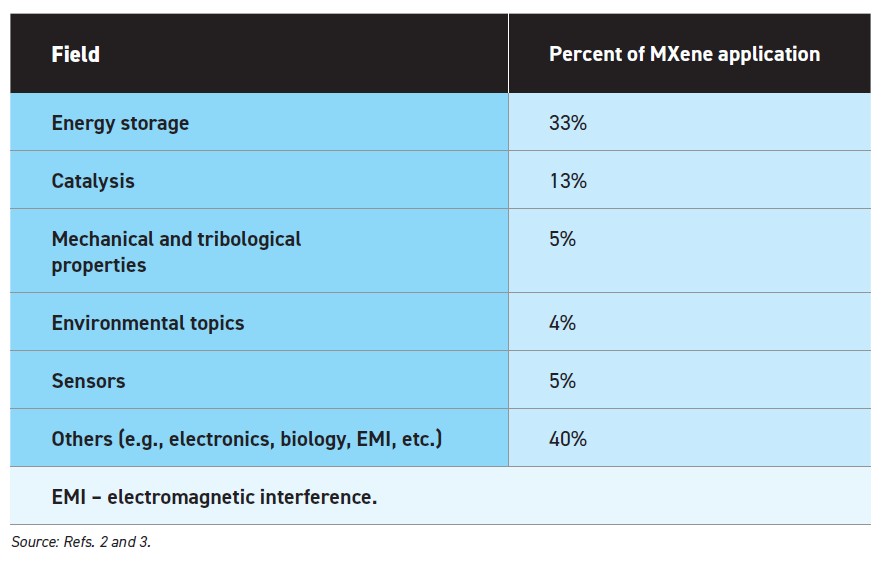 Table 1. MXene use in different fields
Catalysis is the second biggest research topic (13%) as these materials offer an interesting surface to volume ratio, as well as interesting redox potentials based on the elements included in the MXenes layers. These materials offer a certain reactivity that allows for catalyzing reactions. They also offer mechanical and tribological properties (5%), as well as environmental advantages (4%). Research related to sensors (5%) is also an area of MXene study.
Rosenkranz notes that new applications for MXenes are found nearly weekly in fields ranging from electronics to biology to electromagnetic interference (EMI), among other areas, accounting for the remaining 40% on Table 1.
How MXenes are synthesized
The term MXenes comes from the combination of the MAX phase and graphene. The MAX phase is basically a 3D carbide structure that has existed for over 50 years. As an example, aluminum (Al), carbon (C) and titanium (Ti) powders can be mixed in the right stoichiometry under an argon atmosphere, then heated to 1,650ºC for two hours with correct heating and cooling phases to end up creating Ti
3AlC
2 (i.e., a titanium aluminum carbide), a MAX phase compound.
4
The atoms in a MAX phase compound are arranged in planes in a highly ordered structure with two types of bonds, Ti-Al and Ti-C. There are no Al-C bonds in the MAX phase. Ti-Al is a metallic bond, but the Ti-C bond is both ionic and covalent and stronger compared to the Ti-Al bond. These phased materials “exhibit a hexagonal structure and possess a unique combination of ceramic and metallic properties, making them suitable for high-temperature structural applications.”
5
MAX phases differ by stoichiometry from M
2AX to M
5AX
4:
•
“M” elements represent all the potential early transition metals (e.g., scandium [Sc], Ti, vanadium [V], chromium [Cr], yttrium [Y], zirconium [Zr], niobium [Nb], molybdenum [Mo], hafnium [Hf], tantalum [Ta], tungsten [W]), where titanium is just one example metal.
•
“A” elements represent metalloids that can have properties of both metals and nonmetals (e.g., Al, silicon [Si], phosphorus [P], sulfur [S], gallium [Ga], germanium [Ge], arsenic [As], indium [In], tin [Sn]), where aluminum is one example.
•
“X” represents carbon or nitrogen (N) or a mixture of the two.
This creates an entire family of chemicals.
To move from the MAX structure to the MXene structure, the aluminum layers are removed from the MAX structure and surface terminations are formed. These steps are accomplished by etching the MAX structure using lithium fluoride (LiF) and hydrochloric acid (HCl) to transform MAX into the Ti
3C
2T
x structure. “T” represents all the potential surface terminations that can be formed (e.g., hydrogen [H], oxygen [O], fluoride [F], chlorine [Cl]).
After etching, the MXene results range from M
2XT
x up to M
5X
4T
x.
3 Research is occurring to make the conversion process less toxic by avoiding use of LiF and using more sustainable chemicals. The resulting MXenes are metallically conductive, layered solids that behave like conductive clays.
1
Graphene is one example of a familiar material similar to MXenes. Rosenkranz offers a 2D explanation of these materials; that is, graphene sheets are like a deck of cards that can slide over each other with little sheer resistance.
Tribology
MXenes can be used as lubricant additives, solid lubricants and composites. These compounds can also be used to create coatings or as a solid lubricant. Laboratory testing shows that a homogeneous reaction zone forms on top of the steel substrate. Based on complementary materials characterization using high-resolution microscopy techniques, this coating stays in position during testing, indicating that the MXenes do adhere to the substrate. Rosenkranz notes that durability can be an issue with these coatings and is a topic for further research.
Rosenkranz observes that a lot of mechano-chemistry is occurring during the formation of the tribofilm. Contributing effects include:
•
Densification of the MXene coating
•
Partial re-orientation of MXene flakes to be better aligned in the sliding direction
•
Structural and chemical degradation of MXene flakes leading to formation of a kind of composite structure that helps to enhance the mechanical properties
•
Exfoliation versus tribofilm formation completion
Open research questions remain regarding these materials, especially around the formation of the tribofilm. For example, the beginning and ending of the tribofilm formation are known, but not the stages in the process. Both the evolution and the kinetics involved in the formation of the tribofilm are still unclear. Also, the mechanical properties of the formed tribofilms are not currently fully known.
Laboratory testing of the mechanical properties of a titanium carbide MXene (i.e., Ti
3C
2T
x) coating shows relatively low hardness (i.e., 0.15±0.1 GigaPascals [GPa]) and low elastic modulus (i.e., 4.2±1.8 GPa) for the coating. However, the formed tribofilm has quite different properties from the original coating. The formed tribofilm showed increased hardness (i.e., 1.4±0.6 GPa) and elasticity (i.e., 31.6±12.5 GPa), with more than an order of magnitude increase in these properties from the coating to the tribofilm. These property changes show that the kinds of structures that are being formed can lead to improved mechanical properties.
6
Testing has also shown that when compared to different commercially available lubricants (e.g., graphene, graphene oxide, graphene/molybdenum disulfide [MoS
2], etc.), the solid lubricant coatings of multi-layer titanium carbide MXenes have the potential to meet and exceed the performance of currently commercially available lubricant options. MXene nanosheets are an emerging solid lubricant for machine elements that can increase energy efficiency and extend service life.
7
Beyond titanium-based MXenes
Beyond titanium, molybdenum titanium MXenes (i.e., Mo
2TiC
2T
x) have been created, which also have a highly ordered structure. Friction with the molybdenum MXenes applied as a simple spray coating has been studied. These tests have shown that titanium-based MXenes are acceptable for friction and have potential for durability. Short-term performance of the molybdenum titanium MXenes showed similar property trends with the titanium MXenes; however, the molybdenum performed better in long term endurance testing.
Beyond lab-scale testing
While laboratory testing has value, determining how these materials perform in real world applications is key. The performance of MXene solid lubricant coatings were tested in rolling bearings in highly-loaded machine components. The commercially available solutions performed less well than the MXene coatings that were only spray coated. These results are very encouraging that MXenes can improve on and extend the current state of the art solutions.
Beyond tribology
MXenes are also interesting compounds for their biological properties. They can be biocompatible if they do not exceed a certain concentration, as well being nontoxic and antimicrobial. These properties open up options in biotribology, including with implant materials for joint replacements and dental implants, which eventually suffer from wear using today’s materials.
Synovial fluid is naturally found in joints and allows the bones and joints to move smoothly while protecting against impact and supporting the joint’s cartilage. MXenes have the potential to act like synovial fluid for replacement parts and improve the wear resistance of these replacements to increase the lifespan of the parts. Research is occurring relative to load-bearing implants (e.g., hip, knee replacements) to advance this science.
Conclusions
MXenes show great potential to help respond to the climate crisis and offer new solutions to tribological problems across many scientific fields. Research on possible uses for MXenes is proceeding on many topics.
REFERENCES
1.
Naguib, M., Mochalin, V.N., Barsoum, M.W. and Gogotsi, Y. (2014), “25th anniversary article: MXenes: a new family of two-dimensional materials,”
Advanced Materials, 26 (7), pp. 992-1005, doi: 10.1002/adma.201304138. Epub 2013 Dec 19. PMID: 24357390.
2.
VahidMohammadi, A., Rosen, J. and Gogotsi, Y. (2021), “The world of two-dimensional carbides and nitrides (MXenes),”
Science, 372 (6547), eabf1581. doi: 10.1126/science.abf1581. PMID: 34112665.
3.
Wyatt, B.C., Rosenkranz, A. and Anasori, B. (2021), “2D MXenes: Tunable mechanical and tribological properties,”
Advanced Materials, 33 (17), 2007973.
4.
Shuck, C.E., Han, M., Maleski, K., Hantanasirisakul, K., Kim, S.J., Choi, J., Reil, W.E.B. and Gogotsi, Y. (2019), “Effect of Ti
3AlC
2 MAX phase on structure and properties of resultant Ti3C2Tx MXene,”
ACS Applied Nano Materials, 2 (6), pp. 3368-3376.
5.
www.sciencedirect.com/topics/materials-science/max-phases
6.
Zambrano, D., Wang, B., Duan, B., Valenzuela, P., Gacitúa, W., Greiner, C., Wyatt, B.C., Anasori, B. and Rosenkranz, A., “Interplay between mechanical properties and tribological performance for multilayer Ti3c2tx coatings,” Available at SSRN:
https://ssrn.com/abstract=5098641 or
http://dx.doi.org/10.2139/ssrn.5098641.
7.
Marian, M., Tremmel, S., Wartzack, S., Song, G., Wang, B., Yu, J., Rosenkranz, A. (2020), “Mxene nanosheets as an emerging solid lubricant for machine elements – Towards increased energy efficiency and service life,”
Applied Surface Science, 523, 146503, ISSN 0169-4332,
https://doi.org/10.1016/j.apsusc.2020.146503.
Andrea R. Aikin is a freelance science writer and editor based in the Denver area. You can contact her at pivoaiki@sprynet.com.