HIGHLIGHTS
•
Doping a well-known solid electrolyte, LLZO, with a silver coating has been found to strengthen the surface against lithium intrusion without compromising the electrolyte.
•
Silver ions were found to penetrate the surface of the solid electrolyte and undergo an exchange with lithium ions.
•
Mechanical testing determined that nearly five times as much force was needed to crack the surface of a silver impregnated LLZO compared to the pristine solid electrolyte.
All solid-state lithium metal batteries (ASSLMBs) are under development for their improved safety and higher energy density compared to conventional lithium-ion batteries. In ASSLMBs, flammable solvents used in liquid electrolytes, such as ethylene carbonate, are replaced with thermally stable solid electrolytes.
However, solid electrolytes also have performance issues because they are based on brittle ceramic materials. Samuel Lee, graduate student at Stanford University in Stanford, Calif., says, “These electrolytes are ceramics that exhibit a Young’s modulus of 150 gigapascals, but they are vulnerable to surface crack formation due to their intrinsic brittleness. Theoretically, it is counterintuitive that soft lithium metal could penetrate through such stiff solid electrolytes. However, during battery charging, lithium preferentially plates at surface defects, generating pressure within the cracks. The pressure can increase rapidly and exceed the fracture toughness of the solid electrolyte. This leads to the formation of uncontrollable crack growth and lithium plating in those cracks, which will eventually short the battery causing performance and safety concerns.”
Ion exchange via a very thin silver coating has been evaluated as an approach to improve their resistance to dendrite formation. In a previous TLT article,
1 researchers determined that application of alumina as a protective layer on the solid electrolyte, LPSCl, can reduce the vulnerability of this material to decomposition in the presence of oxygen and moisture. A thin coating (0.1 nanometers) of alumina was found to improve the stability of LPSCl when exposed to 22% relative humidity ambient air for 15 minutes. The alumina coating acts as both a physical barrier and also affects the chemical composition of the solid-state battery electrolyte.
Increasing the residual compressive stress at the surface of solid electrolytes has been achieved by replacing lithium ions in the well-known solid electrolyte, LLZO (an oxide based on lithium, lanthanum and zirconium) with bigger silver ions. Previous work in the literature found that the silver coating is effective in improving the wettability of solid electrolytes and the lithium metal anode through lithium-silver alloying.
Lee says, “In our work, we focus on the effect of silver ions doping to generate residual compressive stress rather than a metallic silver coating to lower interfacial resistance between solid electrolytes and the lithium metal anode.”
Lee and his colleagues just reported on a new study2 that demonstrates how the doping of silver ions via a thin coating on the solid electrolyte can strength the surface against lithium intrusion without compromising the intrinsic properties of LLZO.
Silver-lithium-ion exchange
The researchers worked with LLZO. A three-nanometer-thick coating of silver was deposited on LLZO in an inert atmosphere by a sputtering technique at room temperature. This step was followed by annealing at temperatures ranging from 100°C to 400°C for one hour.
Visual inspection of the LLZO surface using optical microscopy showed that the metallic grey appearance of the solid electrolyte changed to an amber hue as the annealing temperature increased, suggesting the incorporation of silver ions into the solid electrolyte. To confirm this, further characterizations were performed on the annealed silver-coated LLZO. X-ray photoelectron spectroscopy (XPS) depth profiling revealed a shift in the silver peak from metallic silver to silver ion with increasing depth, while nanoscale secondary ion mass spectrometry showed that silver had penetrated to a depth between 20 and 50 nanometers in LLZO. No such silver penetration was detected in non-annealed samples of silver-coated LLZO.
Density functional theory was conducted to understand the mechanism of silver doping in LLZO. Lee says, “DFT calculations confirmed that silver-lithium-ion exchange in an oxidizing environment is thermodynamically feasible, especially at elevated temperatures. Notably, there was minimal change in LLZO’s electronic properties when lithium ions were replaced by silver ions which reinforces our experimental findings.”
The annealing temperature is a critical factor in controlling the effectiveness of silver-lithium-ion exchange in LLZO. Lee says, “Too low of a temperature does not provide enough driving force for desirable ion exchange to occur. At too high of a temperature, residual compressive stress formed by silver-lithium-ion exchange is not maximized. Our electrochemical results showed a highest local critical density, and the largest lateral diameter at failure when the annealing temperature was 300°C.”
A schematic of the silver-doped LLZO is in Figure 4.
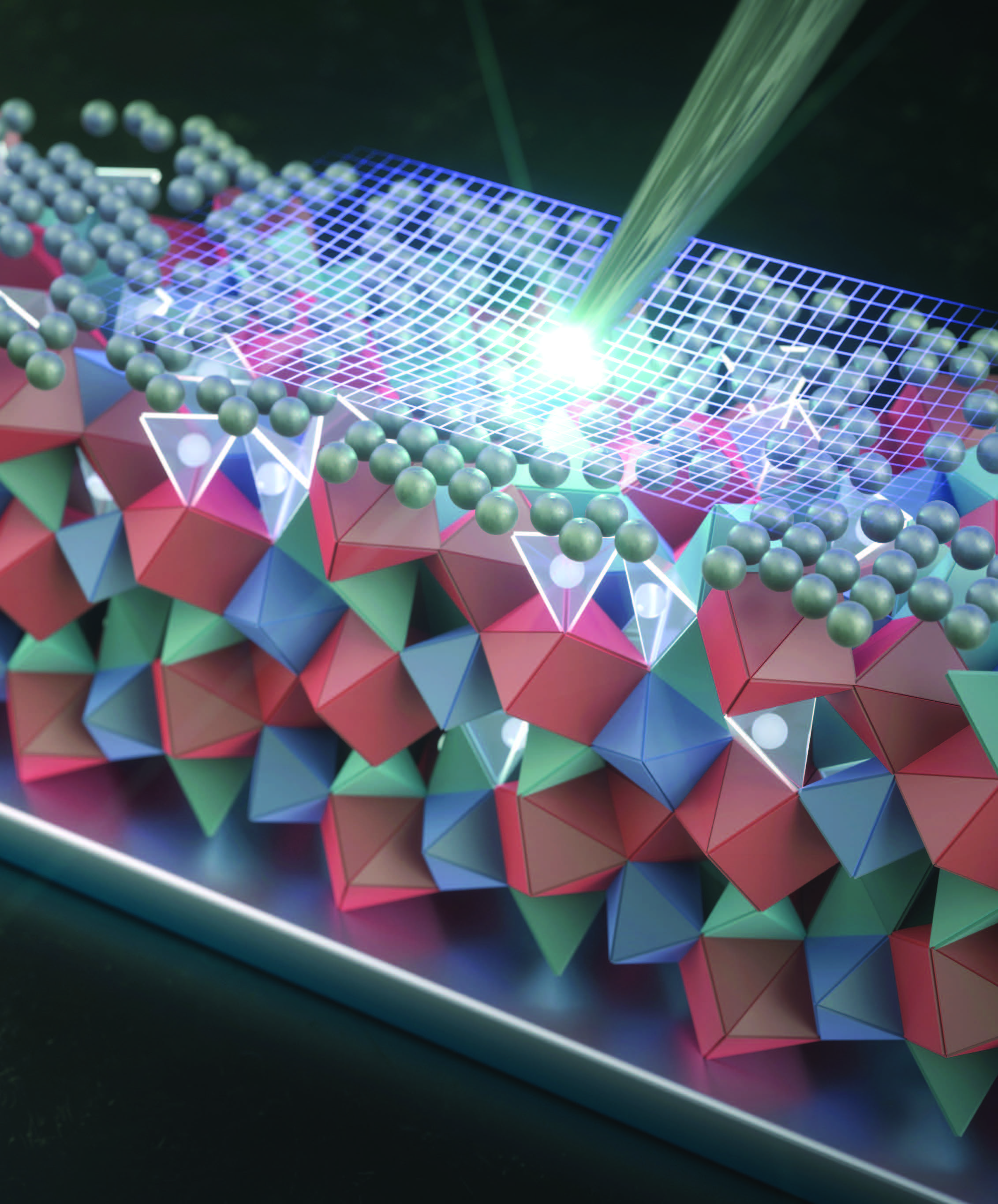
Figure 4. An atomically thin coating of silver atoms on and below the surface of the solid electrolyte LLZO protects against mechanical pressure due to lithium intrusion. Figure courtesy of Stanford University.
To understand the compressive stress effect of silver ions in LLZO, the researchers conducted mechanical testing via a nanoindenter inside a scanning electron microscope to assess how much force is required to fracture the surface. When impregnated with silver ions, nearly five times as much force was needed to crack the surface of the solid electrolyte compared to pristine LLZO.
An evaluation of silver-doped LLZO in a full cell will be carried out in the future to determine how well the electrolyte holds up under repeated fast-charging and extended operation. The researchers will also further investigate the use of less expensive metals to find out if similar performance can be achieved.
Additional information can be found in the new study
2 or by contacting Dr. Wendy Gu, associate professor of mechanical engineering at Stanford University at
xwgu@stanford.edu.
REFERENCES
1.
Canter, N. (2026), “Improving stability of sulfide-based solid-state battery electrolytes,” TLT,
82 (1), pp. 16-17. Available at
www.stle.org/files/TLTArchives/2026/01_January/Tech_Beat_II.aspx.
2.
Xu, X., Cui, T., McConohy, G., Jagad, H., Lee, S., Wang, S., Melamed, C., Yang, Y., Barks, E., Kaeli, E., Narun, L., Cui, Y., Zhang, Z., Lee, H., Xu, R., Wang, M., Hoogendoorn, L., Romana, A., Geslin, A., Sinclair, R., Cui, Y., Qi, Y., Gu, X. and Chueh, W. (2026), “Heterogeneous doping via nanoscale coating impacts the mechanics of Li intrusion in brittle solid electrolytes,”
Nature Materials, 25, pp. 627-634.