HIGHLIGHTS
•
A new enzymatic structural material (ESM) has now been developed that has characteristics similar to those of concrete.
•
ESM is produced through a sustainable process that produces a water-insoluble biochar from the carbohydrate, sucrose.
•
ESM exhibits an average compressive strength that exceeds the minimum strength for structural concrete.
Concrete remains an essential building material needed in construction. Lubricants are a key component needed in the production of the precursor to cement, concrete, and in machinery such as excavators, loaders and cranes used in the construction industry. Among the lubricants utilized are engine oils, gear oils, hydraulic fluids and greases.
The manufacture of concrete and its use in construction are energy-intensive processes that generate significant emissions. Nima Rahbar, The Ralph W. White Family Distinguished Professor and head of the Department of Civil, Environmental, and Architectural Engineering at Worcester Polytechnic Institute (WPI) in Worcester, Mass., says, “Concrete accounts for nearly 8% of global carbon dioxide emissions due to its prevalent use as a construction material. Building and construction account for 40% of global energy consumption and 33% of greenhouse gas emissions, according to the World Economic Forum.”
While widely used and exhibiting good compressive strength, easiness to shape and low cost-to-weight ratio, concrete does have negative characteristics including high brittleness and low tensile strength. A previous TLT article
1 discussed the incorporation of an auxetic polymeric lattice as a reinforcement into a cement matrix leading to an improvement in the mechanical properties of the resulting concrete and a reduction in brittleness. These metamaterials also display an additional benefit under stress by generating electricity such as when an automobile passes over a conductive concrete on a highway. This discovery may lead to the future use of concrete in intelligent infrastructure systems.
Ultimately, the most desired strategy for reducing the carbon footprint of concrete is to find a more sustainable alternative. Rahbar says, “Our interest in using biobased resources in material design has led us to work to find options for concrete. One approach that we tried was to use the concept of crystal growth to produce microbial concrete. This process involved incorporating a specific microbe into the concrete to microbially induce calcium carbonate precipitation as a means to reduce carbon dioxide emissions generated during construction. We encountered difficulty due to the use of a specific bacterium that unfortunately would only slowly produce calcium carbonate. Use of microbially induced calcium carbonate precipitation is not commercially viable due to the viability of the bacterium, extensive cost and low rate of crystal precipitation.”
Past work by Rahbar and his colleagues identified an enzyme, carbonic anhydrase, that effectively converts carbon dioxide and water to form carbonic acid that can be precipitated as the calcium salt. While this material exhibited a compressive strength of 12 megapascals and self-healing characteristics, it was vulnerable to humidity in losing strength.
The researchers have now used carbonic anhydrase in a new process resulting in the preparation of a new enzymatic structural material (ESM) that exhibits properties similar to those of concrete but can be prepared without producing carbon dioxide emissions.
Particle-liquid-liquid interactions
The initial step in preparation of ESM was to prepare a primary fluid by taking cleaned sand particles and dispersing them in a low viscosity paraffinic base oil. A secondary fluid was then produced by adding a calcium source (in the form of calcium formate) to carbonic anhydrase. This step was followed by the addition of an aqueous solution containing the carbohydrate, sucrose.
Eventually the primary and secondary fluids were mixed together, and then, through thermal curing, a biochar was created that formed the basis for a ternary composite. The initial heating was done at 95°C for one hour, followed by curing conducted at 200°C for 1.5 hours.
Rahbar says, “These processing steps created a series of particle-liquid-liquid interactions that lead to the synthesis of ESM. The high-temperature curing causes sucrose to decompose into a water-insoluble biochar that forms the scaffolding for ESM. Strengthening the building material is the presence of sand and calcium carbonate that are both held in the scaffolding.”
Figure 3 displays an image of an ESM brick that was prepared by placing the slurry formed by mixing the primary and secondary phases into a silicone mold, followed by thermal carbonization. The ESM displayed an average compressive strength of 25.8 megapascals, which exceeds the minimum strength for structural concrete.
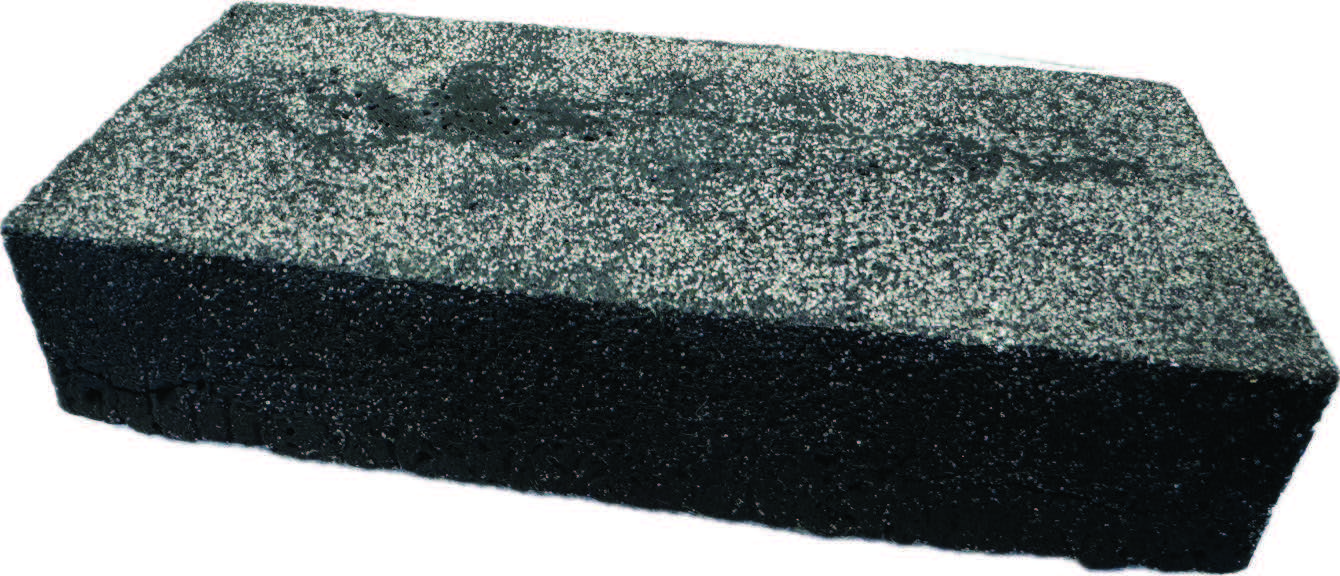
Figure 3. A brick produced with a sustainable alternative to concrete, known as an enzymatic structural material (ESM), can be prepared within hours and does not require the use of high temperatures and weeks of curing. Figure courtesy of Worcester Polytechnic Institute.
Rahbar says, “The concentrations of calcium carbonate and sucrose in the final mixture have proven to be critical in impacting the strength of the ESM. We found the compressive strength of ESM was significantly lower without calcium carbonate, but too much of this mineral also reduced mechanical strength by increasing the viscosity of the secondary fluid, leading to crystal cluster formation that weakened the scaffolding. For sucrose, the optimum concentration in the secondary fluid was 18%. If sucrose concentration was raised to 20%, the result is a drop in performance.”
One of the issues with using biobased raw materials to produce structural materials is their high degree of hydrophilicity which leads to inferior mechanical properties. In the case of ESM, the decomposition of sucrose produces a hydrophobic biochar which is resistant to hydrolysis. Rahbar says, “We demonstrated the water stability of ESM by placing a model of The Gateway Arch in St. Louis, Mo., in water for two weeks and found no decrease in compressive strength.”
In contrast to the process used to manufacture conventional concrete, ESM can be prepared within hours, does not require high temperature and weeks of curing, and producing a single cubic meter is a carbon negative process. Rahbar says, “We calculated that ESM sequesters more than six kilograms of carbon dioxide compared to the 330 kilograms emitted during the preparation of concrete.”
Future work will concern determining if ESM can reheal itself when damaged and to ascertain the mechanism for its formation. Rahbar says, “We will also evaluate the use of more sustainable calcium sources and alternatives to paraffinic oil to further improve ESM’s carbon footprint. Other properties where improvement is needed include enhancing water durability and reducing porosity.”
Additional information can be found in a recent article
2 or by contacting Rahbar at
nrahbar@wpi.edu.
REFERENCES
1.
Canter, N. (2023), “Intelligent concrete,” TLT,
79 (7), pp. 12-13. Available at
www.stle.org/files/TLTArchives/2023/07_July/Tech_Beat_I.aspx.
2.
Wang, S., Pourhaji, P., Vassallo, D., Heidarnezhad, S., Scarlata, S. and Rahbar, N. (2025), “Durable, high-strength carbon-negative enzymatic structural materials via a capillary suspension technique,”
Matter, 9 (3), 102564.