KEY CONCEPTS
•
There are many guidelines and recommendations for formulating greases with PAO.
•
There are benefits of a wax free PAO chemical structure for grease formulations.
•
PAOs benefit in boosting low-temperature grease characteristics and performance.
Polyalphaolefins (PAO) have gained increased acceptance as high-performance lubricants and functional fluids because they exhibit certain inherent and highly desirable characteristics. The physical and chemical properties of PAO fluids make them attractive for a variety of applications requiring a wider temperature operating range than can normally be achieved by petroleum-based products.
1 PAOs are highly suitable for lubricating greases; not only does PAO-based grease enable extended re-greasing intervals, but it is also used in applications where fill for life is non-negotiable. Compared to conventional mineral oils, PAO oils exhibit exceptional viscosity–temperature and low-temperature flow behaviors, a high viscosity index, low Noack volatility and non-toxicity.
2 There are many benefits of PAO base oils in grease formulas, however this article will focus on their outstanding performance in low-temperature environments through molecular structure, pumpability, torque and volatility control.
Wax free chemistry
PAOs are widely recognized for their excellent low-temperature properties. The chemistry used to produce PAOs precludes waxy hydrocarbons, which are common in mineral oils and can hinder flow at low temperatures. This results in a significantly lower pour point, enabling PAO-based greases to maintain fluidity and lubrication even in extreme cold conditions.
STLE member Matthew Moore, technical director, Primrose Oil Co., shares that the non-existence of wax in PAO enhances grease’s low-temperature properties by allowing the grease to be more pumpable and provide stable and continuous lubrication at lower temperatures than that of paraffinic base oil containing greases. He says, “Grease’s low-temperature properties can be complex as the thickener and base oil both can contribute to the grease’s low-temperature properties like pumpability, etc. One type of base oil used in many low-temperature greases is synthesized PAO, which does not contain wax and stays fluid (does not gel) at lower temperatures when compared to paraffinic base oil containing greases.” He continues: “The reason for this is that paraffinic base oil greases encompass wax molecules. When these paraffinic (paraffin/wax containing) mineral base oils reach their gelling point, the wax molecules in these base oils crystallize to the point that the wax molecules in them conglomerate together, thicken and stiffen, which can make said greases not provide adequate pumping or lubrication at this gelling point. This is not as much the case with PAO-based greases, since PAO does not contain wax and has a lower pour point. The wax molecules in paraffinic grease naturally gel before base oils of the PAO.”
Molecular structure of PAO
According to Moore, PAO base oils are synthetically engineered to possess an inherently low pour point and a uniform molecular structure that also provides a high viscosity index, which enables consistent performance across a wide temperature range, making it ideal for applications requiring reliable low-temperature mobility.
“Molecular structure of PAO benefits users in regard to its consistency and uniformity,” says Moore. He explains that PAO is synthesized molecules of the same “cut”: “The molecular structure of a particular PAO molecule has very similar structure, e.g., PAO 4 molecules are of very similar molecular size, with the majority of molecules containing from 28 to 34 carbons. With paraffinic mineral base oil, this is not the case. In contrast, there is a larger range of molecular sizes, from minimums to maximums, that a particular viscosity paraffinic mineral base oil will contain, e.g., Group I paraffinic bright stock, typically, has minimum size molecules, containing 30-35 carbons and maximum size molecules containing 60-70 plus carbons. Why is this important? Because the tighter the ‘cut’ of base oil used in a grease, the more consistent and uniform a grease can be specified/made to in correlation to cold temperature properties. This can also correlate to lower traction and better low-temperature mobility.”
Beyond molecular size distribution, controlled branching also plays an important role in the robustness of the PAO molecular structure. STLE member Dr. Tom Malinski, Americas PAO business development and technical services manager, Chevron Phillips Chemical (CPChem), describes the importance of PAO branching control: “The controlled branching of metallocene PAOs (mPAOs) results in excellent low-temperature properties and can be used to formulate greases with very good flow in cold conditions. Branching in all PAOs is a little bit of a goldilocks problem. PAOs need just enough branching to disrupt molecules from packing together. Branching interrupts the molecules from interacting with each other and essentially crystallizing. However, if too much branching is incorporated into a PAO, it could lead to higher viscosities at low temperatures and could also reduce the lubricity of the molecule. mPAOs are designed to have the optimal amount of branching to stay fluid even in very cold conditions.”
Low-temperature torque
Low-temperature torque is one of the most important low-temperature grease characteristics that shows product performance in sub-zero environments, as it directly impacts application’s startup, wear and energy efficiency.
As Moore explains previously, conventional base oils are prone to crystallization and wax formation at sub-zero temperatures, significantly increasing the viscosity of the grease. This results in elevated torque levels and mechanical inefficiencies, which can impede the operation of vehicles and equipment in cold or extremely cold environments. In field applications, such limitations often render machinery inoperative or require extensive preheating, both of which are costly and time-consuming.
The low-temperature torque of grease is often evaluated using standardized tests like ASTM D1478, which measures the torque required to rotate a ball bearing assembly at sub-zero temperatures.
Malinski explains: “The ASTM D1478 test is useful for looking at the performance of grease in low-temperature applications under low load.” He continues: “The test uses a low-speed ball bearing packed with grease and measures the amount of torque that is generated when the bearing is rotated. The test can be run at a variety of temperatures starting at -20°C and lower. These conditions allow simulation of equipment startup in cold temperatures and are applicable in applications ranging aerospace, cold storage and many others that run in the wintertime.” Moore says that ASTM D1478 test consistently demonstrates that greases formulated with PAO base oils exhibit markedly reduced starting and running torque under low-temperature conditions. “This translates to enhanced energy efficiency and reliable performance across a wide temperature spectrum,” Moore says.
Indeed, PAO-based greases typically exhibit lower starting and running torque values in these tests compared to greases formulated with other base oils. Malinski says: “PAOs generally will outperform mineral oils in low-temperature torque tests. Many mineral oil-based greases have use limits around -20°C, while PAO-based greases often will remain fluid at temperatures below -50°C or lower.”
Moore adds that this reduced torque translates to improved energy efficiency and smoother operation in low-powered mechanisms, such as aerospace instrument bearings or automotive components. Their ability to maintain low torque and effective lubrication ensures reduced wear and energy consumption, enhancing the longevity and reliability of machinery. For industries like transportation, construction and aerospace, the use of PAO-based greases can significantly improve operational efficiency and reduce maintenance costs.
Malinski explains: “Having good low-temperature torque performance can be crucial for equipment operating in low-temperature environments. Having the proper lubrication during startup can mean less wear on the equipment since this is often when the most stress on the equipment occurs. This has implications ranging from aerospace to cold storage and can potentially extend and/or allow winter operations of equipment when using mPAO-based grease
(see Figure 1).”
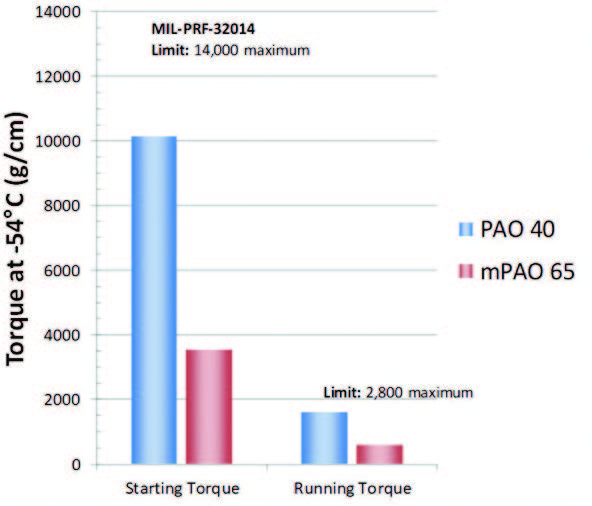
Figure 1. High viscosity PAOs, especially mPAOs, can enable formulations that perform well even at -54°C. Figure courtesy of Chevron Phillips Chemical and Triboscience & Engineering.
Malinski adds: “Beyond the benefits of low-temperature torque, mPAOs are renowned for having excellent longevity and chemical stability. This can be very important when considering the human aspect of lubricating equipment. In very cold conditions, maintenance can be more challenging, and the stability of mPAO can help support longer service intervals and extend the lifetime of the grease, which leads to more reliable operation.”
Low-temperature fluidity: Pumpability and mobility
Moore says that overall, PAO greases have better low-temperature pumpability, which can be measured by the Lincoln Ventmeter Test, than more common paraffinic mineral greases. This is due to PAO-based greases':
•
Excellent low-temperature fluidity
•
Higher viscosity index
•
Lower yield stress in colder conditions
•
Less stiffening of the grease structure as temperature drop
Moore says: “Because PAOs are highly branched base oils of synthetic hydrocarbons with inherent lower pour points, they encompass great low-temperature fluidity; basically, they will stay mobile at colder/lower temperatures when compared to standard paraffinic mineral base oils of straight chains.”
He further explains that PAO greases have higher viscosity index: The PAO base oils in PAO grease’s viscosity change less with temperature “ups and downs.” He notes that different grease thickeners have different effects on grease cold temperature performance. Studies have shown that non-soap grease thickeners, specifically bentonite clay, can “overpower” the typical behaviors that base oils have on cold temperature performance. Additionally base oil viscosity advantages, like those found in PAO, do not always equate to better cold temperature performance, especially when used in bentonite thickened greases.
Moore adds: “PAO greases lower yield stress in colder conditions. In soap greases, base oils have an effect on how rigid its grease thickener becomes at cold temperatures since PAO has better cold temperature flow characteristics, and this translates to lower yield stress for the grease structure compared to that of a paraffinic mineral base oil matrix.”
Evaporation and volatility
PAOs are well-known saturated olefin oligomers that are gaining popularity as high-performance lubricants. PAOs typically have a higher viscosity index, lower-temperature fluidity, better oxidation stability, lower volatility and lower evaporation losses than mineral oils.
Evaporation loss should be limited when working at low temperature, STLE member John Barnes, senior scientist, Southwestern Petroleum Lubricants LLC, says. To balance the formulation to mitigate evaporation loss while maintaining consistent performance at low temperatures, it is important to keep in mind that it is PAO viscosities below 4 cSt that have the lowest pour points and evaporation concerns. PAOs at 8 cSt or higher have minimal evaporation issues while still operating well below -40℃, explains Barnes.
Moore adds that when a grease has reduction in volatility of its base oil (less evaporation), the grease will stay more uniform and consistent and not harden up as fast. The thicker a substance is, the harder it will be to pump and less lubricant (the base oil[s]) will be available for the grease to bleed out into the area needed for lubrication, e.g., onto the surface of a spherical roller bearing. So, in colder climates, a reduction of base oil volatility will benefit grease usage. Note a general rule: the thicker the base oil, the less evaporation when comparing the same type of base oil.
Formulation guidance: PAO viscosity and thickeners selection
Lubricating greases are formulated products consisting of a base oil (50%-98%), a thickener (2%-50%), and various performance additives (0%-10%) such as antioxidants, corrosion inhibitors, antiwear and extreme pressure additives, depending on the application.
3,4
In general, for most soap-thickened greases, base fluid viscosity and grease consistency are independent properties of a lubricating grease. The viscosity of the base fluid is determined by the viscosity of the fluids used, as well as the effect of some additives.
4
When it comes to a selection of the PAO viscosity grade, Barnes shares: “PAO viscosity grades affect the low-temperature performance and torque characteristics of the grease.” He adds: “PAO base oils have been shown to greatly enhance the low-temperature and torque properties in some greases; the thickener content and type will additionally affect level of grease performance.”
Indeed, the consistency of grease is determined by the type and concentration of the thickener in the product.
4
Barnes has observed that the best performance of PAO bases oil is with clay, lithium stearate, aluminum complex and calcium stearate greases. “There is a reduced, yet positive effect when used in calcium sulfonates due to the high thickener content,” he adds.
In other words, the correct selections of the thickeners are a key; ultimately the thickener in a lubricating grease is the component that sets grease apart from fluid lubricants.
4
In order to validate the low-temperature operational capabilities of PAO-based greases formulation, Barnes recommends incorporating field testing: “At minimum, test for low-temperature torque, pumpability and mobility,” he says.
Conclusion
PAO base oils provide strong performance and foundation for excellent low-temperature grease formulation with its main advantages being wax free molecular structure, high viscosity index and controlled branching molecular architecture that optimizes viscosity change at sub-zero environments, which preserves grease mobility, fluidity and startup pumpability. PAO base oils provide outstanding thermal and oxidative stability, strong lubricating properties and excellent compatibility with mineral oils and other synthetic oils. As demonstrated through standardized testing such as ASTM D1478 and Lincoln Ventmeter Test, PAO-based formulations consistently show low running torque and improved pumpability at low-temperature conditions. These characteristics directly improve application reliability and enable stable performance in the most critical phases of the operations. However, it is important to carefully design formulations from other components perspectives as the thickener choice impacts grease performance as well as the viscosity of the PAO base oil.
In summary, the PAO usage in lubricating greases not only significantly reduces re-greasing intervals but also greatly extends the application life, which establishes PAO-based grease as a benchmark for modern low-temperature grease performance.
REFERENCES
1.
Rudnick, L. R. (2020), “Polyalphaolefins,” in
Synthetics, Mineral Oils, and Bio-Based Lubricants, pp. 1-36, CRC Press.
2.
Chen, Y., He, Z., Wang, H., Li, Y. and Wang, H. (2025), “Rheological properties and lubricating film formation performance of very low-viscosity and biodegradable polyalphaolefins,”
Lubricants, 13 (2), 62.
3.
Li, H., Zeng, Q., Fan, M., Pang, Z., Wang, J. and Liang, Y. (2024), “Recent progress in high-temperature greases: constitutive relationships, mechanisms and applications,”
Friction, 13 (5), 9440951.
4.
Casserly, E., Langlais, T., Springer, S. P., Kumar, A. and Mallory, B. J. L. M. (2018), “The effect of base oils on thickening and physical properties of lubricating greases,”
The European Lubricants Industry Magazine, 144, pp. 32-37.
Dr. Yulia Sosa is a freelance writer based in Peachtree City, Ga. You can contact her at dr.yulia.sosa@gmail.com.