HIGHLIGHTS
•
Solid-state sodium batteries must display high ionic conductivity at room temperature, must be stable under dry room conditions and should be soft and malleable to allow for processing.
•
A solid-state electrolyte candidate, NBH, was produced that exhibited an unstable orthorhombic phase leading to inferior ionic conductivity.
•
By adjusting the process conditions for the solid-state electrolyte candidate, NBH, a stabilized orthorhombic phase was produced that exhibits a higher ionic conductivity than previously reported.
Progress is continuing to be made on the development of sodium batteries. While lithium-ion batteries have become the dominant choice for applications such as electric vehicles, sodium remains a complementary option due to better safety, and lower cost attributed to sodium being more readily available.
In a previous TLT article,
1 researchers led by Y. Shirley Meng, professor of molecular engineering in the University of Chicago’s Pritzker School of Molecular Engineering, developed the first anode-free sodium solid-state battery. This step is significant because it simplifies the manufacturing process of the battery and lead to the possibility of developing batteries with higher volumetric energy densities. A boron based solid-state electrolyte known as NBH was used in combination with an aluminum foil based current collector that is needed to facilitate electrochemical deposition of sodium ions. Battery performance was improved by adding pelletized aluminum to the current collector. When combined with a sodium chromium oxide cathode, the battery displayed good stability for 400 cycles.
Meng indicates that solid-state sodium batteries must exhibit three key requirements to generate excellent performance. She says, “The battery must display high ionic conductivity at room temperature. Values above 1 millisiemens per centimeter are desired with the goal being 10 millisiemens per centimeter. Electrical conductivity of the battery must be five to six times lower than ionic conductivity values. A solid-state battery must be stable under dry room conditions to facilitate manufacturing. The solid electrolyte used should be soft and malleable to allow for cold pressing at room temperature and atmospheric pressure.”
Two other characteristics that need to be considered are electrode compatibility and oxidation stability. Meng states that a suitable solid-state electrolyte must be compatible with both the anode and the cathode. Oxidation stability in solid-state electrolytes is essential to ensure that battery performance is not compromised.
To find a suitable solid-state electrolyte, Meng and her colleagues found that past work was conducted with polyhedral boranes based on a closo orientation. This class of compounds are promising solid electrolytes because of their low density, low toxicity and moderately soft mechanical properties. Upon starting to work with these species, the researchers were surprised by their stability with metallic sodium which is essential for use in solid-state batteries.
The researchers have now further explored the properties of a specific closo polyhedral borane and developed a new solid-state electrolyte that displays excellent ionic conductivity at room temperature.
Orthorhombic sodium closo-hydridoborate
Work continued with NBH which combines the sodium salts of a closo-hydridoborate with borohydride. The chemical composition is Na
3(B
12H
12)(BH
4). Initial synthesis of NBH involved taking a hand-mixed blend of the polyhedral borane (Na
2B
12H
12) and sodium borohydride and heating the combination up to 410℃ at a rate of 3℃ per minute. After being held for 10 hours, the reaction mixture is cooled to 25℃.
Meng says, “We found that this solid-state electrolyte candidate exhibited an unstable orthorhombic phase that produced inferior ionic conductivity compared to other phases. Theoretical analysis determined that the orthorhombic phase is not thermodynamically stable, but it is entropically stable above 375℃. We used differential scanning calorimetry and
in situ X-ray diffraction to demonstrate that an orthorhombic phase of NBH starts to form upon heating of the polyhedral borane and sodium borohydride at 360℃ and is fully formed at 400℃.”
Cooling of the reaction mixture proved to be essential in producing an orthorhombic NBH. Meng says, “Rapid cooling by quenching the reaction mixture in room temperature water enabled the orthorhombic phase of NBH to be retained. In contract, slower cooling at 0.5℃ per minute, produced a mixture of the closo-hydridoborate and sodium borohydride. Our conclusion is that the orthorhombic NBH is a metastable phase that can disassociate into its precursors over time.”
The rapid cooling allowed the orthorhombic NBH to kinetically stabilize the crystal structure that started to form at elevated temperature. Orthorhombic NBH displays an ionic conductivity of 4.6 millisiemens per centimeter at 30℃ which is at least one order of magnitude higher than what was reported in the literature and three to four orders of magnitude higher than the precursor.
Meng provided insight into the reason for why orthorhombic NBH effective conducts ions at room temperature. She explains, “Rotation of the smaller borohydride species around the polyhedral borane cage provides a very attractive environment for sodium-ion diffusion. There are seven sites for sodium-ion occupancy that provide multiple pathways for sodium-ion hopping. The result is a fast three-dimensional sodium-ion diffusion network.”
Figure 1 illustrates an image of a solid-state sodium-ion battery that contains a sodium chromium oxide cathode that can be used with the electrolyte. High energy density can be achieved through the use of a thick composite cathode, dense solid electrolyte separator and deposited sodium metal anode. As noted earlier in the article, the development of an anode-free battery represents a progression from a hard carbon anode.
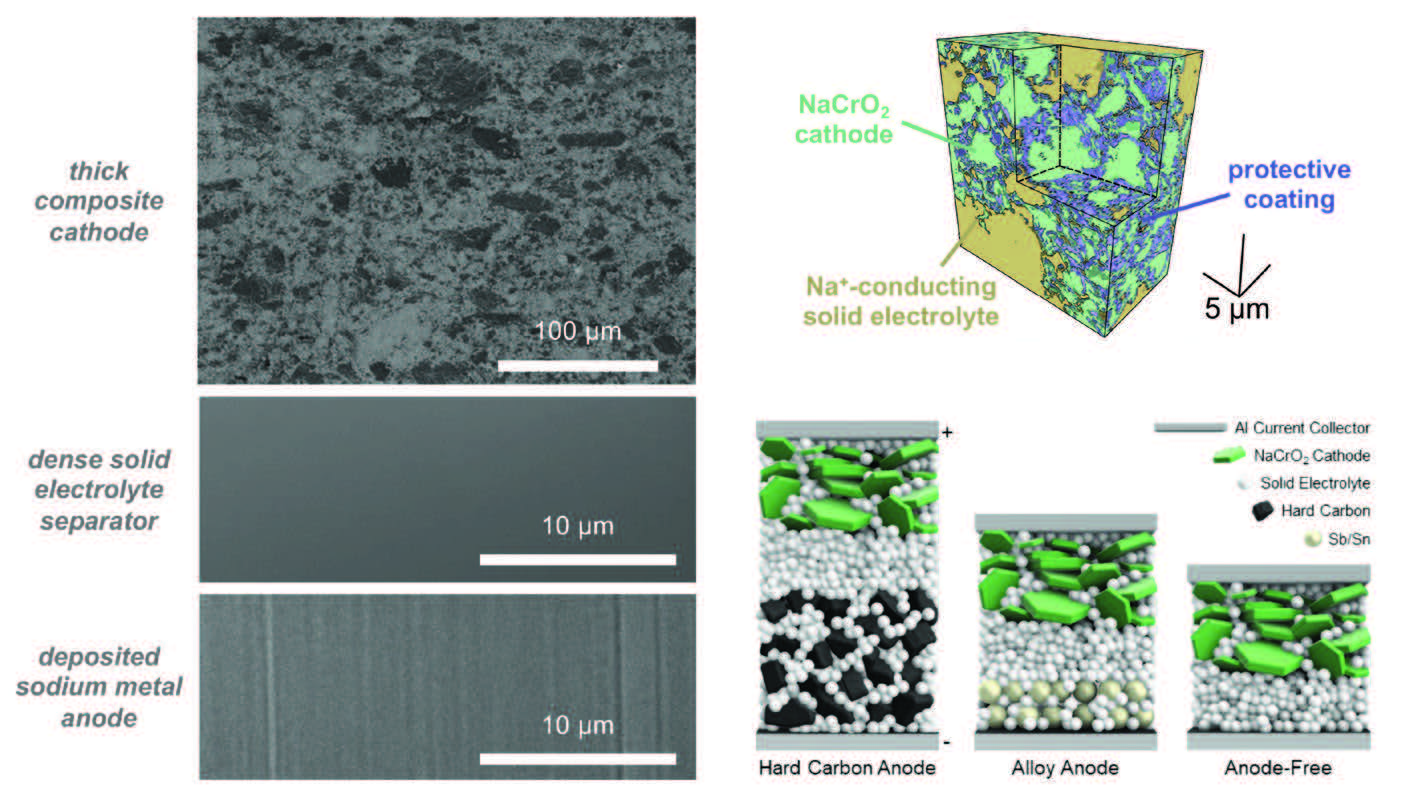 Figure 1. The components used in preparation of a solid-state sodium-ion battery are shown. Key components needed to achieve high energy density include a thick composite cathode, dense solid electrolyte separator and deposited sodium metal anode. The latter is a progression from a hard carbon anode. Figure courtesy of the University of Chicago.
Meng indicates that this work represents a continuing progression to having sodium solid-state batteries be viable alternatives to lithium-ion batteries. She says, “Both battery types are needed but sodium ions do have one key advantage over lithium ions in the solid state. Though larger in size, they could exhibit faster movement through electrolyte media, if we design the media properly.”
Future work will include determining if a lower cost gas phase synthesis is possible, examining approaches for recycling this expensive solid-state electrolyte and determining the oxidative stability of orthorhombic NBH. Meng says, “The ultimate objective is to identify superionic solid-state conductors that can act as faster ion conductors than liquid electrolytes.”
Additional information can be found in a recent article
2 or by contacting Meng at shirleymeng@uchicago.edu.
REFERENCES
1.
Canter, N. (2024), “Development of first anode-free sodium solid-state battery,” TLT,
80 (11), pp. 14-16. Available at
www.stle.org/files/TLTArchives/2024/11_November/Tech_Beat_II.aspx.
2.
Oh, J., Yu, Z., Huang, C., Ridley, P., Liu, A., Zhang, T., Hwang, B., Griffith, K., Ong, S. and Meng, Y. (2025), “Metastable sodium closo-hydridoborates for all-solid-state batteries with thick cathodes,”
Joule, 9 (10) 102130.