Interactive Lubrication Training Experience
By Nicole Gleeson, TLT Editorial Coordinator | TLT Lubrication Insights April 2026
This new STLE event brought lubrication professionals together for a comprehensive foundational program.
STLE held its first Interactive Lubrication Training Experience at Southwest Research Institute in San Antonio, Texas, Feb. 10-11, 2026. The sold-out training course brought together participants from across North America for a combination of classroom instruction and hands-on laboratory experience, as well as expert presenters from a mix of industry and research backgrounds.
Day one: Lubrication fundamentals and chemistry
The first day of the program began with Lubrication Basics, led by Dr. Peter Lee of Southwest Research Institute. Lee began by defining common tribological terms, including various types of friction, wear and lubrication. He also discussed key lubrication concepts like viscosity and lubricant degradation before moving into lubrication regimes. He concluded his opening presentation with an explanation of the Stribeck curve. This opening presentation served as an essential foundation for attendees who were new to the science of lubrication—even introducing the term “tribology” to some—and a quick recap for the more experienced attendees.
The next presentation in the course was Base Oil/Refining Fundamentals, led by Jake Finn from HF Sinclair. Finn began by defining base stocks, which are refined mineral or synthetic oils, and base oils, which are combinations of one or more base stocks blended with additives. He then discussed how the process conditions to make base stocks varies widely, from simple and straightforward for API Group I base stocks to complex and severe for API Group II and III. Finn continued his presentation with an overview of the API base oil categories, covering topics including processing methods, effects of chemical structure on key properties and costs.
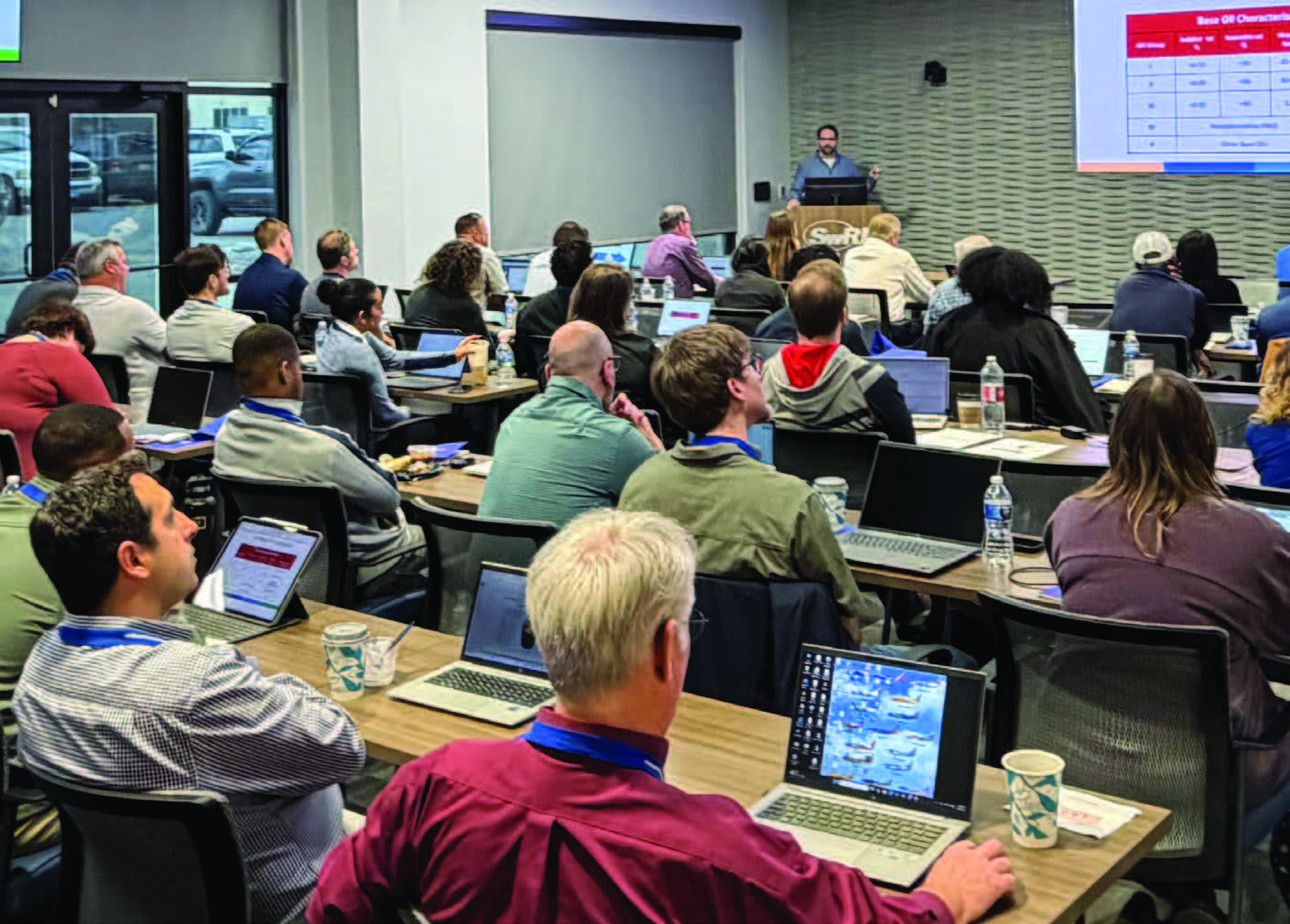
Jake Finn gives an overview of API base oil categories.
Following Finn was Dr. Tom Malinski from Chevron Phillips Chemical presenting on Synthetic Lubricants. He began by explaining applications where a synthetic lubricant is the optimal choice, then moved on to the chemical process and properties of synthetic base fluids. Malinski covered hydrocarbons, esters, ethers and silicones, providing a comparative perspective on the properties of each versus mineral oil. After thoroughly covering the key features of various polyalphaolefins, alkylated aromatics, polybutenes, esters, polyalkylene glycols and silicone lubricants, he summarized the advantages of synthetic lubricants, including efficiency, reduced operating costs, increased equipment life and more.
David Turner of CITGO Petroleum Corp. was up next on the topic of Additives. He began with basic lubricant compositions, discussing the base oil, additive package and viscosity modifier makeup of six common lubricant types. Then Turner discussed additive types and functions, providing an overview of the role of a viscosity modifier, dispersant, detergent, antiwear, extreme pressure, antioxidants, friction modifier, rust inhibitor, corrosion inhibitor, pour point depressant, demulsifier, foam inhibitor/antifoam, seal swell additive/seal conditioner and dye. He also covered additives unique to grease, including polymer for tackiness and solid additives. He wrapped up his presentation with a reminder that lubricant additives must be a carefully balanced combination of many different components—and that adding in aftermarket additives can throw off this balance.
The final classroom session of day one was Lubricant Tests, presented by chair Raymond Drost from Calumet. The objective was to provide attendees with background information on test methods before they transitioned to the lab. Drost covered the purposes of specification tests, background on how standards get developed and examples of how test methods are structured. He then gave an overview of product data sheets before moving into specific tests. Both physical tests and performance tests were covered, with a focus on what each test is used for, when and why it might be needed, how results can be interpreted and the relevant standards. Before heading to the lab, Drost emphasized that testing is crucial for ensuring product quality, safety and reliability, and that standardized test methods and procedures ensure that results are consistent and reliable across labs.
In the lab: Lubricant blending and tour
Attendees left the classroom session informed, energized and ready to get hands-on in the lab. After reviewing health and safety protocols, the attendees split into small groups with one instructor to mix their own lubricants, using base oil and additives.
After the lubricant blending module was completed, attendees left the tribology lab for a tour of Southwest Research Institute’s Petroleum Products Research Department (PPRD) laboratory. The PPRD lab conducts physical and chemical analyses of fuel samples from many independent clients, including some attendees’ companies. These attendees got an inside look at what happens to the samples they send in for analysis, and they left the PPRD lab with a deepened understanding of this process.
Then it was time to head back to the tribology lab, where the instructors had performed testing on the lubricants blended by attendees earlier. The results were presented and discussed, and attendees applied their learning from the classroom session to the real-world findings on the lab results. Afterward, attendees got the opportunity to assist with running two tribology tests, the pin & vee block and four-ball test, before the first day in the lab came to a close.
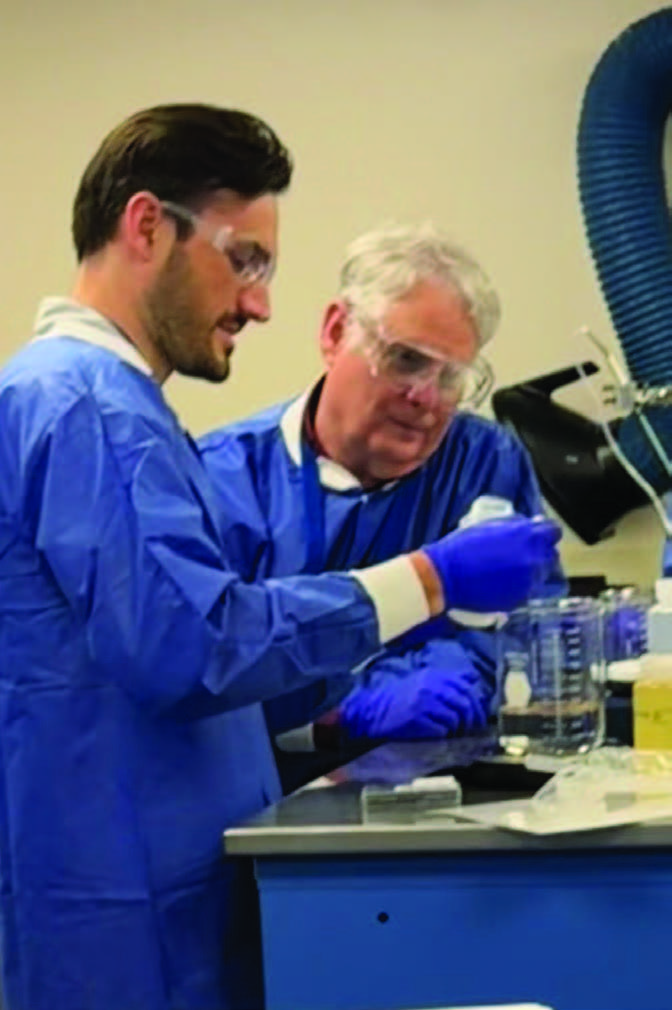
David Turner guides attendees through lubricant mixing in the lab.
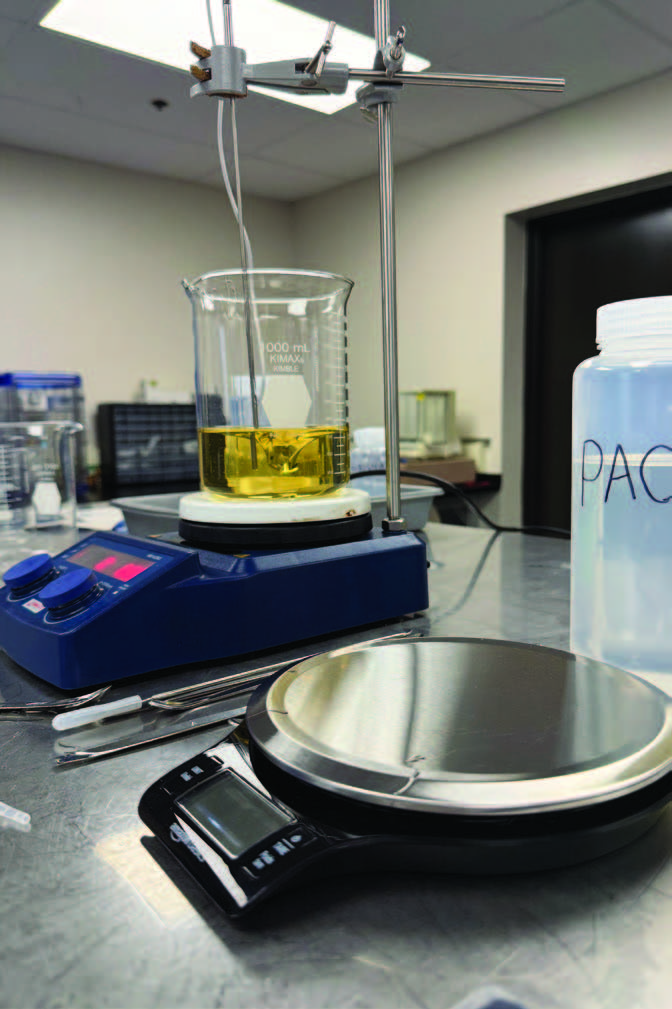
The blended lubricants were prepared and tested, and attendees reviewed and discussed the results after touring the labs at SwRI.
Day two: Grease, applications and regulations
Day two opened with energy and enthusiasm as David Turner opened the classroom sessions with Lubricating Greases. He began by introducing what grease is, focusing on the physical characteristics. Turner then shared some common applications where grease is used, and why it is preferred over oil in these applications. He then moved on the grease composition, covering lubricating fluid, additives and thickeners. Turner emphasized that grease manufacture is far more complex than oil blending, and that manufacturing is just as important as formulation in providing a grease with the desired properties and performance. After a discussion of grease testing and specific applications, he provided an overview of grease selection, providing attendees with a list of the right questions to ask a customer when working to determine the best grease for their application.
Following Turner’s presentation, Andrew Velasquez of Southwest Research Institute presented on Industrial Applications, starting with an overview of the common industries and systems where lubricants are required: automotive, manufacturing, marine, agricultural and construction, renewal energy and aeronautics. He then discussed examples of the parts in these systems where lubricants are required, including bearings, gears and seals. Lee provided an overview of various types of each of these parts, as well as the loads/speeds and other demands they face. He also discussed common causes of failure and lubricant compatibility. By the end of Velasquez’s presentation, attendees had a clearer insight into the key considerations when choosing an appropriate lubricant for an application
Dr. Peter Lee immediately followed with Engine Lubrication, starting with an overview of engine types and their lubricant requirements. Next he covered the functions of engine oil: to lubricate, protect, clean, maintain the oil’s properties, cool and seal between surfaces. Lee also discussed the relationship between lower viscosity lubricants and friction in the engine, as well as how surface texture and coatings change the operating regime. He then focused on critical engine lubrication points, as well as the tribology challenges and lubrication regimes for various engine components.
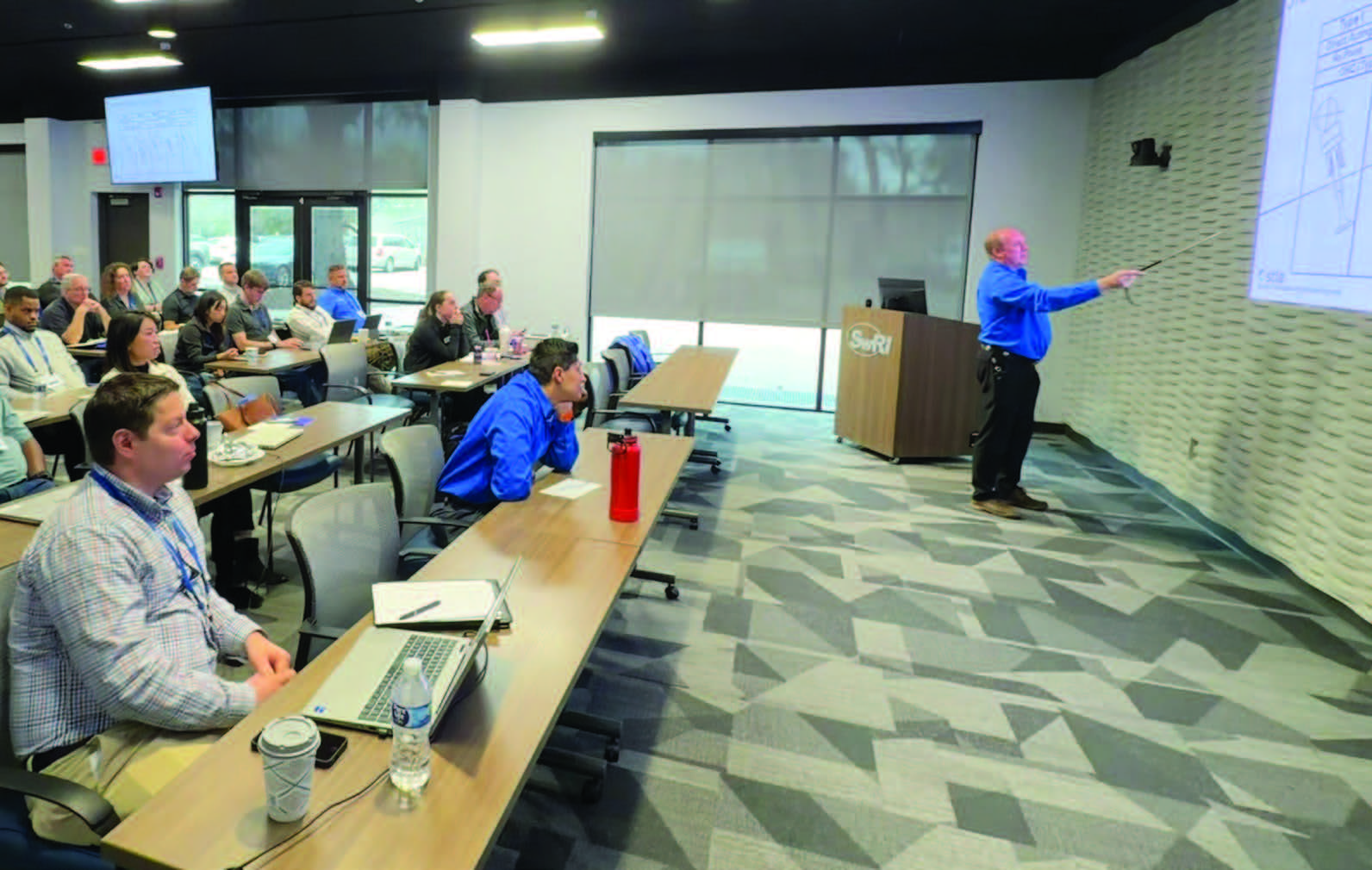
Peter Lee instructs attendees on automotive applications.
Next up was Used Oil Analysis with Lake Speed, Jr. from SPEEDiagnostix. Speed began his presentation with a helpful analogy: just like a doctor samples your blood to check your health, used oil analysis can be used to determine the health of the equipment as well as the health of the oil itself. He provided real-world examples showing that used oil analysis does correlate to equipment wear before diving into how used oil analysis is performed. Speed then talked attendees through the best practices for used oil analysis—as well as common pitfalls to avoid.
Raymond Drost followed with an overview of Regulations and Credentials, starting with Chemical Abstract Services Numbers (CAS#) and moving on to U.S. Food and Drug Administration (FDA) regulations and NSF International categories, focusing on regulations and categories that are highly related to lubricants. Then he discussed volatile organic compounds (VOC) and the related requirements from global regulatory bodies. Drost wrapped up with a reminder that regulations and credentials ensure product safety, as well as reduce risk and liability, but the challenge lies in numerous regulations and credentials that are often application or industry specific.
The final classroom session was Tribology and Rheology Research and Evaluation by Dr. Carlos Sanchez of Southwest Research Institute. Sanchez began by discussing how tribology is applied in virtually every industry, with the common element of surfaces in contact. He emphasized that understanding surfaces is key to designing both effective products and experiments. After a brief discussion of surface science, lubrication regimes, understanding wear modes and calculating coefficient of friction, Sanchez began an overview of the tribology work performed at Southwest Research Institute. His presentation covered the testing performed in the tribology laboratory, where attendees would soon spend their afternoon. Sanchez’s presentation also introduced rheology, the study of flow and deformation of materials, and its connection to oils, fuels, greases, polymers and other everyday products.
In the lab: Tribology tests
After wrapping up the classroom portion of the training, the presenters and attendees headed back to the Southwest Research Institute tribology laboratories. This 3,500 square foot facility features some unique test rigs created by the researchers in the tribology group. Attendees split into their small groups again to participate in demonstrations. Each group experienced a full demonstration of four tribology tests, from set-up to the breakdown process. Tests covered included the electrified mini traction machine (MTM-ec), TE-77 (Denison pump screener), block on ring (Seq IVA Screener) and Universal Mechanical Tester (UMT using pin-on-disc). The demonstrations were led by the researchers and technicians in the tribology group, who talked through the processes and answered attendees’ questions. The lab session even included a visit to the rheology lab, where an MTM is located.
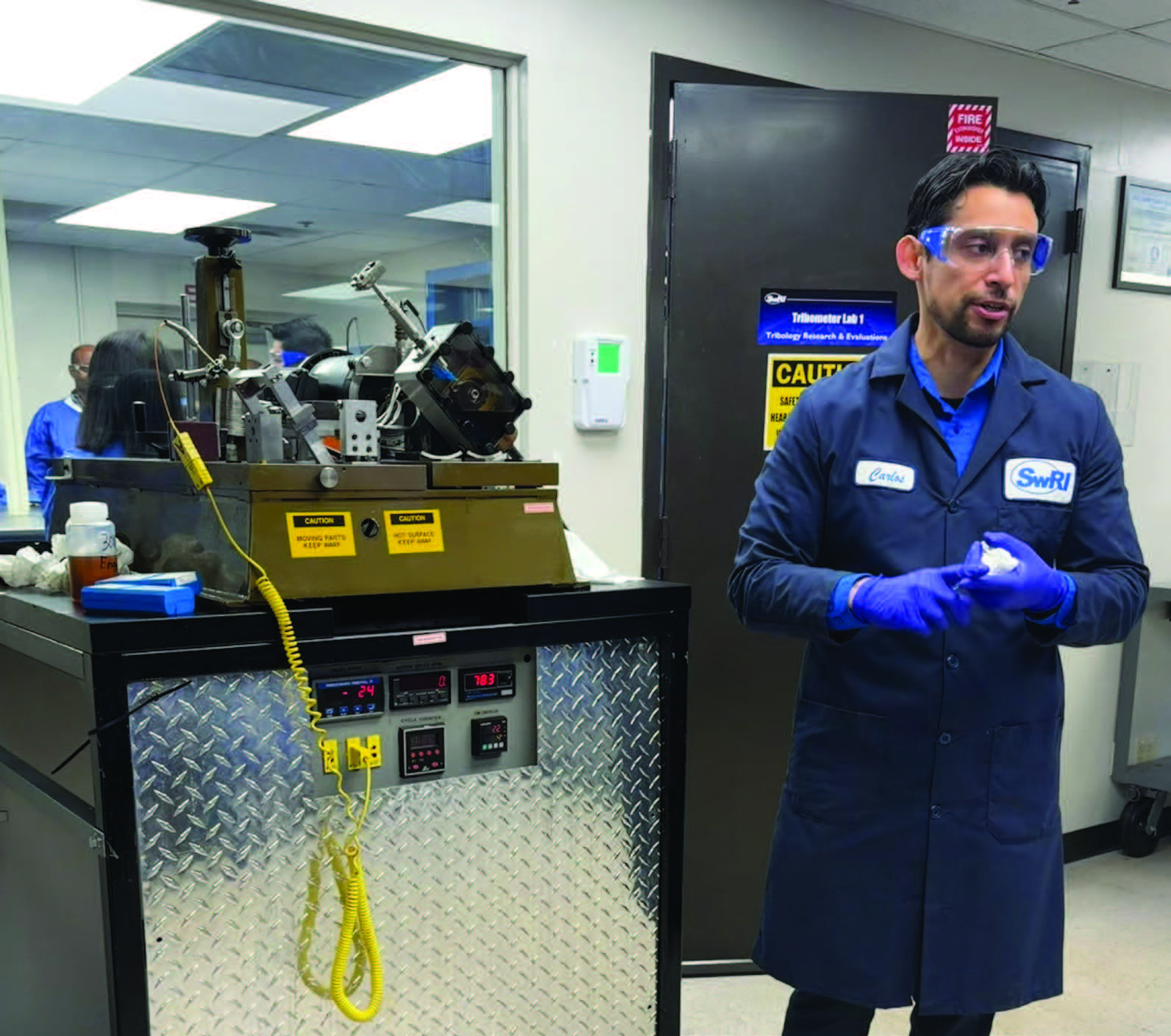
Carlos Sanchez demonstrates a TE-77 reciprocating tribometer.
Conclusion
STLE would like to thank Southwest Research Institute, the team of presenters and all of the attendees for making the first Interactive Lubrication Training Experience a huge success. Their enthusiasm for sharing knowledge and thoughtful feedback will help STLE develop more opportunities for lubrication industry professionals to connect, learn and achieve with future training programs.