TLT: Could you tell us a bit about your background and what initially sparked your interest in tribology and the dynamics of automotive transmissions?
Mohammad-Pour: During my undergraduate study at University of Tabriz in Iran, we were asked to choose a scientific word and prepare an English technical text around that. I chose tribology which sounded fascinating. So, nothing too technical in how I got to learn about tribology. However, whilst searching my faculty’s library to find anything related to tribology, I found an excellent book called “Elastohydrodynamic” by Ramsey Gohar, a scientist from Imperial College London who later became my doctoral examiner. I read the book several times, which made the backbone of my tribological knowledge. I still use that book in any project from aerospace systems to electric vehicle (EV) drive units, and from medical syringes to F1 transmissions. I always appreciated the comprehensive knowledge presented in that book by Gohar, and of course the academic who had purchased that book for our library.
TLT: Founding your company is an impressive example of translating academic research into practical engineering solutions for noise, vibration and harshness (NVH) challenges. Can you walk us through that journey—from concept to company—and share the impact it has had in real-world applications?
Mohammad-Pour: TriboDENS (which stands for TRIBOlogy, Dynamics and ENergy Systems) is the climax of my efforts in making real-world impact from my tribological knowledge and all the hard work of my research team. My research, from the source of funding to problems that I tried to solve, as well as how the team was built around it, was inspired by industry and real-world challenges. Therefore, the concept was organically developed as I progressed from a graduate engineer in a small joint venture to a busy academic trying to build a team which adds value to the world. During the COVID-19 pandemic, I had more time to focus and develop the concept for a company, and prepare myself for the world of business and commerce. All products, company structure, funding and the value proposition were consolidated between 2020 and 2023 with the help of 11 dedicated researchers and engineers. In 2023, the company started with very limited resources from my family’s saving, hence the team had to leave, and for a short period of time, the company comprised myself, and some kits and algorithms. It should be noted that the above-mentioned teams didn’t include my academic group and the scientific research continued throughout. After establishment, to everyone’s surprise it flourished in a very short period of time and became a household name for the tribology community. We now have a team of 14 people, from scientists to technicians and admin.
TLT: You’re also a reader, an editor for two major journals and a NAFEMS UK Steering Group Member. How do you manage these overlapping roles, and what unique perspectives do they offer you—and the field of tribology as a whole?
Mohammad-Pour: I started from an engineering role in a transmission manufacturing company. But scientific research always pulled me toward academia. Finally, I decided to invest a few years of my life to do doctoral and post-doc research. I could never leave academia, and I am not intending to. I believe it is a privilege to be closely related to academic and research environment. It allows me to be connected to enormous wealth of knowledge from the scientific community. I am also all about using the scientific research to make real-world impact. It acts as a course-correcting tool for my research, as I can see first-hand what is needed in the near future and what may remain as a blue-sky idea.
My editorial and administration roles bring all my activities together. For instance, via NAFEMS, the International Association for the Engineering Modelling, Analysis and Simulation Community, I remain closely connected to all major software vendors, whilst engaging with all major software users. This is whilst doing novel research at university. So, the complete package provides an ecosystem which significantly enhances the reach, influence and effectiveness of myself and my team members.
The drawback is sacrifices made particularly by my family. This is perhaps the greatest challenge to constantly weigh pros and cons of doing more versus losing more. The balance should be maintained, which becomes harder as the load increases. My coping mechanism is to make everything as one whole package, everyone becoming part of everything. My son loves sitting in one of our labs, watching our high-speed bearing rigs and reading his book (and sometimes playing a bit of extra-quota Minecraft). My wife is in charge of our not-for-profit grants, and we all have occasional meals with the whole team, with a hint of EV oil.
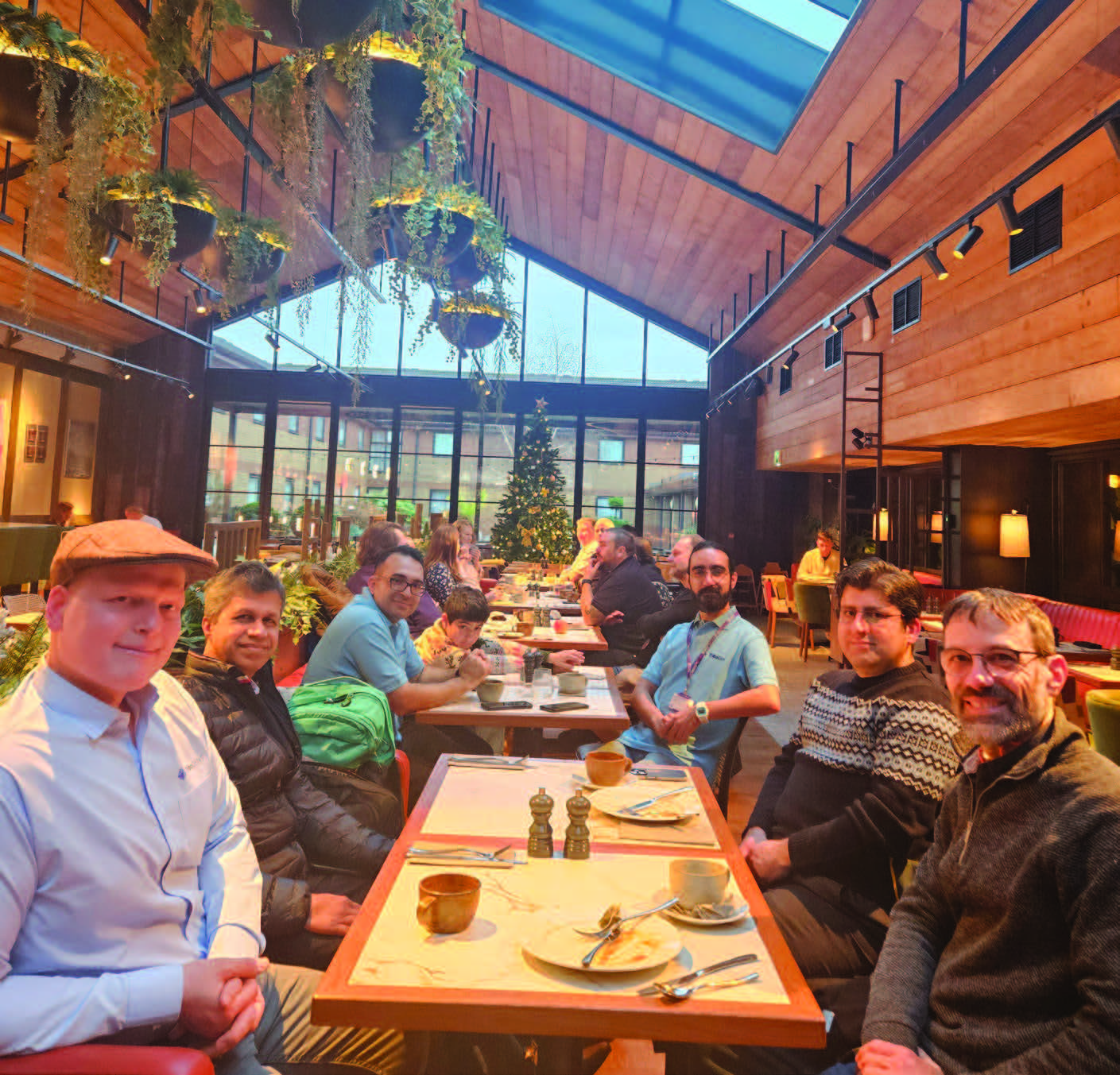 Dr. Mehdi Mohammad-Pour and his team enjoy one of their meals together.
TLT: You had the unique opportunity to be supervised by the late Professor Duncan Dowson, a pioneer in tribology whose legacy continues to shape the field. In your view, what is the significance of having scientific role models in shaping an individual’s development? And how has Professor Dowson’s mentorship influenced your own journey, both professionally and personally?
Mohammad-Pour: I was extremely privileged to have role models like Professor Dowson. When I read my first tribology book (mentioned previously), Dowson, Gohar, Johnson, Greenwood and many more were sounding like an unreachable world. Doing my doctorate allowed me to earn the privilege of meeting these individuals, being part of them and being able to become, or at least trying to become, one of the next ones. It was extremely moving to meet them, talk to them and see their wide vision. Professor Dowson would supervise PhDs, read papers and examine PhDs to the very end. I would like to mention my other supervisors who offered me the PhD place, Professor Homer Rahnejat and Professor Stephanos Theodossiades, who opened the door to this exciting world and held the torch for me. I hope I can play a small role in the future of this field, in such a consequential world.
You can reach Dr. Mehdi Mohammad-Pour at m.mohammad-pour@tribodens.com.