TLT: You began your career researching a cure for gingivitis—how did you find yourself in the lubricants industry, and what made you stay?
Quinn: Like many of my classmates, my Honors year at university saw me completing research linked to the pharmaceutical industry and in my case, investigating how porphyrins could be used by acting as a trojan horse carrying antibiotics as a potential treatment for gingivitis. I enjoyed the challenge of the project and working with one of the major hospitals in Sydney as well as the university so decided to look for a career in pharmaceuticals. My major was in chemistry, but my minor was pharmacology, so this set me up nicely.
Upon graduating, I applied for what felt like hundreds of jobs and managed to secure two offers at the same time. The first was with a multinational pharmaceutical company collating data from clinical trials. The other was with Chevron working in their technology center testing and formulating oils. I had been so sure of what my path would be, however, when faced with the choice I ended up choosing the lab job with Chevron. After five years working away in the lab at university, it made sense to me that my first full time job should also be in the lab.
After about a year, I had the opportunity to move to grease product development and manufacturing support. I was hooked. I felt I was able to put my chemistry degree to use in the formulating and manufacturing of grease, and it was a completely new world that I knew nothing about. I was lucky to have some great mentors to help teach me the ropes and get hands on experience in grease manufacturing. Working in the lubricants industry has taught me a lot and enabled me to meet amazing people around the globe. It’s an industry where there is always something to learn, and this keeps things interesting.
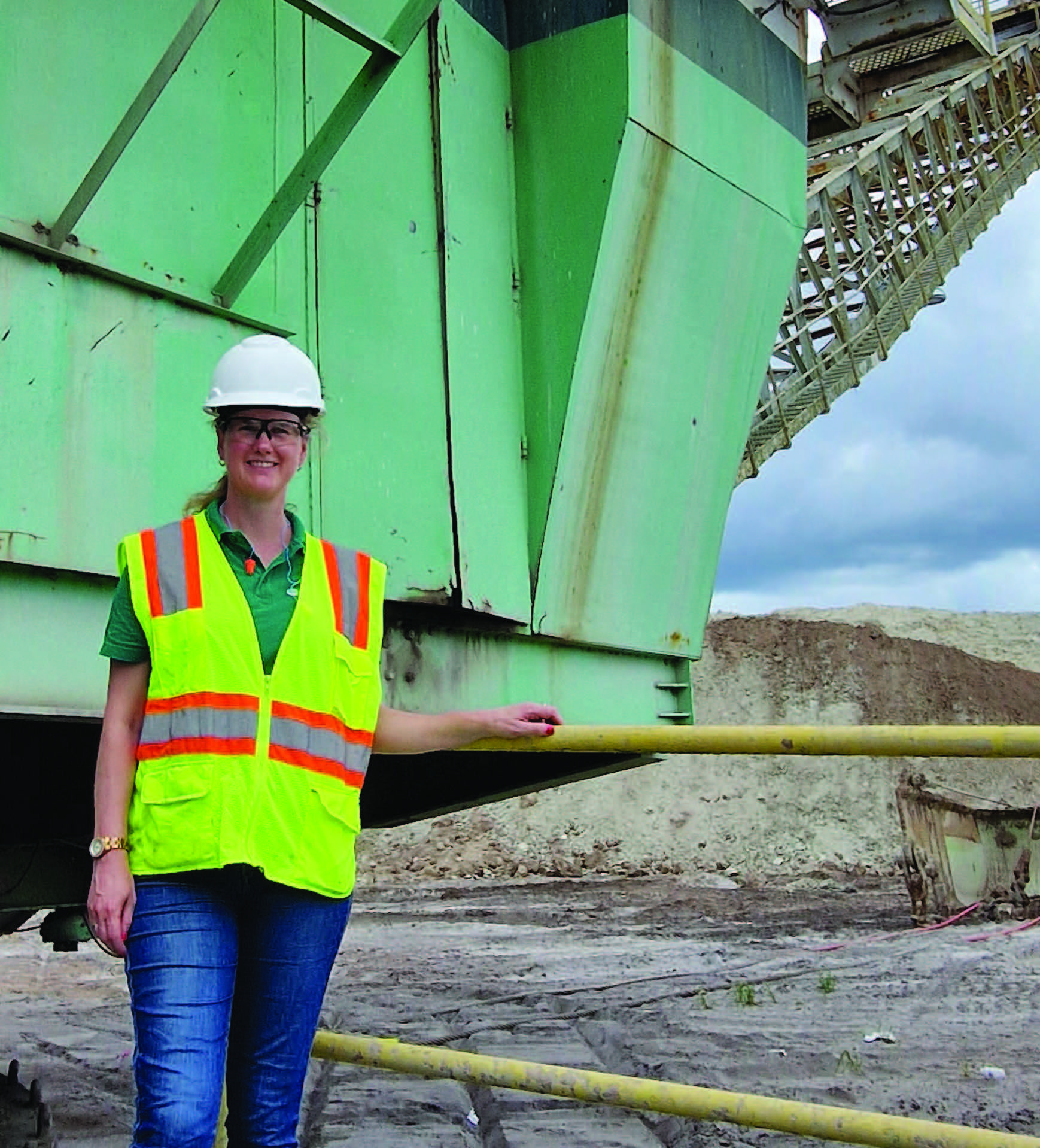 Melissa Quinn on the job at a mine site.
TLT: What does sustainability in grease formulations and production really look like, and how do you approach this challenge?
Quinn: The first question I ask when asked about sustainable grease is, what does sustainability mean to you, and what is it you are looking for? Sustainability can mean many things—low product carbon footprint, biobased, renewable, biodegradable, etc.—and clarity on what exactly is required of the grease is key in developing in greases. With grease it’s not just the additives used that can play a role in the sustainability of the end product, but the selection of the thickener and manufacturing process are also key elements. Not all thickeners are created equal when it comes to things like the manufacturing component of the product carbon footprint of the grease.
Education is key in approaching the sustainability challenge. Having industry organizations such as STLE, NLGI, ELGI and UEIL promoting sustainability education is a step in the right direction.
TLT: Having worked in Australia, the UK and now Germany, what are some of the key challenges and opportunities you’ve encountered working across different countries and cultures?
Quinn: Working in global companies teaches you quickly that cultural differences influence how business is conducted, and you need to adapt to work effectively together. Moving to another country takes this to a whole new level. One of the obvious challenges when moving to another country is language. You may not expect it, but even between Australia and the UK, language can cause confusion; different phrases and words keep you on your toes! Moving to a country where your first language isn’t widely spoken adds another layer of complexity, and not just because I’m still learning German. Even when speaking English, the way a native speaker communicates can differ significantly from someone who learned English as a second language.
I’ve also encountered cultural differences in communication styles. For example, Australians and British nationals tend to be more reserved and careful in how they express themselves, often trying not to “rock the boat.” In contrast, German nationals can be more direct with what they’re saying, which has pushed me out of my comfort zone at times.
That said, these differences are also opportunities. They’ve helped me grow personally and professionally—building confidence and developing hybrid ways of working that combine the best aspects of different cultures. These experiences will be a real asset for my career going forward.
TLT: From your perspective, what are some of the most significant changes you’ve seen in the lubricants industry over the past two decades?
Quinn: When I first started in the industry all those years ago, it was alarming to see that the demographics across a lot of companies seemed to be geared toward older, experienced professionals and a smaller amount of early career individuals. This was always a concern as you need to have a succession pipeline growing and coming through. Over the years, I have noticed a shift and there seems to be a new wave of people joining, and importantly staying, in the industry. There is still a long way to go, and attracting and retaining new talent needs to be high on companies agendas and is something that the industry as a whole needs to prioritize.
It’s also been interesting to see the growth of new industries such as data centers, the growth of automation and robotics and the transition from internal combustion engines (ICE) to electric vehicles (EVs). Some changes haven’t happened as quickly as predicted—the “lithium crisis” due to the rise in EVs had a big impact on the grease industry at the time with issues with availability globally, and the belief was that the amount of lithium grease produced globally would take a big hit. There has been a steady decline since 2022, however not as large as what some people might have expected, and lithium grease is still going to be around for many years to come.
TLT: How has your experience across various functions—like product development, sales and marketing—shaped your approach as a global grease expert today?
Quinn: This has been a critical factor in my career in the lubricants industry. Having had the opportunity to work across various functions such as product development, supply chain, product management and sales have given me a unique perspective as to how other parts of the business operate and the challenges they can face. Coming full circle back to product development, it has shaped how I see the development process. Yes, there is a full suite of industry lab tests available to run, but taking a step back and thinking about how the customers are actually using the grease and what is important to them—which can sometimes be different to the developer—is critical. Having spent time in a technical sales role and immersing myself with the customer and OEM has been a benefit in this front.
In my current role, it also allows me to be able to share this knowledge with my colleagues.
You can reach Melissa Quinn at melissa.quinn@castrol.com.