Friction in ball sports
By R. David Whitby, Contributing Editor | TLT Worldwide March 2026
Friction between a ball and a surface depends on the type of material and whether it is hard or soft, wet or dry.
I wrote in July 2024 about the role of tribology when playing golf. My article included aspects of friction, drag, lift, potential energy and kinetic energy.
Recently, a good friend of mine, who is a prizewinning player of lawn bowls, explained to me that playing bowls indoors on a carpet is very different from playing bowls outdoors on grass. I asked her why this is so. She replied that significantly more energy is required when playing outdoors. This got me thinking and I soon realized that friction must be involved.
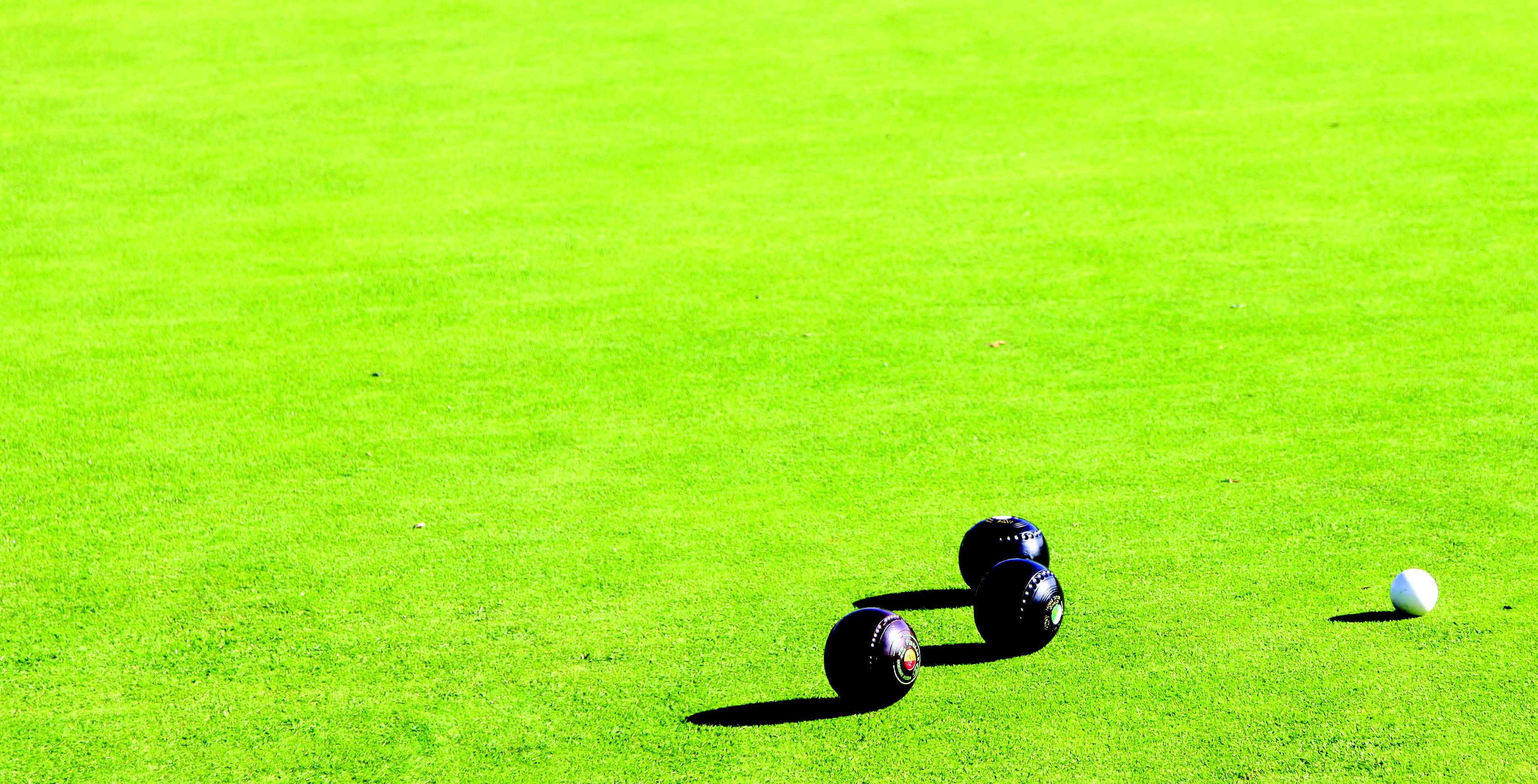
Lawn bowls is a game played either in teams or one against one in which players try to roll their balls (bowls), closest to a smaller ball, commonly known as a “jack.” The bowls are shaped and weighted, so they can follow a curved path depending on how they are rolled.
The game is often played outdoors on a large, rectangular, precisely leveled and manicured grass or synthetic surfaces, known as a bowling green. It can also be played indoors (usually during cold winter months) on a smaller rectangular arena on green carpets. The playing surface is divided into parallel playing strips called rinks. The player or team going first will roll the jack from a “mat” to the other end of the green, to serve as a target. Whichever player or team gets the most bowls closest to the jack wins the “end” and scores points.
It seems obvious that rolling a bowl on a carpet would require less energy than doing so on grass, due to the different friction between the bowl and the surface. Also, rolling the bowl on dry grass should involve less effort than if the grass is wet or slightly long. There must be some friction between the bowl and the surface, otherwise it would not come to a stop.
I then thought of other games played with a ball on some types of surfaces. Pétanque is a French game that is very similar to lawn bowls. Both, together with raffa and bocce, are known as boules sports.
The objective of pétanque is to score points by throwing boules closest to a target ball. Boules are thrown while standing in a circle with both feet on the ground. The game is normally and best played on hard sand or gravel. Like lawn bowls, it can be played in teams or one on one. A boule will usually be thrown so that it lands in front of the jack and then rolls toward it. Boules can be thrown so that they hit opponents’ boules and moving them away from the target. Again, any rolling movement of a boule will be affected by the condition of the surface, whether soft or hard or wet or dry.
Tennis can be played on many different surfaces. The friction of the tennis ball on each of these surfaces will be slightly different and players are likely to need to adjust their game to suit the surface and whether it is dry or wet. The International Tennis Federation (ITF) currently recognizes more than 160 different kinds of tennis courts including grass, carpet, clay, gravel, concrete, wood and asphalt.
With cricket, the bounce of a cricket ball on the wicket is markedly influenced by the hardness of the surface, whether the grass on the wicket is short or long or whether the surface is hard or soft. This will determine whether the wicket is favorable to batsmen or bowlers.
And finally, there is soccer, in which the kinetic energy that must be expended to roll the ball to a teammate, will be determined by whether the grass is wet, dry, long or short.
Attempts have been made to estimate the friction of balls on various surfaces, particularly with regard to tennis. Courts with high coefficients of friction will slow the ball down. Experiments performed by the ITF suggest that a shot hit without spin traveling at 67 mph will lose about 43% its ground speed on a clay surface, slowing to 38 mph, while on a grass surface it will slow to only around 45 mph. As with golf, knowledge of tribology might benefit elite players of ball sports.
David Whitby is chief executive of Pathmaster Marketing Ltd. In Surrey, England. You can reach him at pathmaster.marketing@yahoo.co.uk.