•
A new approach uses hydrothermal liquefaction followed by hydrotreatment to convert food waste into sustainable aviation fuel (SAF).
•
Hydrothermal liquefaction is a beneficial process because water present in food waste can be tolerated and this process can be used to treat different renewable feedstocks.
•
In the hydrotreatment phase, the researchers needed to adjust the retention time of the process, temperature, hydrogen loads and the ratio of biocrude oil to the cobalt molybdenum catalyst to produce SAF meeting current jet fuel specifications.
Sustainable aviation fuel (SAF) is growing in use as a means to reduce greenhouse gas (GHG) emissions attributed to using conventional jet fuel (Jet-A) derived from petroleum. Currently, aviation is responsible for 2%-3% of global GHG emissions. SAF has the potential to reduce carbon emissions by 80% compared to Jet-A.
SAF can be derived from renewable waste materials, which can then be used from a life cycle assessment, to offset carbon emissions produced during its use. A previous TLT article
1 discussed how researchers were able to utilize the renewable raw material, lignin to produce an alternative to the hydrocarbon-based Jet-A. Incorporation of 10% of this lignin-based candidate with 90% commercial Jet-A produced a jet fuel that was found to be within the specification limits of the incumbent Jet-A. The calculated heat of combustion of the lignin-based hydrocarbon was found to exhibit a superior value compared to Jet-A due to higher seal-swell properties and much lower aromatic content.
Yuanhui Zhang, professor in the department of agricultural and biological engineering at the University of Illinois Urbana-Champaign in Urbana, Ill., says, “There are a number of suitable renewable feedstocks that can be used in producing SAF with many of them classified as collectable biomass. The challenge is to technically convert them into crude oil with techno-economical feasibility.”
Dr. Sabrina Summers, post-doctoral researcher at the University of Illinois Urbana-Champaign, says, “The most widely used and least expensive pathway is to produce jet fuel from hydroprocessed esters and fatty acids (HEFA-SPK). The problem is that this pathway relies on edible feedstocks such as vegetable oils (soybean oil is an example). This means there is competition for raw materials used in supplying food. A second factor is the HEFA-SPK approach does not yield any aromatics, which can be present in jet fuel at concentrations ranging from 8% to 25%.”
One potentially appealing feedstock that will not compete with edible options is food waste. Zhang says, “From a global perspective, over 30% of food is wasted or lost from the production phase to when it reaches the consumer. As part of this process, some food waste is landfilled leading to decomposition which can create additional GHG emissions.”
Zhang, Summers and their colleagues have now developed a process for converting food waste into SAF through the use of a process known as hydrothermal liquefaction followed by hydrotreatment.
Cobalt molybdenum catalysts
Hydrothermal liquefaction is a reaction that converts biomass under high temperature and pressure conditions to biocrude oil. Aqueous, solid residue and gaseous byproducts are also formed. Zhang says, “One of the key benefits of hydrothermal liquefaction is that water present in biomass can be tolerated and in fact is useful as a reaction medium. This benefit avoids a drying pretreatment step thereby reducing cost and improving the efficiency of the process. The flexibility of hydrothermal liquefaction in tolerating different renewable feedstocks makes it a more effective pathway to convert food waste into renewable transportation fuels such as SAF.”
Before producing SAF, further processing is needed to refine the biocrude oil. Summers says, “The co-products contained in the biocrude oil include inorganic components such as nitrogenous and sulfur-based components. Oxygenated compounds, present in food waste, also need to be removed to refine the biocrude oil to a hydrocarbon-based material.”
To address this need, the researchers turned to the use of hydrotreating the biocrude oil in a similar manner to what is done in the manufacture of lubricant base stocks. Summers says, “Our approach was to identify a type of catalyst that will remove these heteroatom impurities. Food waste is not a uniform raw material, which means that in some cases, the feedstock used may be high in nitrogen content due to the presence of proteins. The presence of high-lipid feedstocks may also require hydrocracking to minimize the present of polymers formed during the hydrothermal liquefaction process.”
The researchers found that cobalt molybdenum catalysts are effective in removing impurities in the hydrothermal liquefaction biocrude oil. Summers says, “We determined that hydrotreating biocrude oil at a temperature range between 350-400°C, and pressures of 4-10 Megapascals will yield SAF products that are close in composition to Jet-A.”
The experimental setup used to evaluate catalysts in hydrotreating biocrude oil is shown in Figure 4.
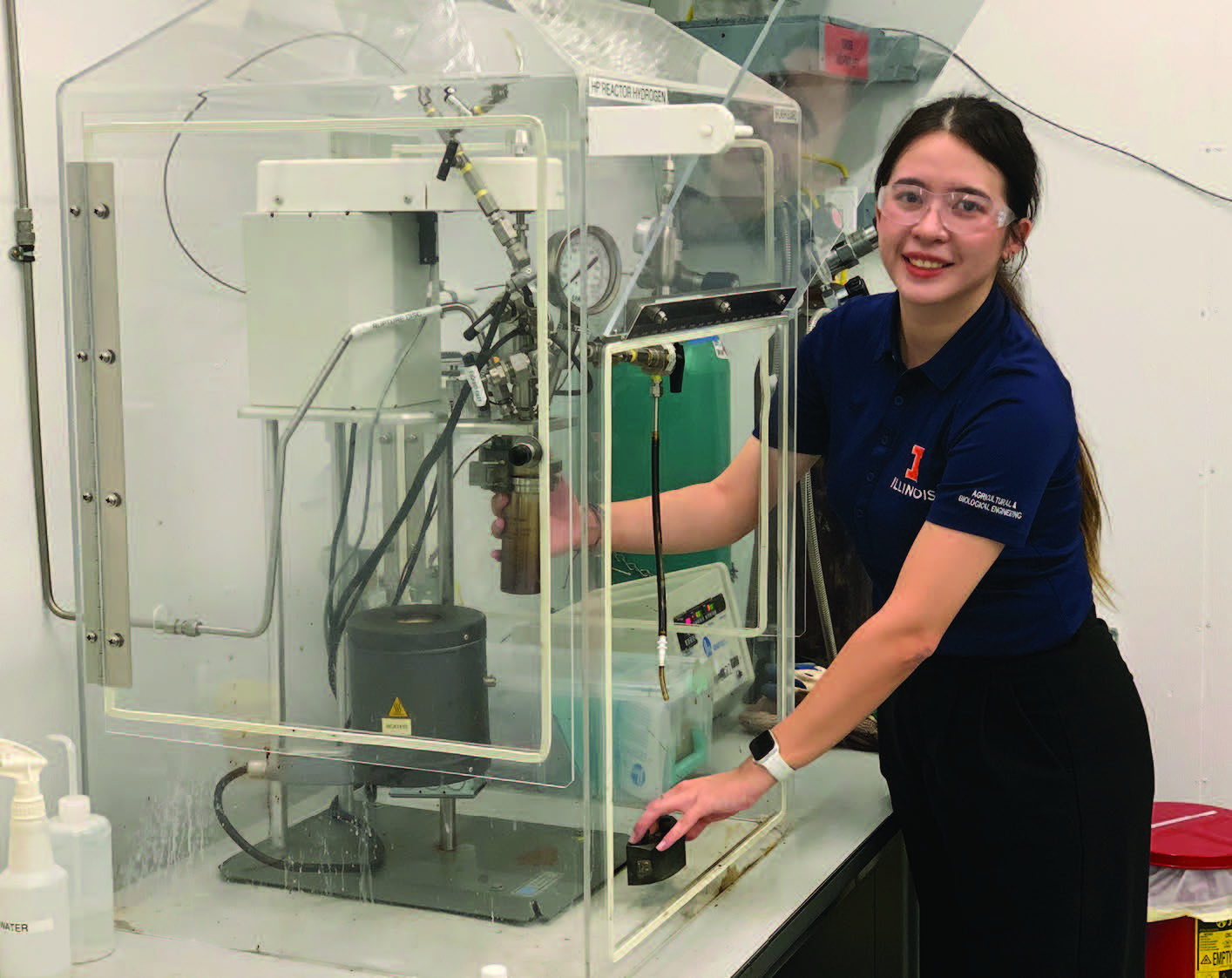 Figure 4. This experimental set-up was used in developing the hydrotreatment process for converting hydrothermal liquefaction biocrude oil into sustainable aviation fuel (SAF). Figure courtesy of the University of Illinois Urbana-Champaign.
In working with the variability of the composition of the food waste, the researchers adjusted the retention time of hydrotreatment, temperature, hydrogen loads and the ratio of biocrude oil to catalyst to achieve the production of SAF, which meets current jet fuel specifications. Zhang says, “Our SAF candidates passed Tier Alpha and Beta prescreening tests and were found to meet ASTM and Federal Aviation Administration (FAA) requirements without the need for any additives or blending with fossil-based jet fuels.”
Future work will entail scaling up the process for commercialization. Zhang says, “We are also working on the development of new catalysts to determine if SAF derived from food waste can be produced more efficiently and under milder conditions.”
One other potential for combining hydrothermal liquefaction with hydrotreating is to synthesize lubricant base stocks in a more sustainable manner. Zhang says, “The possibility exists for this approach to be used to manufacture polyalphaolefins (PAOs) in the future.”
Additional information can be obtained from a recent paper
2 or by contacting Zhang at
yzhang1@illinois.edu.
REFERENCES
1.
Canter, N. (2022), “Sustainable jet fuel based on lignin,” TLT,
78 (8), pp. 14-15. Available at
www.stle.org/files/TLTArchives/2022/08_August/Tech_Beat_II.aspx.
2.
Summers., S., Yang, S., Si, B., Wang, Z., Watson, J., Yu, S., Yang, Z., Kawale H., Heyne, J. and Zhang, Y. (2025), “From food waste to sustainable aviation fuel: cobalt molybdenum catalysis of pretreated hydrothermal liquefaction biocrude,”
Nature Communications, 16, Article Number 9570.