HIGHLIGHTS
•
Vibrations in machinery can lead to an increase in wear and eventually permanent damage.
•
A new theoretical study demonstrates that a metamaterial known as a kagome lattice can be formed into a three-dimensional tube structure capable of dampening vibrations.
•
The tube geometry is attractive because it is a self-supporting structure that is convenient for integration into machinery systems.
Vibrations in machinery are an indication of potential problems. This issue may be caused by the oscillation of such machinery components as bearings, compressors, pumps and shafts. Vibrations can be generated due to imbalance in a rotating component, misalignment (such as if machine shafts are out of line), looseness of a machine component and wear. If not corrected, machine vibrations will lead to an increase in wear and eventually to damaging the machinery itself.
Lubricants can play an important role in minimizing vibrations in machinery. The use of a proper lubricant in a particular machinery application should reduce friction and vibration-induced wear by forming a protective film to minimize contact between moving machinery parts. But an issue with a lubricant could be the cause of increased vibrations in a specific component so one tool used to evaluate machinery in use is vibration condition monitoring.
The introduction of a material known as a metamaterial in a machine may also provide a strategy for dampening or stifling vibrations. Xiaoming Mao, professor in the physics department at The University of Michigan in Ann Arbor, Mich., says, “Metamaterials are materials that can be engineered to produce properties for specific applications based on their geometry and independent of the type of material used.”
In a previous TLT article,
1 Mao and her colleagues conducted a theoretical study to demonstrate that a metamaterial can transform from being soft to being hard and then reverting back to being soft. Such a material is known as a transformable topological mechanical material. This phenomenon can occur due to the movement of floppy modes (i.e., free mechanical motion in structures) that are deformations which do not cost elastic energy from the edges of materials causing them to become rigid. The resulting property is known as topological polarization.
An example of a metamaterial with floppy modes is a two-dimensional structure known as a kagome lattice that is prepared from rigid triangles. Kagomes are examples of a Maxwell lattice, which is a marginally rigid mechanical network that meet the minimal requirements for supporting external loads, according to Mao. She adds, “In this manner, Maxwell lattices are on the verge of instability, offering blueprints for the most light-weight stress-bearing structures.”
The unique properties of kagomes may enable them to be candidates for manipulating vibrations so that they are isolated or even stifled in machinery. Mao says, “As an example, advanced components in modern machineries often require low-vibration conditions to accurately operate. The potential exists for developing a metamaterial that can direct noise generated in a machine away from these components so they can continue to fulfill their function over time by remaining stable.”
A new theoretical study
2 has now been published to demonstrate how a kagome can be used as a tool to isolate vibrations.
Three-dimensional kagome tube
Mao and her colleagues found that a three-dimensional kagome can be prepared by wrapping two-dimensional bilayers into a tube structure. Their study determined that this structure should be capable of isolating vibrations. She says, “We chose the kagome lattice because it is a topological Maxwell lattice that supports floppy mode localization-essential for vibration isolation and protection of sensitive components.”
The tube geometry is attractive because it can be a self-supporting structure, convenient for integration into machinery systems.
The kagome tube fulfills four important requirements of a topological Maxwell lattice. Such materials are entirely passive, which eliminates the cost of power consumption. The geometry of the kagome tube will dictate performance rather than selection of a specific material. This factor reduces concern about operational temperature, and frequency in passive isolators. Preparation of the kagome tube is relatively simple and makes this structure easier to scale and simpler to manufacture. The fourth factor is the kagome tube has the ability to isolate in one direction while allowing transmission in the opposite direction.
A vertical view of a kagome tube is shown in Figure 2 while a horizontal orientation is found in Figure 3.
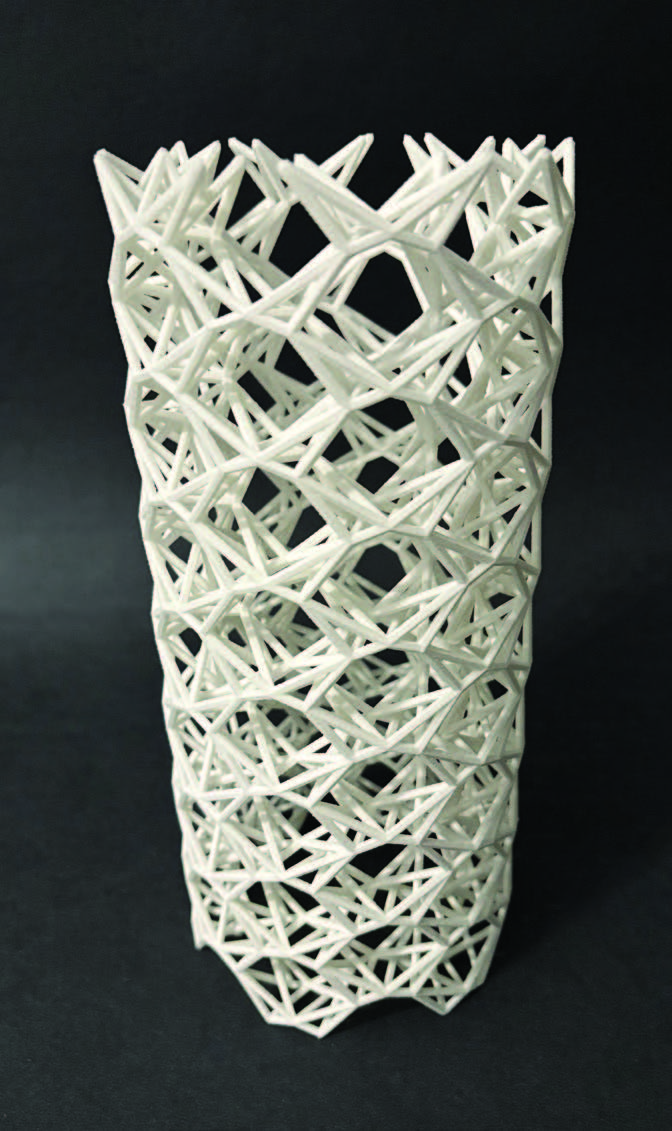
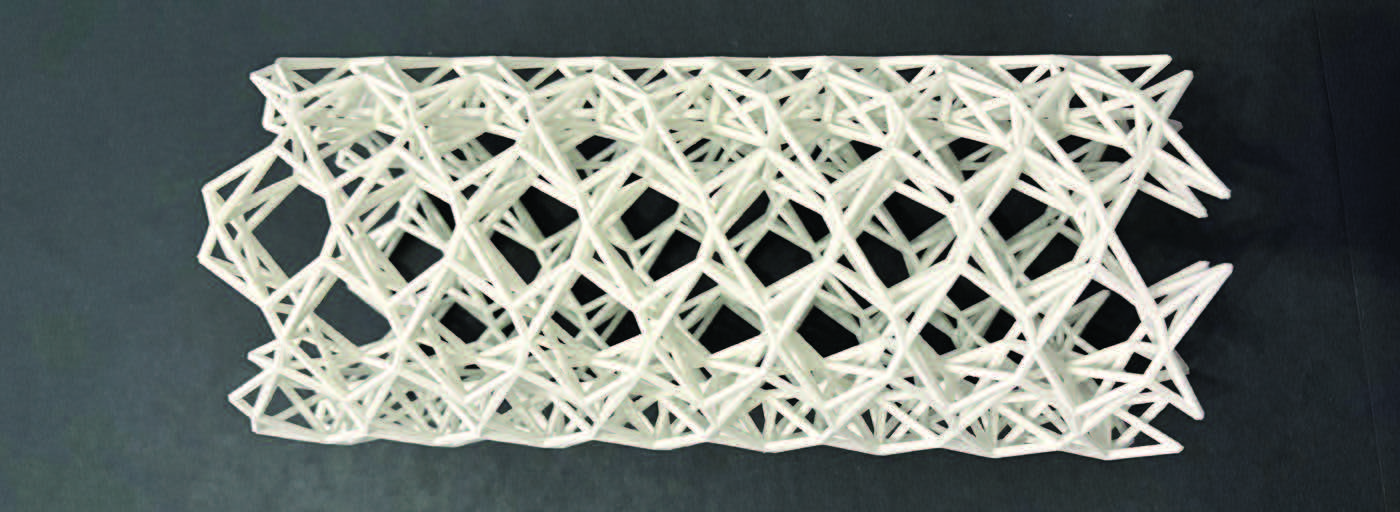
Figures 2 and 3. The geometry of a kagome tube (as shown in vertical and horizontal images) will dictate dampening performance no matter the material used in its preparation. Figures courtesy of The University of Michigan.
One challenge for installing a kagome tube vibration dampener in a machine is the trade-off found between load bearing and vibration isolation. Mao says, “Our study indicates that a kagome tube demonstrating excellent dampening of vibrations can only support a limited load. If the structure’s geometry is altered to improve load bearing, then isolation of vibrations declines. This trade-off is important in guiding the choice of structures for specific applications, such as the frequencies of vibrations to be isolated.”
This study provides a theoretical approach to dampening with the next logical step being to experimentally produce a viable kagome tube. Mao says, “We believe that using 3D printing offers the most viable approach for producing an actual kagome tube that can exhibit the vibration dampening properties illustrated in this study. Once a kagome tube is produced, we can better understand how its microscopic architecture can lead to corresponding macroscopic parameters that actually generate effective vibration isolation.”
If a viable dampening component can be placed in machinery to minimize the negative consequences of vibration, it will be interesting to determine what impact this will have on lubricant selection. Additional information on this study can be found in a recent paper
2 or by contacting Mao at
maox@umich.edu.
REFERENCES
1.
Canter, N. (2017), “Variable-hardness materials,” TLT,
73 (4), pp. 10-11. Available at
www.stle.org/files/TLTArchives/2017/04_April/Tech_Beat_I.aspx.
2.
McInerney, J., Idrissi, O., Willey, C., Tol. S., Mao, X. and Juhl, A. (2025), “Topological polarization of kagome tubes and applications towards vibration isolation,”
Physical Review Applied, 24, 044037.