TLT: What are your thoughts on adding more granularity to the ISO 4406, breaking the codes down into smaller groups?
Sheffield: As part of the ISO TC131/SC6 group, we are always reviewing standards to make sure they are updated to stay current with new technologies. We set the ISO 4406 code table so that each code is directly attached to an acceptable range of particles. Each time a code number increases by one, the acceptable range for that number of particles doubles.
For example, a sample having a code of 22/18/13 would have roughly quadruple the particles of a code 20/16/11.
The ISO 4406 code levels of 4, 6 and 14 are used because these specific particle sizes (in micrometers, µm) represent the most damaging types of contamination in hydraulic fluids:
•
≥4 µm: These are the smallest particles, and while they may not cause immediate damage, they can accelerate wear in sensitive components and get trapped in small clearances. This range provides an overview of the total particle concentration.
•
≥6 µm: These mid-sized particles can interfere with the operation of hydraulic controls and components like bearings.
•
≥14 µm: These are larger debris that can cause immediate damage such as blocking, scoring and damaging cylinders and actuators.
At this time, we are reviewing to see if these need changes but will stay as written for now.
TLT: Is there anything you can discuss about current work within the working groups associated with the TC 131?
Sheffield: The biggest work going on now is twofold. One is the overall work on climate control for each working group. This details how each standard would affect the environment and help lower the carbon footprint globally. The 2021/2022 London Declaration is a commitment, led by BSI Group and adopted by the ISO, to integrate climate science and action into all ISO standards. Key aspects include embedding climate considerations into the development of new standards and adding climate requirements to existing ones to accelerate the global transition to net zero. The declaration also pledges to involve vulnerable communities in the standards development process.
The second is in TC131/SC6; we are reviewing all documents as they relate to ISO 11171, which is the calibration standard used worldwide for particle counters. Some may ask what exactly does ISO 11171 do. ISO 11171 is an international standard that specifies the procedures for calibrating automatic particle counters used in hydraulic systems and other fluids. It ensures that these counters are accurate and consistent by standardizing the calibration process using National Institute of Standards and Technology (NIST)-traceable standards, such as the primary calibration suspension NIST SRM 2806. The standard covers the calibration of both primary and secondary particle-sizing, as well as how to establish performance limits, verify sensor performance and determine coincidence and flow rate limits.
TLT: What is the approval process for a typical ISO standard?
Sheffield: In ISO TC131 we follow the same process for each standard as outlined below:
ISO 131 standard development and approval process
Proposal: A new work item proposal (NWIP) is submitted for consideration by the relevant technical committee, such as TC 131.
Preparatory: The work item is registered, and working groups are formed to begin drafting the standard.
Committee: The draft is developed and refined by the working group.
Enquiry: The draft international standard (DIS) is circulated to member bodies for comments and a vote. If approved, it becomes a DIS.
Approval: If the DIS is approved and no technical changes are needed, the project moves to publication. If technical changes are made, a final draft international standard (FDIS) is circulated for a final vote.
Publication: Once approved, the final standard is published by the ISO Central Secretariat and made available to the public.
After publication each standard is reviewed every five years to determine if the standard needs to be revised, confirmed or withdrawn.
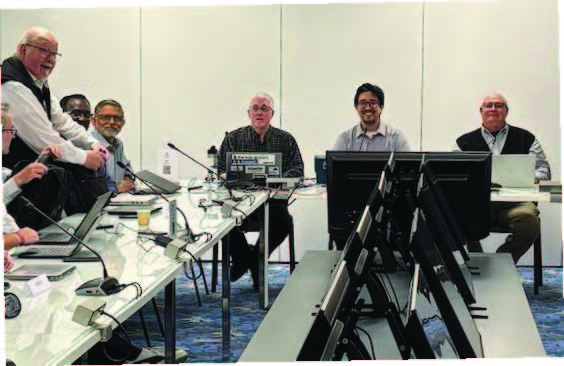 Ivan Sheffield at the ISO TC131 meetings in Paris, France, in October 2025.
TLT: How would someone become involved in ISO?
Sheffield: To get involved with ISO TC 131 in the U.S., you must join the National Fluid Power Association (NFPA) U.S. Technical Advisory Group (TAG) for ISO/TC 131 by contacting them directly. You can also join by contacting the American National Standards Institute (ANSI) to be part of their process for forming and accrediting TAGs. Once a member of the U.S. TAG, you can participate in committees and contribute to developing U.S. positions on ISO standards.
TLT: What would be the easiest method to incorporate filter analysis into a condition monitoring program?
Sheffield: The easiest method of filter analysis is to incorporate oil analysis into a condition monitoring system. To incorporate oil and filter analysis into a condition monitoring program, you should establish a baseline, set regular collection schedules based on equipment criticality and use both analyses to create a more complete picture of machinery health. Oil analysis tracks the lubricant’s condition and wear metals, while filter analysis provides specific information on the size, shape and composition of contaminants, helping you pinpoint wear-related issues and optimize filtration and oil change intervals.
You can reach Ivan Sheffield at Ivan.sheffield@descase.com.